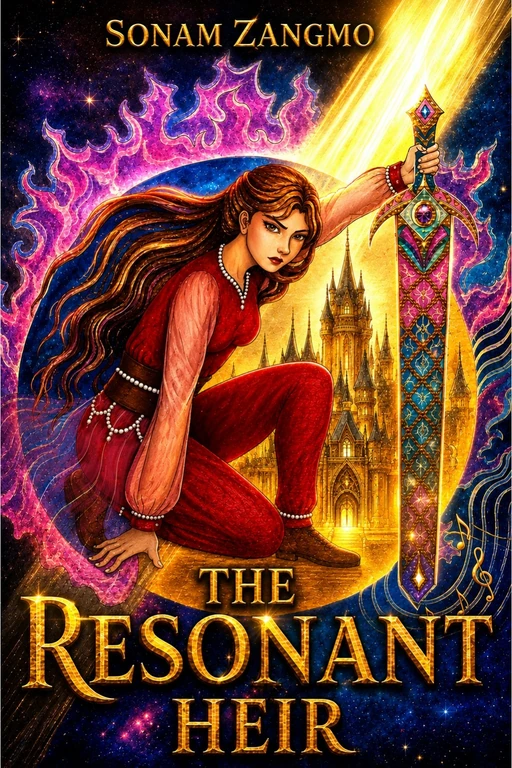
 Explore The Resonant Heir
Royal Fantasy · Hidden Magic · Female Lead · Coming-of-Age · Royal Intrigue · Fantasy Adventure
Explore The Resonant Heir
Royal Fantasy · Hidden Magic · Female Lead · Coming-of-Age · Royal Intrigue · Fantasy Adventure
Fiction Knowledge · 05
Coming-of-Age Fantasy Books
If coming-of-age stories are about growing up, why do we keep reading them long after we have grown up? Maybe because growing older and becoming who we are are not quite the same thing.
The appeal
Why do adults still love coming-of-age fantasy?
Coming-of-age stories are full of firsts: leaving home, failing badly, falling in love, taking responsibility, making a choice no one else can make for you.
Yet adults keep reading them long after many of those firsts are over.
Perhaps because growing older is automatic. Becoming is not.
A person can feel certain of who they are at twenty and question it again at forty. A career changes. A relationship ends. A familiar role disappears. A new responsibility asks for a version of us that does not yet exist.
Developmental psychology identifies adolescence as a particularly important period for identity formation, shaped by biological, cognitive, and social change. But identity does not simply freeze once adolescence ends.
That may help explain why young adult fantasy for adults and crossover fantasy can reach beyond their expected age group. Readers do not have to share a protagonist's age to recognize the feeling of standing between an old self and an uncertain new one.
Who am I now? Where do I belong? Who am I becoming?
Coming-of-age fantasy simply gives those questions a much larger world to inhabit.
Identity & change
What really happens when we come of age?
Coming of age sounds like crossing a clear line between childhood and adulthood.
Literature makes it much messier.
The tradition is closely connected to the Bildungsroman, or novel of formation: stories concerned not simply with age, but with how a person develops a sense of self. Contemporary scholarship on coming-of-age narratives also pays close attention to liminality—the unstable stage between one identity and the next.
You are no longer quite who you were. But you do not yet know who you will become.
The tension often forms between three selves: who I was, who others expect me to be, and who I choose to become.
That makes coming-of-age especially powerful in stories about duty and identity, family expectations, inheritance, belonging, and responsibility.
Fantasy can make those invisible conflicts visible.
Identity becomes magic. Expectation becomes prophecy. Leaving home becomes exile. Responsibility becomes a kingdom. Fear becomes a monster.
Questions of identity and power can even become literal. A character's bloodline may determine what magic they inherit, what duty they owe, or what future their family expects them to accept.
A prophecy can become the fantasy equivalent of inherited expectations. A royal legacy can turn Who should I become? into Who was I born to become?
And a character resisting that destiny may be confronting one of the oldest coming-of-age questions of all: How much of who I am belongs to me, and how much was decided before I had a choice?
A useful distinction
Does coming-of-age fantasy have to be YA?
No.
Coming-of-age fantasy and young adult fantasy overlap, but they are not the same thing.
Young adult fantasy describes a publishing and readership category. Coming of age describes a pattern of personal development within a story.
The two often meet because adolescence naturally brings questions of identity, independence, friendship, family expectations, and responsibility. But a YA fantasy does not have to make personal formation its central journey, and a coming-of-age story does not have to be written for teenagers.
This is also why crossover fantasy can work across age groups. A teenage protagonist may be facing something for the first time, while an adult reader recognizes the deeper conflict beneath it: living up to a legacy, choosing between duty and desire, or discovering that becoming yourself may disappoint the people who once defined who you were.
Age changes the circumstances. It does not necessarily change the question.
The definition
So, what exactly is coming-of-age fantasy?
Coming-of-age fantasy is a type of fantasy in which a protagonist's personal growth, identity, and movement toward greater independence or maturity are central to the story.
The character may grow older, but age alone is not what matters. Their understanding of themselves changes.
Some of the most memorable coming-of-age fantasy books make that inner transformation inseparable from the external adventure. Magic, friendship, exile, family conflict, hidden identity, inheritance, prophecy, failure, or responsibility can all become part of the process.
This is why coming-of-age fantasy often overlaps with character-driven fantasy. The quest does not merely move a character across a map; it changes the person who reaches the other side.
And self-discovery does not always mean learning that you were secretly powerful all along. Sometimes it means discovering your limits. Sometimes it means questioning what you inherited. Sometimes it means accepting responsibility. Sometimes it means choosing a life that other people did not choose for you.
The world may contain kingdoms, monsters, and impossible magic, but beneath them lies an intensely human question: Who will I become when I finally have to choose for myself?
Perhaps that is why we never quite outgrow these stories.
Growing older never stops. Perhaps becoming doesn't either.