 Explore The Resonant HeirYA crossover royal fantasy · inherited magic · female heir · exile · adventure · Book I Complete
A Literary Commentary on Chapter Six of The Resonant Heir
The Weight of an Inherited Crown: A Philosophical Reading of The Fractured Crown
On the moral burden of inheritance, the uneasy relationship between peace and justice, and the difference between learning a painful truth and deciding what to do with it.
Spoiler Notice: Contains spoilers for Chapter Six.
Explore the twelve themes in this commentary
- A Crown Can Fracture Without Falling
- A Life Judged Before It Began
- Peace on the Path of Power
- The Courage to Ask a Question That Might Hurt
- The Claw, the Champion, and the Nameless Beast
- Can Peace Justify the Silencing of a Witness?
- The Foundation Beneath the Throne
- Inheriting Responsibility Without Inheriting Guilt
- Voxath: From Finding a Voice to Restoring One
- A Choice Arranged by Someone Else
- The Conversation Hidden Inside the Music
- Conclusion: An Answer She Cannot Force
Theme 01 · Philosophical commentary
A Crown Can Fracture Without Falling
A crown need not be stolen, broken, or removed from a ruler's head to lose something essential. Sometimes what fractures is the belief that makes its authority seem deserved.
In Chapter Six of Sonam Zangmo's The Resonant Heir, Princess Lyra receives information that unsettles two foundations of her life. Her mother reveals that Lyra's extraordinary magic was sealed before her birth. Later, her maternal grandfather tells her that Aethrador—the revered founder of her kingdom—ordered the mouth of a celebrated dragon champion sewn shut.
The first revelation challenges the story Lyra has told herself about her own inadequacy. The second challenges the story she has inherited about royal virtue.
Neither revelation causes the kingdom to collapse. No armies march against the throne. Aethrador's statue still stands in the Royal Hall. But the person expected to inherit the royal legacy can no longer regard that legacy with uncomplicated admiration.
The title The Fractured Crown is therefore especially apt. Its first visible fracture is moral rather than political: the opening of a distance between what royal authority claims to represent and what that authority may have done.
The chapter's philosophical concern is not merely whether the past contains wrongdoing. It is what a future ruler owes to a past she did not create but may nevertheless inherit.
Theme 02 · Philosophical commentary
A Life Judged Before It Began
The chapter begins in a room that once belonged to Queen Velaria, before she married King Eryndar. She plays an ocarina to soothe Lyra, as she did when her daughter was younger. In this intimate setting, Lyra finally asks about the seal.
Velaria tells her that she was foretold to possess the strongest magic in the kingdom, yet that power was sealed before she was born. The Queen does not know who did it. She believes the unknown person understood what Lyra's magic would mean for the throne, and suspects that the incident at the Umbral Tower fractured part of the seal.
The disclosure rearranges the moral meaning of Lyra's childhood. For years, her lack of visible magic has been treated as a deficiency. She has responded with exhausting effort and the fear that she must somehow earn the right to occupy her place.
Now she learns that an intervention made before she could speak or choose may have shaped how the world judges her.
To be judged for an absence is painful. To discover that the absence may have been imposed for someone else's political reasons is a different kind of injury.
The scene suggests how power struggles can reach people who have taken no part in them. A child may inherit not only a title but also the consequences of decisions made about her before she existed as a political actor.
Lyra imagines that someone marked her as an enemy before she drew breath. That is an understandable interpretation of her mother's disclosure, not yet an established account of the unknown person's motives.
What is certain is her lack of control over the story she has been forced to live inside.
Theme 03 · Philosophical commentary
Peace on the Path of Power
Lyra's most immediate question is whether she will regain all her magic. Her mother's answer is cautious: perhaps.
Then Velaria changes the subject in a way that is philosophically revealing. What matters more, she says, is whether Lyra can find peace while walking the path of power.
This is not advice to abandon ambition. Velaria does not tell her daughter that possessing magic is unimportant, or that a ruler should remain weak. She places power beside another question: what happens to the person who possesses it?
Lyra has assumed that strength will end her insecurity. Yet her victory in the arena did not bring lasting satisfaction, and her first successful resonance arose only when she stopped forcing her mind into silence.
The Queen's concern belongs to that developing pattern. Greater power may change Lyra's circumstances without healing her relationship to herself.
It may also increase the moral weight of her decisions. A princess who becomes strong enough to act upon others' lives must eventually learn that inner peace cannot be purchased simply through public obedience or acclaim.
The setting deepens the scene. Velaria's music comforts Lyra, but after giving an incomplete answer about the seal, the Queen returns to her instrument. The melody holds affection and silence together.
The mother can offer comfort. She cannot yet offer her daughter a complete account of what happened.
This tenderness does not cancel the significance of withheld knowledge. The chapter allows parental care and the limits of parental openness to coexist.
Theme 04 · Philosophical commentary
The Courage to Ask a Question That Might Hurt
Unable to sleep, Lyra steps onto the balcony overlooking Lake Lyrenthis. She misses her father and Obewich. Her mind returns to Ravok's accusations: that Eryndar is cruel and Aethrador is a liar.
These claims threaten two people through whom Lyra understands home, family, and authority. She has not found a way to reconcile them with the affection and reverence she feels.
When her grandfather joins her and places a cloak around her shoulders, Lyra sees an opportunity. He lived in Aethrador's era. Perhaps he knows what the Silent Beast was trying to tell her.
Her hesitation matters. She is not searching for a convenient excuse to denounce her family. She is struggling to ask a question that might change what family means to her.
The High Lord warns that some truths are harder to carry than wounds. He invites her to follow if she is not afraid.
Inwardly, Lyra admits that she is unsure. But she wants to know, even if the knowledge breaks her.
This is a credible form of intellectual courage. It does not require pretending that truth is painless. It means refusing to make emotional comfort the condition for inquiry.
At the same time, Lyra has not become an independent historian. She is turning to another elder whom she trusts. Her willingness to hear a different account is a beginning, not proof that she can yet assess every source without bias.
The important change from the previous chapter is that she no longer covers her ears. This time, she follows.
Theme 05 · Philosophical commentary
The Claw, the Champion, and the Nameless Beast
The High Lord brings Lyra into a chamber of sealed chests and opens one marked by a triangular fragment of silver armor. Inside, on dark red cloth, lies a curved and scarred claw.
It belonged, he says, to Ravok: Aethrador's dragon champion during the Great War of the Fae.
Lyra recognizes the connection between the celebrated figure in the epic she studied and the chained creature whose mouth she saw sewn shut. The Silent Beast has a name and a history she already knew, but did not know how to connect to the prisoner before her.
The revelation is accomplished through an object rather than through argument alone. The claw makes two accounts of the past suddenly occupy the same world.
One account praises a champion whose service helped win a war. The other presents a silenced captive as an opponent in a royal trial.
The difference between Ravok and the Silent Beast is not merely vocabulary. A proper name can invite attention to a life that existed before its present circumstances. A category can make that life easier to overlook.
The chapter does not demonstrate that everyone at court knows the prisoner's identity and deliberately conceals it. But it shows what happens to Lyra once the connection is restored: the creature she wounded can no longer remain an anonymous obstacle on the way to recognition.
The claw gives history back to someone whose present treatment has largely erased it.
Theme 06 · Philosophical commentary
Can Peace Justify the Silencing of a Witness?
According to the High Lord, Aethrador himself ordered Ravok's mouth sewn shut, and an Aulith mage carried out the order with enchanted black thread. The reason, he says, was that Ravok knew truths the king sought to bury or distort.
This is devastating testimony for Lyra. Aethrador was the ruler who ended a war, founded her kingdom, and became a model of righteousness in the stories she inherited.
The chapter does not independently establish the entire history of the alleged betrayal. The High Lord is a witness who offers an account; the claw confirms Ravok's identity, not by itself every claim about Aethrador's motives. Lyra's growing conviction should not be mistaken for a completed historical investigation.
Nevertheless, the allegation forces a question that cannot be dismissed by citing Aethrador's achievements.
Can a ruler's contribution to peace justify the suppression of someone who knows an inconvenient truth?
There may be decisions during war that involve genuine conflicts of duty. A ruler might sometimes need to restrain a dangerous person. But preventing a witness from speaking because his knowledge threatens a ruler's reputation or legitimacy would raise a different moral problem.
The distinction is between safeguarding a community and safeguarding an official story.
Aethrador's accomplishments need not be imaginary for his actions to deserve scrutiny. Peace and injustice can coexist in the history of the same reign.
What Lyra confronts is the possibility that an honored outcome was accompanied by a dishonorable means.
An inherited account of victory may be true about the peace it celebrates and incomplete about the suffering it omits.
Theme 07 · Philosophical commentary
The Foundation Beneath the Throne
When Lyra insists that Aethrador was revered as a just man, her grandfather answers with the image of a tower whose foundations have worn away. If too many people see the damage, he suggests, the structure above cannot remain standing.
The metaphor exposes the relationship between political power and public belief.
A crown rests not only on force, law, or lineage. It also rests on stories about why its authority should be accepted. Founding heroes embody those stories. Statues, epics, and ceremonies preserve them.
If those accounts turn out to have concealed wrongdoing, what happens to the institutions built around them?
The High Lord's metaphor does not itself determine whether exposing the truth would destroy the kingdom or help it confront what needs repair. It expresses a fear about the fragility of political legitimacy.
That fear can be used in opposite ways.
Someone who wants to hide wrongdoing might argue that the truth must remain buried for the sake of stability.
Someone who seeks reform might argue that a kingdom cannot become secure while its foundations are misrepresented.
The chapter leaves that contest unresolved.
What it does make clear is that reverence cannot serve as evidence of innocence. A person may be admired across generations and still have committed acts that deserve condemnation.
For Lyra, this is not an abstract lesson. She has wished to resemble Aethrador. If his legacy is morally divided, she must decide which parts of that legacy she can honor without reproducing the rest.
Theme 08 · Philosophical commentary
Inheriting Responsibility Without Inheriting Guilt
Lyra did not command the sewing of Ravok's mouth. She did not imprison him fifty years earlier. She could not have prevented those actions.
Yet she belongs to the family whose rule has continued while Ravok remains captive. She has also wounded him in a public ritual that treated his defeat as grounds for celebration.
The distinction between guilt and responsibility becomes essential here.
A descendant is not automatically personally guilty of an ancestor's deeds. But someone who inherits an institution may acquire the power to preserve its consequences or to question them.
That power brings obligations of its own.
Lyra's first response after her sleepless night is modest. She thinks that perhaps she should apologize to Ravok when she returns.
The thought is important because it directs her away from the need to feel innocent and toward the person she has hurt.
An apology may acknowledge the injury she caused and the judgments she made too quickly. It cannot, by itself, undo the injury or settle the legitimacy of Ravok's confinement.
Nor does Ravok owe her forgiveness.
Still, the desire to apologize marks a moral movement. She is no longer asking only whether she can be proud of herself. She is beginning to consider what she owes someone whose suffering her own actions have increased.
The chapter's larger question is whether that acknowledgment will someday expand from personal regret into responsibility for the exercise of royal power.
Theme 09 · Philosophical commentary
Voxath: From Finding a Voice to Restoring One
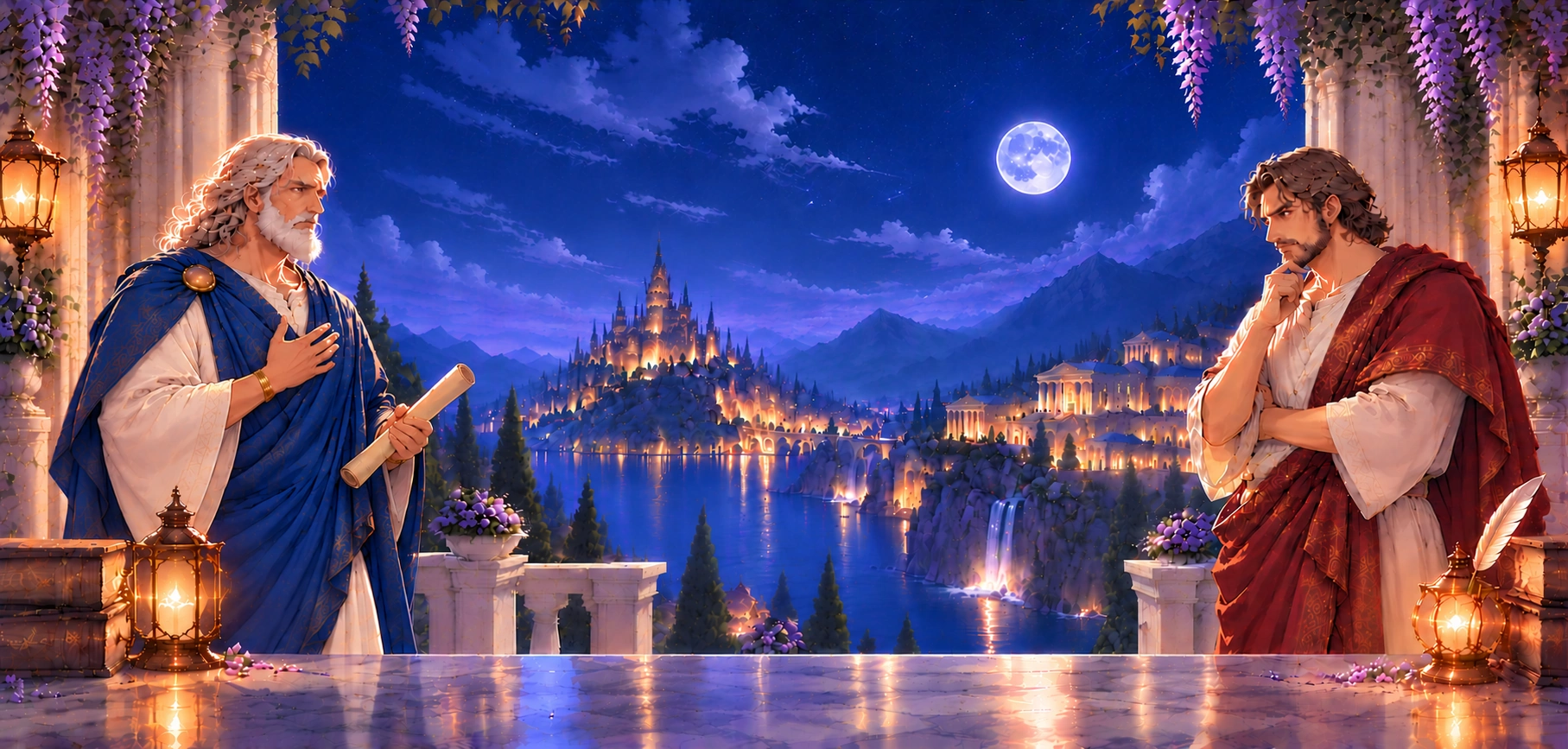
As Lyra prepares to leave Sonareth, her grandfather gives her Voxath, the instrument through which she produced her first resonance at Lake Lyrenthis.
Then he reveals a capability she did not know it possessed. Voxath can dissolve the spells of Aulith thread. Its true note can be heard only by Sonareth's people.
The implication is hard to miss. An Aulith mage used enchanted thread to stitch Ravok's mouth shut; the instrument now placed in Lyra's hands may be capable of undoing that magic.
In the preceding chapter, Voxath helped Lyra find a form of power that did not depend on forcing an opponent into submission. In this chapter, it may allow her to challenge a form of forced silence.
That parallel gives the gift moral weight.
Lyra has long wanted to be heard and recognized. Now she possesses something that could help another being recover the ability to speak.
The High Lord does not simply instruct her to use it. He tells her: "You've heard. Now learn to decide."
It is a pointed distinction. Hearing testimony creates an opportunity for judgment; it does not automatically supply the right action.
The instrument also cannot solve every problem by itself. Removing a spell is not identical to determining the truth of a historical claim, judging the safety of a prisoner, or repairing decades of harm.
But the gift changes Lyra's position. She no longer faces only an accusation she can accept or reject. She may have a means of altering the conditions under which Ravok has been forced to live.
Knowledge is beginning to acquire the possibility of consequence.
Theme 10 · Philosophical commentary
A Choice Arranged by Someone Else
The High Lord's decision to give Lyra Voxath deserves careful attention.
He selects the evidence she sees, explains the significance of the claw, names Aethrador's alleged order, and provides an object capable of undoing Aulith thread. Then he tells her that the decision is hers.
There is generosity in this gesture. He does not treat Lyra merely as a child who must obey. He asks her to exercise judgment.
But there is also influence.
The choices available to a young person are shaped by what adults decide to disclose, when they disclose it, and which tools they place within reach.
This does not make the High Lord equivalent to Syveris, whose earlier manipulation relied upon concealment and another child's trust. The text gives no basis for assuming identical motives.
It does, however, complicate the idea of complete independence.
Lyra is being invited to decide within a situation prepared by someone who knows more than she does.
This makes the High Lord's final gift a test not only of Lyra's compassion but of her capacity to think beyond the preferences of the people guiding her.
A genuinely responsible decision may require her to ask further questions, including questions that the person who offered the choice did not encourage her to ask.
She must learn not simply how to choose, but how to recognize the conditions under which she is choosing.
Theme 11 · Philosophical commentary
The Conversation Hidden Inside the Music
The chapter's closing departure adds a revealing dramatic irony.
As the carriage leaves, Velaria hums a melody that carries a question back toward her father. She asks whether he feared that Lyra might unleash the beast.
His answer returns in another melody: "Justice has its reasons."
Lyra notices none of this exchange.
For a story so concerned with hearing, the moment is striking. Lyra has learned to listen for subtle vibrations and recover hidden voices, yet she remains outside a conversation taking place almost in her presence.
Her grandfather has considered the possibility that Voxath could be used to free Ravok. Her mother recognizes that possibility as a risk. Both adults know more about the implications of the gift than Lyra does.
The exchange also prevents the reader from treating liberation as a simple matter.
If Ravok has been unjustly silenced, restoring his voice may be necessary. But the possibility of releasing a powerful, long-imprisoned dragon raises questions about consequences for others. The chapter has not disclosed enough about Ravok's present intentions or abilities to settle them.
The High Lord invokes justice rather than denying the danger.
His words deserve to be taken seriously, but not as an infallible moral verdict. A character's confidence that justice requires a particular course does not eliminate the need to examine its risks.
What remains unsettling is the asymmetry of knowledge. Lyra is being encouraged to decide, while a decisive part of the adults' own deliberation is withheld from her.
The story leaves the reader hearing something the heroine cannot.
Theme 12 · Philosophical commentary
Conclusion: An Answer She Cannot Force
The final pages return Lyra to the problem of Aethrador.
He ended the war. He brought peace. Yet, as she now believes, he betrayed Ravok, who had fought beside him.
She wonders whether there is something she still does not understand. She also considers whether anyone occupying Aethrador's position would have acted in the same way.
That last possibility is morally dangerous as well as humanly understandable. It can invite serious reflection on the burdens of leadership, but it can also become a way to excuse wrongdoing by calling it inevitable.
The chapter does not settle the question. No answer comes that feels right to Lyra, and she cannot force one.
The wording creates a quiet connection with The First Resonance. At Lake Lyrenthis, pressing harder could not compel Voxath to respond. Here, thinking harder cannot manufacture an explanation that reconciles every contradiction.
But accepting uncertainty must not become a permanent excuse for inaction.
Lyra has been shown a possible injustice, a tool that may undo part of it, and a legacy she may one day be responsible for governing. Her next task is not merely to soothe herself. It is to discover what honest judgment and responsible action might require.
That is what makes the crown's fracture consequential.
The problem is no longer whether Lyra can obtain the power of her ancestors. It is whether she can inherit that power without accepting every justification her ancestors offered for its use.
To inherit a crown is not to inherit an unquestionable rightness. It is to inherit the obligation to decide what should be preserved, what must be examined, and what may need to be repaired.
Lyra leaves Sonareth with Voxath in her hand and unanswered questions about a hero she once wished to resemble. She has not yet chosen what to do.
For the first time, however, the shape of the choice is beginning to emerge.