
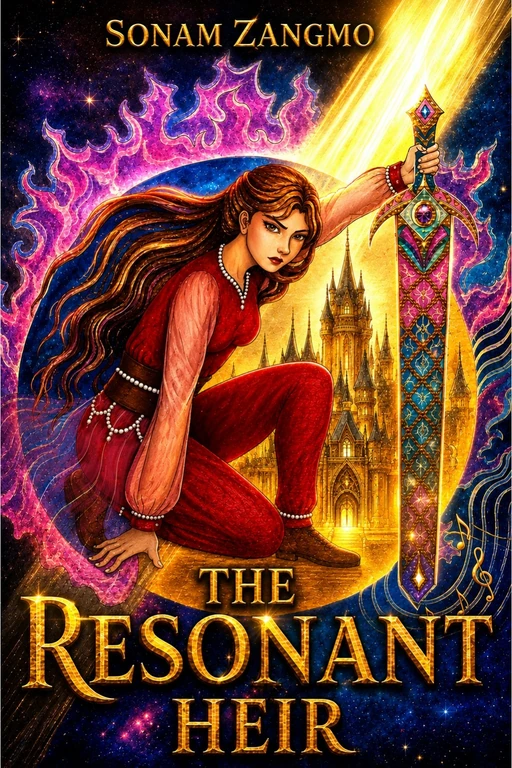
 Explore The Resonant HeirBook I: Reclaim the Throne · Explore the book
The Resonant Heir · Book I: Reclaim the Throne · Read-alike Guide
Books Like Graceling or The False Prince? Comparing The Resonant Heir — Book I: Reclaim the Throne
A comparison of prose, fantasy elements, characters, and reader expectations in Book I only—not the wider series.
Read-alike guide · Book I: Reclaim the Throne · Spoiler-light
A read-alike guide to The Resonant Heir — Book I: Reclaim the Throne, comparing prose, pacing, characters, magic, adventure, and storytelling.
If you enjoyed Graceling by Kristin Cashore or The False Prince by Jennifer A. Nielsen, what should you look for in your next fantasy book?
Perhaps you liked Katsa's struggle to decide how her extraordinary abilities should be used. Perhaps you enjoyed Sage's defiant personality, quick thinking, and the secrets surrounding a royal succession. Or maybe you want another adventure where a character ventures beyond familiar surroundings and discovers a much larger world.
The Resonant Heir — Book I: Reclaim the Throne, the first installment of Sonam Zangmo's fantasy series, shares certain elements with these stories, but the similarities are not universal. Every comparison in this article concerns Book I only. It does not describe, predict, or establish the content of later books.
Its central character, Princess Lyra, begins at eleven years old. She is heir to a kingdom where magical ability matters greatly to royal status, yet she appears to possess none of the magic expected of her.
Her curiosity soon draws her toward secrets within the kingdom. What begins around the royal palace develops into a journey through magical communities, dangerous trials, unexpected friendships, and political conflicts that challenge her understanding of power and responsibility.
Quick Answer: Is Book I of The Resonant Heir Like Graceling or The False Prince?
If you liked Graceling for its exploration of magical ability, personal freedom, and the misuse of power, The Resonant Heir examines related themes from a different starting point: a princess judged for apparently lacking magic rather than possessing an extraordinary gift. Unlike Graceling, however, romance is not a central focus of The Resonant Heir Book I. That is a description of this volume, not a promise about Book II or the wider series.
If you liked The False Prince for its resourceful young protagonist, royal secrets, quick dialogue, and accessible storytelling, The Resonant Heir Book I offers some comparable elements within a more expansive magical adventure. Book I uses multiple third-person perspectives rather than Sage's first-person narration.
Neither comparison is an exact match. This article is a guide to the relationship between one novel and several read-alikes, not a ranked list of interchangeable recommendations.
- Part I — How It Reads: Prose, voice, pacing, and narrative presentation.
- Part II — What It Contains: Characters, relationships, magic, quests, themes, and story structure.
The goal is to help readers identify particular similarities while understanding the differences that may matter just as much. The discussion avoids major spoilers, although it mentions developments beyond the opening chapters.
Part I — How It Reads
Prose, Voice & Reading Experience
Two fantasy novels can contain similar events and still offer very different reading experiences. One might spend considerable time exploring a character's thoughts. Another may rely more heavily on dialogue, physical action, or the unfolding of events within a scene.
The Resonant Heir generally favors concrete actions, dialogue, and visible reactions. Its descriptions establish places, movement, and magical events, while information often emerges through encounters rather than lengthy explanations.
The story is not uniformly fast-paced. Political developments, investigations, conversations, grief, and quieter character moments occupy space alongside action. These five novels offer different points of comparison; they do not share one identical prose style.
1. Truthwitch — Susan Dennard
Closest connection: Action-driven scenes and multiple third-person perspectives.
Susan Dennard's Truthwitch follows Safiya and Iseult, friends whose magical abilities draw them into the struggles of powerful political interests. Safiya can detect lies, while Iseult's Threadwitch abilities allow her to perceive connections between others.
The narrative moves between several viewpoints. Readers encounter characters with different information, loyalties, and objectives, allowing separate parts of a larger conflict to emerge.
The Resonant Heir also uses third-person narration that occasionally follows characters beyond its protagonist. While Lyra is occupied with her journey, events continue elsewhere. Members of the royal court, allies, and political opponents make decisions readers may learn about before Lyra does.
Where they differ: Truthwitch gives several characters substantial attention from early in the novel. The Resonant Heir remains more consistently centered on Lyra, using other viewpoints to broaden the surrounding conflict. The books also differ in the density of their magical and political terminology.
Reader fit: Relevant if you enjoy interconnected storylines and seeing a fantasy conflict through more than one character's understanding.
2. The False Prince — Jennifer A. Nielsen
Closest connection: Direct storytelling, quick dialogue, clever decisions, and royal secrets.
The False Prince follows Sage, a defiant orphan forced into a dangerous scheme involving the succession to a kingdom's throne. Jennifer A. Nielsen uses Sage's first-person voice to create much of the novel's personality. His sarcasm, observations, and willingness to challenge authority make conversations feel like contests of intelligence.
The Resonant Heir shares an interest in protagonists who refuse to accept authority unquestioningly. Lyra's curiosity and stubbornness frequently lead her into trouble. She may act before fully understanding a situation, forcing her to improvise or confront the results of her decisions. Both stories allow observation and strategic thinking to matter.
Where they differ: Sage controls the telling of his story; his first-person account shapes how readers experience its secrets. The Resonant Heir uses third-person narration, sometimes following events Lyra has not witnessed, and places greater emphasis on magical exploration across multiple regions.
Reader fit: A useful comparison for accessible prose, resourceful young characters, and royal intrigue—but not for someone specifically seeking a narrator who sounds like Sage.
3. Children of Blood and Bone — Tomi Adeyemi
Closest connection: Action with emotional consequences and political conflict involving magic.
In Children of Blood and Bone, Zélie struggles to restore magic in Orïsha after the monarchy's violent persecution of the maji. Tomi Adeyemi uses multiple first-person perspectives to place readers close to the characters' emotions, conflicts, and personal stakes.
The Resonant Heir also presents magic as something influencing more than combat. Lyra gradually encounters evidence that institutions and historical accounts surrounding her are more complicated than she first understood. In both stories, political decisions affect specific people.
Where they differ: Adeyemi's narration often emphasizes intense internal emotion and lyrical expression. Zangmo generally uses a more restrained third-person style, allowing actions, dialogue, and circumstances to reveal emotional developments. The novels also differ in cultural influences and narrative intensity.
Reader fit: For magical adventure in which political power and personal consequences matter, rather than nearly identical prose.
4. Rebel of the Sands — Alwyn Hamilton
Closest connection: Adventurous momentum, humor, and an independent-minded protagonist.
Alwyn Hamilton's Rebel of the Sands follows Amani, a gifted gunslinger determined to escape a life with little freedom. The novel combines desert mythology, western-inspired action, sharp dialogue, and a lively first-person narrator.
Lyra has a comparable readiness to act. Her determination can be admirable, reckless, or both. Both novels allow moments of humor and defiance to coexist with genuine danger.
Where they differ: Rebel of the Sands has a distinctive desert-western setting, an individualized first-person voice, and a significant romantic thread. The Resonant Heir Book I uses a broader high-fantasy world with multiple third-person perspectives and places less weight on romance in this first installment.
Reader fit: If you enjoy movement, adventure, resourceful heroines, and lively exchanges, rather than a specific romantic storyline.
5. Mark of the Thief — Jennifer A. Nielsen
Closest connection: Mythological adventure, accessible narration, magical discoveries, and humor.
Mark of the Thief follows Nic, an enslaved boy in ancient Rome who discovers a magical amulet connected to Julius Caesar and the gods. Nielsen draws on Roman mythology to combine dangerous powers, political conspiracies, escapes, and personal struggles.
The Resonant Heir also introduces fantastic elements through encounters. Talking flowers, unusual creatures, magical artifacts, and unfamiliar places can become sources of humor, danger, mystery, or valuable information.
Where they differ: Nielsen builds upon Roman history and mythology. Zangmo uses an invented fantasy world with its own magical clans, social institutions, and history. The protagonists occupy very different social positions.
Reader fit: For accessible mythological fantasy with active adventure, surprising discoveries, and occasional humor.
What These Five Books Have in Common
The five novels do not share identical narration. The False Prince, Rebel of the Sands, and Mark of the Thief use first-person storytelling. Truthwitch uses multiple third-person viewpoints, while Children of Blood and Bone alternates among first-person narrators.
Their descriptive styles and emotional intensity also differ. What connects them to The Resonant Heir is their reliance, in different proportions, on scenes where characters encounter problems, act, speak, make decisions, and discover consequences.
The common ground is primarily scene-driven storytelling and forward narrative movement—not an identical literary voice.
Part II — What It Contains
Characters, Magic, Adventure & Themes
Writing style determines how readers experience a story. Its characters, relationships, setting, and conflicts determine what they encounter along the way.
The Resonant Heir combines royal succession, magical inheritance, adventure quests, friendship, political danger, and the consequences of choices made by those in authority. Different books provide useful comparisons for different parts of that combination.
1. Characters & Relationships
Graceling — Kristin Cashore
Shared element: Magical abilities, social expectations, and the right to define oneself.
Katsa possesses an extraordinary Grace that makes her valuable to her uncle, King Randa, who exploits her abilities. Lyra begins from almost the opposite position: where Katsa is used because of what she can do, Lyra is judged for what she apparently cannot.
Both confront expectations that reduce their worth to magical capabilities. However, Katsa is already a formidable fighter, while Lyra begins much younger and must develop her understanding of the world through experience. Katsa's relationship with Po also plays an important role in Graceling. Readers particularly interested in that romance should not expect the same emphasis in The Resonant Heir Book I. This comparison makes no claim about relationships in later volumes.
An Alchemy of Masques and Mirrors — Curtis Craddock
Shared element: A princess without inherited magic and a protective guardian.
Princess Isabelle des Zephyrs is underestimated because she lacks her family's magical abilities. Jean-Claude, the royal musketeer who has protected her since childhood, recognizes strengths others overlook. Lyra's early circumstances offer a close parallel: her apparent lack of magic weakens her standing as a royal heir, while Obewich offers protective and personal care.
Isabelle relies heavily on mathematics, scientific reasoning, and political intelligence, and an arranged marriage is central to her danger. Lyra's story moves further toward physical adventure, magical discovery, friendship, and the responsibilities of growing up.
The Goose Girl — Shannon Hale
Shared element: A royal heroine discovering life beyond the protection of a palace.
In Shannon Hale's The Goose Girl, Princess Ani loses her recognized position and must survive by working as a goose girl. Lyra encounters a different form of displacement. When she must earn her living in Gemariel, she discovers how little royal privilege has prepared her for physical labor.
Working with a pickaxe, struggling with hunger and exhaustion, she instinctively begins to call for Obewich before remembering that no servant is there. It is during this period that Sion offers her water and becomes an important companion.
Both novels allow work, hardship, and new relationships to change a royal protagonist's understanding of the world. The Goose Girl also develops a meaningful romantic relationship between Ani and Geric; its similarity to The Resonant Heir Book I lies in displacement and personal growth, not an equivalent romance in this volume.
Truthwitch — Susan Dennard
Shared element: Female friendship that shapes the story.
Safiya and Iseult enter Truthwitch with an established bond. Their different personalities and abilities complement one another. Lyra and Sion meet under less secure circumstances; their friendship grows through labor, danger, cooperation, and difficult decisions.
Sion is not merely a companion who supplies help whenever Lyra needs it. Her abilities, problems, and personal goals influence the journey. Dennard begins with a deep friendship under pressure; Zangmo allows a new friendship to form through successive experiences.
2. Worldbuilding & Magic
An Alchemy of Masques and Mirrors — Curtis Craddock
Shared element: Hereditary magic affects social status and political opportunity.
In Craddock's Risen Kingdoms, magical bloodlines shape how royal individuals are valued. Similarly, Lyra's apparent lack of expected power raises doubts about her suitability as heir.
The worlds are visually and mechanically distinct. Craddock combines floating kingdoms, musketeers, science, and gaslamp-inspired fantasy; Zangmo presents a world of magical clans, artifacts, and territories. This is a comparison of the social meaning of magic, not an identical system.
The Tethered Mage — Melissa Caruso
Shared element: Magical ability as a political resource.
In The Tethered Mage, the Raverran Empire regulates powerful mages through the Falcon–Falconer system. Zaira's abilities make her valuable to an institution that restricts her freedom.
The Resonant Heir explores different ways magic influences political life: abilities can affect standing, authority, obligations, and the treatment of communities. Caruso focuses on state control over individual mages; Zangmo explores hereditary powers, clans, royal authority, and their relationships.
The Bone Shard Daughter — Andrea Stewart
Shared element: Magical systems can become instruments of governance.
In The Bone Shard Daughter, bone shard magic powers constructs used to maintain imperial control, making its human cost inseparable from the political system. The Resonant Heir also examines magical consequences beyond individual battles.
At Gemariel, Lyra's pursuit of a hidden map fragment leads her to interfere with the Ametrine Keystone, whose damage threatens the region's mining network. Her objective therefore carries potential consequences for people who have no part in her quest.
The magical mechanisms are different, but both novels connect power with responsibility toward others.
3. Story, Themes & Plot
The Demon King — Cinda Williams Chima
Shared element: Royal succession, magical history, and political danger.
The Demon King follows Princess Raisa and Han Alister through separate but connected storylines involving royal expectations, a dangerous magical artifact, and powerful rivals. The Resonant Heir links rightful succession with hidden magical history.
Lyra's circumstances, discoveries about the past, and the actions of political opponents become part of a larger conflict. Chima gives Han and Raisa distinct central storylines, whereas Zangmo keeps Lyra's journey more prominent.
The Bone Shard Daughter — Andrea Stewart
Shared element: Inheriting authority does not automatically establish the ability to govern well.
Lin seeks to reclaim her position as heir while confronting the system supporting her father's rule. Lyra's experiences likewise challenge the assumption that birth and status are sufficient preparation for leadership.
Travel outside the palace exposes her to people whose circumstances and needs differ from her own. Stewart focuses more on imperial intrigue and revolution; Zangmo combines political conflict with magical travel and varied adventures.
A World Without Heroes — Brandon Mull
Shared element: A major quest completed through multiple discoveries and challenges.
Jason and Rachel travel through Lyrian seeking pieces of a magical word that may help them confront Maldor. Progress requires clues, unfamiliar people, and dangers.
Lyra's quest similarly requires investigation of magical objects and successive obstacles. Not all can be solved by strength: when seeking Emberheart she observes the rhythm of lava eruptions and a dangerous bridge's movement to plan her crossing.
Mull's protagonists arrive from the modern world, while Lyra travels within her own fantasy setting. The first A World Without Heroes also has a more pronounced cliffhanger.
A Related Comparison: The Thief — Megan Whalen Turner
The Thief offers a narrower connection through a mission involving a legendary artifact, concealed information, and strategic thinking. Turner's adventure is more concentrated and makes particular use of what characters know and what readers understand.
The Resonant Heir contains more varied quests, but certain obstacles likewise demand observation and interpretation rather than combat alone.
4. Tone, Stakes & Content
Six Crimson Cranes — Elizabeth Lim
Shared element: Fairy-tale wonder alongside danger and responsibility.
Shiori's journey begins with forbidden magic, a family curse, and separation from her brothers. The novel combines mythical creatures, magical objects, peril, and the effort to recover what has been lost.
The Resonant Heir begins with unusual magic—talking flowers, mysterious voices, and enchanted objects—but grows more serious as Lyra experiences hardship, political betrayal, violence, and loss. Lim's novel has a more concentrated fairy-tale structure and a more prominent romantic storyline.
The Goose Girl — Shannon Hale
Shared element: A shift from royal security toward vulnerability and emotional growth.
Ani's displacement exposes her to work, hardship, and unfamiliar relationships. Lyra likewise discovers that royal privilege does not prepare her for every situation. Changing circumstances create humor but also demand maturity.
Hale sustains a more intimate fairy-tale atmosphere; Zangmo's story ranges across numerous regions, magical challenges, and political developments.
Sabriel — Garth Nix
Shared element: Strange magic, danger, and inherited responsibility.
Sabriel enters the Old Kingdom while searching for her missing father and confronting duties associated with the Abhorsen. Lyra's journey also brings personal concerns into conflict with obligations affecting other people.
The atmospheres differ. Sabriel is distinctly Gothic, with necromancy and the boundary between Life and Death central to its magic. The Resonant Heir moves among adventure, humor, wonder, political tension, and grief.
During her search for Emberheart, Lyra returns across a hazardous lava bridge to help Caelor after obtaining what she came for. This exposes her to injury and shows how responsibility can become costlier than completing the quest. Readers seeking Sabriel's specific death-magic atmosphere should not expect the same experience.
5. POV & Narrative Structure
Elantris — Brandon Sanderson
Shared element: Multiple third-person perspectives reveal a wider conflict.
Elantris follows Raoden, Sarene, and Hrathen in a deliberate sequence. Sanderson organizes much of the book through chapter triads, using more viewpoint changes as events converge.
The Resonant Heir also shifts perspective to show political developments outside Lyra's knowledge. But Elantris begins with a defined three-character rotation, while The Resonant Heir follows Lyra more consistently. The similarity is functional, not an identical structure.
Truthwitch — Susan Dennard
Dennard follows several important characters whose information, motivations, and interests differ. The Resonant Heir uses other perspectives for a related purpose, showing events that may later affect Lyra.
However, Truthwitch distributes attention among several significant viewpoints earlier; Lyra remains the more consistent narrative center of The Resonant Heir.
Warbreaker — Brandon Sanderson
Warbreaker follows connected storylines involving Siri, Vivenna, Lightsong, and Vasher. Readers combine information from those perspectives to understand the wider magical and political conflict.
The Resonant Heir also uses scenes beyond its central character's knowledge. Sanderson grants the parallel storylines greater independence, while Zangmo's shifts more frequently serve the conflict around Lyra.
6. Romance & Relationship Balance
Romance is important in many fantasy novels but not central to every adventure. In The Resonant Heir — Book I: Reclaim the Throne, friendship, family, mentorship, political loyalties, and the quest carry more weight than a central romantic couple. This assessment is limited to Book I. Later installments may develop relationships, including romance, differently.
First Test — Tamora Pierce
Shared element: Personal development and responsibility take precedence over romance.
First Test follows Keladry as she attempts to become a knight despite prejudice and an unfair probationary year. Discipline, competence, friendship, and perseverance matter more than romance in this first volume.
The Resonant Heir Book I likewise develops its young protagonist through challenges and meaningful non-romantic bonds, but its story is a broader magical adventure rather than a focused training narrative.
The Serpent Called Mercy — Roanne Lau
Shared element: Friendship as a central relationship in its own right.
Lythlet and Desil are lifelong friends who enter dangerous monster-fighting arenas while struggling to escape debt. Their bond is tested by ambition, financial pressure, and political danger.
The Resonant Heir Book I also gives narrative weight to friendship, especially as Lyra and Sion cooperate, depend on each other, and confront different personal needs.
Lau's novel explores a longstanding friendship between a woman and a man in a more adult setting. Zangmo follows a friendship formed during the journey between two girls from different circumstances.
The Emperor's Soul — Brandon Sanderson
Shared element: A magical objective driven by intelligence and judgment rather than romance.
The Emperor's Soul follows Shai, a Forger asked to recreate an emperor's soul under extraordinary constraints. Its conflict emphasizes knowledge, negotiation, craftsmanship, and identity.
The Resonant Heir Book I also features magical problems requiring judgment, though its setting, cast, and adventures are much broader. The connection is not length or structure, but the fact that romance does not drive this volume's central objective.
7. Reading Commitment & Ending
Readers selecting a series may want to know whether its first volume reaches a meaningful outcome. Book I: Reclaim the Throne resolves its principal political conflict while leaving certain consequences, mysteries, and obligations unsettled. This description concerns the ending of Book I, not the endings of future installments.
The Thief — Megan Whalen Turner
The Thief presents a concentrated central mission with meaningful resolution despite the existence of a larger series. The Resonant Heir likewise follows a major storyline to an outcome, but covers more adventures, magical locations, and relationships along the way.
Six Crimson Cranes — Elizabeth Lim
Six Crimson Cranes reaches an important resolution in its central family-centered story while leaving a further obligation leading into the sequel. The Resonant Heir Book I also distinguishes between achieving a central goal and settling every consequence of the journey.
The obligations differ, but both allow continuation without leaving the whole first-book conflict unanswered.
Sabriel — Garth Nix
Sabriel presents a substantial central story in a world that supports later novels. The Resonant Heir Book I likewise introduces a larger world while bringing its principal conflict to an outcome.
Later Old Kingdom books expand the characters and conflicts of that setting; some unresolved responsibilities at the end of The Resonant Heir Book I remain more directly attached to Lyra's journey.
Is The Resonant Heir Book I Right for You?
It may be worth exploring if you enjoy:
- Young protagonists who challenge authority and sometimes make costly mistakes.
- Royal succession, political conspiracies, and hidden histories.
- Magic connected to inheritance, society, and political power.
- Quests involving artifacts, clues, unusual creatures, and dangerous places.
- Friendship, family, and mentorship as important relationships.
- Dialogue, action, mystery, and quieter emotional scenes in a third-person narrative.
It may be less suited to your preferences if you primarily want:
- A romance-centered story resembling Katsa and Po's relationship in Graceling within Book I.
- A distinctive first-person narrator like Sage throughout The False Prince.
- A brief adventure built around a single mission.
- A pure training story or a plot exclusively about political negotiations.
- A consistently lighthearted story without grief or serious violence.
Age and Content Expectations
Although Lyra is eleven when Book I begins, The Resonant Heir — Book I: Reclaim the Throne should not be assumed to be a light children's fantasy based on her age alone. This volume includes on-page combat, bloodshed, death, political coercion, grief, and psychological distress. Its tone and intensity change over the course of Book I. No content assessment of Book II or later volumes is intended.
The protagonist's young age does not, by itself, establish the intended reading age or content suitability.
Final Thoughts
These comparisons apply to The Resonant Heir — Book I: Reclaim the Throne alone. A later installment may shift its emphasis, including in relationships and romance.
Graceling and The Resonant Heir Book I examine magical identity and personal autonomy from contrasting starting points. The False Prince and The Resonant Heir share an interest in resourceful young protagonists, royal secrets, and active storytelling but differ in narrative voice and the breadth of magical exploration.
Truthwitch offers connections through multiple viewpoints and consequential friendship. Mark of the Thief provides a comparison for mythological adventure and humor. A World Without Heroes offers a connection through quests and successive challenges. Other novels overlap in political legitimacy, magic's social consequences, friendship, grief, or endings.
None guarantees that someone who enjoys one book will enjoy another. The question is not simply which books are alike, but which parts of a reading experience matter most to you in this first volume.
About This Comparison
This comparison is published on the website of Sonam Zangmo, author of The Resonant Heir. Its scope is exclusively Book I: Reclaim the Throne, using the complete 55-chapter Book I manuscript. It does not claim that Book II or the overall series has the same pacing, romance balance, POV, tone, or narrative structure. Information about the other books was checked against available author and publisher materials, authorized excerpts, and selected literary sources; it is not a complete close reading of every book mentioned.
This is an author-site reading guide about Book I, not a third-party review or an endorsement by the other authors or publishers. Book I's manuscript is complete, but chapter availability on the public website may differ during serialization. To explore the story and see the available reading options, visit the official The Resonant Heir book page. You can also consult the Reader Fit profile before deciding.
Sources & Scope
This guide is published on the website of Sonam Zangmo, author of The Resonant Heir. Every comparison of The Resonant Heir concerns Book I: Reclaim the Throne only, using the archived full 55-chapter manuscript. It does not characterize Book II or the wider series, especially its possible romance or future narrative choices. This is not an assertion that all Book I chapters are currently publicly available. Other-book comparisons rely on the author and publisher pages below plus limited permitted excerpts and research; they are not claims of complete full-text close reading. No endorsement or affiliation by the other authors or publishers is implied.
- Elantris — Brandon Sanderson (chapter structure)
- Warbreaker — Brandon Sanderson (multiple viewpoints)
- Elantris — Brandon Sanderson (POV transitions)
- First Test — Tamora Pierce · Penguin Random House
- Graceling — Kristin Cashore (author website)
- Children of Blood and Bone — Tomi Adeyemi · Macmillan
- The Goose Girl — Shannon Hale · Bloomsbury
- The False Prince — Jennifer A. Nielsen · Scholastic
- Mark of the Thief — Jennifer A. Nielsen (author website)
- Six Crimson Cranes — Elizabeth Lim · Penguin Random House
- Truthwitch — Susan Dennard · Macmillan
- The Demon King — Cinda Williams Chima · Hachette
- Rebel of the Sands — Alwyn Hamilton · Penguin Random House
- The Bone Shard Daughter — Andrea Stewart · Hachette
- The Tethered Mage — Melissa Caruso · Orbit / Hachette
- An Alchemy of Masques and Mirrors — Curtis Craddock · Macmillan
- The Serpent Called Mercy — Roanne Lau (author website)