
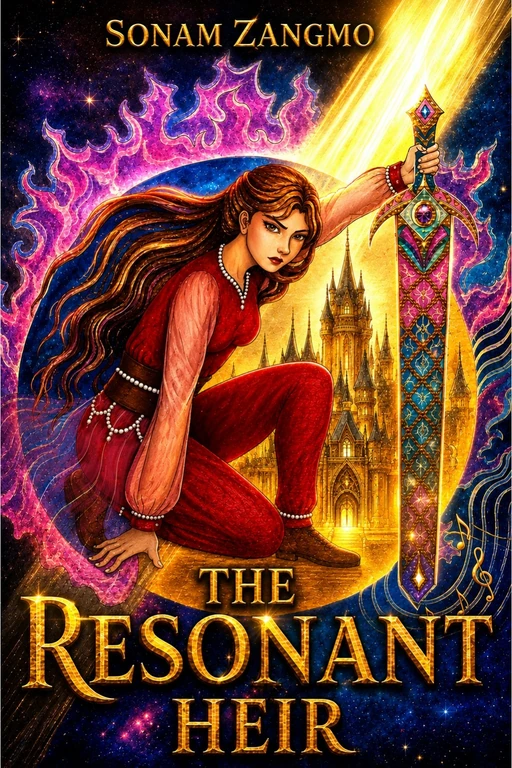
 Explore The Resonant HeirYA crossover royal fantasy · inherited magic · female heir · exile · adventure · Book I Complete
The Resonant Heir · Book I · A Literary Commentary
What Power Cannot Set Right: The Philosophy of The Resonant Heir, Book I
On human worth, inherited injustice, the moral cost of victory, and the responsibilities that remain when a hero's journey ends.
A Literary Commentary | Contains Spoilers for Book I
Explore the eight themes in this commentary
The Philosophy of Book I
Fantasy often begins with a character who lacks something the world considers essential. The familiar promise is that, through courage and perseverance, the character will eventually acquire it. Weakness becomes strength, obscurity becomes recognition, and suffering finds its reward.
Sonam Zangmo's The Resonant Heir begins within this tradition, then gradually questions its assumptions.
Princess Lyra is born into a royal family where magical ability determines status and authority. Without magic, she must continually confront the possibility that her birthright means little without the strength to defend it. Her desire to become powerful is understandable, even sympathetic.
Yet the philosophical significance of Book I lies less in whether Lyra succeeds than in what she discovers about success itself.
Across fifty-five chapters, the novel repeatedly places its protagonist in situations where strength cannot establish justice, good intentions cannot prevent suffering, and victory cannot erase responsibility.
Its central concern is not simply how an apparently powerless princess becomes a queen. It is whether someone who has spent her life seeking power can learn to question the values that made her seek it.
Theme 01 · Philosophical commentary
The Violence of Measuring Human Worth
Lyra's earliest wound is not physical. It is the belief that she may be fundamentally inadequate.
In Tharion, magical ability functions as more than a practical advantage. It becomes a measure of legitimacy, a distinction between those whose authority appears natural and those who must continually justify their place.
The humiliation Lyra experiences at the fountain in Chapter One demonstrates how deeply she has absorbed this judgment. When Haris and the other princes mock her lack of magic, they are not merely challenging her abilities. They are attacking her understanding of who she is.
Her response is revealing. Lyra feels anger, shame, and a desire for retaliation. She eventually throws a stone at one of the boys.
This is not the conduct of an idealized heroine whose suffering has automatically made her virtuous. It is the conduct of a child who has been hurt and wants to restore her dignity by hurting someone else.
That imperfection matters.
The novel does not begin by presenting Lyra as morally superior to the society that rejects her. She has inherited many of its assumptions, including the belief that strength determines whose dignity deserves recognition.
The consequences become more disturbing during the Royal Proving.
When Lyra defeats the chained Ravok before the royal court, she finally obtains the public recognition she has sought. Her father praises her, and the arena celebrates.
By the standards of her society, she has succeeded.
But the creature she defeats has been restrained, silenced, and forced to endure violence for the benefit of those watching.
The girl who once suffered humiliation at the hands of the powerful has now participated in the humiliation of another being.
Her victory becomes morally unsettling precisely because it is genuine. She has demonstrated courage and skill. She has also inflicted suffering on a captive.
The novel asks us to consider whether an achievement can remain admirable when the conditions that make it possible are unjust.
This distinction becomes essential to Lyra's development. The ability to exercise power and the moral authority to exercise it are not the same thing.
By the time Lyra finally recovers her magic, the reader has witnessed the emergence of qualities that cannot be measured through magical strength alone.
The irony is that her claim to genuine leadership begins to take shape long before she gains the very power her society considers necessary for it.
Theme 02 · Philosophical commentary
Resonance and the Ethics of Listening
The novel's title invites an interpretation that extends beyond its magical system.
Resonance is associated with vibrations, sound, and the ability to perceive what others cannot ordinarily hear. As Lyra develops this power, its significance becomes increasingly connected to another kind of perception: recognizing lives and experiences that established authority has ignored.
Throughout Book I, silence is rarely innocent.
Ravok's mouth has literally been sewn shut. His inability to speak reflects the power of those who control both his body and the story told about him.
The imprisoned spirits of Aulith carry histories of suffering that the surviving political order has failed to resolve.
Sion's past demonstrates how a person's identity can be shaped, concealed, or exploited by those who possess greater power.
Even Orlas, whose circumstances differ greatly from theirs, lives under a form of enforced silence. He understands that his father's instructions may be wrong, yet struggles to resist the authority that governs his life.
These characters do not share the same experiences. What connects them is the difficulty of making their own perspectives matter.
Lyra's growing ability to hear therefore acquires an ethical dimension.
She begins the novel demanding that others acknowledge her worth. Over time, she becomes increasingly confronted with the worth of beings her society has treated as insignificant, dangerous, or expendable.
Her encounter with Ravok is particularly important because listening does not immediately produce understanding.
When the creature challenges the heroic history of Aethrador, Lyra initially responds with anger. She has been raised to honor the founder of her kingdom, and Ravok's accusations threaten the legitimacy of the world she knows.
To hear an unfamiliar truth is one thing. To permit that truth to challenge one's identity is another.
The novel's treatment of Resonance suggests that meaningful listening requires more than the ability to receive a message. It requires a willingness to examine what one already believes.
This interpretation also finds support in Lyra's magical training.
Her progress does not arise simply from imposing greater force upon her surroundings. She must learn to distinguish, attend, and recognize rather than continually struggle against every sensation.
The parallel is compelling. Just as she cannot master every vibration by brute force, she cannot understand her kingdom by insisting that its inherited explanations must always be correct.
Yet the novel does not suggest that every unheard voice possesses the complete truth.
Ravok's testimony must still be understood within a larger history. Ancient grievances do not automatically determine the right course of action. Listening creates an obligation to investigate; it does not eliminate the need for judgment.
Resonance, understood in this way, becomes an unusually fitting power for a future ruler.
A kingdom needs more than someone strong enough to command obedience.
It needs someone capable of recognizing what its existing institutions have refused to hear.
Theme 03 · Philosophical commentary
The Burden of Inherited History
One of Book I's most substantial philosophical concerns is the relationship between personal responsibility and historical injustice.
Aethrador occupies a foundational place in Tharion's understanding of itself. He is remembered as the figure who ended a great war and established the kingdom.
But as Lyra encounters the consequences of his reign, the distinction between a celebrated victory and a just peace becomes increasingly difficult to ignore.
The political arrangements inherited by later generations preserve more than stability. They also preserve unresolved grievances, unequal obligations, and forms of punishment whose origins have become obscured by time.
The Soul Covenant of Aulith represents this problem with particular force.
An agreement established in the past continues to determine the lives of people who did not freely choose its terms. Historical decisions remain active long after their original architects are gone.
The novel thereby raises an uncomfortable question: can an institution remain legitimate merely because it has endured?
King Eryndar makes this problem more complicated.
He is not portrayed simply as an unfeeling tyrant. His relationship with Lyra reveals genuine parental concern, even when he struggles to express it. Nevertheless, his willingness to preserve inherited arrangements leaves serious injustices uncorrected.
His personal virtues do not automatically justify the political order he maintains.
This is an important distinction because readers may sympathize with Eryndar without being required to defend every decision associated with his reign.
The novel allows affection and criticism to coexist.
Lyra ultimately inherits this contradiction. She receives the authority of the crown, but also the accumulated consequences of those who wore it before her.
Her first decisions as queen suggest an attempt to distinguish legitimate inheritance from unquestioning obedience to the past.
She orders the review of old sentences and sealed chambers, requires treatment for wounded people regardless of allegiance, and rejects the condemnation of individuals solely because of their bloodline.
The principle is expressed with striking economy:
"Names first. Judgment after."
It is a modest statement, but one with significant political implications.
People must be recognized as individuals before the state decides what they deserve.
This does not erase history or resolve every injustice. The practical difficulties of reform remain largely ahead of Lyra.
Nevertheless, it marks a change in the moral basis of authority.
She is no longer content merely to occupy the throne she inherited. She begins questioning the structures through which that throne has exercised power.
The distinction matters. Replacing a cruel ruler is not necessarily the same as replacing an unjust system.
Theme 04 · Philosophical commentary
The Moral Cost of Doing Good
Perhaps the most mature aspect of The Resonant Heir is its recurring refusal to make compassion entirely comfortable.
Lyra often acts from a sincere desire to help others. Yet her choices do not consistently produce painless outcomes.
Her encounter with Bramor illustrates how an apparently heroic gift can carry a terrible historical burden.
The old sword he possesses is not merely an impressive weapon from a legendary war. It carries the resentment of those who died by its blade.
When Bramor undertakes the work of forging a new weapon, the process confronts both characters with the human suffering embedded in an object traditionally associated with heroic achievement.
A sword may represent protection to its wielder and devastation to those it strikes.
Its meaning cannot be separated from the lives affected by its use.
Bramor's eventual death deepens this tension. What Lyra receives is not simply a useful instrument for her quest. It is the result of another person's final sacrifice.
Such moments complicate the familiar relationship between virtue and reward.
A compassionate decision may require sacrifice. A necessary action may cause irreversible harm. Even a struggle against oppression may claim the lives of people who bear little responsibility for it.
During Lyra's confrontation with Syveris, a young mage dies when the Regent uses him as a human shield.
The act exposes Syveris's willingness to treat another person's life as expendable. But the death remains a tragedy even though Lyra is fighting a justified battle.
The narrative does not need to deny the necessity of resisting Syveris in order to acknowledge the cost of that resistance.
This is where the novel's philosophy becomes more persuasive than a simple opposition between good and evil.
The justice of a cause does not make every consequence of pursuing it just.
A related concern appears in Aulith, where temporary relief cannot by itself repair the conditions producing suffering. The difference between helping someone survive an injustice and ending the injustice itself becomes increasingly important.
Lyra's journey therefore moves beyond individual acts of generosity.
As a princess, she can intervene when she witnesses cruelty.
As a queen, she must begin asking why the conditions that permit such cruelty continue to exist.
That shift—from personal kindness to institutional responsibility—is one of the novel's most consequential developments.
Theme 05 · Philosophical commentary
When Pain Becomes a Claim to Power
The contrast between Lyra and Syveris provides another philosophical dimension.
Both characters are marked by experiences of inadequacy and frustrated recognition.
Lyra fears that her lack of magic renders her unworthy of the throne.
Syveris's resentment is entangled with his position beneath Eryndar and his conviction that power and recognition have been unjustly denied to him.
Their circumstances are not equivalent, and neither are their actions. But the resemblance in their emotional starting points makes their divergent choices meaningful.
Vael'Kharoth's temptation of Lyra reveals how easily the desire for dignity can become a desire for domination.
The stone does not initially appeal to cruelty.
It offers recognition, importance, and the promise that others will no longer dismiss her.
Only gradually does that promise develop into fantasies of supremacy and destruction.
This progression recognizes something troubling about human ambition.
The desire for power does not always begin in hatred. Sometimes it grows out of humiliation, helplessness, or the wish never to be vulnerable again.
But suffering does not grant an unlimited moral entitlement.
Having been treated unjustly does not justify treating others unjustly in return.
The crucial distinction between Lyra and Syveris is not that one has suffered and the other has not. It is how each responds to the temptation to make others answer for that suffering.
Syveris increasingly treats control as proof of his own importance.
Lyra, despite her mistakes and occasional recklessness, develops a greater capacity to recognize the consequences of her actions.
The novel thus resists two equally simplistic claims: that suffering necessarily makes people compassionate, and that those who commit evil must never have suffered themselves.
Pain may explain a person's conduct without excusing it.
Theme 06 · Philosophical commentary
Justice Does Not Make Grief Obedient
The emotional aftermath of Syveris's death may be the clearest demonstration of the novel's moral complexity.
Lyra defeats a ruler whose cruelty has endangered the kingdom. His removal is necessary for the restoration of her throne and the protection of those he has harmed.
But Syveris is also Orlas's father.
For years, Orlas has struggled beneath his father's authority. He recognizes Syveris's wrongdoing and cannot honestly deny it.
Nevertheless, when his father dies, he grieves.
The end of oppression does not immediately produce the experience of freedom.
Orlas is no longer under his father's control, but he has also lost the person around whom much of his life was organized.
His conflicting emotions cannot be resolved by declaring Syveris guilty.
This is one of the novel's strongest observations about grief: understanding why something happened does not necessarily reduce the pain of having experienced it.
Lyra, meanwhile, must accept that her justified actions have caused suffering to someone she loves.
She does not demand forgiveness from Orlas. Nor does she pretend that reclaiming the throne should automatically reconcile them.
Instead, she offers what she can responsibly offer as queen: his father's crimes will not be transferred to him.
This moment unites the personal and political themes of the novel.
Lyra cannot restore Orlas's father. She cannot command his grief to end. She cannot guarantee that their friendship will survive unchanged.
But she can refuse to transform one man's guilt into an inherited punishment.
Her inability to repair the emotional consequences of her victory does not prevent her from attempting to limit its political consequences.
Justice remains necessary, even when it cannot make everyone whole.
Theme 07 · Philosophical commentary
A Crown, a Promise, and an Unopened Door
Book I's final philosophical statement emerges not from the coronation but from what follows it.
Lyra has recovered her magical ability, defeated Syveris, reclaimed her throne, and reunited with her mother.
By the conventions of heroic fantasy, she has reached the destination toward which her journey has been moving.
Yet the novel returns her to the Wind-Crystal Garden, the place where her childhood story began.
The once-whispering tulips have withered. The fountain remains suspended. Rubiad still hangs above it.
And beneath the garden, the imprisoned High Lord of Sarrakha is still waiting.
Lyra has promised to free him.
But the Awakening Spring, which restored her powers and removed Vael'Kharoth's mark, has also taken away the connection through which Rubiad once recognized her.
She is now considerably more powerful than the child who first approached the fountain.
And she cannot open it.
This reversal gives the ending its force.
A transformation that benefits Lyra has also deprived her of something needed to fulfill an earlier obligation. Recovery has not restored everything. Victory has not made her capable of answering every need.
The crown grants authority over a kingdom, but it does not make an ancient promise easier to keep.
There is also an unresolved question beneath the immediate problem: Lyra still does not know why the High Lord was imprisoned.
That uncertainty matters.
The obligation created by her promise must eventually confront her duty to investigate the truth and protect others. Honoring a promise may prove more complicated than simply accomplishing what was promised.
The novel leaves these obligations in tension.
Its final image does not suggest that Lyra's achievements were meaningless. Rather, it refuses to let those achievements become a complete moral settlement.
She has won the throne, but someone remains unheard and unfreed.
The very form of her new responsibility is captured in the chapter title, A Debt Without a Door.
She has gained the power to rule.
She has not gained the power to make every obligation disappear.
Theme 08 · Philosophical commentary
The Meaning of the Resonant Heir
Taken as a whole, Book I traces a movement from the desire to be recognized toward the responsibility to recognize others.
At first, Lyra wants the world to acknowledge her value.
She trains, struggles, and seeks magic because she believes her future depends upon proving that she deserves respect.
But the journey gradually draws her attention beyond herself.
She encounters creatures whose suffering has been dismissed, communities living under inherited burdens, individuals trapped by family authority, and people whose lives have been altered by decisions made long before they were born.
Her understanding of strength changes because the meaning of responsibility changes.
It is no longer enough to be powerful enough to win.
She must become attentive enough to question what winning costs, whose stories have been excluded, and what obligations remain after the conflict ends.
The novel does not always pursue these questions with equal ambiguity. Some trials offer recognizable moral choices followed by relatively clear rewards. At such moments, the story approaches the reassuring logic of traditional heroic fantasy.
Its most compelling passages, however, are those in which the morally preferable choice does not guarantee comfort, reconciliation, or success.
Bramor's sacrifice cannot be undone. Eryndar cannot be brought back. Orlas cannot be made to stop grieving. Historical injustice cannot be repaired by a change of rulers alone. And the person beneath Rubiad remains imprisoned.
These unresolved consequences give weight to Lyra's transformation.
The word Resonant ultimately suggests more than a magical talent. It evokes the capacity to respond to another existence—to perceive suffering beyond one's own and recognize that it may demand something of us.
The word Heir likewise extends beyond royal succession. Lyra inherits not only a kingdom but its unfinished history, the mistakes of its rulers, and the promises that still require an answer.
The philosophical achievement of The Resonant Heir, Book I, lies in bringing those two ideas together.
To inherit power is not necessarily to deserve it. To possess power is not necessarily to understand its consequences. And to exercise it justly requires more than the strength to defeat an enemy.
It requires the willingness to remain answerable to those whom victory has not saved.
Book I begins with a princess who fears she is not worthy of a crown.
It ends with a queen who has gained that crown, only to discover that worthiness is no longer the question she can afford to ask.
The question now is what she owes.
And that is a far more demanding beginning to a reign than victory alone could ever provide.