
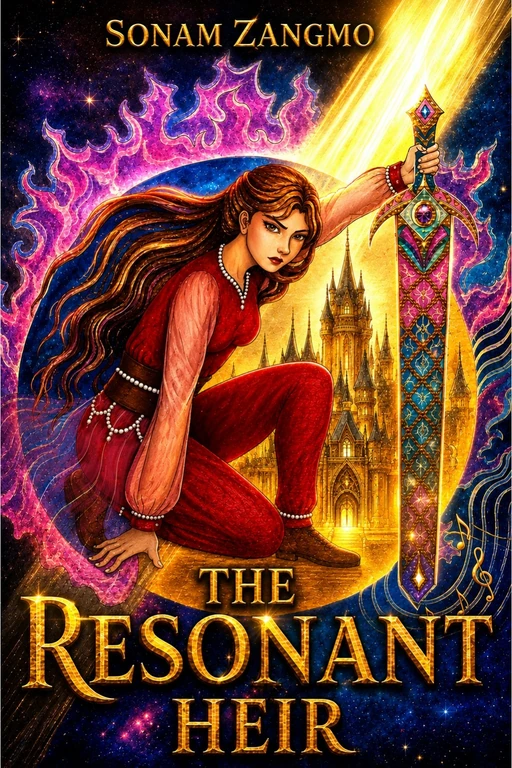
 Explore The Resonant HeirYA crossover royal fantasy · inherited magic · female heir · exile · adventure · Book I Complete
The Resonant Heir · Book I · Chapter 01 · A Literary Commentary
The Burden of Proving One's Worth: A Philosophical Reading of The Forbidden Garden
A literary commentary on Chapter One of The Resonant Heir, exploring human worth, the desire for recognition, the ethics of power, and the boundaries between protection and freedom.
Spoiler Notice: This commentary discusses the events and ending of Chapter One.
Explore the eight themes in this commentary
- A Child Who Has Already Learned to Doubt Her Worth
- The Difference Between Being Worthy and Being Recognized
- When the Humiliated Become the Powerful
- Power as Domination, Power as Protection
- The Forbidden Garden and the Problem of Knowledge
- The Loneliness Beneath Privilege
- The Unseen Seal and the Limits of Self-Knowledge
- The Question Chapter One Leaves Behind
Theme 01 · Philosophical commentary
A Child Who Has Already Learned to Doubt Her Worth
The opening chapter of Sonam Zangmo's The Resonant Heir, titled The Forbidden Garden, introduces a familiar fantasy premise: a young princess born without the magical ability that her society considers essential.
Yet beneath its enchanted flowers, suspended fountain, and childhood rivalries lies a more unsettling question: What happens when a child learns to measure her worth according to a standard she cannot meet?
Princess Lyra is eleven years old, but she already understands that her position as heir is conditional in the eyes of others. Her royal birth grants her a title, yet her apparent lack of magic threatens the legitimacy of that title.
She has inherited a crown she may one day wear, but not the confidence that she deserves it.
This distinction becomes apparent almost immediately.
When Lyra recalls her father's warnings about the forbidden garden, she wonders whether the danger has something to do with her lack of magic. The King has never given her that explanation. She supplies it herself.
The moment is psychologically revealing.
A child who repeatedly encounters doubt about her abilities may eventually begin to interpret unrelated events through the same perceived deficiency. What starts as an external judgment becomes an internal explanation for how the world works.
Lyra does not merely know that others consider her inadequate. She has begun to suspect that her inadequacy explains the restrictions placed upon her.
The chapter therefore introduces more than a society organized around magical power. It introduces a child whose developing identity is already being shaped by that society's expectations.
Her problem is not simply that she lacks something valuable.
It is that she has learned to question whether she possesses value without it.
Theme 02 · Philosophical commentary
The Difference Between Being Worthy and Being Recognized
The confrontation at the fountain exposes the emotional consequences of this belief.
Lyra approaches three boys with an almost painfully ordinary hope: she wants friends.
For a royal child surrounded by attendants and expectations, companionship with children her own age is apparently rare. Her excitement is immediate, and Obewich, despite his concern, cannot bring himself to interrupt it.
The boys, however, are less interested in meeting her than in assessing her place within their hierarchy.
Haris possesses the magical strength Lyra lacks. When he challenges her identity and the other boys mock the idea of a princess without magic, they expose the contradiction around which her childhood has been organized.
She is a princess by birth, but her society has taught her that authority must be supported by power.
The humiliation becomes physical when Haris strikes her with a wave of water.
Yet the narrative makes clear that Lyra's deepest injury is not the fall. It is the laughter.
She has been reminded, in front of other children, that her title cannot protect her from being considered inferior.
What follows is perhaps the most important philosophical passage in the chapter:
Strength rules this kingdom.
Haris has it.
I don't.
Then what am I?
If I have to prove my worth, I'll prove it another way.
These thoughts reveal both Lyra's determination and the limits of her understanding.
She refuses to surrender to the judgment placed upon her. She intends to find another means of proving herself.
But she does not yet question why her worth must be proven at all.
That difference matters.
There is a considerable distance between believing that one can succeed despite an apparent disadvantage and believing that one's fundamental worth does not depend upon success.
Lyra has reached the first position, not the second.
Her defiance remains bound to the very standard that has wounded her. She wants to overcome the judgment rather than reject its authority over her identity.
This is what makes her response convincing.
At eleven, she has not developed a philosophical alternative to the values of her world. She has developed the determination to survive within them.
Her struggle begins not as liberation from society's expectations, but as a desperate effort to satisfy them on different terms.
Theme 03 · Philosophical commentary
When the Humiliated Become the Powerful
One of the chapter's more interesting decisions is its refusal to portray Lyra as morally flawless.
She is undoubtedly mistreated. Haris uses superior magical ability to humiliate someone who cannot defend herself in the same way.
But Lyra's response contains its own troubling impulse.
She wants revenge.
For a moment, she restrains herself, remembering that being a princess requires her to consider the consequences of reckless behavior.
Then, as the boys walk away, she adopts a different justification: she is the heir, and therefore she sets the rules.
She throws a stone at one of them.
The act is understandable as the retaliation of an angry child. It is also revealing.
Lyra resents the privilege Haris enjoys because of his magical strength, yet she appeals to her own royal privilege when deciding she has the right to strike back.
The two forms of authority are not identical, but the resemblance deserves attention.
Both children inhabit a world where power shapes their understanding of what they are entitled to do.
Haris uses magic.
Lyra invokes her status.
Neither has fully separated personal injury from the right to impose consequences on someone else.
This creates a moral tension that a simpler heroic introduction might have avoided.
Lyra's suffering does not automatically make her just. Her courage does not eliminate her pride. Her desire for dignity can coexist with a desire to punish.
The chapter allows these qualities to occupy the same child.
It raises a question that extends well beyond its fantasy setting: Does experiencing injustice teach a person to reject the misuse of power, or can it make that person more determined to acquire power for themselves?
The Forbidden Garden does not answer.
It gives us a protagonist standing at the beginning of that uncertainty.
Theme 04 · Philosophical commentary
Power as Domination, Power as Protection
The contrast between Haris and Obewich offers another perspective on the moral meaning of strength.
Both can use magic, but their actions demonstrate different relationships to power.
Haris employs his ability to intimidate and humiliate.
Obewich uses his magic to protect Lyra when another prince retaliates with a dangerous attack.
The distinction is not a matter of whose magic is stronger. It concerns the purpose for which power is exercised.
This becomes particularly interesting because Obewich hardly resembles the conventional image of a formidable protector.
He is short, plump, frequently breathless, and visibly anxious about Lyra's behavior. His attempts to maintain order are sometimes comical.
Yet when the situation turns dangerous, he intervenes.
His courage is expressed not through a desire to establish superiority, but through responsibility for someone entrusted to his care.
There is no suggestion that physical appearance determines moral character, or that the person most capable of inspiring fear is necessarily the person most deserving of respect.
Instead, the chapter presents two contrasting uses of strength: one directed toward asserting dominance, the other toward preventing harm.
This distinction quietly challenges the kingdom's apparent equation of magical ability with personal worth.
Possessing power tells us what someone can do.
It does not tell us whether that person can be trusted to do it.
Theme 05 · Philosophical commentary
The Forbidden Garden and the Problem of Knowledge
The garden itself introduces a different philosophical tension.
Lyra enters a place she has repeatedly been forbidden to visit. Her father has warned her that it is dangerous, but he has never explained why.
The prohibition therefore exists without an explanation she can evaluate.
Obewich continues that pattern.
When the enormous tulips offer to tell Lyra a story about what lies beneath her feet, he urgently pulls her away, dismissing their words as nonsense.
Whether the flowers can be trusted remains uncertain. Obewich may have excellent reasons for preventing Lyra from listening.
Yet the scene raises a question about the relationship between protection and knowledge.
To protect a child sometimes requires withholding information. But protection can also become a form of control when the protected person is never allowed to understand the reasons behind a restriction.
Lyra senses this tension.
She wants to know what the flowers are about to reveal, but she does not forcibly resist Obewich. She trusts him because he has cared for her for years.
Her decision shows that trust and understanding are not the same thing.
She obeys without being persuaded.
The distinction is important because the chapter does not portray all authority as inherently malicious. Obewich's affection is evident, and his concern appears sincere.
At the same time, his good intentions do not erase Lyra's unanswered questions.
The garden consequently becomes more than a setting for magical discoveries. It represents a world in which information is unevenly distributed, where some individuals know more than others, and where affection, authority, and secrecy can become difficult to separate.
The talking flowers deepen this symbolism.
They possess mouths but no eyes. They invite Lyra to hear a hidden story, yet their intentions remain unreadable.
Their strange appearance makes them both possible sources of knowledge and possible sources of danger.
The chapter offers no simple instruction to trust every unfamiliar voice or reject every established authority.
Instead, it places Lyra between competing claims and leaves her without enough information to determine which deserves belief.
Her curiosity is therefore neither entirely foolish nor unquestionably wise.
It is the beginning of her effort to understand a world that others have already interpreted for her.
Theme 06 · Philosophical commentary
The Loneliness Beneath Privilege
For all its questions about power, The Forbidden Garden is also concerned with something less grand: the emotional isolation of a child.
Lyra's excitement at seeing the boys by the fountain is significant because she knows nothing about them.
She sees the possibility of friendship before she sees the possibility of danger.
Her disappointment is therefore more than wounded royal pride.
She approaches the boys hoping to find companionship and instead encounters ridicule.
The social hierarchy that grants her extraordinary status has not supplied an ordinary sense of belonging.
Her brief interaction with Orlas near the end of the chapter offers a contrast.
Unlike the boys at the fountain, he approaches her with concern. He recognizes that she has been treated unfairly and offers the possibility of friendship.
The effect upon Lyra is immediate. Her anger softens, and she regains some of her earlier playfulness.
Yet Orlas's reassurance contains an interesting limitation.
He tells her that he believes she will one day become stronger than Haris.
The statement is kind. It gives Lyra hope at a moment when she feels defeated.
But it also reinforces the assumption that becoming stronger is the answer to her humiliation.
Orlas does not challenge the standard by which Lyra has been judged. He imagines a future in which she can finally meet or surpass it.
This is entirely believable for a child raised within the same culture.
It also demonstrates how deeply social values can shape even our attempts to comfort one another.
Sometimes reassurance does not free someone from a harmful standard. It merely promises that they may one day succeed by that standard.
The chapter allows Lyra to be comforted without suggesting that the deeper problem has been resolved.
She has gained a friend.
She has not yet escaped the belief that she must become stronger to deserve respect.
Theme 07 · Philosophical commentary
The Unseen Seal and the Limits of Self-Knowledge
The final scene complicates everything that has come before.
Throughout the chapter, Lyra and those around her treat her lack of a magical aura as an established fact.
Then a raven delivers information to a mysterious observer, who expresses satisfaction that a seal is still holding.
The revelation does not explain the seal's origins, purpose, or precise effects.
It does, however, introduce the possibility that Lyra's apparent condition is connected to forces operating beyond her awareness.
This changes the philosophical implications of her insecurity.
Lyra believes she knows what is wrong with her. Her society believes it knows as well.
But neither perspective necessarily contains the whole truth.
The distinction between how a person is perceived and what that person actually is becomes suddenly uncertain.
Earlier, the Rubiad briefly responds to Lyra's presence, suggesting a mysterious connection that she cannot understand. At the time, the moment is easily overshadowed by the confrontation with Haris.
Only afterward does the reader begin to suspect that there may be more to Lyra's identity than her visible lack of magic suggests.
The chapter does not establish that she possesses some extraordinary hidden destiny. Such a conclusion would require information not yet available.
Its more immediate implication is that the judgments surrounding Lyra may rest upon incomplete knowledge.
This is a particularly effective way to conclude a chapter preoccupied with personal worth.
An eleven-year-old child has built much of her self-understanding around what she believes she lacks.
Yet the reader has now been given reason to question whether even that belief is fully informed.
The tragedy is not simply that others may have underestimated her.
It is that she has already begun to underestimate herself.
Theme 08 · Philosophical commentary
The Question Chapter One Leaves Behind
The structure of The Forbidden Garden brings its philosophical concerns together with considerable subtlety.
The chapter begins with Lyra stepping across a forbidden boundary, apparently exercising her independence.
It ends by revealing that an unseen constraint may exist within her own life.
She can defy the visible rules of a garden, but she cannot challenge a restriction she does not know exists.
This contrast gives the opening and closing scenes a particular resonance.
Freedom is not merely the ability to disobey an order. It may also depend upon knowing which forces shape one's choices in the first place.
Throughout the chapter, Lyra struggles to exercise agency within circumstances she only partially understands.
She wants to explore, but does not know the garden's danger.
She wants friendship, but does not know the boys' intentions.
She wants recognition, but accepts the standards by which others judge her.
And she wants to prove her worth, without knowing the truth about the condition that supposedly makes her unworthy.
Her determination is admirable. Her understanding remains incomplete.
That combination makes her an engaging protagonist and provides the chapter with its philosophical tension.
There is, however, an important distinction between the questions the chapter raises and the conclusions it establishes.
The narrative has not yet demonstrated that power is irrelevant, that all restrictions are unjust, or that Lyra's judgments about herself are entirely mistaken.
What it has demonstrated is the danger of allowing an external hierarchy to determine one's internal sense of value.
Lyra's first response to humiliation is to seek another way to prove herself.
The deeper question, still unanswered, is whether she should have to prove herself at all.
And perhaps that is the most compelling aspect of the chapter.
It does not begin with a heroine who understands her worth and sets out to defend it.
It begins with a child who doubts her worth and decides to earn it.
The difference is profound.
A person who believes their worth must be earned may pursue extraordinary achievements. But every achievement can also leave the original fear intact: that without continued success, recognition might disappear.
The Forbidden Garden presents this fear without resolving it.
Lyra walks away from the fountain determined to become someone the world can no longer dismiss. She has not yet considered that the world's judgment may be an unreliable measure of who she is.
Her journey begins with courage, curiosity, pride, loneliness, and a wound she does not know how to name.
For a first chapter, that is a meaningful philosophical beginning.
The question is not yet whether Lyra will become powerful enough to prove her worth. It is whether she will ever discover that her worth and her power were never the same thing.