
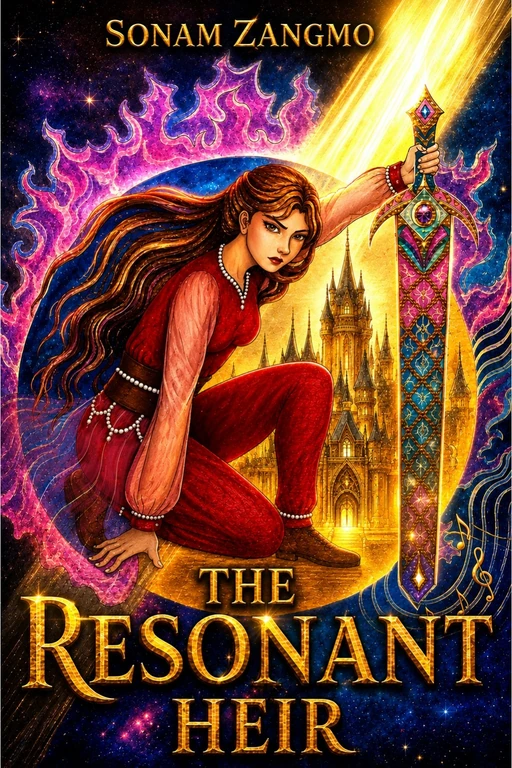
 Explore The Resonant HeirYA crossover royal fantasy · inherited magic · female heir · exile · adventure · Book I Complete
A Literary Commentary on Chapter Three of The Resonant Heir
The Violence Beneath Applause: A Philosophical Reading of A Hollow Victory
On the pursuit of recognition, the suffering hidden beneath public triumph, and the moment a young princess begins to question the meaning of her own success.
Spoiler Notice: Contains spoilers for Chapter Three.
Explore the twelve themes in this commentary
- The Triumph That Cannot Bring Peace
- Beneath the Arena
- When an Institution Makes Cruelty Ordinary
- The Achievement Is Real
- The Creature That Cannot Speak
- The Applause and the Accusation
- The Limits of a Father's Praise
- The First Failure of an Old Explanation
- The Private Costs of a Public Celebration
- Two Fallen Swords
- The Beginning of a Moral Question
- Conclusion: What the Crowd Could Not Give Her
Theme 01 · Philosophical commentary
The Triumph That Cannot Bring Peace
There is a particular kind of disappointment that comes not from failing to achieve something, but from achieving it and discovering that the experience is not what one imagined.
Chapter Three of Sonam Zangmo's The Resonant Heir, titled A Hollow Victory, examines precisely this contradiction.
For years, Princess Lyra has struggled under the belief that her lack of magic makes her unworthy of the royal status she was born to inherit. She has trained relentlessly, endured humiliation, and sought an opportunity to prove that her abilities deserve recognition.
The Royal Proving finally offers that opportunity.
Despite an injured wrist, Lyra succeeds where superior magical force has failed. She identifies a weakness in the armored creature before her and delivers a decisive strike. The court erupts in celebration. Her father rises and publicly praises her.
By every visible measure, she has accomplished what she set out to do.
Yet the chapter ends with Lyra standing alone in the arena, unable to take comfort in what she has achieved.
The significance of this ending extends beyond a conventional lesson about the emptiness of fame.
Lyra does not discover that she secretly dislikes recognition. Her joy upon receiving her father's praise is genuine.
What changes is her understanding of the event that earned it.
The chapter asks a difficult question: Can an achievement establish our abilities without establishing the moral worth of what we have done?
Its answer emerges through a striking contrast between the celebration of the powerful and the suffering of a creature that has been denied nearly every means of resistance.
Theme 02 · Philosophical commentary
Beneath the Arena
The chapter opens not with the princess, the royal court, or the anticipated competition, but with a prisoner.
In the Ashen Dungeon beneath the Crucible Arena, a massive creature lives in darkness, its movements restricted by chains.
A soldier enters carrying food. He complains that the creature eats better than the soldiers do, then throws the tray across the floor.
The prisoner offers no reply.
It lowers itself and eats.
Only afterward does the narrative turn toward the preparations taking place above, where soldiers arrange the seating for a grand public display.
This sequence establishes the moral geography of the chapter.
Beneath the arena is confinement. Above it is celebration.
The creature's suffering is not hidden because nobody knows it exists. The people organizing the event know that it is imprisoned. Its captivity is an accepted part of the institution.
What remains hidden is the significance of that suffering.
The soldier's resentment adds another dimension. He regards the prisoner's food as an undeserved privilege, directing his frustration toward a being with even less freedom than himself.
Whatever grievances the soldier may have about his own conditions, he expresses them through contempt for someone more vulnerable.
This is a recognizable pattern of social behavior. Frustration does not always move toward the structures responsible for it. Sometimes it is redirected toward those least able to respond.
The creature itself is not established as innocent. The chapter does not provide the full history of its captivity or explain whether its confinement originally served a legitimate purpose.
That uncertainty matters.
Yet a creature's potential dangerousness does not automatically justify every form of treatment imposed upon it.
Confinement for protection, punishment for wrongdoing, and deliberate exploitation for entertainment are ethically distinct.
The Royal Proving appears to blur those distinctions.
The creature has spent nearly fifty years in captivity. Its legs are chained, its wings restricted, and its mouth nearly sewn shut.
It is then placed before young members of the royal family as an opponent against whom they may demonstrate their strength.
The arrangement raises a question that none of the spectators appears interested in asking: What kind of victory is possible when one participant has no meaningful freedom to refuse the contest?
Theme 03 · Philosophical commentary
When an Institution Makes Cruelty Ordinary
The arena is more than a physical setting. It is an institution that transforms violence into recognized achievement.
The royal family attends. Nobles gather. The banners of the fae clans decorate the stands. Ceremonial sounds announce the beginning of the event.
Everything surrounding the competition conveys legitimacy.
The princes attack the chained creature with lightning, fire, and water. Each attempts to distinguish himself before the watching court.
The crowd responds with excitement.
Within this setting, the suffering of the prisoner becomes almost invisible beneath the performance of those attacking it.
The princes are not presented as individuals who have independently invented a cruel game. They are participating in an established royal tradition.
That distinction is philosophically significant.
A society does not require every participant to possess cruel intentions in order to sustain a cruel practice.
Custom, ceremony, ambition, and social approval can normalize conduct that might appear disturbing outside its accepted context.
The princes have been given a way to demonstrate their abilities. The spectators have been given an occasion to celebrate. The institution supplies a common explanation for what everyone is doing.
The creature's perspective has no comparable place in that explanation.
This is one of the chapter's strongest ethical observations: Public approval can establish that an action is socially valued without establishing that it is morally justified.
Lyra enters this institution as someone who has herself suffered under its hierarchy of strength.
She wants to prove that a person without magic can still be capable and courageous.
Yet the opportunity offered to her requires participation in a contest whose fundamental conditions she has not questioned.
Her personal struggle against prejudice and the larger institution's treatment of the prisoner are not the same problem.
But the arena brings them together.
Lyra can challenge the assumption that magical power is the only meaningful form of strength while still accepting a system that uses another being's suffering to measure that strength.
The distinction becomes central to the chapter's eventual reversal.
Theme 04 · Philosophical commentary
The Achievement Is Real
One of the reasons A Hollow Victory works as a philosophical episode is that Lyra's success cannot simply be dismissed.
She enters the arena with an injured wrist, a consequence of her encounter with Vael'Kharoth in the previous chapter.
When she attempts her first strike, pain overwhelms her arm and her sword falls to the ground.
The spectators fall silent.
For Lyra, the moment threatens to confirm the fear that has shaped her childhood: that she will fail when everyone is watching.
Meanwhile, Haris demonstrates the kind of spectacular magical ability that Tharion associates with superiority.
His attack hurls the creature backward and covers its armored chest in ice.
The crowd celebrates.
But the creature rises again.
When Lyra returns to the fight, she does not attempt to match Haris's magical force. She studies her opponent, identifies an opening between its silver scales, and strikes with precision.
Her success reveals that effectiveness cannot be reduced to a single form of power.
Observation, timing, discipline, and courage matter.
In this respect, her victory challenges the assumptions that have caused her so much suffering.
The princess without magic proves that she possesses formidable abilities.
Yet this genuine achievement creates the chapter's central ethical complication.
Lyra's demonstration of skill does not alter the condition of the creature she has wounded.
Its chains remain.
Its mouth remains stitched.
Its blood falls upon the arena floor.
The moral question therefore cannot be resolved by insisting that Lyra fought bravely.
She did.
The question is whether bravery and skill are sufficient to justify the circumstances in which they are exercised.
The chapter allows two judgments to coexist: Lyra's performance is impressive, and the suffering involved in that performance deserves examination.
One truth does not cancel the other.
Theme 05 · Philosophical commentary
The Creature That Cannot Speak
Perhaps the chapter's most powerful image is the prisoner's mouth.
It has been nearly sewn shut with black stitches.
The creature is identified as the Silent Beast, yet its silence has been imposed upon it.
This distinction deserves attention.
Being silent is not the same as having nothing to say.
During the competition, the creature attempts to roar, but its voice is obstructed by the enchanted threads.
Its body resists. Its chains strain. Its wounds bleed.
These are visible expressions of distress, yet they do not interrupt the ceremony's accepted meaning.
The creature remains an opponent to be defeated.
After Lyra delivers her successful strike, however, a voice reaches her mind.
It expresses pain and accuses her of cruelty.
The chapter has not yet fully explained the source or mechanism of this communication. The connection between the voice, the creature, and Lyra's injured wrist remains mysterious.
Nevertheless, the juxtaposition is unmistakable.
A being prevented from speaking aloud appears to reach the very person who has wounded it.
The scene reverses the relationship that has governed Lyra's experience until now.
For years, she has wanted others to recognize her.
She has wanted the court to acknowledge her abilities, her father to express pride, and her peers to stop looking down on her.
Her attention has largely been directed toward how others perceive her.
Now she encounters the possibility that another being has a perspective she has failed to consider.
The shift is subtle but substantial.
Her central concern begins moving from being seen toward seeing.
This is not yet a complete ethical awakening. Lyra does not suddenly understand the creature's history or know whether its accusation is entirely fair.
But she can no longer regard the encounter solely as a test of her abilities.
Another experience has entered the meaning of her victory.
Theme 06 · Philosophical commentary
The Applause and the Accusation
Sound plays a remarkable role in the chapter's structure.
When Lyra drops her sword, the arena falls silent.
That silence represents public judgment. She has failed before the people whose recognition she desperately wants.
When she succeeds, the same space erupts in applause.
The crowd's approval appears to reverse the earlier humiliation.
But immediately afterward, another voice interrupts her happiness.
The contrast places two kinds of judgment beside each other.
The spectators evaluate what Lyra has accomplished.
The mysterious voice draws attention to what her accomplishment has cost.
These judgments are not equivalent.
The spectators recognize her courage and skill. Their applause confirms that she has satisfied the expectations of the competition.
But those expectations do not include an examination of the prisoner's suffering.
For the crowd, the conclusion is simple. A difficult opponent has been defeated.
For Lyra, the same event suddenly becomes uncertain.
The voice does not change the outcome of the contest. It changes her ability to celebrate that outcome without reservation.
This is where the title acquires its deeper significance.
The victory is hollow not because it lacks achievement, but because achievement alone cannot answer the moral question that has emerged.
The crowd has given Lyra the recognition she sought.
It cannot give her certainty that she has done something good.
Theme 07 · Philosophical commentary
The Limits of a Father's Praise
King Eryndar's reaction makes the moment especially painful.
When Lyra defeats the creature, he rises and praises her before the assembled court.
His approval is not an insignificant reward.
For Lyra, it represents the recognition she has pursued through years of exhausting training.
Her response is immediate and deeply personal.
She has finally made her father proud.
There is no reason to regard this happiness as false. The novel allows the moment to possess genuine emotional value.
But it is almost immediately interrupted.
The creature's apparent accusation reaches Lyra just as she begins to enjoy the fulfillment of her ambition.
This creates a difficult distinction between external validation and moral self-judgment.
A respected authority can tell someone that they have performed well.
That authority cannot necessarily resolve every question about whether the performance was right.
Eryndar sees his daughter's achievement within the values of the Royal Proving.
Lyra begins to experience something that those values have not prepared her to consider.
The chapter does not establish that the King knowingly celebrates cruelty, or that the Queen's uneasy reaction necessarily reflects moral opposition to the event. Their complete understanding of the creature and its history remains unclear.
What the scene demonstrates is a difference in perception.
The father sees an accomplishment worthy of praise.
The daughter begins to see a wounded being.
For perhaps the first time, the recognition she receives from her father is not enough to settle what she feels about herself.
That is a meaningful step in the development of moral independence.
Theme 08 · Philosophical commentary
The First Failure of an Old Explanation
After the creature is dragged away, Lyra watches the blood left upon the arena floor.
She attempts to reassure herself that it is merely a beast.
The thought does not hold.
She begins asking what she has done.
This brief sequence is among the chapter's most revealing moments.
The phrase just a beast reduces the creature to a category.
That category allows Lyra to interpret the violence as ordinary, permissible, and perhaps unworthy of further concern.
But she has encountered something that the category does not adequately explain.
The creature appears capable of suffering in a way that reaches her personally.
Its gaze and apparent accusation resist the simplicity of the label.
The problem is not that Lyra now possesses complete knowledge of the prisoner.
She does not.
The problem is that her previous explanation no longer feels sufficient.
This is a recognizable beginning of moral reflection.
People often inherit categories through which they understand the world. Those categories can serve practical purposes, but they can also conceal the individuality or suffering of those placed within them.
When experience contradicts an inherited classification, a person faces a choice.
They may defend the classification more aggressively.
Or they may begin questioning whether it has prevented them from seeing something important.
Lyra has not yet rejected the assumptions of her society.
But she has become unable to accept one of them without discomfort.
That discomfort matters.
Moral awareness does not always arrive as a clear principle. Sometimes it begins when an explanation that once seemed obvious no longer provides peace.
Theme 09 · Philosophical commentary
The Private Costs of a Public Celebration
The chapter also contrasts the public spectacle with the private emotional lives of those connected to it.
Orlas is absent from the banquet and competition. He sits alone, troubled by the possibility that his actions in the previous chapter may have destroyed Lyra's chance to participate.
The unfinished emotional significance of the deerskin arm guards is especially poignant.
They were intended as an expression of care.
Now, lying unused, they remind Orlas of the harm he fears he has caused.
His absence places personal guilt beside the court's celebration, suggesting that the same event can carry radically different meanings depending upon one's knowledge and involvement.
Syveris offers another contrast.
When Lyra drops her sword, his concealed satisfaction distinguishes him from the parents who fear for her.
He observes the event through the calculations of someone pursuing an ulterior purpose.
His reaction underscores the vulnerability of public judgment: spectators may believe they are witnessing a straightforward test of ability while other interests operate beneath the surface.
Haris, meanwhile, offers Lyra a brief acknowledgment after the contest.
He tells her that she performed well.
Considering their earlier confrontation, this recognition might once have meant a great deal to her.
Yet Lyra barely responds.
Her attention remains fixed upon the dungeon gate.
The moment is quietly ironic.
The boy whose superiority once humiliated her now acknowledges her ability, but that acknowledgment arrives when her attention has turned toward a different concern.
She has achieved something that might have seemed sufficient only hours earlier.
Now it is not.
The chapter does not require Haris to understand what has changed.
His inability to interpret Lyra's silence helps demonstrate how private moral experience can remain invisible even to those standing nearby.
Theme 10 · Philosophical commentary
Two Fallen Swords
The chapter's most elegant structural device is the repetition of the falling sword.
The first fall occurs when Lyra attempts to fight despite her injured wrist.
Pain overcomes her, the weapon strikes the stone, and the spectators fall silent.
The incident represents the humiliation she has feared.
Her body has failed to perform at the moment when her abilities are being publicly measured.
She recovers, resumes the fight, and ultimately wins.
Then, at the chapter's conclusion, the sword falls again.
This time the competition is over.
Lyra has received her father's praise. The crowd has departed. Even Haris has acknowledged her accomplishment.
But she remains disturbed by what she has heard and witnessed.
Her vision blurs, her fingers loosen, and the sword slips from her hand.
The chapter does not establish a single cause for her physical reaction. Her earlier injury and the unexplained magical experience remain relevant.
Symbolically, however, the parallel is powerful.
The first fallen sword accompanies the fear that she is not strong enough to achieve her goal.
The second accompanies her growing uncertainty about the goal she has achieved.
At first, she cannot do what she wants.
By the end, she has done what she wants, but cannot fully accept what it means.
The repetition transforms an image of technical failure into an image of unresolved moral experience.
There is a further auditory connection with the chapter's opening.
The metallic clang of the food tray in the dungeon precedes the sounds of the competition.
At the beginning, the imprisoned creature endures humiliation in silence.
At the end, the victorious princess stands in a nearly empty arena, unable to celebrate.
The chapter begins and ends with the consequences of a system that treats one being's suffering as another person's occasion for judgment or achievement.
What links the two is not equal suffering, but an emerging awareness that their experiences belong to the same event.
Theme 11 · Philosophical commentary
The Beginning of a Moral Question
It would be premature to describe Lyra's reaction as a completed transformation.
She has not yet discovered the full truth about the Silent Beast.
She has not condemned the Royal Proving, challenged her father, or taken action to change the creature's circumstances.
She does not even understand the voice that has interrupted her celebration.
Her response is confusion, revulsion, and unease.
Yet these emotions have philosophical significance precisely because they interrupt a belief that previously seemed unquestionable.
Lyra has spent years measuring herself against a society that reveres strength.
She has trained to satisfy its expectations.
At the Royal Proving, she finally succeeds.
Then she begins to recognize that the institution capable of granting her recognition may also be capable of ignoring another being's suffering.
The achievement that was supposed to resolve her insecurity introduces a different and more demanding question.
Not whether she is capable of winning, but what winning requires of her.
The distinction opens the possibility of a more mature understanding of power.
A person may possess strength without understanding its effects.
A person may demonstrate courage while participating in an unjust practice.
And a person may be celebrated for an act that still deserves moral scrutiny.
These possibilities do not negate Lyra's accomplishment. They make its meaning more complicated.
That complexity is the chapter's achievement.
Theme 12 · Philosophical commentary
Conclusion: What the Crowd Could Not Give Her
A Hollow Victory marks an important development in the philosophical trajectory of The Resonant Heir.
In the opening chapter, Lyra suffers because others judge her by a standard she cannot meet.
In the second, her desperation for recognition leaves her vulnerable to a promise of extraordinary power.
In the third, she finally demonstrates her ability before the people whose approval she has sought.
But the moment of fulfillment does not bring the peace she expected.
Instead, it exposes a limitation in the values she has inherited.
Strength can defeat an opponent.
Skill can overcome an apparent disadvantage.
Public achievement can inspire admiration.
None of these things, by themselves, can determine whether the suffering involved was justified.
Lyra's emerging moral awareness is not yet a philosophy she can articulate. It is an experience she cannot comfortably dismiss.
And that may be precisely why the ending is effective.
The novel does not give her a speech about justice. It leaves her alone with the consequences of her actions.
There is no crowd remaining to applaud or condemn her.
The creature has been dragged away.
The blood remains.
The sword falls.
And the princess who once wanted nothing more than to be recognized has begun to confront the existence of someone whom her society has refused to recognize.
The deepest irony of A Hollow Victory is that Lyra finally becomes visible to the world at the very moment she begins to see what the world has overlooked.
Her triumph proves that she is capable of more than others believed.
Her discomfort suggests that she may also become capable of questioning what they believe is worth celebrating.
The first achievement wins her applause.
The second has only just begun.
And unlike the Royal Proving, it offers no promise that doing what is right will end in victory.