
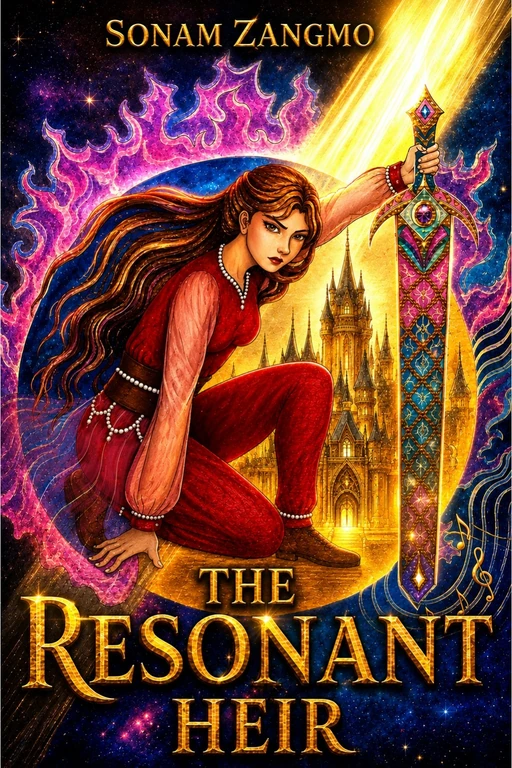
 Explore The Resonant HeirYA crossover royal fantasy · inherited magic · female heir · exile · adventure · Book I Complete
A Literary Commentary on Chapter Four of The Resonant Heir
When Truth Threatens Belonging: A Philosophical Reading of The Voice Beneath
On the courage to question inherited beliefs, the difference between compassion and justice, and the unsettling possibility that the people we love may not be the people we believe them to be.
Spoiler Notice: Contains spoilers for Chapter Four.
Explore the thirteen themes in this commentary
- The Difficulty of Hearing What We Do Not Want to Know
- Curiosity Is Not the Same as Intellectual Courage
- The Wall Between Them
- The Difference Between Compassion and Justice
- The Desire to Win Without Bearing the Cost
- When Family Loyalty Becomes a Barrier to Truth
- The Dangerous Logic of Authority
- Who Owns the Story of the Past?
- The Prisoner's Inherited Judgment
- The Moment Belief Becomes Fear
- The Paradox of Hearing
- A Mother's Counsel and the Complexity of Moral Choice
- Conclusion: The Courage to Question What We Inherit
Theme 01 · Philosophical commentary
The Difficulty of Hearing What We Do Not Want to Know
There are truths we resist because they frighten us. Others are difficult to accept because they threaten the foundations upon which we have built our identities.
In Chapter Four of Sonam Zangmo's The Resonant Heir, titled The Voice Beneath, Princess Lyra encounters the second kind.
The chapter begins with an accusation that will not leave her alone. The creature she wounded during the Royal Proving appears to have spoken directly into her mind, calling her cruel. Days later, the memory continues to disturb her, interfering with her studies and drawing her back toward the dungeon beneath the arena.
Lyra wants an explanation.
She wants to understand the strange voice and determine whether the creature is communicating with her.
But when she finally succeeds in making contact, the answers she receives threaten far more than her understanding of the previous day's battle.
The imprisoned creature, Ravok, accuses her grandfather, King Aethrador, of betrayal. He challenges the heroic history upon which Lyra's family and kingdom have built their legitimacy. He also holds her father morally accountable for allowing his suffering to continue.
For Lyra, these accusations are almost unbearable.
She has been raised to honor her grandfather as the founder of Tharion. She knows him through the history of a kingdom, the authority of her family, and the story of a war brought to an end.
Ravok offers another account.
The chapter does not establish that his testimony is entirely truthful. Nor does it provide enough evidence for Lyra to determine precisely what happened in the past.
Its central conflict is therefore not simply a choice between two established truths.
It is the struggle of a young person who discovers that the story she has inherited may be incomplete—and who fears what accepting that possibility would mean.
The philosophical question at the heart of The Voice Beneath is not whether Lyra can discover the truth, but whether she can bear to question what she has always believed.
Theme 02 · Philosophical commentary
Curiosity Is Not the Same as Intellectual Courage
Lyra's return to the arena begins with a commendable desire to understand.
Rather than ignoring the strange experience, she looks for a way to investigate it.
During a lesson in Classical Arithmancy and Arcane Trigonometry, she asks Master Magnus whether the principles he is teaching could be used to estimate the depth of the dungeon beneath the arena.
The question is practical, but its placement is significant.
Lyra uses knowledge acquired through formal education to examine something that her formal education has not explained.
She calculates, observes, and searches for a location where she might establish contact with the prisoner.
When she discovers that vibrations passing through the stone may allow communication, she attempts to use the affinity for sound associated with her mother's fae clan.
Her approach combines reason, curiosity, and experimentation.
Yet the chapter soon reveals the limits of these qualities.
Lyra possesses the determination to seek an answer. She does not necessarily possess the emotional readiness to accept one that contradicts her beliefs.
This distinction is fundamental to intellectual honesty.
A person may be eager to investigate a mystery while remaining unwilling to reconsider the assumptions through which that mystery is interpreted.
Lyra wants to know why the creature's voice reached her.
She is less prepared to ask whether the royal history she has been taught might be unreliable.
The problem is not a lack of intelligence.
It is the emotional cost of revising a belief that has become part of one's identity.
Her curiosity brings her to the prison wall.
Whether she can listen without defending herself is another matter entirely.
Theme 03 · Philosophical commentary
The Wall Between Them
The conversation with Ravok takes place through a granite wall.
Lyra stands outside the dungeon, pressing her ear and palm against the stone. Ravok remains beneath the arena, chained and confined.
They cannot see one another.
They communicate through vibrations.
This arrangement is one of the chapter's most suggestive images.
The wall separates a royal heir from a prisoner, a child of the ruling family from a creature whose history has become inseparable from that family's authority.
They inhabit radically unequal circumstances.
Lyra can leave whenever she chooses.
Ravok cannot.
Lyra possesses a name, a title, and a recognized place within the political order.
Ravok is publicly known as the Silent Beast.
Yet the barrier does not entirely prevent communication.
Lyra discovers that she can hear him through the stone.
Symbolically, the scene suggests that physical and institutional separation need not make another person's experience inaccessible.
The act of listening, however, requires effort.
Lyra must find the correct location, approach the wall, pay attention to subtle vibrations, and attempt a form of communication she has never practiced.
Understanding does not arrive simply because she occupies a privileged position.
She must actively seek it.
But the scene also demonstrates that hearing another voice is only the beginning of understanding.
The stone wall proves easier to cross through sound than the psychological distance between Lyra and Ravok.
She can receive his words.
She cannot yet accept the possibility that they may challenge her most cherished beliefs.
Theme 04 · Philosophical commentary
The Difference Between Compassion and Justice
When Ravok begins speaking about his imprisonment, Lyra offers to help him if he can establish his innocence.
Her proposal seems compassionate.
She wishes to know the truth and promises to see justice done if he has been wrongfully confined.
Yet Ravok responds with bitterness.
His reaction complicates the assumption that the offer of assistance must automatically be experienced as kindness.
From Lyra's perspective, she is attempting to correct a possible injustice.
From Ravok's perspective, she belongs to the ruling family whose decisions have helped define his existence as a prisoner.
His suffering is not an abstract problem awaiting the generosity of a benevolent princess.
It is a lived history in which the authority Lyra represents may itself be implicated.
This creates a distinction between compassion and justice.
Compassion begins with recognizing another person's suffering.
Justice requires asking why that suffering occurred, whether it was justified, and what responsibilities follow from the answer.
Compassion may motivate an investigation.
It cannot replace one.
Nor does compassion entitle the person offering assistance to immediate trust or gratitude.
Ravok's response may arise from resentment, humiliation, or a complete loss of faith in royal promises. The chapter does not establish every motive behind his anger.
But his refusal to welcome Lyra's offer exposes a limitation in her position.
She assumes she can approach him as someone capable of granting justice.
He sees her as a representative of the very authority whose justice is in question.
The contradiction is significant.
Justice cannot be reduced to the willingness of the powerful to help the powerless. It also requires that the authority of the powerful remain open to examination.
Lyra has begun to recognize suffering.
She has not yet learned how difficult it may be to distinguish administering justice from defending the legitimacy of the institution she hopes to inherit.
Theme 05 · Philosophical commentary
The Desire to Win Without Bearing the Cost
The conversation becomes more personal when Lyra asks Ravok whether the wound she inflicted during the Royal Proving still hurts.
His response is furious.
He reminds her that she was the person who struck him.
Then he accuses her of wanting victory without accepting responsibility for the suffering involved.
The accusation returns the philosophical conflict of Chapter Three in a more confrontational form.
In the arena, Lyra began to experience discomfort after realizing that her celebrated achievement had caused pain.
Now the injured creature refuses to separate her concern from the action that made such concern necessary.
This does not prove that Lyra's question is insincere.
She may genuinely regret hurting Ravok.
Indeed, her inability to forget the encounter suggests that his suffering has affected her.
But sincere regret does not erase the injury.
Nor does it oblige the injured party to make the person responsible feel better.
The distinction matters because moral discomfort can produce more than one response.
It may encourage genuine accountability.
But it may also create a desire for reassurance—for someone to say that the harm was insignificant, that the circumstances justified everything, or that the person who caused it should no longer feel guilty.
Ravok offers no such reassurance.
He insists upon the reality of what happened to him.
His accusation may be harsh, and his judgment of Lyra may not fully account for her age or the conditions of the Royal Proving.
Still, the question it raises is legitimate.
Can a person acknowledge the pain caused by their success without attempting to preserve the innocence of their self-image?
Lyra is only beginning to face that question.
She has discovered that victory can carry consequences.
Now she must confront the possibility that expressing concern does not absolve her of responsibility for those consequences.
Theme 06 · Philosophical commentary
When Family Loyalty Becomes a Barrier to Truth
The deepest conflict emerges when Ravok accuses Aethrador of betrayal.
Lyra reacts immediately.
She invokes her grandfather's accomplishments: he ended the war and founded the kingdom.
For Lyra, these achievements are inseparable from his moral identity.
Aethrador is not merely an important historical figure.
He is her grandfather, a revered ruler, and the origin of the political inheritance she has been taught to value.
To question him is therefore to threaten several forms of belonging at once.
Lyra belongs to a family.
She belongs to a royal lineage.
She belongs to a kingdom whose identity is bound to its founder.
Her defense of Aethrador is emotionally understandable.
But the reasoning behind that defense deserves scrutiny.
Ending a war does not logically establish that every decision made during the war was just.
Founding a kingdom does not establish that no betrayal occurred in its creation.
Historical achievement and moral innocence are different claims.
A person may accomplish something of lasting value while also committing serious wrongs.
The challenge for Lyra is that she has not yet learned to separate these possibilities.
Her grandfather's achievements function in her mind as evidence of his goodness.
Ravok's accusations threaten that relationship between greatness and virtue.
This is where the chapter moves beyond a familiar mystery about a hidden past.
It explores the emotional difficulty of examining admired figures without either idealizing or entirely rejecting them.
Aethrador may deserve recognition for his accomplishments.
That recognition cannot, by itself, settle every allegation against him.
Equally, Ravok's suffering does not automatically establish that every claim he makes is accurate.
The chapter leaves both the historical facts and Lyra's capacity to investigate them unresolved.
What it reveals with clarity is the strength of her resistance to questioning the version of history she has inherited.
Theme 07 · Philosophical commentary
The Dangerous Logic of Authority
One of Lyra's questions is especially revealing.
She asks why her grandfather would have imprisoned Ravok if the creature were innocent.
The question seems reasonable from the perspective of someone raised to trust royal authority.
But it contains a troubling assumption.
It treats the existence of punishment as evidence that punishment was deserved.
This reasoning is circular.
If imprisonment is precisely the action being challenged, its existence cannot establish the guilt of the imprisoned person.
The fact that a ruler possesses the authority to make a decision does not establish that the decision is just.
This distinction lies at the heart of political philosophy.
Power can enforce a judgment.
It cannot, merely by enforcing that judgment, make the judgment morally correct.
Lyra's difficulty is that she has grown up within an order in which royal authority carries immense prestige.
She has been trained to become part of that authority.
Consequently, she initially approaches Ravok's situation from within its assumptions.
If Aethrador imprisoned him, she reasons, there must have been a reason.
Perhaps there was.
But the legitimacy of that reason still requires investigation.
The chapter does not yet provide the information needed to decide.
Lyra's question reveals how inherited trust can become an obstacle to independent judgment.
This does not mean that all established authority is illegitimate.
It means that authority and truth must remain distinguishable.
For a future ruler, the distinction may prove more important than the ability to defeat any opponent.
Theme 08 · Philosophical commentary
Who Owns the Story of the Past?
The chapter's history lesson introduces another revealing contrast.
While studying Epic History, Lyra encounters an old hymn praising Ravok's strength in war.
The account evokes a magnificent creature whose wings dominated the sky and whose breath destroyed enemy weapons.
Yet the Ravok Lyra has encountered is chained beneath an arena, his mouth nearly sewn shut.
The contrast between historical celebration and present degradation invites questions about how collective memory is formed.
How does a figure once praised in the language of heroic warfare become a captive creature known primarily as the Silent Beast?
What happened between those two representations?
And who has possessed the authority to explain that transformation?
The chapter does not supply complete answers.
But it places incompatible impressions of Ravok before Lyra.
There is the Ravok of the old hymn.
There is the prisoner she wounded.
There is the angry voice accusing Aethrador of betrayal.
Each perspective invites a different understanding.
The existence of competing accounts does not imply that historical truth is impossible to discover.
It does suggest that inherited narratives must sometimes be examined against testimony, evidence, and the experiences of those excluded from the dominant account.
The danger lies in confusing an official version of the past with the totality of the past itself.
History can preserve genuine accomplishments while omitting wrongdoing.
It can also preserve grievances through testimony that must itself be examined critically.
Lyra's challenge is not to replace one unquestioned narrative with another.
It is to develop the intellectual independence necessary to investigate both.
Theme 09 · Philosophical commentary
The Prisoner's Inherited Judgment
Ravok, however, is not free from the influence of history.
He identifies Lyra with her bloodline, treating her as a descendant of those he believes betrayed him.
His anger is directed not only toward Aethrador and Eryndar but also toward the princess standing outside his prison.
This creates a troubling parallel.
Lyra is inclined to defend her grandfather because of their familial connection.
Ravok is inclined to distrust her because of the same connection.
Both risk allowing inherited identity to determine their judgments about an individual.
Their positions are not morally equivalent. Ravok is imprisoned and wounded; Lyra belongs to the family that rules the kingdom.
Their circumstances and responsibilities differ greatly.
Nevertheless, the exchange introduces an important question about inherited guilt.
To what extent should a person be held morally accountable for actions committed by their ancestors?
Lyra did not personally make the decisions Ravok attributes to Aethrador.
Yet she may eventually inherit authority sustained by those decisions.
That inheritance creates a distinction between personal guilt and responsibility for institutions.
She need not be guilty of every wrong committed by her predecessors in order to acquire obligations concerning the consequences of those wrongs.
The chapter does not yet ask her to resolve this problem.
It brings her into contact with it.
And for a young heir whose identity has been inseparable from her family's honor, the distinction may be extraordinarily difficult to grasp.
Theme 10 · Philosophical commentary
The Moment Belief Becomes Fear
The emotional center of the chapter arrives after Lyra returns to her chamber.
Away from Ravok's accusations, she tries to restore her faith in her grandfather.
She calls the creature insolent.
She rejects the possibility of betrayal.
But the possibility returns.
What if Ravok is telling the truth?
What if Aethrador was wrong?
And if the founder of Tharion was wrong, what might that mean for the kingdom he established?
Lyra cannot finish the thought.
She draws her knees toward herself and covers her ears.
This is perhaps the chapter's most psychologically convincing moment.
Her reaction is not simply anger at an insult.
It is fear of what further understanding may require.
Accepting that a beloved ancestor might have committed a serious wrong would not necessarily invalidate the entire kingdom. Political institutions and personal identities can contain both worthy achievements and troubling origins.
But Lyra has not yet developed the ability to distinguish the guilt of an individual from the value of everything associated with that individual.
Her understanding of family, authority, and belonging remains tightly bound together.
As a result, the possibility of one false belief threatens to unravel the others.
The reader witnesses the emotional cost of intellectual growth before the growth itself is complete.
Lyra has discovered a question she cannot comfortably answer.
She has not yet learned how to live with it.
Theme 11 · Philosophical commentary
The Paradox of Hearing
The chapter's title acquires a deeper significance through its repeated attention to sound.
Lyra first notices a strange pulse beneath the bandage on her wrist.
The pulse does not match her heartbeat.
Later, vibrations carry the prisoner's breath, movements, and voice through the granite wall.
Her developing ability to perceive these sounds allows communication that would otherwise be impossible.
Yet the chapter ends with Lyra covering her ears.
The contrast is striking.
She has discovered a capacity to hear what others cannot.
But she has also encountered something she desperately wishes she had never heard.
The paradox is philosophical as well as dramatic.
Access to information is not identical to a willingness to receive its implications.
A person may possess remarkable perceptual abilities and remain constrained by fear, loyalty, or inherited prejudice.
The barriers to understanding are not always physical.
Some are made of convictions so deeply embedded that questioning them feels like threatening one's own existence.
The title The Voice Beneath can therefore be read in more than one way.
The voice comes from beneath the arena.
It also emerges from beneath the visible structure of royal ceremony and accepted history.
And it reaches the assumptions beneath Lyra's understanding of herself.
This is an interpretive possibility rather than an explicitly stated meaning, but it is supported by the chapter's imagery.
Lyra can transmit her thoughts through stone.
What she cannot yet do is allow an unfamiliar account of the past to pass freely through the defenses of her own identity.
Theme 12 · Philosophical commentary
A Mother's Counsel and the Complexity of Moral Choice
The chapter concludes with a quieter encounter.
Queen Velaria enters Lyra's chamber and finds her distressed.
Rather than demanding an explanation, she sits beside her daughter and offers a reflection on choices.
She suggests that some situations cannot be understood simply through the categories of right and wrong, and that certain experiences must be faced in order to move forward.
The statement is open to more than one interpretation.
If understood to mean that moral responsibility is irrelevant, it would sit uneasily beside the questions raised by Ravok's suffering.
Wrongdoing cannot be dismissed merely because it occurred through someone's choices.
But the Queen's words can also be understood as an acknowledgment that difficult situations often involve incomplete information, conflicting obligations, and consequences that cannot be avoided through simple declarations.
People must still choose.
They must still face what follows.
The chapter does not establish exactly how much Velaria knows about Lyra's encounter or the accusations against Aethrador. Her words should not be treated as a definitive explanation of the historical dispute.
Their immediate significance is emotional.
Lyra has been overwhelmed by accusations and uncertainty.
Her mother does not insist that she settle the matter at once.
She offers reassurance without providing an easy answer.
The invitation to visit her maternal fae clan also suggests another environment in which Lyra may encounter perspectives and experiences beyond those of the royal court.
The chapter ends, then, not with the resolution of a moral argument but with the possibility of continuing to learn.
That is appropriate to the philosophical problem it has established.
Understanding cannot always be forced into existence through a single confrontation.
Sometimes a person must first acquire the courage to remain with a question whose answer may be painful.
Theme 13 · Philosophical commentary
Conclusion: The Courage to Question What We Inherit
The Voice Beneath marks a significant development in Lyra's moral and intellectual journey.
In the Royal Proving, she sought recognition through victory.
Afterward, she began to question the suffering that victory caused.
Now she encounters a possibility more disturbing than personal wrongdoing: that the institutions, historical figures, and family loyalties through which she understands the world may themselves require moral examination.
Her response is conflicted.
She seeks out the prisoner, but struggles to hear his accusations without anger.
She offers justice, but has not fully questioned the authority from which she proposes to administer it.
She wants the truth, but fears its implications.
She is capable of transmitting her voice through stone while remaining unable to confront what that voice brings back to her.
These contradictions do not make her an unconvincing protagonist.
They make her a believable young person beginning to discover that inherited certainty and independent judgment are not the same thing.
The chapter does not ask the reader to accept Ravok's testimony without evidence.
It asks something more demanding: to recognize that the truth of an accusation cannot be determined by the prestige of the person accused, the suffering of the accuser, or the emotional comfort of those who must decide what to believe.
All three deserve consideration.
None can substitute for inquiry.
For Lyra, the stakes are unusually personal.
Aethrador is her grandfather. Eryndar is her father. Tharion is her home and future responsibility.
To investigate their history may require her to distinguish love from unquestioning loyalty, inheritance from innocence, and authority from justice.
She is not ready to make those distinctions.
But she has begun to encounter the necessity of making them.
And this is what gives the chapter its lasting philosophical force.
The most difficult truths are not always those that expose an unfamiliar evil.
Sometimes they are those that force us to reconsider the people, stories, and institutions through which we have learned to recognize ourselves.
Lyra has discovered a way to hear a voice buried beneath the foundations of her kingdom. Her greater challenge will be deciding whether she can listen when that voice questions the foundations of her own identity.
The wall between the princess and the prisoner is made of stone.
The wall between loyalty and truth may prove much harder to cross.