
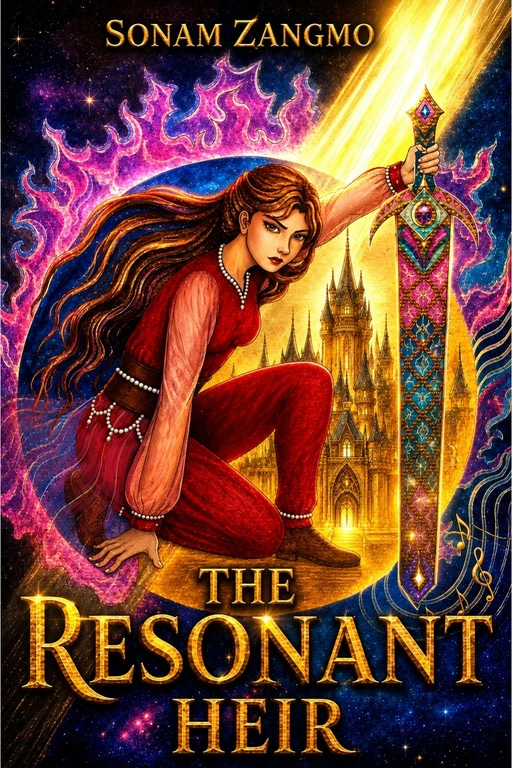
 Explore The Resonant HeirYA crossover royal fantasy · inherited magic · female heir · exile · adventure · Book I Complete
A Literary Commentary on Chapter Thirteen of The Resonant Heir
The Cost of Belonging: A Philosophical Reading of The Price of Alliance
On political marriage, the price of collective security, and the quiet ways power can make other people's futures its own.
Spoiler Notice: Contains spoilers for Chapter Thirteen.
Explore the thirteen themes in this commentary
- A Celebration That Conceals Its Cost
- The Necklace and the Girl Wearing It
- From the Soul Covenant to a Marriage Alliance
- Two Glasses, Two Kinds of Freedom
- An Apology That Does Not Erase the Past
- The Maid's Refusal and the Limits of Privilege
- The Fist She Does Not Throw
- Haris and the Difference Between Restraint and Withdrawal
- The Promise of a New Beginning
- A Letter That Cannot Be Shown
- The Northern Camp and the Politics of Necessity
- Protecting Elena Without Deciding for Her
- Conclusion: Who Has the Right to Name the Price?
Theme 01 · Philosophical commentary
A Celebration That Conceals Its Cost
Chapter Thirteen of Sonam Zangmo's The Resonant Heir, The Price of Alliance, begins with a celebration of royal history.
Within Quartz Canopy Hall, candlelight breaks into shifting colors, flowers fill the air with an almost excessive sweetness, and nobles raise their glasses to the legacy of King Aethrador.
Everything in the room suggests prosperity, continuity, and confidence in the dynasty.
Yet beneath the festivities, a very different story begins to emerge.
A young woman from the Aulith clan is preparing to marry into the royal family. A prince behaves as though his position places him beyond ordinary restraint. A mysterious message speaks of transferring military authority, delaying supplies, and merging armed forces.
None of these events has been conclusively shown to belong to a single conspiracy. That uncertainty is part of the chapter's design.
What connects them thematically is the question of who benefits from the arrangements made by those in power—and who must live with their consequences.
An alliance may be celebrated as a triumph for two families or two peoples. It may promise stability, influence, and security.
But those promises do not tell us whether the individuals expected to sustain the alliance have been treated justly.
A political agreement can serve a collective interest while asking a particular person to surrender something no collective has the moral right to take for granted.
This is the difficult territory the chapter begins to explore.
Its most important question is not simply whether the proposed alliance will succeed. It is whether success, however defined by the powerful, can justify the price demanded of those with less power.
Theme 02 · Philosophical commentary
The Necklace and the Girl Wearing It
Lyra first encounters Elena standing alone in a quiet corner of the banquet hall.
The young woman wears a necklace whose design belongs to the royal court. When Lyra asks about it, Elena explains that Prince Luca gave it to her as an engagement gift.
The necklace marks her new proximity to royal privilege.
It is a visible sign that she is being welcomed into a powerful family. For a clan seeking greater favor from the crown, that connection may carry considerable political value.
Yet Elena's explanation is striking for what it does not include.
She does not speak of affection for Luca or excitement about their future together. Instead, she repeats what her father has told her: binding their fae line to the royal family will bring greater favor to Aulith.
That statement does not prove Elena has been forced into the engagement. The chapter has not established whether she freely accepted it, reluctantly agreed, or sees the marriage as something she genuinely desires.
But it reveals the language through which the arrangement has been explained to her.
The justification is collective.
The consequence is personal.
Elena's marriage is presented through what it may accomplish for Aulith rather than what she herself hopes to find in it.
Lyra senses this imbalance. Looking at Elena in the refracted candlelight, she sees someone who resembles a display piece more than a future bride.
That is Lyra's perception, not an objective verdict on Elena's entire situation. Nevertheless, the image is revealing.
A necklace can honor its wearer while also marking the role others expect her to perform.
The distinction matters because recognition is not the same as agency.
A person may receive gifts, titles, and public admiration while still having little influence over the decisions that will determine the course of their life.
To be valued for what one represents is not necessarily to be valued for who one is.
The chapter leaves Elena's wishes largely unspoken. Rather than filling that silence with assumptions, a careful reading should recognize it as one of the central uncertainties surrounding the alliance.
Theme 03 · Philosophical commentary
From the Soul Covenant to a Marriage Alliance
The proposed marriage gains additional significance when placed beside the previous chapter, The Hidden Covenant.
There, Lyra discovers that Aulith once sought Aethrador's protection against extinction. Its leaders entered a covenant involving the sacrifice of portions of their souls.
In the present, Aulith's High Lady challenges a tribute system that leaves her people struggling to feed themselves. Chancellor Syveris subsequently discusses the possibility of dissolving the Soul Covenant, but only after the High Lady agrees to an undisclosed condition.
Now Lyra learns that Elena's marriage to Luca is expected to bring Aulith greater favor.
She begins to wonder whether these developments are connected.
The suspicion is reasonable. It is not yet proof.
The narrative has not established that Elena's marriage is the condition Syveris proposed. Nor has it confirmed that the engagement will dissolve the Soul Covenant, alter the tribute laws, or accomplish any other particular political objective.
What the juxtaposition does establish is a recurring ethical problem.
Aulith appears repeatedly as a community seeking something important from royal power: protection, relief, favor, or release from an old obligation.
When a people depend upon another institution for something necessary to their well-being, the terms of cooperation deserve careful scrutiny.
An alliance may be entered voluntarily. Its participants may sincerely believe that it offers the best available future.
But when declining an arrangement might endanger an entire community's prospects, the freedom of those asked to participate becomes more complicated.
If Elena believes her marriage will help Aulith, she may regard it as a meaningful sacrifice.
If she has been allowed little genuine choice, however, the same marriage could represent an unfair demand disguised as service.
The chapter does not yet tell us which account is true.
That uncertainty should not prevent us from identifying the principle at stake.
Sacrifice for a community can be honorable. A community's decision to require sacrifice from an individual is a different moral question.
The distinction becomes particularly urgent when the sacrifice concerns a person's future marriage and intimate life.
A political advantage cannot substitute for the individual's consent.
Theme 04 · Philosophical commentary
Two Glasses, Two Kinds of Freedom
One of the chapter's more effective contrasts appears during the banquet.
Syveris stands beside Luca and pours his wine before the servants can intervene. When Luca's glass empties, it is refilled.
Luca jokes that he should not hold back on such a memorable night.
Syveris encourages him.
Elsewhere, Elena stands alone, holding a glass she has not touched.
The parallel is brief, but it creates a strong impression.
Luca is surrounded by celebration and encouraged to indulge himself. Elena remains composed, isolated, and apparently preoccupied with the significance of the engagement.
The scene does not establish that Syveris has drugged Luca or intentionally arranged the misconduct that follows. Nothing in the chapter proves such a plan.
But the contrast has literary value without requiring that conclusion.
The prince is shown enjoying the freedoms attached to his position.
The future bride is shown contemplating the obligations attached to hers.
That difference becomes more disturbing after Lyra encounters Luca in the garden.
His conduct suggests a man who understands privilege primarily as permission to pursue his wishes without accepting the limits imposed by other people's wishes.
The banquet's indulgence thus becomes more than a decorative detail.
It introduces a character whose lack of restraint is not confined to drinking.
And because that character is about to marry Elena, his behavior raises questions about what marriage into the royal family may mean for her.
The danger is not that a man enjoys a celebration.
It is that a man accustomed to having his desires accommodated may begin to confuse accommodation with entitlement.
Theme 05 · Philosophical commentary
An Apology That Does Not Erase the Past
Before the chapter's darker events unfold, Lyra encounters Haris in the Great Garden.
Their conversation reaches back to childhood, when Haris humiliated her near the fountain.
He admits that he wanted to show off and never intended to hurt her.
Lyra says she has forgotten the incident.
The narration immediately complicates that answer by recalling how much she once hated him for it.
This is a quiet but credible moment of character development.
Haris has changed enough to acknowledge his past behavior. Lyra has changed enough to receive the apology without turning the encounter into another confrontation.
Yet neither change requires the past to become harmless.
An apology can acknowledge wrongdoing without undoing the hurt that wrongdoing caused. Likewise, a person's willingness to move forward need not mean they have entirely forgotten.
Haris then thanks Lyra for helping clear his father, High Commander Rogan, of the charges that destroyed his position.
Lyra refuses to present herself as a grand hero. She insists that Rogan was always a good man.
Their exchange allows the relationship to move beyond the roles they occupied as children.
This matters because the novel repeatedly asks whether people must remain prisoners of inherited or imposed identities.
Haris was once a boy who mocked Lyra's lack of magic. That does not mean he must remain that boy forever.
But acknowledging someone's capacity for change does not mean suspending judgment about everything they do afterward.
The chapter soon reveals that Haris's emerging maturity has its own limits.
He can apologize for an old wrong and prevent a new act of violence. Whether he can face the consequences of opposing someone more powerful is another question.
Theme 06 · Philosophical commentary
The Maid's Refusal and the Limits of Privilege
The moral stakes become unmistakable when Lyra and Haris hear a young maid crying out for Luca to release her.
They find him gripping her wrist as she struggles to escape. Her clothing has been pulled askew, and he continues advancing toward her.
The maid's refusal is clear.
Whatever Luca imagines about the encounter, his desire cannot override that refusal.
Lyra immediately intervenes, pushes Luca away, and places the maid behind her.
It is a necessary protective response to an immediate threat.
Luca responds by insulting Lyra's lack of magic and asserting that he has the right to like whomever he likes.
The claim reveals a fundamental confusion.
Attraction is a feeling.
Consent is a decision belonging to the other person.
The existence of one does not cancel the need for the other.
The freedom to desire someone does not include the freedom to disregard that person's refusal.
The imbalance of social status makes the encounter especially troubling.
Luca is a prince.
The young woman is a servant within the palace.
She may have far less protection against the consequences of resisting him, even though her right to refuse is no less important than his.
This is where the chapter moves beyond a portrait of one badly behaved nobleman.
It asks what happens when inherited authority becomes a shield against ordinary accountability.
Lyra's intervention affirms something the prince refuses to recognize: another person's body is not an extension of his privilege.
Yet even Lyra's language carries a revealing limitation.
She tells Luca to restrain himself because they are in the Royal Palace. When he presses further, she says he must not behave that way there.
His misconduct, however, would be wrong in any location.
The palace's dignity is not the most fundamental issue. The maid's refusal is.
This does not invalidate Lyra's actions. She has already protected the maid before attempting to reason with Luca.
But it suggests that her understanding of justice is still developing beyond the rules and expectations of the royal environment in which she was raised.
A just ruler must learn to protect a person's dignity because it belongs to that person, not merely because violating it would dishonor the crown.
Theme 07 · Philosophical commentary
The Fist She Does Not Throw
The confrontation becomes more complicated when Luca mocks Lyra and suggests that his approaching marriage will change the balance of power.
Lyra grabs his collar and raises her fist.
At that moment, Haris strikes her wrist with a shard of ice and tells her to stop.
She releases Luca.
The event echoes the previous chapter, The Line Crossed, in which Lyra lost control and physically assaulted Cavren after discovering his role in provoking Rogan's disastrous military decision.
Both scenes involve genuine wrongdoing.
Both provoke her sense of justice.
And in both, her first instinct is to confront the offender with force.
But the outcomes differ.
This time, the blow she intends to deliver never lands.
The distinction should not be overstated. Haris intervenes before Lyra makes the final decision to stop, and she is still furious afterward.
Nevertheless, she allows the intervention to change her course.
She recognizes that striking Luca would shift attention from protecting the maid to a confrontation between members of the royal elite.
Her thought is partly political: a princess's fist would create a scandal.
That is not yet a complete moral argument about the appropriate limits of force.
Still, it is an important step toward judgment under emotional pressure.
Lyra begins to recognize that a response can be understandable in motive and damaging in consequence.
Righteous anger does not become less righteous when restrained. Sometimes restraint is what prevents that anger from producing another wrong.
The episode also clarifies what self-control does and does not mean.
Lyra was right to intervene physically to separate Luca from the maid.
The question is whether additional violence, after the immediate threat has been interrupted, would serve protection or merely satisfy her anger.
The answer matters for someone who may one day possess the power to punish others in the name of the kingdom.
Theme 08 · Philosophical commentary
Haris and the Difference Between Restraint and Withdrawal
Haris plays a constructive role in preventing Lyra's anger from escalating.
But his advice afterward creates another ethical tension.
He observes that Luca hides behind his father's power and acts as though no one can touch him.
Then he urges Lyra not to get involved further, because doing so will only cause trouble.
His caution is understandable.
Haris has recently seen his father disgraced, punished, and restored after a military disaster shaped by another person's manipulation. He has reason to appreciate the danger of political conflict.
But caution and withdrawal are not identical.
Avoiding a fight may be wise.
Ignoring an unresolved threat is a different choice.
The maid has been rescued from this immediate encounter. That does not establish that Luca will never approach her again or mistreat someone else.
Nor does the scene settle what Elena should know about the man she is preparing to marry.
Haris recognizes the misuse of power. His response is to avoid the consequences of challenging it.
The novel has not established him as a coward, and it would be unfair to reduce his caution to one trait.
Yet his statement raises a serious question.
When avoiding trouble becomes the highest priority, who bears the trouble that powerful people are allowed to cause?
The vulnerable may continue to face the danger that more secure observers have chosen to leave unchallenged.
The challenge for Lyra is therefore more demanding than choosing between violence and silence.
She must discover whether there are ways to oppose wrongdoing without repeating the recklessness she has begun to recognize in herself.
Theme 09 · Philosophical commentary
The Promise of a New Beginning
Two remarks about the forthcoming wedding give the chapter an ominous symmetry.
Luca tells Lyra that things will be different after he marries. He later threatens to make others understand their place.
Elena, by contrast, reports that Luca has promised a new beginning after the wedding.
The words face the same future but carry different emotional meanings.
For Elena, a new beginning may promise security, affection, or improved prospects for Aulith.
For Lyra, after witnessing Luca's behavior, the prospect sounds less reassuring.
The chapter does not explain what powers Luca expects to gain through marriage. His threats do not establish that he will command the northern army or acquire any specific political office.
But the language reveals his attitude toward the future.
He anticipates an increase in his ability to impose his will.
Elena anticipates a beginning.
It is possible for both characters to believe they understand the same marriage while imagining very different relationships within it.
That difference returns us to the question of informed consent.
A marriage cannot be evaluated solely by whether its public ceremony is celebrated or its political advantages appear substantial.
The people entering it must understand enough about one another and its conditions to make meaningful choices.
This is where Elena's limited perspective becomes morally significant.
She has heard promises. Lyra has witnessed threatening conduct.
Neither necessarily possesses a complete picture, but they do not possess the same information.
The existence of that gap matters.
A hopeful promise can be sincere. It can also obscure intentions the other person would reject if they understood them.
A new beginning is not necessarily a shared beginning merely because two people are expected to enter it together.
Theme 10 · Philosophical commentary
A Letter That Cannot Be Shown
Near Elena's room, a Spirit Bird drops a slip of paper at Lyra's feet.
The page initially appears blank.
Then blue writing emerges, revealing instructions about the transfer of command authority, the delay of supplies to the northern camp, and the merging of forces.
Moments later, the writing disappears.
The sequence extends a pattern established in earlier chapters.
Lyra found a history book with a page deliberately removed. She witnessed a memory whose crucial participants could not be heard. She overheard a private discussion of the Soul Covenant without learning the condition at its center.
Now she receives information that leaves almost no visible written trace.
Her difficulty is no longer simply gaining access to secrets.
It is determining what can be established from secrets that resist verification.
The letter is plainly troubling. Instructing someone to prevent a military camp from receiving supplies on time is not an innocuous detail, particularly after the events on the northern frontier.
Yet the document does not identify its sender or intended recipient.
It does not name a rebellion.
It does not explain what ritual is being discussed.
Lyra associates its timing with the wedding, but that association remains her interpretation.
The text has not independently established that the ritual refers to the marriage, the Soul Covenant, or another event.
Such distinctions matter because an investigator can be misled even when every word they have read is genuine.
A real message may be incomplete.
A real instruction may be part of a plan whose purpose is still unknown.
A real discovery may appear at a location that encourages the wrong conclusion about who was meant to receive it.
Lyra cannot simply show the document to another person and allow the words to speak for themselves. The words have vanished.
She remains a witness to what she read, but her testimony would have to carry the burden of details others cannot readily verify.
Discovering something alarming is not the same as knowing enough to accuse someone justly.
This does not require Lyra to dismiss the warning.
It requires her to investigate without treating her first explanation as established fact.
Theme 11 · Philosophical commentary
The Northern Camp and the Politics of Necessity
The reference to the northern camp is especially consequential because Chapter Twelve has already established the precarious conditions faced by the soldiers stationed there.
Supplies were scarce. Rations had been reduced. Rogan's command was under pressure even before the manipulated decision to advance.
The mysterious letter now instructs someone to ensure that supplies do not arrive on time.
The command has not been shown taking effect. The reader does not yet know whether any shipment has actually been delayed.
Nevertheless, it introduces the possibility that military necessity may be used deliberately as political leverage.
An army depends on food, equipment, and reliable communication.
Those necessities may be less dramatic than swords, spells, and battlefield victories, but they determine whether soldiers can defend the territory entrusted to them.
The person who controls supplies may therefore influence military choices without issuing a single order on the battlefield.
That idea recalls the previous chapter's account of Rogan.
Cavren manipulated the commander's sense of responsibility under conditions of genuine danger. A deliberate interruption of supplies could similarly create pressures that make certain choices seem unavoidable.
The story has not demonstrated that the same people are responsible for both situations.
It has, however, drawn attention to a recurring political vulnerability: those responsible for protecting others may be forced to make decisions under conditions controlled by someone with an undisclosed agenda.
The connection also recalls Aulith's hardship under the grain tribute system.
The two situations have different causes and remain factually distinct. Yet both concern people whose ability to survive depends upon decisions made elsewhere.
Food is a necessity.
The power to distribute or withhold necessities can become an instrument of control.
When survival depends on another person's permission, the freedom to refuse that person's demands may become painfully limited.
The chapter's title acquires another possible dimension here.
The cost of an alliance may fall not only upon the families who arrange it but also upon people far away from the celebration—soldiers who never took part in the negotiation.
Theme 12 · Philosophical commentary
Protecting Elena Without Deciding for Her
Lyra eventually enters Elena's room.
Her stated purpose is to check that the young woman is all right.
Elena answers politely and repeats Luca's promise that the wedding will bring a new beginning.
Lyra shows her the blank paper and asks whether she dropped it.
Elena says no.
Lyra does not reveal the message she witnessed.
Nor does she tell Elena what Luca did in the garden.
Her restraint may arise from sensible uncertainty. She does not know who sent the letter or whether Elena is connected to its intended recipient. She may also hesitate to alarm a young woman based on suspicions she cannot substantiate.
Those are reasonable concerns.
But another question remains.
Elena is preparing to make a life-defining commitment to a man whose treatment of a vulnerable servant Lyra has directly witnessed.
That observation is different from the vanished message. It is a specific incident, not an inferred political conspiracy.
Lyra has reason to distinguish between what she knows about Luca's behavior and what she suspects about the alliance.
The distinction suggests an ethical challenge for her.
How should she share information that may matter to Elena without deciding in advance what Elena must do with it?
Lyra could be right that the marriage is dangerous. She could also misunderstand important aspects of Elena's intentions or circumstances.
The answer cannot simply be to treat Elena as incapable of making choices.
The young woman's relative silence should invite Lyra to listen more carefully, not to substitute her own voice for Elena's.
This is particularly significant because Lyra knows the pain of being kept ignorant.
Adults have concealed matters concerning her magic, her ancestry, and the history of her kingdom. She has repeatedly sought the freedom to understand her own life.
Now she possesses information another young woman may need.
To protect someone's freedom is not merely to rescue them from immediate harm. It is also to respect their ability to make informed decisions about their own future.
That lesson may prove harder than confronting a reckless prince.
It requires Lyra to trust that another person has a life and judgment beyond the role she occupies in Lyra's concerns.
Theme 13 · Philosophical commentary
Conclusion: Who Has the Right to Name the Price?
The chapter ends without exposing the full political design.
The letter is blank. Its sender remains unknown. The purpose of the ritual is uncertain. Elena continues to speak hopefully about the wedding, and Luca has departed after revealing how lightly he regards the boundaries of others.
Lyra senses that the events point toward the northern camp.
She believes someone is playing a game—and realizes she may already be part of it.
The image of a game is unsettling because games have players, strategies, and pieces.
The players understand what they are trying to achieve. The pieces move according to rules they did not choose.
Much of the chapter concerns the danger of turning human beings into the latter.
Elena may represent the political connection expected to secure Aulith's favor.
The maid becomes an object of a prince's unwanted attention.
Haris sees the danger of resistance and chooses distance.
The soldiers at the frontier may be affected by decisions made in secret far from their camp.
And Lyra discovers that the information reaching her may itself be part of an arrangement she does not understand.
Yet the chapter is not simply an argument against alliances, political compromises, or caution.
Communities sometimes need to cooperate for their survival. Individuals may willingly accept sacrifices for people they love. Prudence may prevent an unnecessary confrontation from becoming a disaster.
The moral problem arises when the benefits of cooperation are used to excuse the absence of meaningful choice, or when those who expect others to pay a price do not have to bear that price themselves.
The distinction is essential.
A legitimate alliance should be judged not only by the security it promises to powerful families, but also by the dignity, safety, and freedom of those whose lives it changes.
Lyra is beginning to understand the difference between confronting an obvious wrong and recognizing a quieter arrangement that may expose others to harm.
She can push Luca away from a frightened maid.
She cannot solve the dangers surrounding Elena by striking the nearest person she distrusts.
She must learn to gather evidence, question promises, and listen to people whose futures others have already begun to negotiate.
That is a different kind of courage.
Lyra once believed that power meant becoming strong enough to stand against those who threatened others. Now she is beginning to recognize another form of power: the ability to arrange a future in which other people carry the cost of choices they were never fully allowed to make.
If she is to become a worthy heir, she must learn not only how to stop a hand raised against the powerless, but how to recognize the quieter bargains that place the powerless in danger long before anyone raises a hand.
And perhaps the hardest question is not whether an alliance is worth its price.
It is who has the right to decide what that price will be—and who must pay it.