
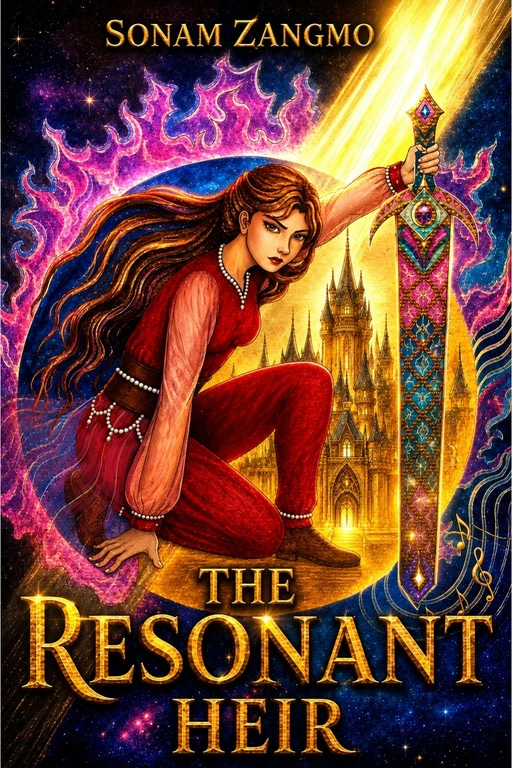
 Explore The Resonant HeirYA crossover royal fantasy · inherited magic · female heir · exile · adventure · Book I Complete
A Literary Commentary on Chapter Twenty-Two of The Resonant Heir
What Gold Cannot Command: A Philosophical Reading of The Smith Who Refused
On kindness offered before reward, companionship freely chosen, and the limits of wealth when another person can say no.
Spoiler Notice: Contains spoilers for Chapter Twenty-Two.
Explore the eighteen themes in this commentary
- A Sword Buried, a Road Reopened
- The Sapphire Without Its Blade
- The High Lord’s Uneven Kindness
- The Horse and the Meaning of Departure
- The Girl Who Fell from the Tree
- Companions Rather Than Servants
- Coins and the Limits of Access
- A Valley of Forges and a Missing Name
- When Persistence Needs Judgment
- The Boy with the Overturned Cart
- Two Gold Can End a Threat Without Ending an Injustice
- Kindness Before the Useful Discovery
- Orin Has a Life Beyond the Quest
- The Grace of Not Asking Again
- The Smith Who Needs No Sign
- The Silence Between Hammer Blows
- Bramor’s Refusal, and Elena’s
- Conclusion: Resolve Without Entitlement
Theme 01 · Philosophical commentary
A Sword Buried, a Road Reopened
The Smith Who Refused, Chapter Twenty-Two of Sonam Zangmo’s The Resonant Heir, begins with a departure that is also a relinquishment.
Lyra’s white horse stands ready in the Citadel courtyard. She has buried the broken halves of the sword that accompanied her since childhood. She removes the sapphire from its hilt and tosses it to the High Lord before riding away.
A princess who recently could not pay her debts now possesses a horse, gold, and a direction: the road toward Igsvar and a smith named Bramor.
But the chapter will resist the notion that recovered wealth means recovered command. She has enough coin to travel, yet not enough certainty to find the craftsman. She has a companion who chooses to follow, yet that companionship cannot be bought. She meets a stranger who can help her, yet she assists him before she knows his importance.
And when she reaches Bramor, he says that he does not take customers.
The chapter asks what remains beyond the reach of gold, rank, and sheer determination when another person has the freedom to say no.
The question is particularly pointed for a young heir. Lyra was raised among people whose service was shaped by their duties to the crown. Outside the palace, her needs bring her into relationships that do not begin with an obligation to obey.
Theme 02 · Philosophical commentary
The Sapphire Without Its Blade
The sapphire deserves attention because of what preceded its removal.
In the preceding chapter, the sword split in two during Lyra’s confrontation with the ancient guardian of Ametrine. She continued to hold its halves as though they mattered. The blade had been with her for years, and her skill with it had helped sustain her confidence despite the absence of magic expected of a royal heir.
The High Lord had also recognized her royal identity from the stone in the sword’s hilt.
The weapon was therefore both something Lyra had worked to master and something that announced the family into which she was born.
She now buries the steel and gives away the sapphire.
The story does not explain her precise purpose. The gesture might suggest gratitude, a desire to leave a part of the past behind, or something not yet disclosed. It is not presented as an explicit payment for the damaged seal at Gemariel, and the critic ought not make it one.
Yet the image can still be read symbolically.
The loss of an object that once defined a person does not mean the experiences and responsibilities attached to it have vanished.
Lyra has not ceased to be Eryndar’s daughter. The High Lord has not forgotten her rank. But she travels without the weapon through which she learned to answer the shame others placed upon her. Her sense of strength may have to take a different shape.
Theme 03 · Philosophical commentary
The High Lord’s Uneven Kindness
The High Lord has restored Lyra’s horse and supplied money. He says he has paid the reward threefold and warns her not to lose it again.
How the reward has been divided between the girls is not fully itemized here. We should not convert the remark into invented sums.
More interesting is Lyra’s assessment of him: generous at times, less pleasant at others.
It would be tempting to demand that the High Lord be either an entirely trustworthy protector or a calculating noble whose kindness must be false. The chapter makes neither verdict necessary.
He has helped her in tangible ways. He has also asked uncomfortable questions and reminded her of Gemariel’s damaged safeguard. His conduct contains concern, authority, and interests of his own.
As Lyra rides away, his private observation is hardly flattering: she seems cold as ever. Yet he calls her back to say, simply, “Take care.”
She offers him a small genuine smile.
The moment is powerful because the words do not ask for anything. They do not demand a new promise or a further explanation about the Awakening Spring.
That does not prove his political concerns have disappeared.
A person can be difficult to like and still offer real kindness; kindness need not erase the rest of a complicated character.
Lyra’s response suggests that she can recognize the farewell without accepting an uncomplicated judgment of the man who speaks it.
Theme 04 · Philosophical commentary
The Horse and the Meaning of Departure
The white horse is a practical instrument of freedom.
In Gemariel, the loss of ready coin had kept Lyra from reclaiming it. She could be born to a crown and still lack the means to continue down a road.
Now she has the reins again. She swings into the saddle, rides out of the Citadel, and follows the High Lord’s directions toward Igsvar.
It is tempting to turn this into a scene of complete liberation. The novel is more careful about the material conditions of her life.
Lyra still has not reached the Awakening Spring. She remains far from the palace, and the consequences of her role in Gemariel have not simply disappeared. Her horse gives her movement, not omniscience or immunity from harm.
Still, the difference is meaningful.
Freedom can be impeded by a small, ordinary need: a debt, a bed, a journey that cannot be made on foot at the required pace.
The royal title that once organized Lyra’s life could not pay the innkeeper. Recovered gold and a returned horse can accomplish what the title did not.
The freedom to choose a road begins, in part, with possessing the means to travel it.
Yet the journey will soon show that the freedom of Lyra’s movement cannot give her rightful command over the wishes of everyone she encounters.
Theme 05 · Philosophical commentary
The Girl Who Fell from the Tree
Lyra’s reunion with Sion arrives with an almost comic violence. The other girl drops out of a tree, lands on her, and sends both tumbling to the ground.
Sion admits she did return to Mining Town. She ate meat buns and played Dice Bones, then decided to wait for Lyra.
Her explanation is the emotional center of the encounter: it feels less lonely with Lyra.
The sentence needs no embellishment. Sion is not swearing fealty or making a bargain. She is not being assigned to accompany the princess by a ruler or a relative.
She simply wants to go with someone whose company matters to her.
Her years of mine work and the death of the aunt who raised her give the choice additional poignancy. The text does not say that Sion has no other acquaintances or that Lyra is the only person she could care for; such claims would go beyond the scene.
But it does show a girl expressing a wish that is her own.
The contrast with earlier royal agreements is quietly significant. In a story where marriages and obligations have often been arranged for political purposes, a friendship begins with an unceremonious request.
One of the most meaningful forms of loyalty is the kind a person is free not to give.
Sion is not made valuable by her usefulness to the heir. Her decision to be near Lyra is already a human act of worth.
Theme 06 · Philosophical commentary
Companions Rather Than Servants
When Sion asks whether she can come along, Lyra agrees.
The narration allows Lyra an affectionate but unsentimental judgment. Sion is frank, perhaps rather fond of shiny things, and knows skills that Lyra can learn.
That recognition matters.
In the mine, Sion taught Lyra how to work. During the pursuit of Vespergnaw, she offered knowledge of the streets and the use of a mirror to see beyond a doorway. Her experience comes from life outside the protections Lyra once took for granted.
Lyra now has gold and a horse. She also has noble education and years of sword training. Their contributions and resources differ, and the narrative does not pretend otherwise.
A friendship need not erase those differences. It asks whether differences become grounds for one person’s will always overruling the other’s.
Sion is not a steward assigned by a king. She has no obligation to address Lyra’s wants before her own. She wishes to travel together, and Lyra welcomes the offer.
Their agreement does not settle every future dispute about routes, danger, or money. Such questions may yet test them.
A voluntary bond does not require two people to be identical. It requires each to acknowledge that the other brings a life and judgment of her own.
For a possible future ruler, that can be a more demanding education than receiving obedience from those already sworn to serve.
Theme 07 · Philosophical commentary
Coins and the Limits of Access
There is a telling detail in how Sion learned Lyra was still at the Citadel.
She gave the guards a few coins.
It is an effective little trick, very much in keeping with her resourcefulness. She does not need an invitation to the High Lord’s table to discover whether her friend remains behind the gates.
But the exchange also creates a small ethical question.
The guards disclose information concerning someone who is staying within the lord’s household. The chapter does not reveal a grave secret betrayed, and it would be extravagant to portray the act as a major conspiracy.
Still, their willingness to answer for money hints that information may flow according to who can pay.
Soon afterward, Lyra will use gold for a different purpose, to bring an immediate end to the intimidation of a young vendor.
In both cases, coins alter another person’s conduct. The morality of the change depends upon what the people involved are doing.
The ability to purchase cooperation does not establish an unlimited right to whatever that cooperation provides.
That lesson will become clearer at the mountain forge, where Lyra discovers that the possession of coin does not obligate a person of skill to receive her.
Theme 08 · Philosophical commentary
A Valley of Forges and a Missing Name
Igsvar comes into view through dark red hills and the smell of heated metal. The smithing quarter spreads across Ironvale beneath high chimneys. Hammers ring; sparks fly like fireflies in the dusk.
The writing makes the craft a living part of the landscape.
Yet in this place full of metalworkers, the girls cannot find the one smith Lyra needs.
They ask at one forge, then another, and continue for days. No useful lead appears.
The High Lord knows Bramor’s name and has directed them toward Igsvar. The workers the girls question seem not to know where he can be found.
It is a beautiful irony: a place may be crowded with evidence of a skill while still concealing the person reputed to possess that skill at its highest level.
The chapter does not explain why Bramor is so difficult to locate. His isolation, reputation, or past cannot yet be confidently described.
What the search exposes is the distance between reputation and access. Knowing that a master exists does not mean that one can walk up to his door.
Knowledge received from the powerful may point the way, but it cannot always spare the traveler the work of finding it.
Lyra has money and a direction. Neither immediately yields the person for whom she has come.
Theme 09 · Philosophical commentary
When Persistence Needs Judgment
Several days of fruitless searching wear on the girls.
Sion complains of the heat, wonders whether the High Lord gave the wrong name, and proposes moving on if Bramor cannot be found.
Lyra remains fixed upon the smith. Yet even she begins to waver. If he truly lives in Ironvale, why has no one heard of him?
Neither reaction is shameful.
Sion is weighing the cost of continued effort. Lyra is resisting the loss of a goal that has become important since her childhood sword was broken.
The interesting question is when perseverance becomes mere repetition.
A worthwhile purpose does not require that a person continue an ineffective method without reflection. On the other hand, a run of disappointments does not prove that the underlying hope is foolish.
The story does not give Lyra a superior plan just before she meets Orin. The discovery comes through a surprising encounter in the street, not through a triumphant new search strategy.
We should therefore avoid the easy lesson that repeating the same attempt long enough always produces success.
Perseverance is strongest when it holds a purpose firmly without insisting that every chosen path must be right.
The girls are about to find Bramor not by asking another smith, but by responding to something entirely outside their search.
Theme 10 · Philosophical commentary
The Boy with the Overturned Cart
A shout interrupts the forge streets.
Two men are threatening a thin boy who sells pots and pans from a wooden cart. One kicks the wheel; the cart lurches and its contents scatter across the stones.
The boy crouches to collect his belongings and begs the men not to break them.
Sion shrinks back. Lyra dismounts at once.
The first thing she does is not to issue a grand pronouncement. She rights the cart and kneels to gather the fallen wares.
That detail matters after The Broken Blade. Lyra no longer carries the sword she had used to prove herself in the palace and defend herself on the road. She nevertheless finds a way to intervene.
Helping someone recover what has been knocked down is not less meaningful because no enemy falls beneath a blade.
The scene also positions the boy as a person with concerns of his own. The pots and pans may look humble beside the treasures of a Citadel, but he clearly fears losing them.
Courage may appear in the decision to stand beside someone vulnerable, before any act of force becomes necessary.
Lyra’s protection here begins with care for a stranger’s immediate loss, not with a calculation about what the stranger can do for her.
Theme 11 · Philosophical commentary
Two Gold Can End a Threat Without Ending an Injustice
The men claim that selling in the street costs money and that a superior expects payment. They name a price: two gold a year.
Lyra asks the amount and pays them. One man bites a coin to test whether it is genuine. They leave the boy alone.
The intervention works in the moment. The child is no longer being harassed, and Lyra has not started a fight.
But there is a difference between ending an encounter and settling the wrong behind it.
The men’s claim is not proof that they have lawful authority to demand the fee. The story does not establish every custom governing trade in Ironvale, so a critic should not assert that any such charge must be unlawful.
It is clear, however, that frightening a boy and knocking down his wares requires its own moral judgment. A legitimate toll, if one exists, would not automatically make intimidation right.
Lyra’s choice is understandable. She has coins, she lacks her old sword, and she wants the men to leave.
Yet their retreat tells us little about what they will do to the next vendor who cannot pay.
An immediate rescue may be genuine even when the conditions that allowed the mistreatment remain unchanged.
The distinction matters to the growth of an heir: defending one person is worthwhile, but rule over a land would also require attention to what happens after the rescuer has ridden away.
Theme 12 · Philosophical commentary
Kindness Before the Useful Discovery
Only after the men depart does Lyra notice the boy’s hands.
They are thin, calloused, and marked by work with metal. The sight gives her an idea. She asks whether he knows Bramor.
The boy answers that Bramor is his father.
This is the chapter’s finest moral reversal.
Lyra did not pay the men because she knew the child could lead her to a legendary craftsman. She did not lift the cart as a bargaining move. The connection to Bramor appears after the assistance.
The order is crucial.
Stories sometimes reward a good deed by revealing that the person helped holds the next clue to a quest. It is a pleasing pattern, but it can also tempt readers into the mistaken conclusion that we should do good because it will surely pay.
That would turn generosity into another investment.
The better reading gives the boy’s need priority over the fortunate discovery. Had he known nothing of any smith, Lyra’s help would still have mattered.
The worth of a kind act does not depend upon the usefulness of the person who receives it.
The encounter brings Lyra closer to her goal, but the goal is not what made the intervention humane.
Theme 13 · Philosophical commentary
Orin Has a Life Beyond the Quest
The boy points toward the mountain and says that Bramor lives there. His father, however, does not see strangers.
Sion asks why. The boy says he does not know.
Later, on the rising path, he gives his name: Orin.
The narrative uses him to bring Lyra to Bramor, but he ought not to be treated as nothing more than the means of reaching an important man.
Orin has been working beside a cart of wares. His hands carry the marks of that work. He fears damage to the things he sells. He has a father whose choices he does not fully understand.
The text does not tell us why Bramor keeps strangers away, and Orin’s uncertainty should not be used as a license to invent a tragic past or a troubled relationship between them.
Lyra asks him to lead the girls, promising not to cause trouble. He nods and begins to push the cart.
That consent is important in a chapter concerned with who may ask for help and who must give it.
The person who possesses a useful answer does not cease to be a person with wishes and limits of his own.
Orin has been helped. He now chooses to help the travelers in return. The choice remains more meaningful than an obligation that Lyra can presume to enforce.
Theme 14 · Philosophical commentary
The Grace of Not Asking Again
As they follow Orin up the mountain road, Sion asks his name.
He answers in one flat word.
Lyra lightly nudges Sion and shakes her head.
It is a small moment of restraint. She sees that Orin is not eager to speak and does not encourage her companion to draw more out of him.
The narrative never identifies the cause of his reserve. He may be wary, naturally quiet, or unsettled by the earlier encounter. A sympathetic reading need not settle what the author leaves unspoken.
The scene recalls Lyra’s conversation with the High Lord in The Ametrine Keystone. She did not want to pour every detail of her dangerous flight into an answer over dinner.
Now, as the one asking another person for assistance, she makes room for his silence.
It cannot be proven that she is consciously applying a lesson from Gemariel. But the scenes illuminate one another.
Respect for one’s own privacy gains ethical substance when it extends to the privacy of someone less powerful.
Lyra does not know Orin well. She nevertheless seems to understand that a quiet boy need not be pressed merely because she is curious about him.
Theme 15 · Philosophical commentary
The Smith Who Needs No Sign
The girls leave the loud forge streets behind.
The path climbs past red earth and heaps of dark slag. A low stone house waits beneath the mountain, its roof patched with dark metal. Beside it stands a modest forge.
There is no sign proclaiming a master smith. No line of splendid weapons is set out for display. The objects nearby are worn horseshoes and plow blades.
These details are worth allowing to remain what they are. They do not establish that Bramor despises weapons or has rejected the craft of sword-making forever.
They do create a contrast between public fame and private practice.
The High Lord spoke of a legendary craftsman. The house offers no theatrical declaration of greatness.
Instead the skill appears in the work.
Bramor is broad as a cliff, with gray hair tied back. Lyra watches the metal upon his anvil, its color, and the way the fire holds it. She recognizes a smith whose manner is not ordinary.
Her judgment is perceptive but is not yet a complete demonstration of all that he can forge.
An extraordinary ability need not be displayed as a claim of importance before it can be observed in the work itself.
Lyra is drawn not by a golden sign or an illustrious hall, but by what the craftsperson does with heat, steel, and a hammer.
Theme 16 · Philosophical commentary
The Silence Between Hammer Blows
The chapter distinguishes Bramor’s forge by sound.
Down in Ironvale, hammering fills the streets. At the mountain forge, the strikes come more slowly and heavily. Each appears measured.
It would be simplistic to suppose that every slow smith is better than every fast one. Skilled labor can demand speed, endurance, repetition, and many kinds of precision.
The literary effect here is the impression that Bramor’s force is carefully directed.
That image contrasts with Lyra’s own recent battles. She has often had to act at once. Sometimes such speed saved lives. In the tower, a decisive blow also damaged Ametrine’s protection of Gemariel.
A smith who seems to know exactly where to bring down a hammer offers a suggestive image of judgment joined to force.
The chapter does not promise that he will teach Lyra restraint or even agree to speak to her at length. His motives remain unrevealed.
Still, the contrast lends the arrival an atmosphere of expectation.
Strength is not only the ability to strike. It is also the judgment to know when, where, and whether striking is required.
For a girl who has lost her most familiar weapon, the carefully placed hammer blow hints at another way of understanding what mastery might mean.
Theme 17 · Philosophical commentary
Bramor’s Refusal, and Elena’s
Bramor turns from his anvil and offers a terse statement: he does not take customers.
Lyra has spent days looking for him, but finding him does not entitle her to his labor.
A master smith’s abilities belong to his knowledge, experience, hands, and time. The willingness of the person who possesses those abilities matters independently of what someone else is willing to pay.
The statement is not yet a final ruling on Lyra’s particular request. She has not shown him a blade or explained the circumstances that brought her there. The chapter does not reveal why he avoids customers.
We should not claim he hates the crown, has sworn to stop forging swords, or is waiting for some secret test. His reasons may emerge later.
There is, however, a moral echo of Elena’s refusal in The Ceremony Unmade. The situations are not equally grave: Elena’s right to refuse a marriage is a different matter from a craftsman’s choice to accept work. But both raise the broader question of whether one person may demand another person’s agreement.
Lyra once stood up for someone whose refusal inconvenienced the powerful. Now she needs something from a man who begins by refusing customers.
The freedom to say no does not lose its worth when the answer disappoints someone we sympathize with.
Whether Lyra respects that principle will depend on how she speaks to Bramor next.
Theme 18 · Philosophical commentary
Conclusion: Resolve Without Entitlement
The chapter ends with Lyra thinking that she has come too far to turn back.
Her determination is familiar. It helped carry her beyond forbidden lines, through hunger, into dangerous work, and toward the possibility of finding the Awakening Spring.
Yet determination cannot erase the independence of another person.
Bramor did not send her from Gemariel, ask her to spend days searching, or promise her a new sword. Her effort gives her reason to hope for a conversation, not a right to command his services.
At the same time, a refusal to take customers need not prevent respectful questions. She might explain her loss, propose fair terms, or ask whether he will hear her out. The story stops before any such exchange.
That is an appropriate ending for a chapter about freedom shared rather than possessed.
The High Lord’s farewell shows kindness without an uncomplicated character. Sion’s choice shows companionship without obligation. Orin receives help before anyone knows he has a useful answer. The smith’s labor remains his to offer or withhold.
Lyra leaves the past of her broken sword buried in Gemariel. She travels with a horse, gold, and a companion who chose to remain beside her. Her generosity has led her to a door she could not find alone.
But the door belongs to someone else.
What gold cannot command is the free will that makes friendship, kindness, trust, and genuine agreement meaningful.
The next measure of Lyra’s strength may be not how forcefully she pursues a new blade, but how she responds to the person who is free to refuse one.