
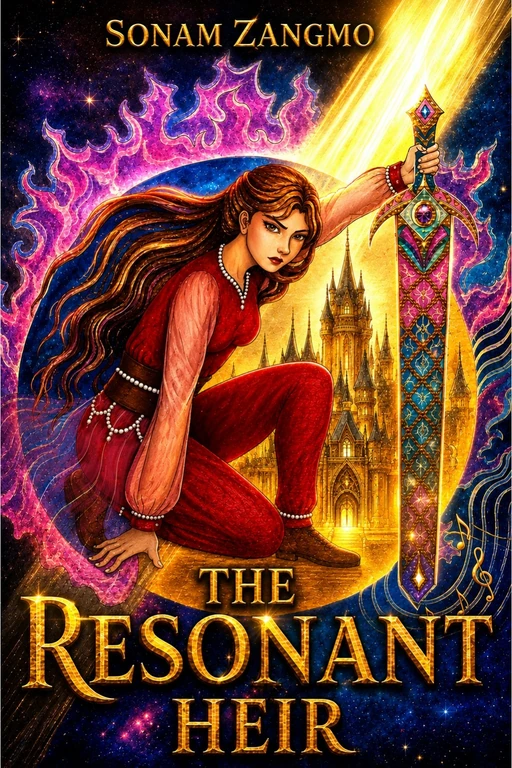
 Explore The Resonant HeirYA crossover royal fantasy · inherited magic · female heir · exile · adventure · Book I Complete
A Literary Commentary on Chapter Twenty-Five of The Resonant Heir
The Choice Behind the Target: A Philosophical Reading of The Trial of Igsvar
On tempered courage, a wounded soldier, and the responsibilities of those who decide what victory requires.
Spoiler Notice: Contains spoilers for Chapter Twenty-Five.
Explore the twenty themes in this commentary
- A Victory That Cannot Feel Like Victory
- An Heir Who Wants to Be Seen as Grown
- “Temper Yourself First”
- Gratitude Before a Name
- A Patient Who Cannot Stay
- The Scar That Raises Questions but Gives No Answers
- Fear in a Chamber Without an Open Door
- “Not Missing. Assassinated.”
- The Map and the Power to Set Terms
- Igsvar Forged into Stone
- An Arrow, a Blindfold, and Unarmored Men
- The Target Behind the Choice
- Voxath and the Quieting of Fear
- The Wound Chosen Instead of a Death
- Was There Really No Other Way?
- The Ruler Who Designed the Trial
- Aethrador’s Resemblance and Difference
- When the Judge Is Satisfied and the Conscience Is Not
- “There Was No Clean Win”
- Conclusion: What a Ruler Must See After the Arrow Falls
Theme 01 · Philosophical commentary
A Victory That Cannot Feel Like Victory
In Chapter Twenty-Five of Sonam Zangmo’s The Resonant Heir, The Trial of Igsvar, Lyra passes a test that should have been nearly impossible. She stands blindfolded in a circle of unarmored soldiers, holding one arrow. The High Lord has told her that she must strike him to win. Instead, she fires low into a soldier’s calf, opening a gap in the ring without killing him.
The High Lord declares that she has passed.
Lyra does not celebrate.
The soldier is alive, but he is bleeding. The ruler praises her restraint, but she cannot stop thinking about the wound. The test appears to have rewarded an ethical choice while leaving its successful participant disturbed by what she was required—or believed she was required—to do.
That disturbance is the chapter’s philosophical heart.
The question is not whether sparing a life is preferable to taking it. It is. Nor is the question whether a wounded person must feel grateful because someone else might have treated him worse. He need not.
The harder question concerns a form of victory that avoids the worst imaginable harm without avoiding harm altogether.
A choice can be better than its alternatives and still leave a moral debt that praise cannot pay.
Igsvar’s High Lord recognizes something promising in Lyra. But the reader is invited to ask a question his verdict does not settle: who should answer for the ordeal in which an innocent soldier became the cost of proving her worth?
Theme 02 · Philosophical commentary
An Heir Who Wants to Be Seen as Grown
The chapter begins not with Lyra but with Caelor kneeling before his father.
The High Lord of Igsvar has forbidden him to go to the Dead Crown. Caelor went anyway. Having barely escaped its broken bridge with Lyra’s help, he accepts the rebuke and says he was wrong.
Then comes the explanation: he is twenty now, and he wants to prove himself.
That is a sympathetic desire. He is no longer a child, and the need to be trusted with meaningful choices can become urgent when one has long lived under a powerful parent.
It is also a desire that can lead to needless danger when proving oneself becomes more important than judging what an action will cost.
The preceding chapter established Caelor’s mistake in practical terms. Nathan urged observation; Caelor assumed that climbing high walls had prepared him for a swaying rope bridge over lava. His confidence placed not just himself, but his companion, in peril.
The High Lord does not deny the wish for independence. He says he understands it.
But the future of Igsvar cannot be entrusted to carelessness, particularly when he is no longer young.
The scene suggests that Caelor may be expected to assume significant responsibility for the land. It does not provide a formal declaration of succession, and the distinction should be preserved.
Maturity is not established merely by taking a risk that a parent would have forbidden.
A young adult may have every reason to seek greater freedom and still have much to learn about the people who will bear the consequences of his decisions.
Theme 03 · Philosophical commentary
“Temper Yourself First”
The High Lord’s counsel has unusual force in Igsvar, a land marked by forges, hammers, and worked metal.
Strength, he tells Caelor, is not only in the blade, or even in courage. A person must temper himself first.
The verb is well chosen for this setting. In smithing, tempering changes the properties of worked metal through controlled heat. In conduct, tempering suggests restraint, proportion, and the capacity not to let impulse govern every decision.
The image does not diminish courage. It asks courage to become answerable to judgment.
Caelor’s problem was not that he lacked nerve on the bridge. He had plenty of it. He was willing to step into a place that ought to have frightened him. His failure lay in treating that willingness as a substitute for understanding what he was entering.
The same issue shadows Lyra’s recent journey. She had the courage to seek Emberheart at an active volcano, but dismissed Sion’s warning before she understood its dangers.
Both young travelers have shown the ability to act. The question is whether they can learn to act with care.
Courage is a capacity to face danger; self-command is part of knowing which danger ought to be faced.
Yet the father’s words create an obligation for the speaker himself. If he claims that power must be tempered, readers have reason to examine how he uses his own power later in the chapter.
His trial for Lyra will put his lesson to the test as surely as it puts her to one.
Theme 04 · Philosophical commentary
Gratitude Before a Name
Having rebuked Caelor, the High Lord asks about the girl who saved him.
He goes to the healer’s room, where Lyra lies unconscious. Caelor does not yet know her name, but says he wants to look after her because she saved his life.
That ignorance of her identity matters.
In a world shaped by allegiance, lineage, and the demands of courts, help can easily become entangled with questions of rank. But Caelor’s immediate reason for remaining beside Lyra is simpler. She pulled him from the broken bridge when he was about to fall into the lava.
The healer tends her burns and instructs Caelor to change the bandages daily. Caelor keeps watch through the night, nodding off despite himself. He hopes they may become friends when she wakes.
The wish is his, not yet a relationship the story has confirmed.
Nor is it evidence that romance has already begun. The text gives us concern, gratitude, and a hope for friendship.
When Lyra wakes, Caelor returns her bag, assures her that her horse is being cared for, and says his men have fitted it with new shoes.
These practical gestures give substance to his gratitude.
Thankfulness matters most when it begins to attend to what the other person needs, rather than merely praising what that person has done for us.
At this stage Caelor cares for the unknown rescuer, not the missing princess. Her royal identity has not earned his consideration.
Theme 05 · Philosophical commentary
A Patient Who Cannot Stay
Lyra wakes after an entire day unconscious and immediately asks for her bag.
She opens it, finds the cold shard of Emberheart, and asks about her horse. Once reassured, she prepares to leave.
Caelor reminds her that her burns have not healed and urges her to accept several more days of treatment. The healer has already given instructions for the salve and bandages.
Lyra insists that she does not need it.
Her urgency is understandable. Bramor awaits her return, and she believes the Emberheart may open the way to a sword strong enough to protect her on the road ahead.
But understanding urgency does not make injured hands instantly well.
In Into the Dead Crown, Lyra confessed that without a blade she did not feel like herself. The need to move forward has become closely tied to the need to recover a sense of identity.
Here that impulse seems to leave little room for rest.
The pattern is familiar: she is ready to protect a stranger over a precipice, yet uneasy with remaining in bed while someone else protects her.
A person can be exceptionally brave in danger and still struggle to accept the ordinary vulnerability that follows injury.
The chapter does not prove she would certainly worsen her wounds by departing. It does show that she rejects counsel from someone concerned about her recovery.
Her strength is real. So is the body in need of care.
Theme 06 · Philosophical commentary
The Scar That Raises Questions but Gives No Answers
The High Lord notices that Lyra resembles someone, though he does not initially name whom.
The healer draws attention to a strange scar on her left wrist. Beneath the skin, it pulses faintly, like a heartbeat.
The High Lord asks to see it. His expression changes. He wants to know who the girl is.
The scene strengthens a mystery that has followed Lyra through the earlier chapters. Her body bears a mark that responds in unusual ways, and others sometimes seem to recognize something about it that she does not fully understand.
But the story is careful about what it reveals.
The scar pulses; this chapter does not describe it as glowing. The High Lord’s reaction is significant, but he does not identify the scar’s cause or explain its nature.
Neither does the scene establish that he has already recognized Lyra’s full royal identity before she speaks.
That uncertainty is an important part of the reading experience. Not every reaction from an older, better-informed character is permission to invent hidden lore.
A sign can carry meaning within a story before its meaning is available to the person who bears it—or to the reader.
Lyra has spent years being judged by a visible absence of magic. Now a strange visible mark provokes interest, yet neither its power nor its origin has been explained.
The contrast invites questions without answering them prematurely.
Theme 07 · Philosophical commentary
Fear in a Chamber Without an Open Door
When Lyra tries to leave, the High Lord questions her about Bramor. Then he signals for soldiers.
They enter and close a ring around her.
Lyra follows him to the council chamber, where great doors close behind them. He asks where she comes from and who her father is.
Her response is startling: if she tells him, will he kill her?
He asks why he would.
Lyra points to the guards who blocked her path.
That exchange deserves attention because it distinguishes a speaker’s stated intentions from another person’s lived position within a room.
The High Lord may not intend to harm her. The chapter has not established such an intention.
But his control of the soldiers and the exit gives Lyra a reason to feel afraid. She has survived threats to her life, and she knows that revealing her identity may change the behavior of powerful people.
A reassurance spoken by the person who controls the doors cannot erase the fact that he controls the doors.
Trust becomes difficult when one person can end the conversation freely and the other cannot.
The scene does not require us to label the High Lord an enemy. It requires us to recognize the imbalance.
For a future ruler, Lyra is witnessing a form of power that cannot be measured by strength of arms alone: the ability to decide whether another person is allowed to leave.
Theme 08 · Philosophical commentary
“Not Missing. Assassinated.”
Lyra reveals that her father is the King.
The High Lord recognizes her as the missing princess. Lyra corrects him: not missing—assassinated.
The word is deliberately jarring because Lyra is standing alive before him. She is not describing a completed death. She is refusing to let what happened to her be treated as an ordinary disappearance rather than an attempt upon her life.
The difference matters.
“Missing” tells the story from a distance, through the uncertainty of people who do not know where someone has gone.
Lyra speaks from within the danger that drove her away.
Neither formulation by itself supplies a complete public history of the events. But her correction resists a narrative that overlooks the violence of her experience.
The High Lord murmurs about civil war. This response suggests how grave the political implications appear to him; it does not prove that a civil war has already begun.
Lyra notices the bearing of someone who may have known war and wonders whether he can tell her something she needs.
The name others give an event can conceal what the person who endured it knows about its cost.
In a novel concerned with inheritance, reputation, and political truth, Lyra’s insistence on naming the attempt against her is another effort to keep possession of her own story.
Theme 09 · Philosophical commentary
The Map and the Power to Set Terms
The mention of Awakening Spring changes the conversation.
The High Lord asks who told her about it. Lyra names Xareth, the former High Lord of Sarrakha, then presents the folded strip of silk obtained in Gemariel.
He examines it and says he has a piece as well.
If she passes his trial, he promises, it will be hers.
This is an enormous possibility for Lyra. Her first fragment has not given her a complete route to the Awakening Spring. A second may bring her closer to the place she has been seeking.
But a promise is not a completed exchange. In this chapter, the High Lord does not actually hand over his piece. Lyra has reason to hope; she does not yet possess it.
The offer also changes their positions in relation to one another.
He has soldiers, authority over the Citadel, and now a piece of knowledge or material Lyra desperately wants. She is recovering from injuries and is in his power.
She accepts the proposed trial immediately.
That willingness matters, but it should not end our questions about the terms. When someone urgently needs what another person controls, an offered choice may carry a pressure not visible in the word “yes.”
To offer someone a path toward what she needs is also to assume responsibility for the dangers placed upon that path.
The moral importance of the High Lord’s test will therefore depend not only on what it reveals about Lyra, but on what he has chosen to demand.
Theme 10 · Philosophical commentary
Igsvar Forged into Stone
The Citadel is described through the forms of metalwork.
Its floor is lined with carved metal patterns. Reliefs rise from walls and pillars in rigid repeated ridges, as though the structure were forged instead of built. The High Lord himself stands like a pillar that bears weight.
The setting does more than provide a handsome backdrop for a council chamber.
It places craftsmanship and strength into the language of rule. Caelor is told to temper himself. Later, the High Lord will strike two smith’s hammers together as part of Lyra’s trial.
These details make the chapter’s ethical questions feel rooted in Igsvar, rather than imported from a different world.
The image of tempering is especially fruitful because a smith cannot produce a reliable blade merely by striking without judgment. Heat, force, and restraint belong together.
It is tempting to carry the comparison directly into the education of the young.
But human beings are not metal.
A person has fear, bodily vulnerability, memories, and the ability to judge the terms under which she is taught. Others may suffer when a lesson is constructed carelessly.
A ruler who wishes to temper courage must also consider what his method of tempering does to the people within it.
That thought will make the final test uncomfortable. The High Lord speaks as one who values self-restraint. Does the ordeal he arranges show equal restraint toward his own men?
Theme 11 · Philosophical commentary
An Arrow, a Blindfold, and Unarmored Men
The trial takes place in a stone training yard.
Dozens of soldiers form a ring around Lyra. None wears armor. She is given a bow and one arrow. Her eyes are covered.
The High Lord stands beyond the ring, striking two hammers together while moving around her. The soldiers sing an old war hymn of Igsvar. Their voices echo from the Citadel walls.
She is told that striking the High Lord will win the trial.
At first, the challenge resembles an extraordinary test of hearing and aim. Lyra must separate a moving man’s position from clanging metal, footsteps, and voices, all without sight.
But the circle makes the problem more than technical. An arrow released toward the target may pass through a person standing between them.
The soldiers’ lack of armor gives this detail terrible weight.
The text does not tell us whether they volunteered with full knowledge of the danger. We should not invent coercion, but neither should military service be treated as proof that they knowingly agreed to be wounded.
The people placed between a test-taker and her prize are not merely features of the test. They are people.
The High Lord’s authority may explain how the formation came to stand there. It does not automatically justify the risks created by its arrangement.
Theme 12 · Philosophical commentary
The Target Behind the Choice
The narrative offers a memorable turn of phrase as Lyra considers the soldiers in front of her: the High Lord stands behind the choice itself.
Physically, he stands somewhere outside their circle.
Morally, his position is more complicated.
Lyra wants to reach him because he has said the trial will be won if she does. She also wants the map fragment that success may bring.
Yet any shot toward his position must account for the bodies between them.
The situation separates the visible objective from the ethical problem concealed within the objective.
A capable archer might find the High Lord through sound alone. That ability would not settle whether she should loose a lethal arrow along the path she has identified.
It is not enough to ask whether she can reach the target. We must ask what reaching it would require her to do.
At the same time, the announced condition introduces a problem of its own.
Lyra does not ultimately strike the High Lord. She wounds a soldier, and he declares that she has passed.
The public rule and the final judgment therefore differ. His response suggests that he values her refusal to kill, but it does not prove precisely what outcome he expected in advance.
A test may reveal character while still leaving its maker answerable for rules the participant could not fully understand.
The deeper target may be moral judgment. That does not make the terms under which judgment is tested beyond criticism.
Theme 13 · Philosophical commentary
Voxath and the Quieting of Fear
Lyra tries to follow the hammer strikes through the dark.
The singing rises. The High Lord moves, sometimes quickly, sometimes slowly. Wind hisses through the yard. Echoes rebound from stone until the sounds seem to break apart.
She loses him.
Fear begins to creep into her thoughts.
Then the scar on her wrist pulses, and she remembers practicing Voxath beside Lake Lyrenthis.
She steadies her breathing. Her shoulders loosen. She lets thoughts of past and future recede.
The world of sound changes. First she distinguishes her own heartbeat; then the High Lord’s. The separate noises begin to resolve into a rhythm.
The scene continues a pattern in Lyra’s abilities. At the Dead Crown, she learned to watch the eruptions before stepping onto the bridge. At Ametrine, an unusual resonance helped her notice a seam others had not used.
Here she listens for an order beneath seeming disorder.
It would be mistaken to dismiss everything as ordinary concentration, for this is a fantasy world in which the responding scar and her perception of another heartbeat are genuinely unusual.
It would be equally mistaken to name a new magical power the chapter has not explained.
Stillness can change what a person is able to perceive without giving that person certainty about what she ought to do with the perception.
Voxath helps Lyra find the rhythm. The moral decision about where to send the arrow remains hers.
Theme 14 · Philosophical commentary
The Wound Chosen Instead of a Death
Lyra draws, lowers her aim, and releases the only arrow.
A soldier cries out. Blood runs down his calf, and he drops to one knee. The soldiers’ song breaks. A gap opens in the formation.
The High Lord calls an end to the trial.
He tells Lyra that she has passed because she did not kill his man. In his account, more skilled archers might have shot through the soldier to reach him.
This explanation recognizes something morally significant. Lyra did not choose a shot intended to pierce a man’s body on its way toward the original target. She aimed low and caused a survivable injury rather than attempting to kill or risking a deadly wound through the torso.
The difference is real.
It is also incomplete.
The soldier was not attacking her. He was standing in the ring arranged for the exercise. His pain is not undone because a worse injury was avoided.
And the High Lord’s opinion about what more skilled archers might have done remains his claim, not a proven description of every skilled archer’s moral character.
Reducing the harm we cause is meaningful. It does not make the harm we still cause disappear.
The story is strongest when it allows both truths to stand. Lyra has shown restraint in a frightening choice. A man who did not deserve to suffer has nevertheless been wounded by her arrow.
Theme 15 · Philosophical commentary
Was There Really No Other Way?
When the blindfold is removed, Lyra sees the injured soldier.
She apologizes and says there was no other way.
The apology is important. She recognizes the human cost. But the explanation contains a claim about necessity that deserves careful examination.
Within the route she chose—loose the single arrow and try to obtain the promised map fragment—her options had become terribly narrow. A shot through the soldier might have killed him. A lower shot could create space without the same likelihood of death.
But a person can sometimes decline to pursue a victory on the terms offered.
Lyra might have withheld the arrow and accepted failure, or asked to know whether another route was possible. The chapter does not establish how the High Lord would have responded.
Those alternatives might have meant losing an opportunity vital to her quest. They were not necessarily easy, safe, or wise.
Yet difficulty is not proof that no alternative existed.
When we say there was no other way, we may mean that every remaining way demanded a loss we felt unable to bear.
That distinction need not become a judgment against Lyra. She is young, injured, under pressure, and faced with a test whose deeper terms were not made clear.
It does prevent us from turning her statement into an objective law of the scene. Her remorse suggests she herself has not found a fully satisfying answer.
Theme 16 · Philosophical commentary
The Ruler Who Designed the Trial
The question of the wounded soldier does not end with the hand that released the arrow.
The High Lord chose the conditions.
He supplied a single arrow and a blindfold. He arranged a circle of unarmored soldiers. He placed himself beyond them and filled the training yard with hammer blows and the voices of an old war hymn.
He also controlled the promised reward.
It may be that he intended to discover whether Lyra would sacrifice an innocent man to reach him. His praise points toward concern with restraint.
But a worthy question does not automatically justify every method used to ask it.
Why did a soldier have to risk being shot in order for Lyra’s principles to be examined? Were the men informed of the risk and willing to bear it? Was any safer trial possible?
The text does not answer.
These unanswered questions matter especially because the chapter opened with the same High Lord condemning carelessness in someone expected to carry responsibility for Igsvar.
He may sincerely value the distinction between courage and rashness. The reader may also ask whether that distinction should guide the tests he sets.
Power carries responsibility not only for the choices a ruler makes personally, but also for the choices his arrangements compel others to confront.
Ordering the wounded soldier treated is necessary and humane. It does not by itself settle whether the wounding could have been prevented.
Theme 17 · Philosophical commentary
Aethrador’s Resemblance and Difference
After praising Lyra’s restraint, the High Lord says she resembles Aethrador, but is nothing like him.
The distinction reaches toward the novel’s concern with inherited identity.
Lyra bears her father’s blood and has lived with the weight of his position. She has been judged for lacking the magic expected of a royal heir. Her struggle has often involved proving that she deserves the place she was born to occupy.
Now another ruler sees a likeness and a difference.
The placement of his remark, immediately after the trial, invites the reader to connect that difference with Lyra’s choice concerning the soldier.
But the High Lord does not state exactly which aspects of Aethrador he has in mind.
We cannot fairly conclude that Aethrador would have killed the man, or that he is cruel, merely because this ruler makes a pointed comparison. The earlier relationship between the men has not been fully explained in this scene.
What the statement does make available is a possibility central to any story about heirs.
Inheritance gives a person a history and a place in the world; it does not predetermine every moral choice she will make.
Lyra may resemble her father in appearance while forming her own judgment of what strength ought to mean. Whether she will succeed remains a question for the life ahead of her, not something one comparison can settle.
Theme 18 · Philosophical commentary
When the Judge Is Satisfied and the Conscience Is Not
The High Lord calls Lyra successful.
He saw restraint where a more destructive choice was possible. He recognizes her courage, removes the blindfold, and orders that the injured soldier receive treatment.
His evaluation is not empty. She avoided the deadlier shot.
But Lyra’s response is not relief. She looks at the wounded man and tries to hold on to the fact that he will live.
She has achieved the approval of the person who set the trial, yet the approval does not feel like peace.
The disagreement between those perspectives matters.
The High Lord compares her action with a hypothetical worse alternative. Lyra confronts the consequence that actually happened.
One asks whether she could have done more harm.
The other asks why any harm had to be done.
These questions are not mutually exclusive, but they are not interchangeable.
A verdict of success cannot require a person to stop noticing the suffering that accompanied success.
For an aspiring ruler, that may be among the most important forms of moral independence. Praise from powerful figures can be gratifying, especially when one has struggled for recognition.
Lyra’s unease suggests that she has not yet surrendered her judgment to the man who congratulates her. The voice that asks about the soldier remains alive after the voice that declares her victorious has spoken.
Theme 19 · Philosophical commentary
“There Was No Clean Win”
The final lines refuse an uncomplicated celebration.
Lyra has passed a trial she thought impossible. She ought, by the familiar rules of heroic adventure, to feel triumphant.
Instead she feels guilty.
She has injured someone innocent.
She wonders whether any outcome could have avoided a cost, and whether that desire is selfish or simply a truth she must accept.
The questions continue a difficult sequence in the previous chapters.
At Gemariel, Lyra saved the High Lord but fractured Ametrine, placing the protection of the mines in jeopardy. At the Dead Crown, she saved Caelor but nearly died herself, needing others to carry her away. At Igsvar, she spared a soldier’s life while wounding him.
These are different forms of danger, not interchangeable cases. Yet together they keep interrupting any simple equation between good intentions and painless results.
It would be equally dangerous, however, to conclude that harm is therefore always necessary.
Some losses may be unavoidable. Others arise because someone arranged the choices badly, misunderstood the risk, or refused to reconsider the terms.
Recognizing that every decision may have a cost is not permission to stop asking whether a particular cost was needed.
Lyra’s guilt may be painful, but it also resists a more troubling development: learning to regard another person’s wound as merely the fee for her progress.
Theme 20 · Philosophical commentary
Conclusion: What a Ruler Must See After the Arrow Falls
The scene that stays with the reader is not the arrow in flight.
It is the removal of the blindfold.
Lyra’s senses have been sharpened through Voxath. She has followed the High Lord’s heartbeat through a chorus of hammers, footsteps, and song. She has chosen a shot meant to avoid killing a soldier.
Then the light returns, and she must face the man whose calf her arrow pierced.
The High Lord sees an heir who did not kill. Lyra sees someone bleeding.
Both descriptions belong to the same event. Neither should be erased to make the ending simpler.
The lord’s judgment may bring her the map fragment he has promised, but the chapter stops before that fragment is given. Her progress toward Awakening Spring remains an expectation rather than a completed acquisition.
More importantly, the challenge exposes two forms of responsibility.
One belongs to the person forced to act within difficult conditions: she must judge the possible harm, try to reduce it, and answer for what she does.
The other belongs to the person powerful enough to establish the conditions: he must ask whether the ordeal needed to place innocent people in harm’s way at all.
A ruler’s conscience must answer not only for the victories she wins, but also for the risks her choices require other people to bear.
Lyra has not solved this problem. She cannot even enjoy the victory she has been awarded.
That may be why the ending matters so much.
The High Lord’s words announce that the test is over. Lyra’s lingering guilt makes clear that the larger test—learning what it means to wield power without forgetting its human cost—has only begun.