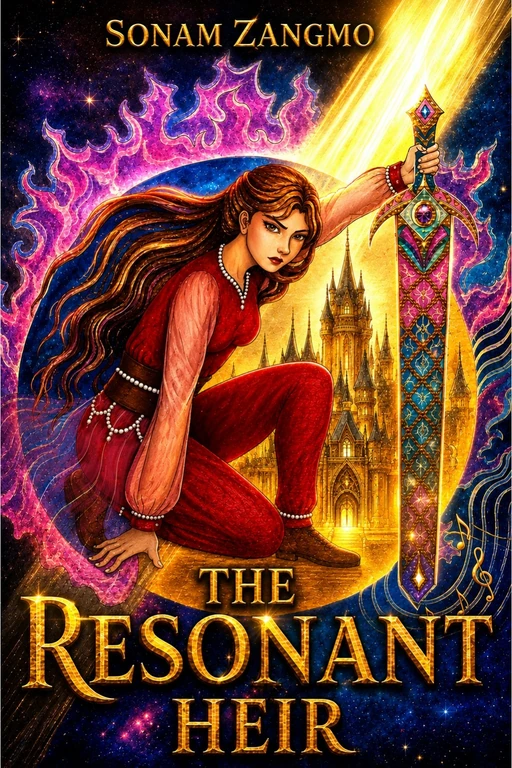
 Explore The Resonant HeirYA crossover royal fantasy · inherited magic · female heir · exile · adventure · Book I Complete
A Literary Commentary on Chapter Twenty-Six of The Resonant Heir
The Will of the Fallen: A Philosophical Reading of The Blade of the Dead
On a sword made against a father, the dead who still cling to its steel, and the limits of what an heir may claim.
Spoiler Notice: Contains spoilers for Chapter Twenty-Six.
Explore the twenty themes in this commentary
- An Inheritance That Cannot Simply Be Claimed
- A Promise Kept After Fifty Years
- Caelor and the Ruler Worth Following
- The Cloth Kept in a Sleeve
- The Old Lord and the New Order
- Riding Through Rain with Two Fragments
- The Names Spoken Into the Rain
- A Place Where Someone Waits
- The Work That Continued in Her Absence
- The Letter from a Living Witness
- The Honest Limit in a Smith’s Promise
- The Dust on the Long Wooden Box
- A Sword Made to Stand Against Her Father
- The Warriors Hidden Inside a Number
- The Black Haze Is Not Merely Ornament
- Reforging the Steel Without Erasing Its History
- Three Drops of Blood and the Burden of Meaning
- Cleansing as Release, or Cleansing as Convenience?
- Survival Is Not the Same as Being Chosen
- Conclusion: A Voice She Cannot Summon
Theme 01 · Philosophical commentary
An Inheritance That Cannot Simply Be Claimed
In Chapter Twenty-Six of Sonam Zangmo’s The Resonant Heir, The Blade of the Dead, Lyra returns to Bramor’s forge carrying two fragments of the map to the Awakening Spring and a shard of Emberheart. She has survived the Dead Crown, won the approval of Igsvar’s High Lord, and found her way back to a friend who feared she would never return.
By the familiar measure of a fantasy quest, she appears to have earned her reward.
But Bramor reveals an older sword, forged fifty years earlier to stand against her father, Aethrador. Thousands of warriors fell to its blade. Their resentment still coils around the steel in a visible black haze.
The smith is willing to attempt a new weapon, but his skill alone cannot promise success. Three drops of Lyra’s blood may disclose whether the fallen will accept her. She has not yet performed this act, and the chapter ends before their answer is known.
The reversal is striking. Lyra has repeatedly moved forward by acting—working, fighting, enduring a volcano, and passing the trial of a ruler. Now she faces a boundary her effort cannot simply force aside.
To inherit a means of power is not automatically to inherit the right to disregard those who suffered because of it.
The chapter’s deepest conflict belongs not between a worthy girl and an unworthy weapon, but between the urgent purposes of the living and the unfinished claims of the dead.
Theme 02 · Philosophical commentary
A Promise Kept After Fifty Years
At the Citadel of Igsvar, Lyra stands beside her white horse with a piece of silk in her hand.
She remembers the High Lord’s words: he now understands why she earned Gemariel’s trust.
The High Lord has kept this fragment of the map for fifty years. Now he has given it to her.
This is a meaningful development because the previous chapter ended with a promise, not the transfer itself. The High Lord had offered his piece if Lyra passed a perilous trial. She did pass, although her arrow wounded a soldier and left her troubled by the cost.
Here the promise has become an act. The silk is in her possession.
But the gift does not answer every question about its history. We are not told who first entrusted it to Torvak, why he kept it locked away, or which circumstances persuaded him to hold it through so many years.
The value of the moment lies partly in its restraint. He has withheld something important for a very long time, and he chooses to entrust it to someone young.
Even his remark about Gemariel deserves precision. That he recognizes the land’s trust does not prove every miner or resident agreed to the risks Lyra took in the tower.
Recognition by a ruler is powerful; responsibility toward a land includes people whose voices that ruler may not speak for.
Lyra is grateful. The obligation to use that trust well remains ahead of her.
Theme 03 · Philosophical commentary
Caelor and the Ruler Worth Following
Caelor comes to the courtyard bearing small vials from the healer.
He wants Lyra to continue caring for the burns she suffered while saving him. Then he asks, with a hesitation that catches her attention, whether she will return.
Lyra does not promise.
Instead, she advises him, for Igsvar’s sake, to become a ruler worth following.
The distinction between being a ruler and being worth following is central.
One may possess a title by birth. Soldiers may obey their High Lord because service requires it. But a person’s moral claim to leadership cannot be established by rank alone.
Caelor’s recent failures make Lyra’s words particularly pointed. He wanted to prove himself at twenty, ignored Nathan’s call for caution, and stepped onto a dangerous bridge. Lyra rescued him, then needed to be rescued herself.
His father warned him that courage needed tempering.
Now Lyra sets the standard in terms of other people’s willingness to trust his judgment.
She is not announcing that Caelor has already achieved this kind of leadership, nor that he has been formally named the next High Lord. She is telling him where to direct his effort.
Power may place others under a person’s command; character gives them reasons to believe that command deserves their trust.
The moment is also quietly generous. Rather than letting his concern revolve entirely around seeing her again, she directs him toward the lives that might one day depend upon him.
Theme 04 · Philosophical commentary
The Cloth Kept in a Sleeve
As Lyra rides away, Caelor remains in the courtyard. After a moment, he takes from his sleeve a strip of cloth once used to bandage her.
He still does not know her name. His father has told him nothing of her identity.
He resolves to become stronger, and one day to find her again.
The scene gives the encounter a lasting emotional weight without specifying what that feeling will become. Caelor hopes to see her. The cloth keeps a trace of the time when he watched over her injuries.
Nothing here requires a declaration of love, a promised reunion, or a destiny already fixed by the narrative.
The significance is simpler and, perhaps, more touching: a young man remembers the person who risked her life for him, and the memory has begun to influence what he wants from himself.
He cannot repay that act by pretending it never happened.
Nor can the bandage serve as proof that Lyra owes him a return visit.
Gratitude may change the course a person hopes to take without giving that person a claim upon the one who inspired it.
That distinction matters in a chapter increasingly concerned with consent. Caelor can choose to remember Lyra, pursue strength, or hope for another meeting. Lyra remains free to follow her own road.
Theme 05 · Philosophical commentary
The Old Lord and the New Order
From the Citadel balcony, Torvak watches Lyra depart.
His thoughts turn toward Thrudor blood, toward an earlier alliance involving Aurelion, and toward the limits that alliance apparently encountered. He declares that a new generation is rising and that a new order will follow.
The statements extend the chapter’s scale from a personal farewell to a history still partially hidden from Lyra.
Torvak knows something of old powers and political relationships. Yet the story has not explained precisely which events he recalls when he thinks that even an alliance with Aurelion was insufficient.
It would be careless to turn this fragmentary thought into a detailed account of a battle or the complete history of Igsvar’s loyalties.
What we can see is a generational divide.
Torvak and Bramor possess memories shaped by a war fought long before Lyra’s current journey. Lyra and Caelor are living among the consequences of those events while making choices that may determine what follows.
The phrase new order offers possibility without guaranteeing justice. A changing balance of power is not automatically a better one.
A new generation can inherit the world it did not make without being condemned to repeat every choice that made it.
But freedom from inherited guilt does not mean freedom from inherited consequences. The sword waiting in Bramor’s cabinet will make that difference frighteningly tangible.
Theme 06 · Philosophical commentary
Riding Through Rain with Two Fragments
Rain sweeps over the plains as Lyra leaves Igsvar.
The narration recalls the night of her flight from the palace: she had no magic, no allies, no attendants, and no clear knowledge of where to begin searching for the scattered map.
Now she has two pieces and the favor of Gemariel and Igsvar.
Her circumstances have changed, even though the Awakening Spring remains unfound.
That progress is more varied than a list of victories. Lyra has worked in a mine, learned from a companion of humbler origins, relied on the help of several strangers, and endured painful consequences when courage was not enough.
The goodwill of two lands is valuable, but it is not the same as two formally negotiated alliances with all their people. The chapter speaks of favor, and that distinction should be kept.
Lyra thinks confidently that she will reclaim her magic. This is her hope for the future, not a result the narrative has yet confirmed.
The storm ends; sunlight returns; her horse continues onward.
The weather change need not be treated as a supernatural blessing. Its emotional force lies in how it carries the reader from the danger of the last two chapters toward the quiet forge.
Progress can be real even while the thing a person desires most remains beyond reach.
Lyra has gained companions, knowledge, and support before she has gained the power she believes she lacks.
Theme 07 · Philosophical commentary
The Names Spoken Into the Rain
As she rides, Lyra whispers for her father, mother, and Obewich to wait for her.
The names change the emotional temperature of the journey.
She has spoken repeatedly about becoming stronger, finding a blade, and reaching the Awakening Spring. Yet those pursuits are not floating apart from the people she has lost contact with.
She wants to return.
Her search for magic is tied, at least in part, to a desire to rejoin those she loves and to recover a life torn apart by violence.
That does not settle every motive. Lyra also wishes to prove herself as an heir who has long been judged for lacking magic. She can want both recognition and reunion.
The tender complication is that a person may risk her life for the hope of returning alive to her family.
At the Dead Crown, Lyra survived a danger she accepted because she believed she could not find herself without a worthy sword. The reader has reason to wonder how she will balance that belief against the simple value of being able to return.
A quest to become strong enough to go home must not forget the life that needs to survive the journey home.
The names in the rain remind us what Lyra’s ambition is meant to protect.
Theme 08 · Philosophical commentary
A Place Where Someone Waits
Sion spots Lyra from the yard while hanging laundry. She drops everything and races toward her, nearly slipping on wet grass.
Then she hugs the white horse.
Her relief includes both traveler and animal: they have both come back safely.
The scene has the warmth of a homecoming even though Bramor’s house is not Lyra’s ancestral home.
Sion did not have to accompany Lyra through the Dead Crown. She was asked to stay behind. Yet the waiting mattered to her, and the reunion demonstrates the place this friendship has begun to hold in Lyra’s life.
The narration describes Sion as bringing a little sunlight into the quieter places of Lyra’s heart. It is affectionate language, unashamed of its softness.
There is no need to claim that Lyra has replaced her family with this new household. Only moments earlier she was calling for her parents and Obewich.
The two loyalties can coexist.
Belonging need not be limited to a single place or a single set of people.
For an exile, an unexpected welcome may restore something that money or an inherited title cannot provide: the knowledge that someone has been worried about her and is glad she returned.
The warmth of the yard will soon stand in striking contrast to the cold light of the sword inside the forge.
Theme 09 · Philosophical commentary
The Work That Continued in Her Absence
Orin is away selling pots and pans. Sion has been cooking for the household and proudly recounts how she learned to polish the wares.
Then she notices that in her rush to greet Lyra, she has dropped the laundry onto the wet ground.
The domestic comedy matters.
For several chapters, Lyra’s story has moved through a volcano, an unfamiliar Citadel, a mysterious map, and an ordeal arranged by a High Lord.
Here the forge household has been living through different concerns: meals, metalwork, clothing, and the small dignity of learning a useful skill.
The supporting characters have not spent every hour in suspension while the princess advances her quest.
Sion can take pride in polishing pots. Orin can keep selling the wares upon which his household depends. These activities are not less real than the making of swords.
They also form a quiet moral counterpoint to what the locked cabinet will reveal.
The weapon inside was present during the deaths of thousands of warriors. But such a number risks concealing the ordinary lives that ended with them: people who worked, ate, cared for loved ones, and expected to see another day.
The chapter does not provide the fallen warriors’ individual stories. The homely setting encourages us not to forget that each death had a human life behind it.
The ordinary acts by which people sustain life deserve attention in a story about the extraordinary instruments by which life can be taken.
Theme 10 · Philosophical commentary
The Letter from a Living Witness
Lyra presents the shard of Emberheart and a letter from Igsvar’s High Lord.
Bramor recognizes the sender as Torvak. It has been a long time since they were in contact.
He wipes the soot from his hands before taking the letter, reads it silently, and folds it with care.
The sequence suggests that the message matters, especially given what Bramor soon reveals about their shared history.
But its contents are withheld.
We do not know whether Torvak makes a request, renews a bond, recounts Lyra’s trial, or reminds Bramor of something that happened fifty years ago. We cannot safely make the letter into an order or a confession.
This restraint creates an interesting contrast with the later sword. One object communicates silently through folded words that Lyra cannot read; the other seems to carry the unfinished resentment of people who can no longer speak to her.
The first may help explain why a man of the past is willing to act now. The second will challenge what action alone can accomplish.
A message can carry the weight of a long relationship without giving outsiders the right to claim they know what was said.
Bramor’s response is measured. He says he will do everything he can. He does not promise that what Lyra wants is certain to be made.
Theme 11 · Philosophical commentary
The Honest Limit in a Smith’s Promise
Bramor’s willingness to try is significant because Lyra has come a long way to change his answer.
He first refused customers. Then he sent her to retrieve Emberheart from the Dead Crown. Now she has returned, wounded, with a shard and a letter from Torvak.
At last he says he will do everything he can.
The phrase is not a guarantee.
This distinction is an ethical strength in the scene. The smith can offer his labor and judgment. He need not pretend to command forces that may be beyond either.
Later, he will explain why he cannot promise the new sword will endure the forge. The old steel carries resentment deep enough that the spirits may tear it apart when it returns to fire.
Bramor’s extraordinary skill is not denied. Rather, the chapter gives his skill a limit.
A craftsperson can be competent and honest about the uncertain outcome of a difficult undertaking.
That is especially important for Lyra, who has repeatedly accepted challenges before learning all that they required.
An honest promise is sometimes a promise of effort, accompanied by a clear acknowledgment that success is not entirely ours to give.
Bramor’s answer is more morally credible because it stops short of offering certainty that he cannot supply.
Theme 12 · Philosophical commentary
The Dust on the Long Wooden Box
Inside the forge, Bramor takes a heavy key and opens an old cabinet. He draws out a long wooden box and brushes dust from its lid.
Only then does he reveal the sword.
This staging matters because the weapon is not hanging over the anvil as a celebrated masterpiece. It is locked away.
A gemstone set in the hilt shifts in color from green toward wine-red. A faint black haze twists along the blade. Lyra feels a chill.
The imagery is unmistakably that of fantasy, not an ordinary blade tarnished by age.
Still, we should resist filling in the unknown history of the box. The story does not tell us exactly when Bramor locked the sword away, or whether its changing gemstone is connected to Rubiad or any other relic.
What the cabinet does offer is a powerful image of a history removed from daily sight without being resolved.
The smith can go on making useful vessels and tools. Orin can sell them in the street. Life continues.
But beneath the surface of that ordinary life lies an instrument from a great war, intact enough to bring its past into the present.
To set a troubling object aside is not necessarily to settle what it means.
When the box opens, what was hidden returns with questions that the smith’s long silence has not answered.
Theme 13 · Philosophical commentary
A Sword Made to Stand Against Her Father
Bramor finally identifies the blade.
Fifty years earlier, High Lord Aurelion and High Lord Torvak brought him rare metal and asked him to forge a weapon capable of standing against Aethrador.
Aethrador is Lyra’s father.
This is the revelation that gives the chapter its sharpest connection to the idea of inheritance. A girl seeking a replacement for her childhood sword is shown an old weapon created to oppose the very father whose name and position helped shape her identity.
Lyra has not chosen that history.
She was not one of the lords who commissioned the weapon. She did not forge it or wield it in the great war.
Nor does the account alone establish that Aethrador was a villain or that those who opposed him were righteous. The causes and events of that conflict remain insufficiently explained.
What is certain is that a former opposition between powerful figures now stands before their descendants.
Lyra’s potential use of the sword’s steel need not be read as betrayal of her father. It may instead become an opportunity to decide what kind of strength she wants to carry forward.
A child may inherit the consequences of an old conflict without inheriting the guilt or the judgments of those who fought it.
The past places choices before Lyra. It does not dictate all the choices she must make.
Theme 14 · Philosophical commentary
The Warriors Hidden Inside a Number
Bramor explains that thousands of warriors fell to this blade during the great war.
The statement changes the moral meaning of the weapon.
In a fantasy tale, the phrase legendary sword can invite awe. A blade that endured great battles may appear beautiful, powerful, and worthy of its place in an ancient chest.
But the legend contains an account of death.
Thousands is an immense number. It is also an abstraction, concealing individual people whose fears, attachments, and final moments we do not know.
The text does not say that every fallen warrior belonged to the same army. It does not identify all who wielded the sword or establish the circumstances of each death.
We should not supply a single moral verdict on an unknown war.
Yet the fact of so much death is sufficient to alter our attention.
A sword famous for defeating enemies may be remembered very differently by those who lost someone beneath it.
A weapon can be an emblem of achievement in one account of history and an emblem of grief in another.
The chapter refuses to let its legendary blade be defined only by sharpness, rarity, or victory. The dead continue to matter, even though we have not heard any of their names.
Theme 15 · Philosophical commentary
The Black Haze Is Not Merely Ornament
Bramor points to the black haze moving around the sword.
What Lyra sees, he explains, is the resentment of the fallen.
The haze then curls around his wrist when he reaches toward the blade. He shakes it away.
Within the fantasy world, this is a material phenomenon witnessed by the characters. It should not be flattened into a decorative metaphor for guilt.
At the same time, much about its nature remains unknown. Bramor identifies the resentment and warns that the spirits may tear the steel apart in the fire. The chapter does not tell us exactly what each spirit remembers, how many are present, or whether they possess a shared voice.
The philosophical force lies in allowing the dead to retain significance for the living.
The war has ended, and those who commissioned its weapon are old. Lyra belongs to a later generation. Bramor’s forge now makes household wares.
Nevertheless, the resentment remains wrapped around the sword.
The fact that the living wish to use what a war left behind does not mean the suffering bound to that history has ceased to matter.
The past here is not merely a lesson told by victors. It is a presence that may affect whether the living can forge anything new from what remains.
Theme 16 · Philosophical commentary
Reforging the Steel Without Erasing Its History
Bramor proposes a specific transformation: he will forge a new blade for Lyra from the ancient sword’s steel.
He is not simply placing the old weapon into her hands.
The promise is to heat the metal and make it anew. The object’s form would change. Its intended use might change as well.
Lyra has said she wants a blade able to defeat the weapons of those who prey upon the weak. That differs from the purpose of an instrument commissioned to stand against a powerful ruler, although we still know too little of the old war to judge its original purpose in full.
Reforging suggests that the same material might serve a different future.
But it does not make history reversible.
Thousands of warriors would still have died even if the blade were eventually used for protection rather than conquest or warfare. A change in purpose cannot undo an earlier wound.
Nor is the metal necessarily condemned forever to repeat its former role. The question is whether a new use can acknowledge the past rather than claim the past no longer matters.
Renewal is not the same thing as forgetting.
Bramor’s warning about the spirits gives that distinction a fantasy form. The steel may not endure the fire because the resentment has not yielded. The old blade’s history becomes a practical limit on the new blade’s making.
Theme 17 · Philosophical commentary
Three Drops of Blood and the Burden of Meaning
Lyra asks whether the blade can be cleansed.
After a pause, Bramor answers: three drops of her blood upon the steel.
It is a small demand in physical measure, especially after the deadly bridge she crossed and the trial she survived. Yet it has a significance beyond the volume of blood.
Lyra is Aethrador’s daughter. This sword was made to stand against him. Now her blood is proposed as the means of learning whether the fallen accept her.
That arrangement invites questions about kinship, the persistence of war, and the distance between children and their parents’ choices.
But the chapter does not establish that Thrudor blood has a special chemical or magical reaction to this weapon. Nor has the ritual occurred. No result can be inferred from the instruction alone.
A few drops of blood might seem to make the choice intimate: the hopeful new bearer offers something of herself rather than merely paying a smith or presenting a lord’s recommendation.
Still, the meaning of the act is not ours to define fully before the story does.
Blood can mark a connection to history without proving that the bearer is responsible for every deed performed before her birth.
The deepest question is not whether Lyra’s ancestry automatically makes her acceptable. It is whether the past will permit her to use a power her ancestry has brought within reach.
Theme 18 · Philosophical commentary
Cleansing as Release, or Cleansing as Convenience?
The word cleanse carries an ethical difficulty.
Lyra wants the resentment to fade, and Bramor has said this may determine whether the old steel can withstand reforging. From the living characters’ point of view, the problem is practical: they need the weapon to survive the fire.
But what would it mean for the dead?
One possibility is release: the fallen may find a form of peace or willingly allow the sword’s steel to serve a different purpose.
Another possibility would be troubling: to remove their visible objection only so that the living may proceed without hearing it.
The chapter does not tell us what the proposed ritual will actually do to the spirits. Bramor’s interpretation, that fading resentment signifies their choice, is the explanation available to Lyra.
We should not invent a mechanism in which every warrior votes, nor a compulsory spell that silences their grief.
Yet the uncertainty makes the question worth asking.
Is the desired peace sought for those who suffer, or merely for those who find the evidence of suffering inconvenient?
The distinction reaches back to Lyra’s remorse in The Trial of Igsvar. She knew a soldier would live, yet could not simply dismiss the wound because the High Lord had declared her successful.
That same attentiveness may matter before a sword whose history contains far more than one wound.
Theme 19 · Philosophical commentary
Survival Is Not the Same as Being Chosen
Near the end, the narration draws a distinction that changes the terms of Lyra’s quest.
She has survived. She has returned with Emberheart. But survival is not the same thing as being chosen.
Bramor tested her courage. Torvak tested her will. Now the matter belongs, if the smith’s account is right, to those who died beneath the old blade.
The structure resists a simple heroic bargain.
Lyra has traveled far and risked much. It would be easy to say that those efforts entitle her to a legendary reward.
The chapter refuses that conclusion.
Her effort can demonstrate determination. It can persuade a living ruler or move a craftsman to attempt his work. It does not automatically grant the consent of someone whose suffering was never part of the agreement.
There is also danger in the opposite assumption—that a refusal by the spirits, if it occurs, would prove Lyra worthless. The chapter has not suggested that a single relic can issue a complete moral judgment on her entire life.
Being chosen is not the same as being good, and being refused need not mean that a person lacks worth.
The decision concerns this blade and this history. Lyra remains more than any answer the ancient steel may give.
Theme 20 · Philosophical commentary
Conclusion: A Voice She Cannot Summon
The chapter ends with Lyra staring at the sword.
She has endured fire, injury, and the judgments of rulers. She has obtained two fragments of a map she once scarcely knew how to seek. Bramor has agreed to do all he can.
Yet before her lies a blade whose past resists becoming merely the material of her future.
It was forged to stand against Aethrador, her father. Thousands died by it. Their resentment hangs about the steel, and the smith cannot promise that it will remain whole when returned to the forge.
Three drops of Lyra’s blood may reveal an answer, but she has not given them yet.
The fallen, according to Bramor, must choose her.
The final cruelty—or dignity—of this condition is that Lyra has no way to speak to them. She cannot explain that she hopes to protect the weak. She cannot point to the risks she has already survived and demand their approval.
She must confront an uncertainty that neither rank nor persistence can abolish.
And perhaps that is why the blade is more than another powerful object waiting to be claimed.
It asks the heir to acknowledge that the history carried by a weapon is not hers to rewrite simply because she has good intentions for its future.
The living may give an old power a new purpose, but they do not thereby acquire the right to silence everyone who suffered beneath it.
Lyra has learned how to seek the trust of the living. Before the black haze of the ancient sword, she faces the possibility that the dead retain a choice of their own.
The blade waits. So must she.