
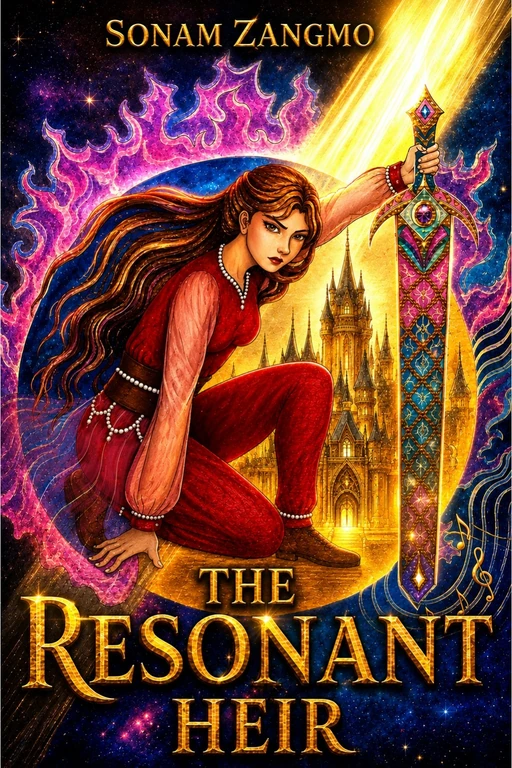
 Explore The Resonant HeirYA crossover royal fantasy · inherited magic · female heir · exile · adventure · Book I Complete
A Literary Commentary on Chapter Twenty-Seven of The Resonant Heir
The Song and Its Cost: A Philosophical Reading of When the Steel Sings
On the voices of the dead, the devotion of a master smith, and the human cost hidden in the making of a legendary blade.
Spoiler Notice: Contains spoilers for Chapter Twenty-Seven.
Explore the 22 themes in this commentary
- When the Sword Sings and the Hammer Falls
- Three Drops, and a Request Rather Than a Command
- What the Vanishing Haze Does—and Does Not—Prove
- The Joy That Arrives Before the Cost
- Orin Comes Home with Eggs
- Emberheart and the Strange Fire
- Listening Is Part of the Craft
- A Son Learning by Watching
- The Work That Stops the Market
- Twelve Days and Nights Without Rest
- The Care That Does Not Hold the Hammer
- “I Never Said Goodbye”
- A Blade Growing Stronger, a Smith Growing Weaker
- When the Blade Seems to Breathe
- The Final Note Is Not a Prophecy
- The Gemstone Returns, and the Blade Wakes
- “I’m Fine”: The Sound Bramor Refuses to Hear
- The Sheath That Must Let Steel Breathe
- “This Can Wait”: Two Duties in Conflict
- The Leaf and the Limit of Proof
- The Hammer Falls: A Different Voice Claims the Ending
- Conclusion: Hear the Smith Beyond the Song
Theme 01 · Philosophical commentary
When the Sword Sings and the Hammer Falls
Chapter Twenty-Seven of Sonam Zangmo’s The Resonant Heir, When the Steel Sings, begins with three drops of a girl’s blood and ends with a hammer falling from an old man’s hand.
Between those sounds, a legendary sword is born.
Lyra has traveled to an active volcano for Emberheart, survived a shattered bridge, earned a second fragment of her map, and returned to Bramor’s forge. The ancient sword he proposes to reforge carries the resentment of warriors who fell to it in a war involving her father. She is not entitled to its steel simply because she needs a weapon.
The ritual produces an answer that allows the work to begin. Bramor then forges for twelve days and nights, while Orin watches, Sion brings food, and Lyra grows increasingly afraid for him. A special sheath follows. At last, the new sword responds to Lyra’s touch and cuts a falling leaf with impossible smoothness.
The victory lasts only a moment. The smith suffers another attack of chest pain and collapses.
The chapter makes a marvelous object visible while asking us not to lose sight of the vulnerable person who made it.
A hero’s reward may be real, useful, and beautiful. None of those qualities makes the human costs of its creation morally invisible. That tension, more than the blade’s sharpness, gives this chapter its lasting weight.
Theme 02 · Philosophical commentary
Three Drops, and a Request Rather Than a Command
Bramor holds a needle in a flame until its tip glows red, then passes it to Lyra. She pricks her finger. Three drops of blood fall onto the old blade.
The black haze thickens. Steel shudders, and the noise of an ancient battlefield seems to rise from within it. Cracks spread across the metal.
Lyra does not demand that the weapon obey her. Inwardly, she pleads to be accepted and promises to prove herself worthy.
This is a revealing choice of language for a princess who has spent much of her life trying to overcome the stigma of possessing no magic. She might imagine worth as something to demonstrate through victory, endurance, or birth. But here she confronts a will she cannot command by royal title.
According to Bramor’s explanation in the previous chapter, the resentment of the fallen must fade if they have chosen her. His account gives the ritual a moral shape: acceptance must come from those whose deaths are bound to the blade.
Yet the chapter does not establish that the spirits heard the precise words of Lyra’s silent plea. We witness the blade’s reaction, not a conversation in which each fallen warrior gives a recognizable answer.
The ability to ask for trust is not the power to require that trust be given.
Lyra can offer herself to the test. She cannot make another will consent merely by believing that her intentions are good.
Theme 03 · Philosophical commentary
What the Vanishing Haze Does—and Does Not—Prove
Blood sinks into the spreading cracks. The sword gradually stops trembling. Light flashes, the fractures close, and new patterns appear along the steel. The black haze dissipates.
Bramor inspects the blade and declares the result good. That night, he says, they will begin to awaken it.
The outcome is favorable by the standards the smith has laid out. The resentment no longer obstructs the work, and Bramor is prepared to risk returning the steel to fire.
It would nevertheless overstate the text to say that Lyra has personally received the spoken forgiveness of thousands of souls. Their individual memories, wishes, and conditions remain unknown. The story has shown a transformation in the blade, interpreted through Bramor’s understanding.
It would also be too easy to treat this as a magical certificate of the heroine’s moral perfection.
Lyra has made courageous and compassionate choices. She has also endangered herself, underestimated a bridge’s peril when speaking to another traveler, and wounded a soldier in the trial at Igsvar. The favorable ritual does not revise those events.
Permission to begin a new use of power does not absolve its bearer from the responsibility of deciding how that power will be used.
The blade may now be open to renewal. Lyra’s ethical education remains unfinished.
Theme 04 · Philosophical commentary
The Joy That Arrives Before the Cost
When Bramor says they may begin, Lyra’s breath catches and then releases. Her eyes brighten, and a laugh escapes before she can stop it.
The reaction is tender precisely because her hope has been so long deferred.
She began the search convinced that, without a sword, she was no longer herself. Her old weapon had broken, and she had buried its pieces. She lacks the magic expected of a royal heir and believes that an exceptionally strong blade may help her survive the road to the Awakening Spring.
She is not wrong to feel relief when the smith finally agrees to proceed.
The chapter does not punish the reader for sharing her happiness. It lets the moment breathe before the work begins.
But the narrative arrangement quietly places that joy before the cost of production is known. Lyra celebrates the opening of a path. She cannot yet know what twelve days and nights without sleep will do to Bramor.
This is not an indictment of her delight. She has no reason at that instant to foresee his collapse.
It is an invitation to distinguish the value a recipient sees from the labor a maker must undertake.
The joy of receiving a gift can be sincere without amounting to a complete understanding of what giving it required.
As the forge grows hotter and the smith grows weaker, Lyra’s understanding begins to change.
Theme 05 · Philosophical commentary
Orin Comes Home with Eggs
Before the first night of forging, Orin returns from the market with his wooden cart. Pots and pans rattle behind him.
He embraces Lyra because he was worried about her. He says that since she helped him secure a place to sell, he now sells almost everything. Then he invites the household inside: he found eggs and wants to cook something good for them all.
The scene could seem like a pause before the extraordinary work resumes. In fact, it establishes what the forge already means.
Bramor makes pots and pans as well as swords. Orin’s trading supports their everyday life. Eggs are a source of modest pleasure, not a legendary prize. The table offers warmth and conversation that no magical weapon can replace.
There is also a subtle musical connection. Spoons tap against bowls in an easy rhythm; later, the hammer will ring against the steel in a rhythm of its own.
One sound accompanies nourishment and fellowship. The other accompanies the making of an instrument that can cut.
The life sustained by ordinary craftsmanship is no less real than the power displayed by extraordinary craftsmanship.
We cannot understand the price of Bramor’s undertaking if we see him only as the man who can make a legendary sword. He is also the father who belongs at this table, with a son whose concern for him will close the chapter.
Theme 06 · Philosophical commentary
Emberheart and the Strange Fire
After dinner, Bramor removes the gemstone from the old sword’s hilt and puts it aside. Then he sets Emberheart deep within the forge.
The fire behaves strangely. For a moment it seems to weaken, as though its heat were being drawn away. The stone’s red light dims within it.
Then the flames surge white-blue, so hot that the air outside the hearth shimmers.
Only after this change does Bramor feed the ancient steel into the fire.
The sequence gives the material Lyra risked her life to obtain a visible role in the transformation. Emberheart does something the ordinary fire could not have been assumed to do, at least in this depicted process.
But the chapter does not provide a technical explanation of the stone’s properties. We cannot say precisely why it first seems to absorb heat or what rules govern the later surge. Nor can we infer that it shares an origin or mechanism with other named gemstones in the story.
What matters philosophically is the difference between possessing ingredients and bringing them into relation.
Lyra could retrieve Emberheart. She could carry a blade. She could persuade Bramor to try. She could not herself make the fire or the steel respond.
An extraordinary outcome may depend on several kinds of knowledge that no single act of courage can replace.
The quest to obtain a material ends at the forge’s threshold. The difficult knowledge of making begins there.
Theme 07 · Philosophical commentary
Listening Is Part of the Craft
As the heated blade emerges from the fire, Bramor tells Orin to watch for the moment the steel begins to sing.
The first hammer blow falls with a sharp metallic cry. Others follow, until the sound settles into a rhythm like a heartbeat. Bramor instructs his son to strike cleanly, driving the force from the shoulder rather than the wrist.
Again and again, the old smith inclines his head as if listening to something concealed within the metal.
This is craftsmanship portrayed as disciplined attention, not merely strength.
Bramor does not treat the unusual steel as mute material that must submit to every impulse of the hammer. His work requires knowing when and how to act, and when the sound has changed.
It is tempting to make this a universal lesson that people should simply be handled as metal is handled. That would be a mistake. Human beings have judgment, vulnerability, and the right to resist.
Still, the craft offers a useful contrast to the fantasy of power as the capacity to impose one’s will without listening.
Skill often includes the patience to recognize that the thing we are working with has conditions we cannot ignore.
Bramor knows more than Lyra does, but even he must attend to the blade. The image suggests a form of authority grounded in knowledge and response rather than command alone.
Theme 08 · Philosophical commentary
A Son Learning by Watching
Orin stands close to the anvil. He follows each movement of Bramor’s arm. At moments he raises his own arm unconsciously, mirroring his father’s stance before lowering it again.
The detail is small and emotionally important.
Bramor’s reputation rests on his ability to create a weapon worthy of legend. But Orin knows him first as a father who works, teaches, and shares a household with him.
The chapter gives us an image of transmission that does not require a formal oath of succession. The child learns by proximity: a direction about shoulder and wrist, the angle of a strike, the timing of a note.
We should not claim that Orin performs every blow, or that he has already mastered the process. The text shows the father instructing and the son watching and responding; it does not specify an equal division of the forging.
But it is enough to raise the question of legacy.
A sword may last beyond its maker. A skill may also pass from one life into another, altered by the memory of how it was taught.
A craftsperson’s legacy consists not only of the objects that endure, but also of the human relationships through which knowledge can endure.
That thought gives the final cry of “Father!” a force no description of the sword’s brilliance could supply.
Theme 09 · Philosophical commentary
The Work That Stops the Market
On the first morning after forging begins, Bramor tells Orin to remain at home for the time being. He is not to take the pots and pans to market.
The instruction marks a change in the rhythms of the household.
Only the day before, Orin proudly explained how well his wares were selling. Now that routine gives way to the sword. Sion brings meals to the forge, Orin observes his father’s labor, and Lyra waits with growing concern.
Nothing in the chapter tells us exactly how much money the household loses, or whether the interruption threatens its survival. We should not invent a financial crisis.
Yet the interruption is real. An exceptional project takes time away from ordinary responsibilities and redistributes what people around its maker must do.
The finished object will be placed in Lyra’s hands. The hours that made its completion possible have belonged to more people than the person whose name may one day be associated with its deeds.
A great achievement can be the visible result of an entire household’s less visible adjustments.
This observation matters in an adventure centered on a royal heir. Leaders and celebrated heroes often possess the final instruments of action; others prepare the food, preserve the shelter, and surrender time so that action becomes possible.
The chapter lets those supporting lives remain visible.
Theme 10 · Philosophical commentary
Twelve Days and Nights Without Rest
By the third day, Bramor is still striking.
Sweat pours down him. His sleeves are scorched. Heat has reddened his hands. Sion leaves bowls beside him; he eats only a little during the moments when the blade returns to the fire.
Lyra urges him to sleep.
Bramor says he cannot. A legendary blade, he explains, must be struck without pause. If it cools, the work is lost.
He gives the required span: twelve days and nights.
In the rules of this particular forging, the requirement is presented as necessary by the expert who understands it. We should not dismiss it using the techniques of ordinary real-world metallurgy.
But the text does not establish that Bramor explored every imaginable alternative. It does not tell us whether another master could have shared the burden, whether any method of maintaining the heat would allow a pause, or why no such solution is available.
The point is not to judge his craft from outside the story. It is to notice the ethical pressure when the conditions of making and the limits of a human body pull in opposite directions.
A task may be technically demanding without making the well-being of its maker an unimportant consideration.
Bramor has chosen to begin. The question is whether the promise he feels bound to fulfill will leave him able to live with the people for whom his work also matters.
Theme 11 · Philosophical commentary
The Care That Does Not Hold the Hammer
Day after day, Sion brings food.
She does not strike the anvil or shape the steel. The narration never presents her as able to replace Bramor’s expertise.
Still, she helps sustain the person whose labor makes the sword possible.
Orin remains by the forge. Lyra watches and speaks when she believes Bramor is approaching collapse.
These roles differ. They should not be flattened into a claim that everyone does the same work, or that every member of the household has agreed with all of Bramor’s risks.
Their care is practical and sometimes powerless. A bowl can offer nourishment; it cannot necessarily persuade a man to stop. Concern may be genuine even when the person concerned refuses to accept advice.
The contrast with earlier adventures is notable. Lyra pulled Caelor up from the broken bridge, yet could not complete the escape alone. Nathan signaled for help, and soldiers brought ropes and a stretcher.
Here, too, an outcome that appears to belong to a single exceptional person is supported by quieter actions.
The hands that maintain a life deserve recognition alongside the hands that make an object.
A legendary sword may be remembered for its maker’s genius. The chapter suggests that the meals and watchfulness surrounding that genius are part of its human story.
Theme 12 · Philosophical commentary
“I Never Said Goodbye”
Watching Bramor’s precise movements and Orin’s attention, Lyra suddenly thinks of her father.
She never said goodbye.
The thought is almost unbearably brief.
There is no long flashback, no explanation of every emotion associated with her flight from the palace. The sight of a father and son at work is enough to bring an unfinished departure into the present.
Lyra tightens her hands around her knees until she can master the sting of tears. Then she tells herself not now, rises, and approaches Bramor to ask him to rest.
The sequence allows a poignant connection. She has been separated from her own father without a farewell. Before her stands another father whose strength is visibly diminishing while his child watches.
But the narrative does not explicitly say that the memory alone causes Lyra to intervene. That is an interpretation of the juxtaposition, not a stated motive.
What the passage does establish is a moment of recognition through someone else’s ordinary family life.
Loss is often recalled not by grand ceremonies but by witnessing the small continuities one can no longer share.
The final scene will echo this memory with frightening force. Orin will call for his father. The story does not yet confirm that Bramor has died; it places the possibility of separation suddenly before the boy who has spent these days learning at his side.
Theme 13 · Philosophical commentary
A Blade Growing Stronger, a Smith Growing Weaker
The middle of the chapter measures progress through days.
By the sixth, Lyra hears a thin vibration beneath the ordinary metallic ring, tense and nearly breaking. By the eighth, luminous lines appear more sharply across the blade, and each blow makes the steel tremble.
The improvement of the sword has a visible counterpart in the decline of its maker.
Bramor’s gray hair grows almost white. His face looks older by the day. The certainty of his strikes remains, but his body is fading.
By the tenth day, Lyra feels the steel’s resonance move through the air and settle in her chest.
The narrative builds two movements at once: the blade acquiring form and vitality, and the smith losing the strength through which that form is made.
The contrast is emotionally powerful because there is no need to announce a moral lesson. We see it in the description of hair, hands, light, and sound.
Nor must we call Bramor’s suffering a sacrifice already completed in death. We do not know his ultimate fate.
A masterpiece can reach the height of its beauty at the very moment its maker approaches the limit of endurance.
The central question is whether our admiration for the work makes us more alert to that cost—or helps us look away from it.
Theme 14 · Philosophical commentary
When the Blade Seems to Breathe
On the tenth day, Lyra experiences the song of the sword not only through hearing but through the body.
A vibration rises from the steel’s core, moves through the air, touches her skin, and seems to settle in her chest. Each pulse receives an answering sensation in her ribs.
The blade is described as though it were learning to breathe.
This is more than a decorative phrase, for the new weapon will later respond to Lyra’s touch with a tremor. Yet the chapter does not explain the full magical mechanism, or state that Lyra has awakened a new power by sensing it.
The pattern nevertheless connects to her earlier acts of attention.
At Ametrine, she recognized a strange resonance. At the Dead Crown, she watched the rhythm of the eruptions before moving. During Igsvar’s trial, Voxath helped her listen through confusion.
Now sound and vibration again create a relationship between Lyra and an unfamiliar force.
In a story about a girl judged for lacking an aura, the ability to listen closely can become an important alternative to the notion that all strength must be outwardly displayed.
To meet power through attention rather than domination is not the same as being weak.
Still, resonance alone grants no moral wisdom. How Lyra wields the finished weapon remains an open question.
Theme 15 · Philosophical commentary
The Final Note Is Not a Prophecy
On the twelfth day, Bramor tells Orin to remember something important.
When the singing fades, that is the end.
He then brings down his hammer once more. The note travels farther than the earlier blows. He plunges the glowing sword into the quench, and steam billows through the forge.
The line is a specific instruction about his craft. It identifies the end of the forging process.
After the events that follow, however, it gains a second possible emotional resonance. A song fades; a process ends; a body that has endured without rest is nearing its limit.
The novel’s arrangement makes that echo difficult to ignore.
It would still be too much to declare that Bramor knowingly foretells his own death. Nothing in the chapter confirms either a prophecy or his death.
That distinction does not weaken the scene. In fact, uncertainty deepens it.
The reader sees a man completing a work that matters to him, while the cost of completion has not yet been fully revealed.
The knowledge of how to finish a creation does not necessarily include knowledge of how to protect the creator through its making.
Bramor can hear exactly when the steel is ready. Whether he has listened adequately to his own exhaustion is another matter.
Theme 16 · Philosophical commentary
The Gemstone Returns, and the Blade Wakes
After quenching the steel, Bramor retrieves the gemstone he had removed before forging. A narrow light crosses its surface like the eye of a cat catching the sun.
He sets it into the hilt.
It locks with a click.
The blade wakes. Its luminous lines brighten, and the gem shifts from dark green toward wine-red.
This is a carefully paced moment of completion. The steel has been worked into new form, and a component held aside at the beginning returns to its place. Sound, color, and motion announce that the resulting object is unlike an ordinary sword.
But the gemstone’s shifting color should not be confused with proof of its connection to Rubiad. The chapter provides no such identification.
Nor has the sword’s full range of abilities been established. It trembles, shines, and resonates. Later it will cut a leaf with extraordinary sharpness. Those are the observed results.
A striking feature of this moment is its quiet mechanical precision: one press, one click. Twelve days of labor are gathered into an almost tiny sound.
A visible instant of success can conceal the long, fragile process that made the instant possible.
Bramor has made something remarkable. His body, however, is about to interrupt the triumph.
Theme 17 · Philosophical commentary
“I’m Fine”: The Sound Bramor Refuses to Hear
Immediately after the blade awakens, Bramor’s hand falters. Pain grips his chest. He bends against the bench, struggles to breathe, and feels pain run down his left arm.
Orin and the two girls move toward him.
He orders them to stay back.
When the pain eases, he says he is fine. Lyra is not convinced; the color has drained from his face.
The symptoms are grave, but the story gives no diagnosis. We cannot conclude that he has suffered a confirmed heart attack or that his death is inevitable.
What matters in the narrative is the contrast between his response to the steel and his response to his own body.
Bramor is attentive to the smallest change in tone from the blade. He hears when to strike and when to finish. Yet he treats his own pain as something to push past.
It is possible that he believes the remaining work cannot safely be abandoned. The subsequent explanation about the sheath supports the seriousness with which he regards that responsibility.
But belief in a task’s urgency is not proof that the person performing it is unharmed.
A person can listen with astonishing precision to the needs of a creation while refusing to hear the warning of his own flesh.
The statement “I’m fine” is Bramor’s assertion, not a judgment the narrator asks us to accept.
Theme 18 · Philosophical commentary
The Sheath That Must Let Steel Breathe
Bramor asks Orin to fetch a coil of silver-colored metal.
It is no rigid sheet. Fine strands are woven into a dense mesh of diamond-shaped openings. The old smith cuts and folds the material around the blade, fastening the links with small rings.
Sion wonders aloud whether such a thing can be a sheath.
Bramor says a solid sheath would kill the blade’s voice. Steel, he explains, must breathe.
Lyra understands the purpose as she watches: this sheath is not intended simply to hide the weapon. It is meant to keep its voice asleep.
The relationship between breathing and sleeping is unusual, and the chapter does not furnish a full account of the mechanism. We should not substitute invented rules for the smith’s brief explanation.
As a literary image, however, the design is suggestive.
The weapon needs to be carried in a condition that restrains its expression without extinguishing it. Its power must neither be allowed to act unchecked nor be suffocated by an inappropriate covering.
Responsible strength requires more than the ability to release force; it requires some way to keep force at rest.
For Lyra, who wants a blade to protect the weak, the sheath makes a useful counterpart to the edge. Knowing when not to draw may become as important as knowing what the sword can cut.
Theme 19 · Philosophical commentary
“This Can Wait”: Two Duties in Conflict
Bramor bends to close the little metal rings, and the pain in his chest returns.
He pauses to catch his breath but continues.
Lyra approaches and tells him he should rest. This part, she says, can wait.
Bramor replies that the blade cannot be left bare and insists the sheath will be finished that night.
The conflict is not between a caring girl and a man who knows nothing of danger. They recognize different dangers.
Bramor believes leaving the completed weapon unsheathed is unacceptable. His special knowledge matters. Lyra, on the other hand, has watched him go without sleep for twelve days and has seen him suffer a frightening episode of pain.
Her concern for the maker is no less important than his concern for the made thing.
Nor can we claim that Bramor is being forced by Lyra to continue. He is the expert, and he has chosen to take on the work.
That choice deserves respect. It does not place its consequences beyond moral reflection, especially when he is a father whose son is present throughout.
Freedom to commit oneself to a difficult task does not make the risks borne by loved ones disappear.
When duty to the work and duty to the person appear to conflict, the chapter resists the easy assurance that completing the work must always take priority.
Theme 20 · Philosophical commentary
The Leaf and the Limit of Proof
At dawn, Bramor announces that the sheath is finished.
He hands Lyra the sword. It trembles as her fingers close on the hilt, then stills.
She steps into the yard and takes her familiar stance. A light breeze sends leaves swirling through the air. She draws the blade, releasing a high, clear sound like wind across a taut string.
One cut divides a falling leaf into two smooth halves.
Sion leaps with excitement. Lyra laughs, astonished.
The test is beautiful because it is simple. There is no enemy, no tournament, and no argument about rank. A girl who has struggled for a replacement weapon finally feels a fine blade move in her hands again.
The feat establishes extraordinary sharpness. It does not demonstrate that the sword can defeat every enchanted shield, survive every confrontation, or judge who deserves to be harmed.
Those questions belong to future choices.
The sword also does not resolve Lyra’s earlier belief that she is not herself without steel. She was capable of compassion and courage before this moment. Having a blade again may give her protection and confidence, but it does not create those qualities from nothing.
The strength of a weapon can be displayed in a stroke; the moral worth of its use must be shown over time.
For an instant, Lyra’s relief and Sion’s delight can be shared without reservation. Then the story changes its focus.
Theme 21 · Philosophical commentary
The Hammer Falls: A Different Voice Claims the Ending
Bramor stands inside the forge watching Lyra test the sword.
He wears a quiet, satisfied smile.
Then his hand trembles. Pain strikes his chest. The hammer slips from his fingers and hits the stone floor. He doubles over and collapses against the workbench.
Orin turns.
“Father!”
The structure of the ending matters as much as the event itself.
Across the chapter we have heard the noise of an old battlefield, the clatter of pots and spoons, the measured blows of the hammer, the singing steel, and the clean whistle of the drawn sword.
The final human sound is a son calling for his father.
We should not write Bramor’s obituary from this scene. The chapter ends with a collapse, not a confirmed death. Its urgency is powerful precisely because the outcome remains unknown.
The hammer, however, has already changed meaning. Throughout the work it was the instrument through which Bramor gave form to the steel and instruction to his son. Now it has fallen from his grip.
The chapter ends not by denying the achievement, but by insisting that the maker’s condition matters more urgently than the audience’s admiration.
Lyra has received her blade. Orin may be about to lose something that no blade can replace. The narrative refuses to let these two facts be separated for the reader’s comfort.
Theme 22 · Philosophical commentary
Conclusion: Hear the Smith Beyond the Song
The ancient sword entered this chapter shrouded in resentment. Under Lyra’s blood, its cracks closed and its black haze vanished. Bramor listened to its changing voice and remade its steel in a white-blue flame.
For twelve days and nights he worked without sleep. Orin watched the movements of his hands. Sion carried food. Lyra worried, remembering her own father while looking at another father whose strength was disappearing.
Then the sword woke.
It answered Lyra’s touch and divided a leaf so smoothly that she laughed with disbelief. She had reason to rejoice. Bramor had reason to take pride. Nothing about his collapse makes the skill or beauty of the work unreal.
But triumph is not the only truth an ending can hold.
The sword had carried the resentment of the dead; now its creation has placed the well-being of a living man in question. The consent suggested by the fading haze cannot guarantee that no one else will suffer in the making of something new.
The chapter does not compel us to condemn Bramor’s dedication or blame Lyra for a choice he made. She twice urged him to rest. It does compel us to reckon with what devotion can cost when the work becomes difficult to stop.
For a girl who wants a weapon to protect the vulnerable, the most immediate vulnerable person is no longer across a battlefield. He is at the workbench.
To value a masterpiece fully is to value the person whose life and labor made it possible—not only the power it places in our hands.
The steel has found its song.
The chapter ends with Orin’s cry, asking us whether we have been listening to the smith as carefully as we listened to the sword.