
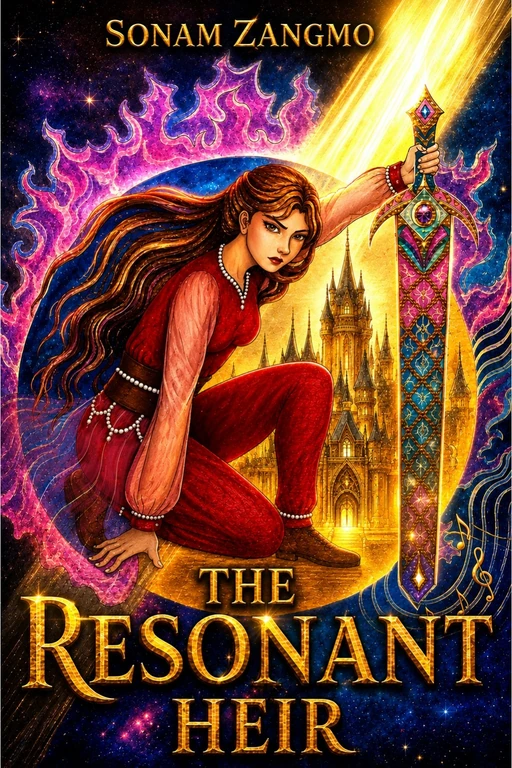
 Explore The Resonant HeirYA crossover royal fantasy · inherited magic · female heir · exile · adventure · Book I Complete
A Literary Commentary on Chapter Twenty-Nine of The Resonant Heir
The Price of Being Saved: A Philosophical Reading of The Coffins of Aulith
On a kingdom preserved at the cost of broken souls, a village searching for someone to blame, and a princess who volunteers to bear an old debt.
Spoiler Notice: Contains spoilers for Chapter Twenty-Nine.
Explore the twenty-one themes in this commentary
- The Price of Being Saved
- Yesterday’s Miracle, Today’s Accusation
- Desperation Is an Explanation, Not an Acquittal
- What the Mage Knows About the Soil
- Five Coffins Without Names
- A Protector Who Can Also Cause Pain
- The Crown Laid Down
- Sion and the Place Where Scent Never Fades
- The War Behind the Covenant
- The Royal Court’s Memory Orbs
- Neither Alive Nor Allowed to Die
- “The Soul Covenant Was a Mistake”
- When the Strongest Claim Becomes Another’s Pain
- One Percent Is Not a Complete Risk Assessment
- The Difference Between Volunteering and Knowing
- Waiting, Blame, and the Burden of Circumstance
- Would Bringing Back the High Lord Mend Aulith?
- The Scar, the Coffin, and the Lightened Blade
- The Words “I Trust My Judgment”
- Sion’s Refusal to Applaud
- The Dawn Before the Vessel
Theme 01 · Philosophical commentary
The Price of Being Saved
The morning after Sion seems to restore dying barley, the fields of Aulith are gray again. Villagers who pleaded for her help now seize her arm and accuse the two travelers of deception. Before the chapter ends, Lyra stands in an underground chamber before five ancient coffins, volunteering to become the vessel for fragments of souls taken fifty years before.
Between these events lies one question with several faces: who must pay when other people need to be saved?
In Chapter Twenty-Nine of Sonam Zangmo’s The Resonant Heir, The Coffins of Aulith, a community’s survival is revealed to have depended upon an old bargain. During the War of the Fae Clans, Aethrador agreed to protect Aulith; the price was borne by its High Lord and four elders, whose souls were partly taken and sealed in Memory Orbs at the royal court.
The people of Aulith have lived on. The five have not been granted an ordinary ending. Now an old mage describes a possible intervention requiring a living vessel, with a chance of success he places at one percent.
Lyra offers herself.
Her courage is unmistakable. What the scene refuses to settle is whether courage supplies everything a moral choice requires.
If an ancient rescue was bought through another person’s suffering, the desire to put things right does not automatically justify risking another life.
The chapter is less interested in announcing a perfect hero than in exposing the human consequences concealed inside words like protection, necessity, and salvation.
Theme 02 · Philosophical commentary
Yesterday’s Miracle, Today’s Accusation
Lyra wakes to overlapping voices. The door bursts open. Hands grab Sion before she can fully understand what is happening.
The villagers accuse the travelers of tricks and order them to come along.
Outside, the green barley of the previous day has withered once more. The sight explains the villagers’ despair without excusing their treatment of two guests who had offered hope.
In The Smith’s Last Gift, Sion promised only to try. She never claimed complete knowledge of the strange recovery and did not guarantee that the crops would remain green.
Yet a few living stalks had already become, in the villagers’ imaginations, a possible answer to years of insecurity.
The difference between an observed possibility and a promised outcome has collapsed.
That collapse is understandable in human terms. People frightened by hunger may seize upon any indication that the future can change. Their disappointment can be correspondingly fierce when the indication fails.
But disappointment does not establish fraud.
The person credited with a miracle should not automatically become the person blamed when the miracle cannot be repeated.
The chapter’s abrupt opening turns the last chapter’s closing unease into action. Lyra had sensed something troubling not in Sion but in the people surrounding her. Now the crowd’s need is being transformed into an accusation against the girl who had tried to help.
Theme 03 · Philosophical commentary
Desperation Is an Explanation, Not an Acquittal
Aulith’s villagers are not strangers to hardship.
The earlier chapter showed dry soil, failing irrigation channels, damaged wooden gates, and a demand that half the harvest be surrendered for military needs. Here one farmer says the King has spared them the tribute this year, but the relief has not been enough.
That new detail matters. Their suffering cannot be reduced to a single unchanged tax policy, and the text gives no full account of the decree or its administration.
Nor does it explain exactly what drained the soil.
The farmers confront a shortage they cannot easily repair. They have reasons to feel abandoned and afraid.
A sympathetic reading should allow those reasons their full weight.
But sympathy must not erase the moral distinction between being hurt and hurting someone else. When the farmers grab Sion, refuse to answer Lyra’s question, and demand punishment, they impose a cost on people whose guilt they have not established.
They have become vulnerable to the temptation of a scapegoat: a person upon whom fear and disappointment may be concentrated because doing so seems easier than confronting a condition no one understands.
To understand the causes of cruelty is not to declare the cruelty justified.
The villagers deserve help with food and water. Sion deserves safety and the opportunity to speak. Those claims can be true at the same time.
Theme 04 · Philosophical commentary
What the Mage Knows About the Soil
In the underground chamber, the old mage passes a dim light over Lyra and Sion, then announces that the crops died because the soil has been drained.
His statement is more precise than the villagers’ accusation.
It also leaves the central mechanism uncertain.
Drained of what? Water, fertility, an invisible magical resource, or something not yet named? The chapter does not say. Nor does it establish that the Soul Covenant caused the soil’s condition.
The preceding evening’s event remains equally uncertain. Sion poured water while Lyra’s new sword stood point-down in the earth. The blade trembled as nearby barley revived. That sequence invites attention to both girls and to the weapon, but it is not proof of a single cause.
The mage may know more than he explains. His magic and later account demonstrate unusual knowledge. Nevertheless, a statement by a character does not by itself supply every missing causal step.
This uncertainty is central to the villagers’ moral failure. They have moved from an unexplained disappearance of green growth to a demand that two strangers be punished.
The urgency of finding someone responsible cannot substitute for finding out what actually happened.
A community can need answers desperately and still owe suspected people the courtesy of evidence, explanation, and a chance to be heard.
Theme 05 · Philosophical commentary
Five Coffins Without Names
The villagers bring the girls through a narrowing stone passage whose damp walls bear moss and rot. Water drips into the hollow silence.
The chamber beyond holds five coffins: one finely carved at the center, with four smaller companions.
There are no names.
This absence is a potent literary detail.
The different craftsmanship preserves hierarchy. A central leader still occupies the place of honor. Yet the individuals themselves remain unidentified to the reader. Their titles and their suffering will be revealed before their personal lives.
The arrangement resembles the selective memory of a society that records offices, bargains, and wars while forgetting the particular people caught within them.
The chapter does not claim that every record of their names has disappeared from Aulith, or that someone deliberately erased them. The namelessness belongs to what this chamber presents.
But its emotional force is clear. These are more than units in an old political calculation.
The High Lord and four elders had bodies, histories, and relationships not reducible to a clause in a covenant.
When sacrifice is remembered only as an amount paid, the people who paid it risk being remembered as currency rather than as lives.
The stone coffins invite us to look beyond the word price to those upon whom the price was imposed.
Theme 06 · Philosophical commentary
A Protector Who Can Also Cause Pain
When the crowd calls for punishment, the mage strikes his staff against the floor. A low magical pulse silences the chamber.
He says he will see to the matter, and the villagers leave.
At first, this is a welcome interruption of collective aggression. The mage has sufficient authority to prevent the crowd from deciding the girls’ fate through anger alone.
But the protection is incomplete.
Later, when Sion asks why no one has dared to serve as a vessel, he points his staff at her and fires a beam into her chest. She doubles over in pain. No warning, explanation, or request for permission precedes the attack.
Lyra draws her blade and demands to know what he is doing.
These two moments prevent the old mage from being read as a simple embodiment of wisdom.
He can restrain the violence of others. He can also exercise violence himself.
His sorrow for the entombed leaders may be sincere. He bows before the central coffin and confesses that the covenant was a mistake.
But recognizing one injustice does not guarantee that he will avoid creating another.
A person’s devotion to the suffering of one group does not give him moral authority over the bodies of everyone else.
The chapter tests the mage’s judgment alongside Lyra’s. His knowledge is extensive, but knowledge and ethical reliability are not interchangeable.
Theme 07 · Philosophical commentary
The Crown Laid Down
The mage claims to know who the girls are and who stands behind them. He says he has seen their memories.
Lyra does not accept the claim merely because it comes from an imposing elder.
She asks him to identify her most painful memory.
He answers: the moment she set the crown down.
She recoils.
The reaction gives his statement credibility, even though the chapter does not reconstruct the complete circumstances of that moment. We should not infer a formal abdication or a permanently surrendered claim to succession from the phrase alone.
What matters is the type of pain the mage identifies.
Lyra has been burned, threatened, and nearly killed. Yet the memory that arrests her is associated with a crown: the visible emblem of the identity and responsibility into which she was born.
She has elsewhere believed that losing her sword meant losing herself. Here another object seems bound to a profound fracture in her sense of who she is.
The episode offers a sharp contrast with Bramor’s last gift of trust.
The smith believed in the person Lyra was, not merely in a future accomplishment or symbol of power. The mage, without knowing whether he deserves her trust, reaches directly into a memory of a lost symbol.
The things that tell the world who we are may not be the same things that determine our worth.
Lyra is still learning the difference, even as political history repeatedly turns her identity into a matter of consequence.
Theme 08 · Philosophical commentary
Sion and the Place Where Scent Never Fades
Sion hears the word crown and asks who her friend truly is.
Lyra does not answer.
Then Sion asks the mage about her own past. He says she was born in a place where scent never fades.
She is bewildered.
The scene extends a quieter mystery established in Aulith’s fields. Sion told Lyra that her aunt never explained the origin of her parents, only that she did not belong to the fae of Gemariel.
The mage’s new statement adds an image, not a location the reader can identify with confidence.
Its poetic force is considerable. A scent can recall someone absent with surprising vividness; a scent that never fades suggests a place where traces are preserved rather than dispersed.
That is a literary possibility, not an established magical law of the setting.
More important is the asymmetry between the questioner and the man who answers. The mage appears able to reach information about Sion that she cannot independently verify.
This power could help her understand her origins. It could also make her dependent upon his interpretation of them.
Knowing something another person longs to know about herself gives us a responsibility not to use her uncertainty carelessly.
The mage offers a riddle and immediately redirects the conversation toward his own ancient grief. Sion’s wish to understand her beginning remains unanswered.
Theme 09 · Philosophical commentary
The War Behind the Covenant
The mage places Aulith’s catastrophe fifty years in the past, during the War of the Fae Clans.
Aethrador stood above the combatants, he says, and Aulith’s High Lord knelt before him. Lyra recalls an image of a kneeling man from a missing page of an epic: the man was before her grandfather.
This relation matters. Aethrador is identified here through Lyra’s memory as her grandfather, not as the father whose support she later wonders about.
Aethrador agreed to protect Aulith. The High Lord and four elders paid a terrible price.
The account gives us the outline of a political bargain without its entire history. We do not know who first proposed each clause, what alternatives were available, or whether all five fully understood that their souls would remain divided.
Nor does the agreement itself tell us whether Aethrador’s military purpose was just in every respect.
The scene’s power comes from the distance between the language of protection and the fate of the protected leaders.
Aulith endured. The leaders did not return to the life they had known.
History can record a rescue while leaving the moral meaning of its conditions painfully unresolved.
A descendant now stands before the human remains of an agreement made by an ancestor. She did not negotiate that agreement, but she cannot pretend its consequences are irrelevant to the world she hopes to help govern.
Theme 10 · Philosophical commentary
The Royal Court’s Memory Orbs
The mage strikes the floor and sends a thin line of light connecting the five stone coffins.
Part of each leader’s soul, he explains, was torn away and sealed in Memory Orbs held at the royal court.
The name Memory Orbs is important. They are not explained here as simple memorial keepsakes. According to the mage, they contain fragments of living spiritual identity taken as a covenant’s price.
The text does not reveal how those objects were made, who currently controls each one, or whether their apparent relationship to memory permits the stored fragments to speak or remember in any familiar sense.
We know only the terms presented by the mage, the disturbed light in the chamber, and his account of those still held.
That is enough to produce an unsettling picture of sovereign power.
The court has preserved a part of its allies or subjects in objects that the people entombed cannot freely leave.
Whatever the original purpose, the result resembles the treatment of persons as collateral: something held to ensure that an agreement remains in force.
A political power that can hold part of another person’s being as security has crossed a boundary far more intimate than the possession of land or tribute.
The orbs give fantasy form to a question with ordinary ethical force: what cannot rightfully become property merely because a powerful institution knows how to possess it?
Theme 11 · Philosophical commentary
Neither Alive Nor Allowed to Die
The five bodies rest in stone, but the mage insists that part of each soul remains held elsewhere.
They are not alive.
Yet they are not allowed to die.
This is the chapter’s darkest description of the covenant.
The problem is not simply that death occurred. It is that the ordinary distinction between living and dying has been interrupted. The leaders remain in a condition the mage describes as prolonged captivity.
He says that, after the High Lady took up the mantle, he returned to this chamber and has heard them calling his name every day.
His report does not explain exactly what consciousness the fragments retain or what those calls sound like. But it makes the situation more than a ceremonial entombment.
If his account is true, the suffering continues.
A bargain that once preserved a region has denied its makers a final release.
To prolong existence is not necessarily to preserve a person’s dignity, agency, or peace.
The horror of the coffins lies in their denial of a completed life. They are the visible form of a past that could not end when the war ended.
That does not prove the covenant caused Aulith’s failing harvest. It does make clear why the mage sees the price of survival as an unresolved wrong.
Theme 12 · Philosophical commentary
“The Soul Covenant Was a Mistake”
Before explaining the ritual, the mage kneels and presses his forehead to the central coffin.
He confesses to the High Lord that the Soul Covenant was a mistake.
The words carry the weight of fifty years spent beside an uncorrected consequence.
They also reveal an important distinction between regret and repair.
The mage can name the wrong. He can mourn those who suffered. He can silence a crowd preparing to harm two strangers.
But he cannot restore the five merely by declaring that the agreement should never have been made.
The cost continues to exist.
His confession also does not establish that he personally wrote the covenant or possessed the authority to prevent it. The story has not told us his exact part in the original bargain.
What can be said is that he now recognizes something grievous in its outcome.
A society may inherit the benefits of an old decision while leaving the suffering created by that decision untouched.
Such inheritance need not make every later citizen personally guilty of the original act. Yet the continued harm can still demand a response.
The difficult question is what kind of response might truly put things right. Regret is not enough; an attempted remedy that creates fresh victims may not be enough either.
Theme 13 · Philosophical commentary
When the Strongest Claim Becomes Another’s Pain
Sion asks why no one has attempted the proposed rescue.
The mage answers not with words but by striking her chest with magical light.
When Lyra challenges him, he dismisses Sion’s pain as nothing compared with what the five leaders have endured for fifty years.
The comparison is emotionally revealing and ethically flawed.
The captives’ suffering may be greater in magnitude, duration, and severity. That does not erase Sion’s separate claim not to be attacked without consent.
One injustice cannot be made acceptable by pointing to another that was worse.
Nor does inflicting a brief hurt necessarily teach a person what a prolonged spiritual captivity is like. The demonstration may frighten Sion or convey that the matter is grave, but it does not become morally justified merely because the mage feels the old suffering so intensely.
The moment invites comparison with the previous trial in Igsvar, where a ruler arranged conditions under which a soldier was wounded so that Lyra’s character might be tested.
The situations are not identical. Yet in each, a person with power constructs or enforces a supposed lesson using another person’s body.
An honorable goal cannot automatically convert someone else’s unwanted pain into a legitimate teaching instrument.
Lyra’s immediate defense of Sion is therefore significant. Her hand goes to the sword because, in this moment, the person directly threatened is not an ancient victim but her living friend.
Theme 14 · Philosophical commentary
One Percent Is Not a Complete Risk Assessment
Lyra asks the question on which any responsible decision would depend: if someone agrees to become the vessel, will the ritual succeed?
The mage answers that the chance is one percent, provided the will is strong enough.
The number shocks the chamber.
It is also insufficient.
The mage gives an estimate; the novel has not established a tested mathematical probability or explained where his figure comes from.
We also do not know the consequences of failure. Does the vessel die, lose memory, fall into captivity, become permanently divided, or suffer some other outcome? The chapter does not say.
Nor is success defined in full. The proposed vessel would hold soul fragments, but the story has not confirmed that doing so restores the five bodies to ordinary life.
A one-percent likelihood of obtaining an unclear result, under an uncertain failure cost, is not enough information to evaluate the undertaking.
That does not mean a character cannot choose a grave risk for good reasons. It means that the quality of the choice depends on more than a willingness to be brave.
A probability of success cannot tell us whether a sacrifice is justified when the consequences of both success and failure remain unexplained.
Lyra’s question shows that she is attempting to understand. Her later answer arrives before the missing details have been supplied to the reader.
Theme 15 · Philosophical commentary
The Difference Between Volunteering and Knowing
After the coffin and her sword respond to her touch, Lyra announces that she will be the vessel.
No one in the chamber explicitly orders her to make that offer.
The mage asks whether she is certain.
These details matter. Lyra is not seized and placed into the ritual against an expressed refusal. She voices her choice.
Yet choosing freely and choosing with adequate information are distinct achievements.
Lyra has not been told precisely what holding five soul fragments would do to her body or mind. She does not know the outcome of a failed attempt, or whether more than one path to release exists.
There is also a relevant imbalance of knowledge. The mage claims extraordinary access to memories and to the covenant’s hidden history, while Lyra must largely depend upon what he is willing to reveal.
His earlier attack on Sion gives the reader reason to examine his judgment carefully, even if his grief is genuine.
The decision is therefore ethically complicated without being meaningless.
A willingness to bear danger is evidence of courage; it is not a substitute for understanding the danger one has agreed to bear.
The chapter ends before the ritual begins, leaving open the possibility that further information or reconsideration may still matter.
Theme 16 · Philosophical commentary
Waiting, Blame, and the Burden of Circumstance
Lyra reflects on Aulith’s condition and the absence of its former guide.
She remembers distress in the palace, the High Lady’s anger at a wedding, an old woman weeping in the fields, the cracked earth, and the failed harvest.
These images gather into one emotional pattern: a fracture that has never been mended.
Then her thoughts turn to waiting. Waiting became easier, she thinks. When nothing came, blame followed.
The connection to Sion’s ordeal is unmistakable. Villagers who greeted green barley with hope returned in anger when the new growth vanished.
Yet the interior reflection should be read as Lyra’s developing diagnosis, not an omniscient judgment that every farmer in Aulith has chosen passivity.
They continue to work the land. Their irrigation system is physically damaged. Their harvest and tribute place them under pressures the chapter has shown but not fully explained.
The ability of a community to act depends partly on resources, coordination, and political authority, not on attitude alone.
Calling for people to take responsibility becomes hollow if we ignore the conditions that make responsible action possible.
Lyra’s insight has force when it challenges the temptation to blame a supposed rescuer. It must remain open to another question: what would help Aulith’s people regain the capacity to repair their world together?
Theme 17 · Philosophical commentary
Would Bringing Back the High Lord Mend Aulith?
Lyra wonders whether restoring the High Lord would change the situation.
Would the villagers rebuild? Or would they continue waiting for someone else to save them?
She also thinks of the throne and asks whether Aulith would then stand with her father.
The questions show her reasoning widening beyond immediate personal sympathy.
She considers political order, communal responsibility, and the possibility of an alliance favorable to her family.
It would be simplistic to treat these thoughts as proof of cynicism. A young heir may genuinely want to end suffering while also considering the consequences for the realm.
It would be equally simplistic to ignore the political dimension and make her decision an act of compassion untouched by self-interest or inherited loyalties.
The chapter gives us questions, not certainties. The High Lord’s release has not occurred. Aulith has not pledged itself to Lyra’s father. No one has demonstrated that a restored ruler could repair the irrigation, crops, and social trust.
Nor does the mere loss of an old leader make the inhabitants incapable of governing their own lives.
Restoring a figure of authority is not the same as restoring a community’s power to shape its future.
Lyra’s willingness to intervene is brave, but the chapter leaves her to discover whether her vision of repair includes the living people of Aulith as participants rather than only as those who await rescue.
Theme 18 · Philosophical commentary
The Scar, the Coffin, and the Lightened Blade
At the central coffin, Lyra lays a hand upon the stone.
The lid shudders.
Her wrist scar burns. When she withdraws her hand, the trembling stops.
Then the sword responds. A haze spreads—not the old black resentment of the blade’s violent past, but a light haze.
The clustering of these images is significant.
The coffin belongs to an agreement made during an ancient war. The scar belongs to a mystery in Lyra’s own body. The sword is Bramor’s last work, remade from steel once bound to the resentment of the dead.
Past, identity, and newly inherited power appear to answer one another.
Yet the precise meaning remains unspoken. We have no direct confirmation that the five soul fragments have chosen Lyra, that Bramor guides her from beyond death, or that the blade has delivered a command to undertake the ritual.
Lyra interprets the reaction as purposeful. She decides it is not chance and believes she knows what must be done.
A powerful experience can feel like a calling without resolving every question about the calling’s source or cost.
The ambiguity strengthens the episode. The reader can recognize why Lyra is moved without being required to treat her interpretation as infallible knowledge.
Theme 19 · Philosophical commentary
The Words “I Trust My Judgment”
The mage asks whether Lyra is certain.
She looks toward the coffins before answering: she trusts her judgment.
The line is a remarkable echo of Bramor’s farewell. The smith had said he trusted what she was. Now Lyra places her own trust in the mind deciding what she will do.
Self-trust matters. A person expected to lead cannot always wait for a stronger voice to approve every choice.
But judgment is not the same as confidence.
Earlier, Lyra entered the Dead Crown despite Sion’s cautions. Caelor followed her across its bridge after dismissing Nathan’s warning. The two young people survived, but the consequences exposed how easily determination can be mistaken for complete understanding.
Here the risk belongs to a different kind of undertaking, not a physical obstacle that can be measured by lava surges or broken planks.
A living vessel would hold divided souls. The mage himself describes success as exceedingly unlikely. The costs of failure remain obscure.
To trust one’s judgment responsibly includes recognizing when one’s judgment has too little information.
Confidence may be necessary to decide; humility is necessary to keep the decision open to correction.
Lyra has spoken a brave sentence. The narrative has not yet shown whether it is the wisest sentence she could have spoken.
Theme 20 · Philosophical commentary
Sion’s Refusal to Applaud
Sion reacts to Lyra’s offer by touching her forehead, half joking that she is not feverish.
Then she says the choice is not like her.
The gesture provides warmth and alarm in a chamber filled with old grief. Sion knows that Lyra has already taken extreme risks, so her surprise should not be flattened into simple ignorance of her friend’s courage.
She has reason to fear for Lyra, especially after Bramor’s death. A major self-sacrifice has just ended a life close to them. The possibility of another is not an abstraction.
Sion does not deliver a lecture. She does not declare Lyra wicked or foolish. She marks an unexpected decision and tries to understand it.
The friendship matters because heroic narratives can make encouragement sound like the only loyal response to a dangerous vow.
Here affection takes another form.
A friend’s concern may be one of the few voices able to question an act of bravery without denying the bravery itself.
In the chamber Sion has already experienced the mage’s willingness to inflict pain. Her reaction deserves attention even though the chapter does not reveal every reason for it.
Lyra is not the only person whose life this choice may change.
Theme 21 · Philosophical commentary
The Dawn Before the Vessel
The mage studies Lyra. His hands tremble. He strikes his staff, and all five coffins shudder.
At dawn, he says.
The ritual itself remains unwitnessed.
No souls have entered Lyra. No High Lord has been restored. No consequence of success or failure has been confirmed. The story stops at the brink, when agreement has been voiced and danger is approaching.
This ending is effective precisely because the reader is not permitted the relief of a completed rescue.
Lyra has accepted a role she believes is hers. The mage has named a time. Sion remains near a friend whose judgment she has just questioned.
There is still a night between declaration and action.
We should not invent a stated reason for the delay. Perhaps the ritual requires dawn; perhaps other preparations are needed. The chapter does not say. Narratively, however, the interval holds open the question of reconsideration.
Fifty years earlier, a covenant preserved Aulith by leaving five of its leaders divided and confined. Now a new generation seeks to undo that condition by risking another living person.
The desire for mercy is genuine. So is the possibility of repeating the old bargain’s logic.
A rescue cannot be judged solely by the hope it offers; we must also ask who has been asked to bear its danger, what they understand, and whether another path has been considered.
The coffins wait.
So does the reader, wondering whether the coming dawn will end a cycle of sacrifice—or ask another innocent life to carry it.