
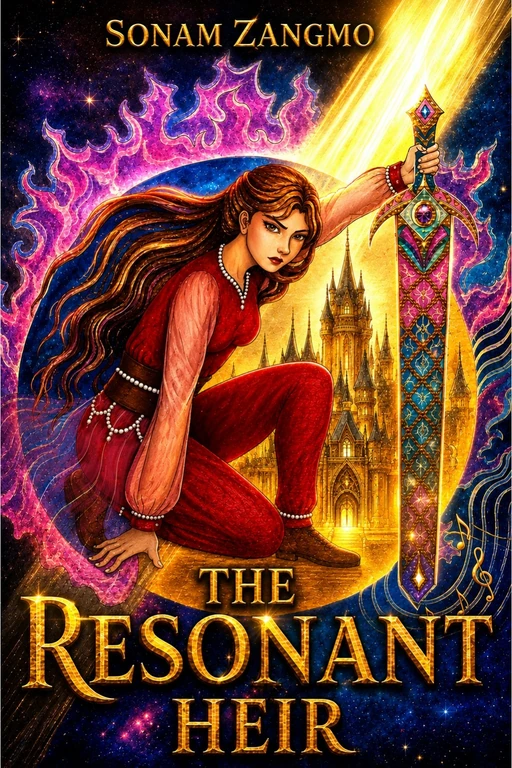
 Explore The Resonant HeirYA crossover royal fantasy · inherited magic · female heir · exile · adventure · Book I Complete
A Literary Commentary on Chapter Thirty of The Resonant Heir
The Will That Remains: A Philosophical Reading of The Vessel of Souls
On a living vessel, the voices of unfinished lives, and the right to remain oneself while bearing the suffering of others.
Spoiler Notice: Contains spoilers for Chapter Thirty.
Explore the twenty-four themes in this commentary
- When Rescue Threatens the Rescuer
- A Dawn Without Warmth
- “If I’m Still Myself”
- Sion’s Old Wound of Not Knowing
- “Stay Away”: The Protector’s Blind Spot
- Trust as a Possible Reward
- The Flesh and Blood of Aulith
- The Last Question Before the Sigil
- Breathing Bodies, Absent Minds
- The Blade Beyond Her Reach
- Two Currents in One Vessel
- Sion and the Wall of Expertise
- Aethrador’s Bargain Seen From Within
- An Anger That Wants a Hand
- A Child, a Voice, and the Grief Beneath Fury
- Hunger, Captivity, and a Land Called Free
- The Voice That Asks for an End
- “Not Mine”: The Boundary of the Self
- Two Hands Behind Her Back
- The Light That Returns to the Coffins
- Sion Is There When the Barrier Falls
- The Mage’s Praise and the Unfinished Accounting
- A Coffin Breaks, but Questions Remain
- Conclusion: The Will That Remains
Theme 01 · Philosophical commentary
When Rescue Threatens the Rescuer
In The Vessel of Souls, Chapter Thirty of Sonam Zangmo’s The Resonant Heir, Lyra enters an ancient ritual intended to restore five leaders of Aulith whose souls were divided under a covenant made fifty years before. The mage has described success as almost impossible. Lyra nevertheless steps into the sigil, aware that something worse than death might await her: she may emerge no longer herself.
What enters her is not simply a quantity of supernatural power. Memories of war, voices of accusation, grief for a vanished child, hunger, captivity, and a longing for release pour through her consciousness. One will urges violence; another longs for death. Her own body begins to move against her wishes.
At the crisis, Lyra must distinguish a foreign desire from her own insistence that she wants to live. She restrains her hands, bears the pain, and the light finally returns toward the bodies waiting in the coffins. The former High Lord jerks upright. Lyra lies weakened in Sion’s arms.
The chapter gives the fantasy of heroic self-sacrifice an unusually intimate complication.
To accept another person’s burden is not necessarily to surrender ownership of one’s own life.
Lyra may help free people denied their autonomy. Yet she can accomplish that only by resisting the possibility that their suffering will erase hers. The deepest battle is not between two warriors. It is between compassion and the dissolution of the self who chose to be compassionate.
Theme 02 · Philosophical commentary
A Dawn Without Warmth
Dawn arrives cold over a limestone slope. Red poppies grow between white gravel, beyond which rusted weapons and broken shields mark a forgotten battlefield.
Lyra and Sion gather the flowers in baskets and fasten them to the white horse. Sion worries that the animal is carrying too much, and Lyra answers with affectionate confidence in his strength.
The modest exchange gives the opening a welcome human texture. The girls have not become ceremonial figures simply because an ancient ritual awaits. They still tease, carry baskets, and depend on a horse that must make the journey back.
But the background is not neutral. Flowers are growing where soldiers once fought and died. The land bears visible traces of violence even after ordinary life has returned.
Later, the mage will describe the poppies as Aulith’s blood. His explanation gives the landscape a second meaning: the beauty of the red blossoms stands beside the history of bloodshed.
The novel does not assert that the flowers are themselves magical memorials or that they contain the dead. Their location is enough.
A country may grow beautiful again without its old suffering becoming unreal.
The morning scene prepares us for a ritual that will force memories normally buried beneath time into the present, through the body of a girl who did not live through the war.
Theme 03 · Philosophical commentary
“If I’m Still Myself”
Sion returns to what the mage said about Lyra’s crown. Is her friend a princess? A queen? She is surely too young to be the latter.
Lyra offers an answer only after the ritual—and only if she remains herself.
This is not the usual conditional farewell before a dangerous journey. She does not merely say that she will explain if she survives. She worries about the persistence of the person who would be able to explain.
In earlier trials, Lyra risked burns, injury, and death. Here the proposed danger concerns memory, agency, and identity.
The five people in the coffins have bodies, but their divided souls leave them without apparent awareness. Lyra may enter their condition from another direction: a still-living body burdened by awareness that is not wholly her own.
The narrative has not stated that she will permanently lose her identity. Her fear remains a possibility, not a forecast.
Yet the line makes an important philosophical distinction.
Continuing to breathe and continuing to recognize oneself are not the same question.
For a princess whose value has repeatedly been judged by magic, a sword, and a crown, the possibility of losing the inward continuity of her life is more intimate than any lost symbol of rank.
The risk is no longer only whether Lyra will live to hold her sword. It is whether there will still be a Lyra who knows why the sword matters.
Theme 04 · Philosophical commentary
Sion’s Old Wound of Not Knowing
Lyra’s promise to explain later awakens a memory in Sion.
Years earlier, her aunt said she would understand her origins when she was older. Sion still does not have that understanding. The mage’s mysterious claim that she was born where scent never fades has given her another fragment without an answer.
Now her closest companion postpones an important truth about herself as well.
We should not equate these situations too simply. The reasons for Sion’s aunt’s silence are unknown; Lyra is about to face immediate danger. Neither is proven to be deceiving Sion for selfish reasons.
But for the girl who hears the words, the resemblance hurts.
Sion wants to understand the people she loves and the place from which she came. Once more, the necessary knowledge seems to live in other hands.
Her response is revealing. Instead of pressing harder about the crown, she suggests that Lyra should not undergo the ritual.
Her friend’s safety outweighs the information she longs to receive.
Care may involve refusing to let our desire for answers become more important than the life of the person who could give them.
The chapter thus allows Sion’s uncertainty about belonging to deepen her compassion rather than reduce her to a character waiting for a revelation.
Theme 05 · Philosophical commentary
“Stay Away”: The Protector’s Blind Spot
Lyra touches Sion’s shoulder and tells her to remain at a distance when the ritual begins.
The words are an act of protection.
Lyra has already seen the mage strike Sion with unexplained magic. She knows that the coming operation is dangerous and wants her friend outside its immediate reach.
Yet Lyra herself is about to stand at the center.
This imbalance echoes the chapters about Bramor. As the old smith worked without rest, Lyra urged him to stop because she feared for his health. He persisted, completed the blade, and died soon afterward.
Now Sion asks Lyra not to proceed. Lyra persists.
The situations are not identical: Bramor knew his craft and made a professional decision, while Lyra has far less information about becoming a vessel. Still, their different willingness to expose themselves to harm deserves attention.
People who wish to protect others can be strangely quick to discount their own right to protection.
Knowing that someone we love should be kept safe does not relieve us of the need to take our own safety seriously.
Lyra’s tenderness toward Sion is genuine. The chapter leaves open whether she has learned how to extend the same tenderness to herself.
Theme 06 · Philosophical commentary
Trust as a Possible Reward
On the way back to the tomb, Lyra’s reflections are unromantic about the undertaking. She understands it as a dangerous gamble.
But she also imagines what victory could bring: Aulith’s trust.
That political possibility was present in the previous chapter. Lyra wondered whether a returned High Lord could rebuild his land and whether Aulith might stand with her father.
The prospect does not cancel compassion. She has encountered an old wrong and people held in an unnatural condition. Wanting to help them is intelligible.
Yet the awareness of a possible political reward complicates the familiar image of sacrifice as action untouched by self-interest.
A ruler or heir may pursue relief for suffering people while also recognizing that relief could change the balance of allegiance.
The chapter neither condemns nor vindicates that combination. It asks readers to remain attentive to it.
When an act of rescue can also secure loyalty, the people being rescued must not be reduced to instruments of political success.
Nor does the hoped-for trust amount to a confirmed alliance. The ritual has not yet happened, the outcome remains uncertain, and the villagers’ response has not been established.
Lyra’s motives are becoming those of a future leader, whose decisions will affect strangers as well as friends. That broader horizon gives her bravery significance—and demands more from her judgment.
Theme 07 · Philosophical commentary
The Flesh and Blood of Aulith
In the chamber, the mage has laid bundles of barley upon the five tombs. He instructs the girls to scatter the poppies around them.
Barley, he says, is Aulith’s flesh. Poppy is its blood.
The language transforms familiar natural things into an image of a communal body.
Barley feeds people. Without it, the families of Aulith face hunger. Poppies bloom near the old battlefield, bringing the color of wounds into a landscape that has outlasted war.
The rite places the life of the fields and the history of battle together before the coffins of leaders who paid a dreadful price for their land’s survival.
The text does not explain whether the plants have specific magical properties. We should not invent an account of how their essence powers the sigil.
Their literary effect is already substantial.
Aulith is no longer an abstract territory to be won, protected, or pledged to a throne. It appears as something made of living bodies, harvested food, and shed blood.
To speak of a nation’s survival without attending to the bodies that sustain it is to leave the meaning of survival incomplete.
The ritual’s imagery makes the cost of the old Soul Covenant tangible. A political bargain was not paid by a map or a flag. It reached into people themselves.
Theme 08 · Philosophical commentary
The Last Question Before the Sigil
The mage traces two overlapping triangles in light, forming an ancient sigil in the air.
Then he asks Lyra whether she regrets her decision.
She breathes deeply and shakes her head.
There is strength in that answer, but it is worth noticing the limits of the exchange.
The mage does not, in this scene, explain the precise physical or spiritual effects of failure. He does not clarify what the divided souls will do inside a living body. The previous chapter gave a one-percent chance of success without a complete account of either outcome.
We cannot conclude that the mage deliberately withholds information for malicious reasons. The novel has not exposed such a plan.
We can, however, see the difference between asking for emotional resolve and providing enough understanding for consent.
A person may feel no regret and still not know what awaits.
The sincerity of a choice does not substitute for the knowledge required to assess its consequences.
That difference matters especially because the person making the choice is young, and the mage possesses expertise she cannot independently test.
Lyra is willing. Whether her willingness has been adequately informed is a question the narrative keeps alive even as the ritual begins.
Theme 09 · Philosophical commentary
Breathing Bodies, Absent Minds
The mage opens the five coffins.
Inside are pale, waxen bodies with hair and beards whitened by decades. Their chests rise and fall in faint, steady motions, but none shows awareness.
The discovery gives physical form to the mage’s earlier account. He said the former leaders were neither alive nor allowed to die. Now we see that their bodies retain some signs of life while ordinary consciousness appears absent.
This is a supernatural condition, not a clinical diagnosis.
The chapter does not authorize us to describe the bodies using a modern medical category or to assume every aspect of thought is gone forever.
Still, the picture is philosophically unsettling.
The men have persisted physically, but they have not participated in the world their bargain helped preserve. Families have aged, fields have changed, and generations have passed while their bodies lie waiting.
Keeping a body from ending is not necessarily the same as allowing the person to live.
The distinction makes the proposed rescue difficult. Restoring movement or breath alone could not resolve a condition already characterized by both.
By the end of the chapter, a High Lord will sit upright. Whether consciousness, memory, freedom, and personhood have been restored remains a separate question.
Theme 10 · Philosophical commentary
The Blade Beyond Her Reach
Before entering the sigil, Lyra places her newly forged sword against the wall and asks Sion to stand beside it.
During the chanting, the blade begins to vibrate within its steel sheath. A high note emerges and finds the rhythm of the pulsing chamber.
The detail recalls Bramor listening to the steel during twelve days of forging. The weapon’s voice seems to respond once again to forces beyond ordinary metal.
Its precise role is unknown. We cannot declare that the sword protects Lyra, channels the souls, or controls the ritual simply because it sings.
But the arrangement has a powerful meaning.
The girl who once declared herself incomplete without a blade now enters the most intimate danger of her journey unarmed.
The sword remains nearby, yet she cannot cut her way out of another person’s memory. Her familiar skill with steel will not decide who controls her arm when a foreign will presses through her consciousness.
A weapon can defend the body from an attacker without solving every threat to the person who lives within that body.
The chapter shifts the meaning of strength away from sharpness and toward agency. Bramor’s gift matters; it is not sufficient to make Lyra’s inner struggle disappear.
Theme 11 · Philosophical commentary
Two Currents in One Vessel
The ritual first produces five pale strands from the brows of the High Lord and four elders.
They enter Lyra.
Then the mage calls for scattered fragments of souls to return to their origin. Colored light races into the chamber from somewhere beyond it and strikes her as well.
The narration distinguishes the two streams: one from the coffins, and one from far outside the tomb.
This is essential to understanding the mechanics without pretending the chapter has explained them completely.
Given the prior account of soul fragments kept in royal Memory Orbs, a reader has good reason to suspect a connection with the distant light. Yet the chapter does not show those orbs opening or trace every strand to an identified source.
What it does show is a convergence too great for Lyra to bear easily.
Her body is compared to a vessel filled beyond its limit. The name of the chapter thus acquires its most distressing meaning.
A vessel is valued for what it can hold. A human being has a life independent of that function.
To treat someone primarily as a container for what others need risks forgetting that the container is also a person.
The crisis is not only whether the divided souls can travel. It is whether Lyra can remain present when more experience than one person can comfortably possess rushes through her.
Theme 12 · Philosophical commentary
Sion and the Wall of Expertise
As Lyra’s knees buckle, Sion runs toward her.
The mage strikes the ground, raising a barrier. Sion collides with it and is thrown back. He orders her to stay away, warning that interference will harm Lyra.
The warning may be justified by the ritual’s demands. Sion does not understand its workings, and the story offers no proof that crossing the barrier would help.
Yet the scene is painful because the mage’s greater knowledge places him in almost complete control of access to Lyra.
Sion cannot verify his reasoning. She can only watch her friend suffer and attempt, unsuccessfully, to reach her.
The mage’s earlier willingness to inflict pain on Sion without consent complicates our trust in his judgment, though it does not prove his present warning false.
The chapter avoids making the older man either an unquestionable savior or an obvious fraud.
Expertise can create legitimate reasons to limit intervention, but it also increases the expert’s responsibility toward the person placed in his care.
Sion’s helpless movements—standing, sitting, rising again—give the issue its human force. What looks like procedure to the mage is the possible loss of a friend to her.
Theme 13 · Philosophical commentary
Aethrador’s Bargain Seen From Within
The soul-borne visions begin with a battlefield: flames, bodies, blood, and screams.
Aethrador appears. He declares that Thrudor will protect Aulith, then asks for a piece of a soul as proof of loyalty.
The previous chapter described the covenant through the mage’s historical account. Now the reader encounters a scene within Lyra’s overwhelmed consciousness.
It is a sharper image of the political price of protection.
A sovereign offers security, but the demand reaches into the personhood of those who submit. Loyalty is not expressed only in service or law. It is to be demonstrated by surrendering part of the self.
The vision has persuasive force, but we should not make it the complete record of fifty years of history. It arrives amid the memories and feelings of divided souls, without an account of everything that preceded or followed the exchange.
Nor does the scene establish every motive of Aethrador or every alternative facing Aulith.
Nevertheless, the ethical problem it dramatizes is unmistakable.
Protection becomes morally compromised when it requires the protected to surrender the very agency that protection ought to preserve.
For Lyra, descendant of the old royal line, this is not merely an accusation against history. It raises the question of what kind of power she herself hopes one day to wield.
Theme 14 · Philosophical commentary
An Anger That Wants a Hand
Voices cry that someone is lying, that someone is a hypocrite, that they are hated.
A blade of light forms in Lyra’s hand. She strikes again and again, and cannot stop.
The cries follow the vision of Aethrador’s demand, making that scene an obvious possible source of resentment. But the text does not identify each speaker or definitively name the target of every command to kill.
It shows something more immediate: anger passing from memory into action.
Lyra does not simply hear a report of a historical wrong. Her arm begins to act under a will that does not feel like hers.
This is the danger of receiving another person’s pain without a boundary between understanding and enactment.
Anger at oppression may be understandable. A person who endured decades of spiritual confinement may have abundant reason to condemn the bargain.
Yet the legitimacy of an emotion does not establish the legitimacy of every act it urges.
Acknowledging the wounded person’s anger is different from allowing that anger to use another body as a weapon.
The distinction is especially important for an heir confronting the misdeeds of the past. Lyra may need to hear what was done. She need not surrender all decisions about what must be done next.
Theme 15 · Philosophical commentary
A Child, a Voice, and the Grief Beneath Fury
The vision shifts away from battle.
A three-year-old child laughs and runs around Lyra. Something about the child’s face is painfully familiar. A man calls warmly, the child turns toward him, and then she vanishes.
The pain that enters Lyra recalls the day she left the palace without saying goodbye to her father, only deeper.
After the voices of hatred, the tenderness is startling.
Here the lost world of the covenant is not expressed through ranks or treaties. It appears as a child’s play, a familiar face, and a voice inviting someone close.
We do not know whose memory this is. The child has not been identified as one of the leaders’ daughters, as Lyra herself, or as any named person. The man’s identity also remains unknown.
The emotional significance does not depend on solving the mystery prematurely.
Beneath political resentment may lie grief for ordinary relationships that war and captivity interrupted.
To witness only the anger would be to understand only part of the people Lyra hopes to help. Their suffering also contains attachment, family, and the sense of life that should have continued.
It is one of the chapter’s most humane turns: the cries for vengeance are followed by a memory that asks for nothing more grand than a loved person coming home.
Theme 16 · Philosophical commentary
Hunger, Captivity, and a Land Called Free
The visions move again: ruined barley, cracked ground, and starving bodies crawling across the earth.
Then a voice within Lyra rejects entrapment in a sphere and declares that Aulith will not live as slaves.
The images bring together spiritual captivity and material deprivation.
The five leaders were divided by the covenant. The people of Aulith have been living among damaged canals, failing crops, and claims upon their harvest. The vision connects these experiences emotionally, even if the causal relationship is not fully established.
We cannot say that the ritual shows an objective record of the current fields, nor that the covenant is the proven direct cause of every crop failure.
But the cry against slavery exposes a political question central to the entire sequence.
Aulith’s earlier bargain brought protection. Did it also leave a form of dependence in which survival was purchased at the cost of freedom?
A community may be kept from destruction and still lack the conditions in which its people can live freely.
The issue reaches beyond a throne or a military alliance. It concerns food, the right to act, and the right not to have one’s continued existence held hostage to another power’s demand.
Theme 17 · Philosophical commentary
The Voice That Asks for an End
The noise of overlapping memories eventually gives way to a thin voice asking to die and to be let go.
The appeal is devastating because the ritual has been framed as a rescue.
The mage wishes to release people trapped for fifty years. Sion asked whether they could be brought back. Lyra agreed to try.
But what does brought back mean to someone who has endured a condition between life and death?
A voice asking for an end might seek freedom from suffering, a peaceful death, an escape from confinement, or something we do not yet know. It is not presented with a clear identity or enough context to establish a settled preference about every possible remedy.
Nor does it prove that all five leaders want the same thing.
The statement must therefore be heard without being converted into a simple authorization for a particular outcome.
A rescuer’s preferred picture of salvation may not be identical to the relief the suffering person desires.
This is the chapter’s most searching challenge to benevolent certainty.
Compassion ought to pay attention to the people it hopes to help, not only to the result the helper can imagine. Yet the novel shows how difficult such attention becomes when voices of pain arrive in fragments, contradicting one another and reaching through another person’s body.
Theme 18 · Philosophical commentary
“Not Mine”: The Boundary of the Self
Lyra’s hand moves to her own throat and tightens without her willing it.
She recognizes the impulse as alien to her own wish to live.
Not mine, she thinks. I do not want to die.
This recognition is the chapter’s clearest moment of moral agency.
Lyra chose to risk herself as a vessel. She did not thereby consent to every foreign desire taking control of her body.
The difference matters. To take someone else’s suffering seriously is not to agree that their despair must become our personal destiny.
The novel renders that distinction as a supernatural struggle, not an ordinary psychological predicament. Its fantasy mechanics should not be reduced to a claim about what determination alone can accomplish in real mental or medical distress.
But as literature it gives form to a fundamental ethical boundary.
To feel another person’s pain deeply does not require us to abandon the conviction that our own life also matters.
Lyra’s insistence is not a retreat from compassion. It is the effort to preserve the person capable of choosing compassion in the first place.
The words are especially moving after her fear that she might emerge without remaining herself. Here, under immense pressure, she names the self she is unwilling to lose.
Theme 19 · Philosophical commentary
Two Hands Behind Her Back
As the visions collide, Lyra forces her arms behind her and locks her hands together.
They slip free. She binds them again.
The physical action is modest by the standards of a fantasy battle. No enemy falls beneath a legendary sword. There is no triumphant display of royal magic.
A girl who has received more than she can bear struggles to keep her own body from doing what she does not choose.
The movement is significant because it does not erase the voices. She cannot instantly command the memories to become quiet or the pain to vanish. Her action preserves only a small remaining area of control.
Yet that small area matters.
In earlier trials Lyra survived by timing movements, recognizing danger, and choosing where to aim. Here she must exercise choice under conditions in which the instrument of choice—her body—is not fully obeying her.
Strength can consist not in imposing our will on others, but in refusing to let another will abolish ours.
The scene is not a promise that sheer resolve solves every problem. It is a vivid literary assertion that accepting responsibility need not mean forfeiting personhood.
Lyra remains determined to help Aulith. She also remains determined not to disappear in doing so.
Theme 20 · Philosophical commentary
The Light That Returns to the Coffins
Lyra screams. Light bursts from her mouth, streams out into the chamber, and drives back into the bodies lying within the five coffins.
The direction of motion completes the visible arc of the ritual. What entered the living vessel now moves toward those from whom parts were missing.
As an image, the return is powerful. The girl no longer holds all the suffering inside herself. Something appears to be moving back to its place of origin.
But the scene does not yet furnish a full account of what has happened to every soul.
We cannot say that all memories are restored, all spiritual fragmentation ended, or all five people have regained ordinary consciousness simply because light travels into their bodies.
Nor can we know whether some residue of their experiences remains in Lyra.
This uncertainty is integral to the chapter’s ethics.
The purpose of rescue is not merely to make the vessel endure. It is to change the condition of the people who needed help without forgetting the condition of the person who helped them.
The success of a rescue cannot be measured only by what leaves the rescuer; it must also be measured by what becomes possible for the rescued—and what remains of the rescuer afterward.
The chapter shows the movement of light, then immediately returns us to Lyra’s fragile body.
Theme 21 · Philosophical commentary
Sion Is There When the Barrier Falls
When the light leaves her, Lyra goes weightless and loses strength.
The barrier in front of Sion vanishes. She rushes forward and catches Lyra.
She asks her not to be gone.
This is a human conclusion to an overwhelmingly magical experience.
The mage has concentrated on an ancient covenant and a ceremony that may free five leaders. Sion has watched one friend endure unbearable pain. She is not primarily calculating the geopolitical meaning of restoring a High Lord.
She wants Lyra to live.
The contrast need not make the mage indifferent. He too hurries toward Lyra and uses a soft light near her chest in an apparent attempt to help.
Still, the two positions illuminate different dimensions of care.
An institution may see a restoration of political authority. A practitioner may see a difficult procedure. A friend sees a particular human being whose loss cannot be replaced by a successful result.
No public benefit makes the life of the person who helped produce it unworthy of private concern.
After Bramor’s death, the point is painfully familiar. Sion’s arms give Lyra something the old Soul Covenant did not give the five entombed leaders: an immediate human presence concerned with her as herself.
Theme 22 · Philosophical commentary
The Mage’s Praise and the Unfinished Accounting
The mage kneels beside Lyra and directs a gentle light toward her chest.
Her eyes slowly clear, but she is still breathing shallowly.
He is moved. Never in his years, he says, has he seen such strength.
The praise tells us how exceptional he judges her endurance. It does not prove that every danger has passed.
Nor does admiration settle whether he fully explained the ritual, whether preventing Sion’s approach was justified, or whether the suffering inflicted upon Lyra was the only possible price of intervention.
His reaction is not meaningless. The tears in his eyes and the effort to attend to Lyra complicate the easy idea of a cold man using a girl as an expendable instrument.
But his earlier decisions remain available for ethical scrutiny.
A person may be sincerely grateful for someone’s courage while still owing that person an account of the risks imposed and the care required afterward.
In the previous chapter, the mage named the chance of success as one percent. Now he sees something that astonishes him. The narrative has not yet explained whether his estimate was accurate or what this outcome means for the broader rules of soul restoration.
The responsible response is wonder joined to caution.
Theme 23 · Philosophical commentary
A Coffin Breaks, but Questions Remain
A loud crack splits the chamber. The central coffin shatters, and the High Lord jerks upright, white hair and beard falling across his shoulders.
It is the chapter’s dramatic final image, a visible reversal of fifty years spent without apparent awareness.
But the novel stops before offering a complete verdict.
The High Lord has moved. Does he recognize anyone? Can he speak? Does he remember the war? What has happened to the four elders? Have their divided souls returned fully, or only in part? How much of the ordeal will remain with Lyra?
None of those questions has been settled by the final movement.
The distinction between physical awakening and full restoration was already present when the coffins were opened: the men had been breathing even while showing no sign of awareness.
The first sign that something has changed is not proof that everything requiring repair has been repaired.
The chapter also leaves Aulith’s fields, the villagers’ distrust, and the old covenant’s political consequences unresolved.
One returned leader cannot by himself repair the whole fabric of a community that has suffered for decades. Whether this awakening becomes the beginning of a just future depends upon what the living choose next.
Theme 24 · Philosophical commentary
Conclusion: The Will That Remains
Lyra began the morning with an uncertain promise to Sion: she would explain her crown if she was still herself after the ritual.
She walked past the remains of a battlefield, gathered the flowers that would be called Aulith’s blood, and entered a sigil that treated her body as a meeting place for divided lives.
Inside her came more than power. There were accusations, a child lost from view, the hunger of a land, the demand for freedom, and a voice longing for an end. At times her body obeyed those foreign impulses instead of her own will.
She had volunteered to become the vessel. She had not volunteered to become no one.
So she recognized the desire that was not hers, insisted she wanted to live, and locked her hands behind her back while the suffering of others still moved through her.
The light returned to the coffins. Sion caught her as she fell. The mage praised the strength he had witnessed. And the High Lord rose.
The novel does not grant us the comfort of knowing yet that every person involved has been made whole.
Its more immediate achievement is to make an ethical boundary visible within a spectacular magical ordeal.
True compassion need not require the disappearance of the person who chooses to care.
Lyra has tried to bear the pain of people denied a voice for half a century. Her courage lies not only in receiving that pain, but in refusing to let it take from her the life that made the choice possible.
The High Lord has awakened. Whether Lyra can now keep her promise to tell Sion who she is—and whether she remains wholly herself—are questions the chapter wisely leaves open.