
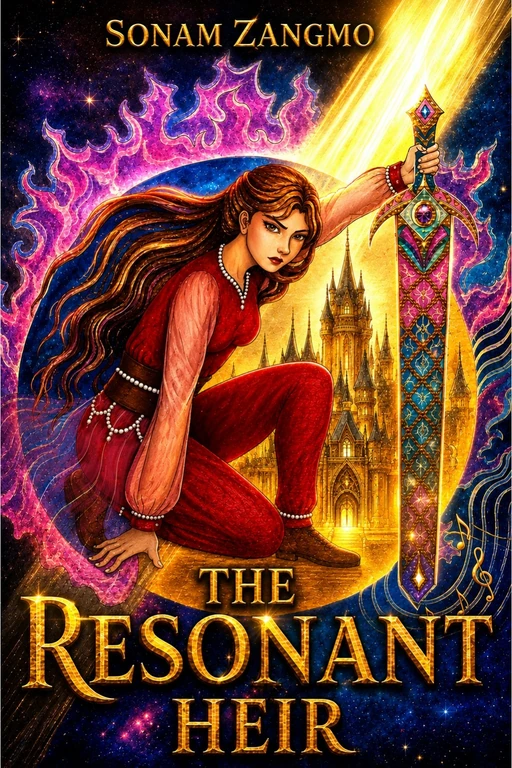
 Explore The Resonant HeirYA crossover royal fantasy · inherited magic · female heir · exile · adventure · Book I Complete
A Literary Commentary on Chapter Thirty-One of The Resonant Heir
The Memory That Power Cannot Own: A Philosophical Reading of The Memory Orb Shatters
On an awakened father, a broken instrument of memory, and the dangerous bargain between political loyalty and the freedom of those we love.
Spoiler Notice: Contains spoilers for Chapter Thirty-One.
Explore the twenty-five themes in this commentary
- When the Orb Breaks, the Bargain Remains
- “Mydrin”: The First Word That Matters
- The Archmage Who Cries Like a Child
- The Body Keeps Time When the Life Cannot
- The Three Questions of a Returned Ruler
- A Hand That Lifts Another Person
- The Palace Loses Its Orb
- The Flowers That Wither in the Court
- A King Who Seals the Room
- The Same News, Two Opposite Meanings
- Riding Through the Land That Still Suffers
- The Daughter Whose Fifty Years Cannot Return
- Melthir Is a Name, Not Merely a Title
- Four Elders, and More Than One Kind of Release
- “There’s Nothing to Repay”
- A Promise Made Out of Elena’s Pain
- The Offer to Break the Orb
- “So He Had Arranged It”: Memory Reinterpreted
- The Value of “Or Coincidence?”
- “Get Me My Sword”: Power Enters the Conversation
- “No Lie There”: Truth and a Person Under Pressure
- Two Secrets, Two Claims to Safety
- The Refusal of Rest After the Ritual
- A Fragment of the Map, Not Yet in Hand
- Conclusion: Memory Beyond the Orb
Theme 01 · Philosophical commentary
When the Orb Breaks, the Bargain Remains
An old man wakes from a stone coffin and calls a familiar name. Far away, a magical orb shatters in the royal palace. A daughter rides through failing fields toward the impossible hope of seeing her father again. Before the chapter ends, a princess has begun to suspect that another politician offered that father’s freedom as the price of an alliance.
These events give Chapter Thirty-One of Sonam Zangmo’s The Resonant Heir, The Memory Orb Shatters, an unusually rich tension. Its emotional center is reunion; its political center is the use of someone’s deprivation as leverage. Both depend on the same object whose destruction gives the chapter its title.
The previous installment, The Vessel of Souls, ended when Aulith’s former High Lord sprang upright after Lyra endured a ritual that threatened to overwhelm her identity. This chapter tells us more: Melthir speaks, recognizes the archmage Mydrin, remembers something of Lyra, and meets his daughter Itharel after fifty years.
At the same moment, the court loses the use of a Memory Orb. Chancellor Syveris is then named as a man who had promised to destroy that orb and restore the imprisoned souls in exchange for Aulith’s political cooperation.
A person’s freedom becomes morally compromised when someone powerful turns the ability to grant it into a bargaining position.
The orb can break in an instant. The institutions, temptations, memories, and unfinished obligations surrounding it cannot be broken so easily. That is the deeper subject of this chapter.
Theme 02 · Philosophical commentary
“Mydrin”: The First Word That Matters
The High Lord’s first words are not a proclamation of authority or a demand for his throne. He asks whether the voice and face before him belong to Mydrin.
This is a profoundly humane opening.
For two chapters, the mage has occupied a strange position. He controlled the underground chamber, silenced an angry crowd, disclosed the Soul Covenant, and directed a ritual whose hazards no one else seemed able to assess. He could be frightening; his attack on Sion in the preceding chapter remains ethically troubling.
Here a familiar name pulls him out of the category of all-knowing magical official.
The person he has spent years trying to release recognizes him.
Mydrin trembles. When he kneels, he weeps openly.
What is restored is not only an important political figure but a living relationship between two people separated by an unnatural condition. Melthir’s voice confirms more than motion or breath could.
Recognition can be a deeper sign of return than the recovery of a title.
A man might rise from a coffin and still be a stranger to himself and others. By speaking Mydrin’s name, Melthir demonstrates a connection between present consciousness and a past shared with someone who remembers.
Yet this does not prove that every memory is intact. The return of one relationship is a beginning, not the complete restoration of fifty stolen years.
Theme 03 · Philosophical commentary
The Archmage Who Cries Like a Child
Mydrin drops to his knees. His sob breaks out without restraint, described as raw and childlike.
The emotional exposure is striking after his earlier displays of command.
His staff subdued villagers. His magic barred Sion from the sigil. His knowledge let him lead Lyra through a procedure he considered almost impossible. But none of those capacities protected him against the grief of long waiting.
His tears help explain why he has become so devoted to the entombed leaders. They do not provide a moral excuse for every decision he made in their name.
In the previous chapter he prevented Sion from reaching Lyra, asserting that interference would harm her. In the chapter before that he deliberately caused Sion pain as a demonstration. Neither action should be declared unquestionably right simply because the man behind it can grieve deeply.
That complexity is a strength of the portrayal.
The ability to feel another person’s suffering and the ability to act justly toward everyone are not the same virtue.
Mydrin’s relief is genuine in the scene. The story allows us to welcome it without abandoning our questions about what responsibilities accompany knowledge and magical authority.
His tears do something else as well: they reveal a private life behind the supposedly impersonal machinery of the Soul Covenant. The past has not been a historical puzzle to him. It has been a wound he carried.
Theme 04 · Philosophical commentary
The Body Keeps Time When the Life Cannot
Melthir raises his hands, studies them, touches his face, and runs his fingers over his beard. He wonders aloud whether he has become old.
Few details are more poignant.
For half a century, he has been held between states that the old mage described as neither living nor permitted to die. In the last chapter, his body still breathed without apparent awareness. Now he can experience the body that endured while his participation in ordinary life was suspended.
Time has visibly marked him even though he could not inhabit those years as other people did.
The old High Lord has not stepped out of the stone unchanged. Nor does the reunion return him to an earlier version of Aulith. The war he remembers is over. The king who made the covenant is dead. His daughter has governed in his absence.
To be released from captivity is not to be given back the time captivity consumed.
This distinction gives the rescue more dignity than an effortless magical reset would have allowed. Melthir may be free to choose again, but he must now face a future altered by a past in which he was unable to choose.
The novel does not specify every bodily consequence of his restoration. The whitened hair and shocked question are enough to register a loss that victory cannot fully compensate.
Theme 05 · Philosophical commentary
The Three Questions of a Returned Ruler
Melthir asks where Aethrador is. He learns that Aethrador has died.
He asks about the war. It is over; Thrudor now rules, and Aethrador’s son Eryndar sits on the throne.
Then he asks after his daughter, Itharel.
These questions move across three layers of continuity: the sovereign who stood behind the covenant, the political world shaped by the conflict, and the family from which Melthir has been separated.
They also establish a distinction important to the larger story. Aethrador belongs to the previous royal generation, while Eryndar is the reigning monarch. Lyra’s contemporary struggle unfolds in a world governed by the descendants of those involved in the original bargain.
Inheritance creates responsibility without making every descendant the author of an ancestor’s actions.
Lyra did not negotiate the fifty-year-old covenant. Neither does the present king become identical to Aethrador simply because his dynasty has survived.
But the continuing consequences of the agreement are now part of the world they inhabit.
A person may inherit the benefits and burdens of a political order without inheriting personal guilt for every act that created it.
The difficulty for a future ruler is to distinguish the past that cannot be undone from the present obligations that can no longer be ignored.
Theme 06 · Philosophical commentary
A Hand That Lifts Another Person
When Mydrin kneels, Melthir pulls him upright.
Later, when the High Lady kneels in gratitude before Lyra, Lyra also raises her to her feet.
The repetition is easy to miss amid the revelations that surround it. Yet the gesture gives the chapter a small visual vocabulary of authority.
Both Melthir and Lyra possess a rank that others acknowledge by bending before them. Neither needs to let the posture continue in order to prove it.
To lift someone up does not abolish the political hierarchy, and it cannot guarantee that a ruler is benevolent. A person might make such a gesture and still behave coercively in another scene.
Indeed, Lyra will soon call for her sword in a confrontation with Itharel, changing the air of the chamber.
The paired acts therefore offer an ideal rather than a verdict.
Authority need not derive its dignity from keeping other people physically lowered.
A ruler might be strongest when secure enough to recognize another person’s standing without demanding constant performance of submission.
That possibility gains force against the background of Aulith’s covenant, in which protection was tied to an invasive demand for loyalty. The restored High Lord begins not by extracting another concession, but by reaching toward a man who has waited for him.
Theme 07 · Philosophical commentary
The Palace Loses Its Orb
At the instant Melthir recalls Lyra’s presence in his memories, the narrative cuts to the palace.
A shock spreads. The Memory Orb has shattered. The flowers around it have withered, and no one can call up memories through it anymore.
The shift in location is a sharp structural choice. One chamber witnesses a recovered person; another witnesses the destruction of an instrument.
The reader is invited to connect these events, though the chapter does not map every technical stage of the magic. It does not establish that all the court’s methods of accessing memory have vanished, or that every detail stored in every possible orb is lost.
It establishes the destruction of this object and its former function.
In earlier chapters, the mage explained that the covenant bound portions of the leaders’ souls in royal Memory Orbs. Here the damaged object is visibly involved in a crisis at the heart of the kingdom.
The loss of the orb can therefore be read as both liberation and rupture: the end of one means of holding the past, and the loss of a way to summon it.
An instrument for preserving memory may also become an instrument for controlling whose memory can be accessed, withheld, or used.
The object is broken. The political questions raised by its use remain untouched by any simple repair of the stone.
Theme 08 · Philosophical commentary
The Flowers That Wither in the Court
The flowers surrounding the shattered orb die.
The detail is brief but resonant. Over the preceding chapters, plants have repeatedly appeared near the limits of life and magical power: Aulith’s barley grew green under inexplicable conditions and then withered again; barley and red poppies became the symbolic flesh and blood of the land in the ritual.
Now a palace object fractures, and flowers nearby lose their vitality.
One might be tempted to propose an elaborate hidden system linking the orb, the fields, the soul fragments, and the plants’ health. The narrative has not yet supplied sufficient evidence for that explanation.
We do not know whether the flowers depended directly on the orb, whether the shock affected them, or whether the events share a more complex cause.
Still, their place in the image does literary work.
The court’s loss of access to memories is accompanied by a visible failure of living beauty. A political and magical disturbance enters the ordinary world of leaves and petals.
The imagery suggests that power has consequences beyond the people who issue its commands, without explaining those consequences before the story is ready.
That restraint matters. Mystery can enrich the world when readers are invited to notice patterns without being instructed to mistake every pattern for a proven mechanism.
Theme 09 · Philosophical commentary
A King Who Seals the Room
The palace erupts in alarm. The king orders the area sealed and forbids the news from spreading.
It is an understandable kind of institutional response to a sudden, unexplained change in a potentially sensitive royal object.
But the chapter does not tell us why Eryndar chooses secrecy.
He may fear an immediate security threat, political instability, or the spread of rumors unsupported by evidence. We should not manufacture a sinister intention without further information.
What the action clearly shows is an attempt to regulate access to news.
The orb may no longer be controllable. Knowledge of its destruction still might be.
When leaders cannot control an event, they may try to control the sequence in which other people learn about it.
This need not always be malicious. There are circumstances in which premature disclosure can create harm. Yet secrecy has a cost: it shifts power toward those permitted to know and away from those directly affected but kept uninformed.
The irony becomes apparent almost immediately. Despite the king’s command, the news reaches Aulith’s High Lady.
The information proves too meaningful to remain only a matter of court procedure. For Itharel, it may be a sign that the life of her father has changed.
Theme 10 · Philosophical commentary
The Same News, Two Opposite Meanings
When Itharel hears that the Memory Orb has fractured, she interrupts her council and rises from her seat.
She immediately asks whether this means something has happened to the Soul Covenant.
Then comes a thought that belongs not to an office but to a daughter: her father.
The chapter presents one event reaching two very different audiences.
At the royal palace, the orb’s destruction inspires alarm and an effort to contain news.
In Aulith, it inspires the terrifying possibility of reunion.
Neither response is complete knowledge. Itharel does not yet know what happened in the underground chamber. Her hope is a response to an indication, not an eyewitness report.
She acts nevertheless.
The difference gives the chapter’s politics a human dimension. What may look like a lost instrument to one group may look like the end of an unbearable captivity to another.
Public events do not have the same human meaning for everyone who lives under their consequences.
A ruler who treats the destruction of the orb solely as a matter of palace order could fail to understand what it has meant for a daughter waiting half a century. And a daughter’s hope, however powerful, cannot by itself explain the whole political impact of the event.
Theme 11 · Philosophical commentary
Riding Through the Land That Still Suffers
Itharel rides toward the mausoleum through fields that have fallen into rot.
The road refuses to let the reader forget Aulith’s present material condition.
The former High Lord may have awakened, but the barley has not suddenly been restored. The water channels have not been repaired. The villagers’ anger at Lyra and Sion has not been answered publicly.
Itharel’s hope grows fragile as she approaches the tomb. The distance between a rumored miracle and an assured reunion makes the journey tense.
The land itself seems to bear witness to the limits of what has been achieved.
Lyra’s ritual has produced an extraordinary change in the state of a person. There is no evidence here that it has solved the harvest crisis or ended every problem associated with the old covenant.
A political community cannot be restored solely by returning the person who once stood at its head.
Leadership matters; people also need workable institutions, food, trust, and the means of taking part in their own lives.
The barren fields therefore remain significant beside the later embrace between father and daughter. The chapter allows one wrong to be addressed without pretending that every other wrong has been repaired along with it.
Theme 12 · Philosophical commentary
The Daughter Whose Fifty Years Cannot Return
Mydrin lights the chamber. The restored High Lord and the High Lady finally see one another.
Melthir speaks her name.
Itharel says father and runs to him.
The embrace is the emotional center of the chapter. After visions of historical bargaining, soul fragments, and ceremonial light, the reader sees two people holding each other while the missing years become unmistakable.
Itharel touches the aged lines on his face. Her hands tremble.
She has spent those years governing, grieving, and living through conditions her father did not witness. Melthir, newly awakened, must meet a daughter who has become the leader of a land once under his own care.
The novel does not need to explain every choice Itharel made in those years for the reunion to matter.
Nor should we reduce the scene to the automatic restoration of a political dynasty. Before he is a High Lord returning to Aulith, Melthir is a father returning to a daughter.
Reunion can restore the possibility of relationship without returning the years in which relationship was denied.
That makes the embrace more poignant than a triumph untouched by loss. The people have found each other again. The time they might have shared is still gone.
Theme 13 · Philosophical commentary
Melthir Is a Name, Not Merely a Title
Only after the reunion does the narrator identify him fully as High Lord Melthir of Aulith.
The name changes how the previous scenes resonate.
In The Coffins of Aulith, the five stone vessels bore no names in the description. The figures within were known chiefly as a High Lord and four elders, the human price of a covenant.
Here the central figure is no longer an anonymous office.
Mydrin recognizes him. Itharel embraces him. He studies his own hands and asks about the people and events from his earlier life.
That personal reality should not be swallowed again by the grandeur of a restored political role.
A High Lord has obligations to subjects. A father has relationships that do not depend on the throne. A captive has a claim to be seen as more than whatever value others assign his confinement.
To return someone from the status of political collateral to the status of a person is a moral achievement distinct from restoring the title that person once held.
The distinction helps us read the later bargain attributed to Syveris. His proposal concerns not merely a useful ancient ruler, but a particular father whose absence has shaped his daughter’s life.
Theme 14 · Philosophical commentary
Four Elders, and More Than One Kind of Release
After greeting Melthir, Itharel looks toward the other coffins and asks whether the elders will return too.
Mydrin shakes his head. Their wishes, he says, have been fulfilled.
The answer deliberately interrupts the easiest version of the rescue story, in which everyone wakes and the spell is over.
The previous chapter carried voices of anger, grief, and a longing for death into Lyra. We do not know which voice belonged to which person, or the precise wishes of each elder.
Mydrin’s statement suggests an outcome different from Melthir’s bodily awakening, but he does not explain exactly what that outcome is.
It would be inaccurate to announce that all four elders have died permanently, that they have been reincarnated, or that they have awakened elsewhere.
Their wishes have been fulfilled: that is the information we have, presented through the mage.
The uncertainty is ethically significant.
To free someone is not always to return that person to the state a rescuer imagines as ideal.
Release may involve different destinations for different people. The obligation of care is not fulfilled by imposing a single picture of salvation without attending to the people concerned.
The chapter refuses to equate successful compassion with identical outcomes.
Theme 15 · Philosophical commentary
“There’s Nothing to Repay”
Itharel kneels before Lyra and says that she cannot repay what the princess has done.
Lyra lifts her and answers that there is nothing to repay. It was her duty.
The words deserve admiration.
Across several recent chapters, Lyra has engaged in transactions: mining for money, obtaining Emberheart to persuade Bramor, undertaking Igsvar’s trial for a map fragment. Her survival has often depended on discovering what powerful people will demand before giving what she needs.
Here she rejects the idea that saving Melthir establishes a debt that must be collected from his daughter.
A person might recognize political consequences to an act while declining to turn gratitude into compulsory payment.
At the beginning of The Vessel of Souls, Lyra understood that a successful ritual could earn Aulith’s trust. That thought makes it inaccurate to describe her as wholly indifferent to political benefit.
But her answer to Itharel still matters.
A deed can serve a larger political purpose without entitling its performer to ownership of the gratitude it creates.
For a future ruler, the difference is fundamental. A community whose safety depends on a leader should not thereby become the leader’s personal debtor. Lyra has, at least in this exchange, chosen the language of duty over the language of purchase.
Theme 16 · Philosophical commentary
A Promise Made Out of Elena’s Pain
The conversation turns toward Elena and Luca’s disrupted wedding.
Itharel admits she let Elena suffer. Then she says she had no choice.
Syveris, she explains, promised that Aulith’s people would be provided for if the region bound itself to the High Commander’s house.
The disclosure places Itharel between the needs of a troubled community and the cost of a political marriage arrangement.
It does not remove her responsibility for her treatment of Elena simply because the community needed help. Nor does it justify dismissing her as a person who felt no concern for those she governed.
Her statement is a confession of failure accompanied by a claim of constraint.
We should distinguish the two.
Feeling that no alternative is available does not establish that every alternative has been examined, especially when another party controls information and resources.
But those pressures can be real even when the decision they influence remains open to criticism.
A leader can sincerely seek the welfare of many people while causing serious harm to one person whose consent or happiness has been subordinated to that aim.
Aulith’s failing fields give the promised assistance weight. Elena’s suffering gives the bargain its moral price. Neither can simply erase the other.
The chapter gains complexity by letting Itharel admit pain rather than describing political necessity as spotless righteousness.
Theme 17 · Philosophical commentary
The Offer to Break the Orb
Itharel then reveals another promise attributed to Syveris.
If Aulith accepted his arrangements, he would destroy the Memory Orb and return the soul of her father and the elders.
This is the chapter’s most troubling political revelation.
The suffering caused by a fifty-year-old covenant has become a condition in a newer negotiation. A daughter who longs to recover her father is told that recovery can be made available in exchange for cooperation.
The chapter does not establish whether Syveris truly possessed the technical means to keep this promise. It does not show his own explanation, and Itharel reports only what she was told.
Still, the reported offer has a clear ethical shape.
The freedom of people held under an old injustice is treated not as a wrong to be corrected, but as a benefit that can be withheld until someone agrees to political terms.
A parallel emerges with the older covenant. In the vision Lyra experienced, Aethrador promised protection to Aulith while requiring part of a soul as proof of loyalty. Syveris now reportedly offers the return of souls in exchange for Aulith’s allegiance.
The transactions are not identical, and the chapter does not prove deliberate imitation.
Both nevertheless expose the danger of making basic human freedom conditional on submission to a superior power.
The orb shatters without the chancellor visibly carrying out his bargain. That may alter the power of the promise; the political expectations built around it remain unsettled.
Theme 18 · Philosophical commentary
“So He Had Arranged It”: Memory Reinterpreted
The name Syveris jolts Lyra back to Elena and Luca’s wedding.
She recalls him standing beside Derron and remembers hearing his voice, a detail she barely registered while watching the bride and groom.
The same memory now looks different.
This is a recognizable experience of retrospective understanding. A detail once assigned little significance can become important when newly discovered information gives it a possible role in a wider pattern.
Lyra begins to suspect that Syveris arranged events behind the visible ceremony.
The story does not allow us to equate that suspicion with proof.
We have Itharel’s testimony about promises involving an alliance and soul release. We have Lyra’s remembered glimpse of Syveris. These are suggestive pieces, not a complete record of who planned the attack on Lyra or every preceding political event.
New knowledge can change the meaning we assign to memory without changing what we actually witnessed.
That distinction matters in a chapter about an orb formerly used to call up memories.
Even without the object, human beings keep interpreting their past. But interpretation is a process, not a guarantee of certainty.
Lyra’s next thought briefly acknowledges exactly that.
Theme 19 · Philosophical commentary
The Value of “Or Coincidence?”
Lyra reviews other events in rapid succession: Rogan’s dismissal, the letter at Elena’s door, and the assassin who appeared during her imprisonment.
Could they all connect to Syveris?
Or could some of them be coincidence?
The small question prevents an emotionally compelling chain from immediately becoming a judicial verdict.
It does not erase the reasons for suspicion. The promise to Itharel gives Syveris an intelligible interest in an alliance. Lyra’s remembered sighting at the wedding provides another reason to look closely at his role.
But neither fact automatically establishes responsibility for Rogan’s removal, the letter, or the attempted assassination.
The distinction is urgent because Lyra is a princess, newly armed and newly aware that people may respond to her rank with fear and obedience.
A mistaken inference from someone with power can harm far more than the person making it.
To suspect responsibly is to remain able to name what would prove the suspicion wrong.
The chapter makes room for a moment of doubt amid justified anger. That moment is not weakness; it is the beginning of the intellectual restraint leadership requires.
The broken orb has deprived the court of one means of calling memories. It has not made every fresh interpretation of those memories true.
Theme 20 · Philosophical commentary
“Get Me My Sword”: Power Enters the Conversation
After the disclosures, Lyra turns sharply to Sion and asks for her sword.
Sion flinches and brings the heavy weapon from the wall. Lyra steadies it with the tip against the stone, its weight suddenly present in the room.
No one is struck.
The change is nonetheless unmistakable. Itharel hesitates as Lyra questions her about what the chancellor said concerning the soul pact.
This is an important development in the sword’s literary life.
Bramor hoped the reforged weapon would no longer be an instrument of slaughter. Lyra has received it as a responsibility bound to his memory. Here it becomes a visible sign of authority during a political interrogation.
The scene does not explicitly say that Lyra threatens to kill Itharel. To treat it as an attempted assault would overstate the text.
Yet the weapon’s presence changes the power relationship among speakers.
Force can influence a conversation without ever being exercised as a blow.
A ruler must sometimes demand answers. But obtaining them in an atmosphere shaped by fear raises questions about how freely another person speaks.
The sword that might protect the weak can also become part of a pressure the strong exert. That possibility deserves attention even when the heroine’s purpose is to discover wrongdoing.
Theme 21 · Philosophical commentary
“No Lie There”: Truth and a Person Under Pressure
Lyra holds Itharel’s gaze. The narration gives her assessment: there is no lie in the High Lady’s eyes, only a soul tightening under pressure.
The moment allows two kinds of recognition.
Lyra sees that Itharel is distressed, and she seems persuaded that the account has been given honestly.
But the text does not identify a newly confirmed, infallible lie-detection ability. Nor could Itharel’s honesty prove the truth of a promise made to her by Syveris.
A person can sincerely report a false assurance she received from someone else.
That distinction protects the scene against an easy collapse of all testimony into certainty.
It also makes room for moral empathy.
Itharel’s decisions affected Elena. Her political position has also been shaped by Aulith’s hardship and by a father held from her for decades.
The reader can recognize her pressure without declaring every decision justified.
An honest account of suffering deserves to be heard, but it does not remove the need to examine the claims and consequences within that account.
Lyra’s stance begins to ease. The scene shows the possibility of authority becoming less coercive as understanding grows.
What she does with the information, however, complicates that movement once more.
Theme 22 · Philosophical commentary
Two Secrets, Two Claims to Safety
Lyra tells Itharel to keep their encounter secret—and the return of Melthir secret too.
Earlier, the king ordered the palace sealed and forbade the news of the Memory Orb from spreading.
The two acts of concealment form a pointed contrast.
We do not know whether their motives match. The king may be responding to a security crisis. Lyra may be trying to protect herself, the returned High Lord, or a political advantage while she investigates Syveris. The chapter does not state her full strategy.
But both responses show how information becomes an object of government.
Once something crucial has occurred, power shifts partly to those who decide who may know, when they may know, and what they may do with the news.
A request for secrecy need not be corrupt. It can protect people from real threats. It can also deny them the knowledge they would need to participate in decisions affecting them.
The ethical meaning of secrecy depends not only on what it hides, but on whom the concealment protects and whose choices it restricts.
Lyra refuses Itharel’s offer of repayment, yet requests silence. The request is not simply equivalent to demanding tribute, but it shows that her rescue has political consequences she is already managing.
The princess is learning to use information as well as steel.
Theme 23 · Philosophical commentary
The Refusal of Rest After the Ritual
Itharel invites the party back to the Citadel for rest and a feast.
Lyra declines. There are matters she must attend to.
The decision sounds characteristic of a determined protagonist, but the recent chapters give it a troubled edge.
In The Vessel of Souls, she endured a flood of alien memories, fought to keep her body from obeying impulses she did not choose, screamed, and collapsed into Sion’s arms. The mage soothed her with magic, but her breathing remained shallow.
In the present chapter, Sion still helps her stand.
We cannot conclude that she is medically unable to travel or that refusing the feast will cause definite injury. Nor is accepting public celebration the same as receiving needed rest.
Still, her urgency recalls Bramor’s refusal to stop after twelve days of forging. He believed his work could not be interrupted, and the cost proved fatal.
Lyra has begun to learn that another person’s extraordinary work does not make that person less vulnerable.
Has she learned the parallel lesson about herself?
Responsibility can include the judgment to stop, recover, and remain capable of serving people tomorrow.
The chapter does not answer. It lets her resolve impress us while leaving room for concern about what that resolve might require of her body.
Theme 24 · Philosophical commentary
A Fragment of the Map, Not Yet in Hand
After the High Lord and High Lady depart, Mydrin stays to pray for the elders.
Then he approaches Lyra quietly and asks whether she seeks a map fragment.
He says he knows where it is.
The final question is immediate and unmistakably characteristic: Lyra asks where.
The scene returns the story to its outward quest after a dense passage through Aulith’s history and the politics of the Soul Covenant.
The search for the Awakening Spring remains unfinished. The girl who set out needing strength still has a destination ahead of her.
Yet the way the information appears is different from the trial Torvak set for a map fragment in Igsvar.
Mydrin volunteers knowledge after Lyra has risked herself to help release those in the coffins.
This timing invites speculation about gratitude or reciprocal trust. But no exchange has yet been offered, no condition stated, and no fragment physically transferred.
We should not claim that Lyra has acquired the fragment or that the mage has revealed its location.
A relationship can open access to knowledge before it becomes clear whether the knowledge will be given as a favor, a bargain, or something else.
The ending preserves both the adventure’s forward motion and the question that has governed the chapter: what will people do with information that someone else desperately needs?
Theme 25 · Philosophical commentary
Conclusion: Memory Beyond the Orb
Melthir awakens knowing Mydrin’s name. Itharel rides through barren fields and embraces a father whose absence shaped fifty years of her life. At the palace, the Memory Orb shatters; flowers wilt, the king commands silence, and a once-functioning means of calling up memories ceases to work.
The object breaks. The memories do not all disappear.
Mydrin remembers his years of waiting. Melthir remembers his daughter and the young princess whose presence he felt inside his memories. Itharel remembers the promises made to her by a powerful chancellor. Lyra remembers the wedding, a familiar voice, and the events she has begun to suspect may be connected.
These memories do not speak with a single infallible voice. Some are direct recollections, some are reports of promises, and some are developing interpretations. They demand care, not automatic certainty.
The central political revelation is also an ethical one. The freedom of people whose souls were divided could be offered as the reward for submitting to someone else’s arrangements. An old injustice had become a tool for creating a new obligation.
Lyra rejects Itharel’s language of repayment, but begins managing dangerous information herself. She lifts a kneeling woman, questions her with a sword at hand, and asks her to keep a return from captivity secret. Her next challenge will not simply be to identify the misuse of power in others. It will be to recognize where the same temptations may arise in her own decisions.
The destruction of an instrument that controlled the past does not by itself end the human desire to control what other people know, owe, or choose.
The Memory Orb has shattered.
Whether the world that allowed souls to become collateral can be changed will depend on the people who remember what happened—and what they decide not to repeat.