
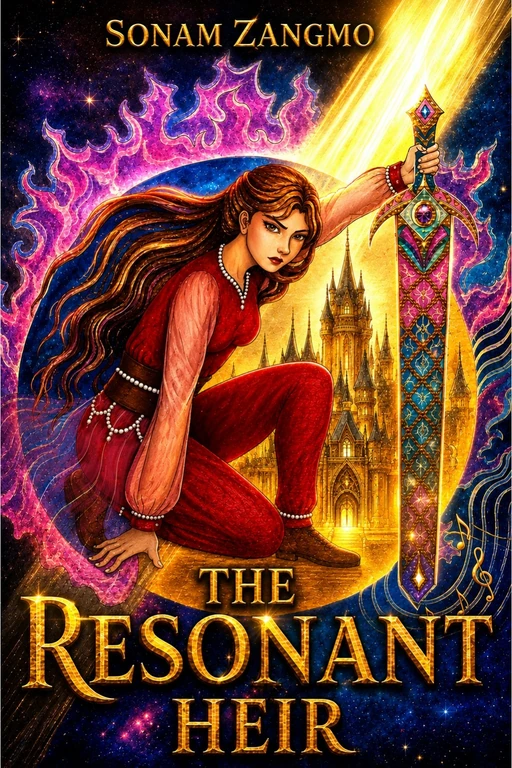
 Explore The Resonant HeirYA crossover royal fantasy · inherited magic · female heir · exile · adventure · Book I Complete
A Literary Commentary on Chapter Thirty-Two of The Resonant Heir
The Power to Refuse: A Philosophical Reading of The Three Poisoned Cups
On immortality, limitless strength, the seduction of knowing every mind, and a young princess who learns to walk away from a gift she cannot trust.
Spoiler Notice: Contains spoilers for Chapter Thirty-Two.
Explore the twenty-seven themes in this commentary
- The Fourth Choice
- A Cave Beyond Sun and Wind
- The Second Wife and Her Own History
- “Aethrador’s Blood?”
- The Needle That Tests Without Asking
- Fine Steel, Unfinished Judgment
- A Table That Is Not Quite Hospitality
- “Not for You”: Sion at the Edge of the Table
- A Deficiency Turned Into a Verdict
- Proving Them Wrong Is Not Yet Being Free of Them
- The Map Hidden in Thread
- A Gift That Arrives with Conditions
- The First Cup: Life Without an Ending
- The Second Cup: A Mind Laid Bare
- The Third Cup: Strength Without Limit
- Three Solutions to Problems They Cannot Solve
- When Mydrin Is Sewn into Silence
- A Host Who Can Withdraw the Exit
- She Watches the Hands, Not the Cups
- Sonareth, Training, Time
- “Sion. We’re Leaving.”
- No Regrets Before There Is a Reward
- What the Spilled Brews Prove
- The Ethics of an Effective Test
- “It Belongs to You”
- “I Don’t Regret Walking Away”
- The Cave Closes Its Eye
Theme 01 · Philosophical commentary
The Fourth Choice
A girl born without magic sits before three cups that promise to erase the limits of human life, knowledge, and strength. She has crossed dangerous country in search of power. The woman offering the cups possesses a fragment of the map she needs to reach the Awakening Spring. To refuse may mean losing that fragment forever.
Yet the crucial choice in Chapter Thirty-Two of Sonam Zangmo’s The Resonant Heir, The Three Poisoned Cups, is not among the three drinks. Lyra stands, calls to Sion, and leaves the cave.
She does so before anyone tells her that refusal is the correct answer.
Only afterward does Mydrin catch up and offer her the map fragment, explaining that the old woman tests those who reach for it. The reversal matters, but it must not swallow the decision that preceded it. Lyra believed she was leaving something essential behind.
The chapter is therefore not chiefly about a heroine clever enough to win a reward. It is about a heroine willing to remain without a reward rather than accept terms she finds dangerous.
Nor does that make the woman who tests her an uncomplicated model of wisdom. The old woman uses an unexpected attack, humiliating remarks about Lyra’s blood, and magical silence imposed on Mydrin. We can admire what Lyra learns without assuming every method used to teach it was just.
The freedom that matters most is sometimes the ability to reject what we desperately want.
For a future ruler, that freedom may prove more consequential than any of the three powers left on the table.
Theme 02 · Philosophical commentary
A Cave Beyond Sun and Wind
Mydrin leads Lyra and Sion to an isolated mountain where jagged stone rises like blades. Mist hangs heavily; the cave ahead has no visible light. From inside comes the repeated click and turn of something working in darkness.
When Mydrin announces himself, bats stream outward. The girls duck and protect their faces. A woman’s voice invites them in, and light suddenly fills the chamber.
The passage stages a movement from the open road into an environment the visitors do not understand and cannot control.
Inside, candles illuminate a spinning wheel. The woman is drawing out thread with one hand. Ordinary domestic labor, rather than a throne or a magical altar, forms the center of the room.
But the chapter will gradually change the meaning of these materials. Thread can bind a secret. A needle can become a projectile. A black strand can sew a man’s lips shut. Shears can cut without a human hand holding them.
The familiar tools of making are also tools of restraint.
This does not establish that the woman literally governs fate, however suggestive a spinning wheel might be. No such power is described.
What the images establish is a person skilled at controlling the terms of encounter: the room, the objects, the timing, and even who is allowed to speak.
Lyra enters a place where another person can manipulate almost every visible thread—but not necessarily Lyra’s final decision.
The cave is less a destination than a concentrated test of what remains hers to choose.
Theme 03 · Philosophical commentary
The Second Wife and Her Own History
Mydrin announces that High Lord Melthir has returned. The old woman’s eyes widen, and she smiles faintly.
His news matters personally as well as politically. Only later does he whisper to Lyra that this woman is Melthir’s second wife.
That detail places her within the history of the Soul Covenant. Melthir spent fifty years in an unnatural confinement before Lyra bore divided souls through a perilous ritual and he awakened. The woman before us belongs to a family directly affected by that absence.
But the nature of her marriage and the circumstances of those fifty years remain largely unexplained. The chapter does not say when she married Melthir, what she suffered, or precisely why she lives in this cave.
Her subsequent hostility toward Aethrador’s blood may be linked to that history. Lyra herself wonders whether the woman was once forced or bound by the High Lord’s soul within the orb. It is Lyra’s attempt to make sense of her, not established background.
Such distinctions matter because complex figures easily become flat when every unsettling action is explained through an invented trauma.
Here the woman is neither a random witch nor a character whose motives are completely known. She is connected to the people Lyra helped, and still chooses to test Lyra in a troubling way.
An understandable reason to distrust someone’s ancestry would not, by itself, give a person the right to endanger that descendant.
Her relationship to the past gives the scene stakes, not a verdict on the ethics of her conduct.
Theme 04 · Philosophical commentary
“Aethrador’s Blood?”
The woman hears that Lyra allowed the spirits to enter her body. She leaves the spinning wheel and approaches.
Her first question concerns Aethrador’s blood.
She touches a strand of Lyra’s hair, circles her, and judges her appearance and bearing. At last she says there is presence in the girl.
The attention is intimate, almost invasive. Lyra has just survived an ordeal that saved Melthir from a condition created under Aethrador’s covenant. Nevertheless, she is assessed first through descent from the man associated with that bargain.
The question recalls a recurrent difficulty of inherited identity in The Resonant Heir. Lyra’s birth marks her for a throne, but also exposes her to judgments about failures and political injuries she did not personally cause.
She is neither free of history nor identical to her ancestors.
The old woman’s observation about presence is intriguing. The term does not by itself establish that Lyra has developed magic, an aura, or another newly revealed faculty. It indicates something the woman detects or believes she detects.
For a girl publicly defined by the absence of magic, even that uncertain recognition carries weight.
A person can inherit a history without inheriting the moral character of everyone who made it.
The scene asks whether Lyra will be evaluated as a bloodline, as a supposed magical deficiency, or as a person whose conduct must speak for itself.
Theme 05 · Philosophical commentary
The Needle That Tests Without Asking
A needle flashes toward Lyra without warning.
She catches the danger in time and raises her sword, knocking the metal aside. It strikes the stone floor. Sion recoils, and Mydrin raises his staff.
The old woman calls it a small test and compliments the blade.
The speed of the exchange makes Lyra’s skill visible without requiring a prolonged fight. She is alert; Bramor’s sword answers her hand; the threat passes.
But the explanation afterward should not be accepted as a moral exemption.
Lyra was not warned that a projectile would be fired at her. The chapter does not specify a guarantee that she could not be injured, nor that the woman had arranged a harmless target.
A test can reveal preparedness while still exposing its subject to a risk she never agreed to bear.
This issue has followed Lyra across earlier chapters. Torvak’s test in Igsvar produced an injured soldier. Mydrin once struck Sion with magic to demonstrate the suffering of the entombed leaders. Each situation differs, but each complicates the assumption that an instructor’s intention settles the ethics of the method.
Calling harm a lesson does not automatically make the lesson fair.
The most interesting reading can admire Lyra’s reflexes and still question the person who made those reflexes necessary.
Theme 06 · Philosophical commentary
Fine Steel, Unfinished Judgment
The woman’s immediate comment is not about Lyra’s moral character. It is about the quality of her sword: fine steel.
The distinction matters.
Lyra has paid for this weapon through a difficult quest to obtain Emberheart, through the labor of Bramor, and finally through the grief of his death. The blade is remarkable. It can intercept the needle with precision.
But the chapter’s main test is not one that the sword can win.
Soon the girl will need to decide whether to accept a power offered under circumstances that threaten her freedom. A blade, however masterfully forged, cannot determine what is worth becoming.
That is part of the chapter’s subtle progression.
Earlier, Lyra treated a sword as essential to her sense of identity. Later, she accepted Bramor’s gift as an obligation rather than merely proof of personal worth. In the cave she keeps the weapon close, hand tightening at the hilt, but ultimately uses neither its edge nor its threat to obtain the map.
The sword protects her against a needle. It is restraint that protects her against the cups.
Possessing an instrument of force and knowing when not to use force are different kinds of strength.
The old woman can praise the metal. The reader is asked to notice what Lyra chooses when metal is not enough.
Theme 07 · Philosophical commentary
A Table That Is Not Quite Hospitality
After the attack, the woman’s expression warms. She invites the visitors to sit and pours tea.
For a moment the scene resembles hospitality: guests in a candlelit chamber, a host at her table, a familiar ritual of sharing drinks.
Mydrin sips his tea and asks for the map fragment, explaining that Lyra has done Aulith a great service and is worthy of the power associated with the Awakening Spring.
The woman agrees, then announces that she has something suitable to offer.
She pushes Lyra’s existing tea away and sets down finely worked cups containing her own brews.
The gesture is small but decisive. An ordinary drink chosen for a guest gives way to drinks chosen by the host for a specific purpose.
An offer is not necessarily coercive merely because it comes from someone in authority. Yet the surrounding actions make this offer suspect: an unexplained attack has already occurred, and the visitor desperately needs an object the host controls.
Hospitality loses its innocence when welcome becomes the setting for a demand the guest cannot comfortably refuse.
The gleam of the tray and the refinement of the cups are not proof of their safety. They are part of the presentation through which the woman tries to shape Lyra’s response.
The scene makes a useful distinction between the appearance of generosity and the freedom of the person being offered a gift.
Theme 08 · Philosophical commentary
“Not for You”: Sion at the Edge of the Table
Sion reaches toward one of the cups. The woman slaps her hand aside.
The brews, she says, are for the princess.
The action excludes Sion physically as well as verbally. She is present with Lyra, but her participation has not been invited. No explanation is offered beyond the distinction between the princess and the friend beside her.
We cannot conclude from this alone that the woman despises Sion’s ancestry or has a specific ideological objection to her. The episode might be connected to the test’s intended subject.
Still, her treatment of Sion is needlessly sharp.
Sion has no political office in the scene. She holds no map fragment, makes no great demand, and appears to possess no authority over the woman. Yet she will soon be the person who most directly warns Lyra against drinking.
That contrast is telling.
Someone can be powerless to set the terms of a situation and still notice what is wrong with those terms.
Wisdom does not become less worth hearing because it comes from the person denied a place at the center of the table.
Sion’s presence also keeps Lyra connected to a relationship in which she is valued as a friend, not primarily as Aethrador’s descendant or a claimant to a throne.
Theme 09 · Philosophical commentary
A Deficiency Turned Into a Verdict
The old woman remarks that all of Aulith knows Lyra was born without magic.
Under the table, the girl grips her sword.
Sion answers quickly that magic is not what makes someone strong.
The woman then invokes a rumor of divine punishment for tainted blood, and goes on to insist that magic proves worthiness for the throne. With it, she says, the king, queen, court, and alliances would honor Lyra without hesitation.
The remarks strike at an old wound. Lyra has lived under the implication that lacking magic makes her deficient, despite her birth as heir.
Yet the reader has been given no reason to accept the woman’s claim of divine punishment as a fact about the story’s world. It is reported as something people say, and Sion recognizes it as rumor.
The rhetorical move is more important than the rumor’s truth.
A person’s involuntary limitation is made to look like a moral failure, then the ability to remove that limitation is presented as the path to public approval.
A standard that makes someone ashamed of a condition she did not choose can render almost any promised cure emotionally powerful.
The three cups will not enter a neutral room. They are offered immediately after Lyra has been reminded of the judgment she has spent her young life resisting.
Theme 10 · Philosophical commentary
Proving Them Wrong Is Not Yet Being Free of Them
Lyra remains silent.
She feels hollow. She needs power, the narration says—not to prove that she is worthy, but to prove the others wrong.
This is one of the chapter’s most revealing distinctions.
Lyra has begun to reject the idea that outsiders define her worth. But she still wants those outsiders to learn that they misjudged her.
The desire is entirely understandable. Public contempt does not disappear from a child’s inner life simply because someone wiser has offered reassurance.
Bramor’s last words gave her trust in the person she already was. They did not erase every year spent hearing that a royal daughter without magic was less than she should be.
There is, however, an unresolved tension.
To organize an entire future around proving a hostile judgment false is still to let that judgment determine the contest.
The wish to answer those who humiliated us can become another form of dependence upon their approval.
Lyra’s silence makes her refusal later in the chapter more convincing. She has not ceased to want recognition. She has not become indifferent to power.
Instead, while the desire remains painfully alive, she discovers a boundary she will not cross for its sake.
That is a more believable form of growth than the sudden disappearance of an old insecurity.
Theme 11 · Philosophical commentary
The Map Hidden in Thread
The woman tosses a pair of shears toward a coil of black thread on the far wall. They begin cutting without a hand guiding them. Light runs through the strands, revealing a tightly bound strip of silk.
She identifies it as a fragment of the map to the Awakening Spring.
Then she gives the fragment a history.
Long ago, she says, the map was divided among four fae houses to keep Aethrador from finding the spring.
The disclosure changes the quest’s moral setting. Lyra is not gathering pieces randomly lost in the world. At least according to this keeper, the map was deliberately separated to restrict access to an extraordinary place.
The text does not specify why Aethrador wanted to find it, what he would have done there, or exactly what the Awakening Spring can bestow. Those possibilities remain open.
Yet the historical decision poses a real question: who ought to have access to a form of power that others once judged dangerous in particular hands?
Restricting access to power can protect a community, but it also gives gatekeepers enormous authority to judge the people who seek it.
The woman’s test exists inside that unresolved tension. She may be guarding something that should not be given thoughtlessly. Whether her treatment of Lyra is justified is another matter.
Theme 12 · Philosophical commentary
A Gift That Arrives with Conditions
For Mydrin’s sake, the woman says, she will give Lyra the silk.
Then she adds two words: but first.
Drink.
The fragment has been displayed. The object is close enough to be real, yet remains beyond Lyra’s reach. The woman has transformed a stated willingness to give into an apparently conditional exchange.
This is more effective than a simple command because Lyra needs what the woman holds. The prospective cost of refusal is already part of the negotiation.
Mydrin’s appeal establishes that he believes Lyra deserves the map. The old woman retains control of delivery.
The chapter’s later revelation shows that drinking was not, in fact, necessary to obtain the fragment. At this moment Lyra has no way to know that. The condition is therefore experienced as real pressure.
The moral significance of a choice depends on the options a person reasonably believes she has when she makes it.
We should not retroactively treat Lyra’s fear of losing the map as irrational just because the woman eventually sends it after her.
Nor should the happy outcome be used to erase the power imbalance under which the decision was demanded.
Theme 13 · Philosophical commentary
The First Cup: Life Without an Ending
The needle circles the first drink. Its liquid turns black.
The promise is immortality.
For Lyra, death has become intimate. Bramor exhausted himself forging her sword and died. The Soul Covenant kept five leaders in a state between life and death for fifty years. Lyra herself recently feared losing her identity during the ritual intended to release them.
It is easy to imagine why a promise of freedom from mortality could be tempting.
But the woman supplies only the word, not an explanation. Does this mean a body that cannot age, a soul that cannot die, or some other condition? The chapter does not establish any of these mechanisms.
Nor is the drink proven to deliver the result.
The earlier leaders’ condition should not be equated with the immortality offered here. It does, however, remind the reader that continuing to exist is not necessarily the same as living freely or well.
Endless duration cannot by itself supply meaning, justice, or the freedom to choose what kind of life one lives.
Bramor’s brief final days contained care and purpose. Melthir’s stolen fifty years contained absence from family and government.
The difference does not condemn longevity. It asks what a life must contain beyond length if its extension is to count as a blessing.
Theme 14 · Philosophical commentary
The Second Cup: A Mind Laid Bare
The second liquid deepens to green.
Its promise is access to any mind, laid bare.
Of the three claims, this one has special political force. Lyra has just begun connecting unsettling memories of Syveris, Elena’s wedding, Rogan’s removal, a letter, and an attempted assassination.
She has reasons to want certainty.
A power to see another person’s thinking could appear to end the frustration of incomplete testimony. Yet even if the drink worked exactly as advertised, it would raise new questions.
Thoughts are not the same as deeds. Fear, fantasy, regret, suspicion, and intention can exist within a mind without ever becoming action. Being able to witness a thought would not automatically establish what happened outside that mind.
More importantly, a person’s private thoughts are not simply public resources waiting for a ruler to collect.
In the previous chapter, Lyra encountered political struggles over who possessed memories and who could control their release. Here she is offered a power that might reproduce that imbalance inside every individual she meets.
The ability to know another person’s hidden thoughts would not automatically give Lyra the right to expose them.
Near the cave entrance, the woman later advertises this cup as omniscience. That extravagant word should not be mistaken for proven universal knowledge; the original stated offer concerned laying minds bare.
Theme 15 · Philosophical commentary
The Third Cup: Strength Without Limit
The third brew flares orange.
The promise is strength without end.
This is perhaps the most direct appeal to Lyra’s longing. She has spent much of the novel navigating dangers made worse by the absence of magic expected of an heir. She traveled to the Dead Crown for Emberheart and witnessed the terrible cost of Bramor’s work.
The cup seems to compress those hardships into a single drink.
Yet strength without end, even if possible, does not settle what strength should be used for. Power magnifies the consequences of judgment; it does not necessarily improve judgment itself.
Lyra has seen people with greater authority create suffering in the name of protection. Aethrador’s covenant divided souls. Powerful figures have arranged trials in which others were hurt. She herself has experienced the moral difficulty of choosing how to use a weapon when no option is without cost.
A boundless capacity to act would make those choices more consequential, not less.
Power that removes resistance from the world may also remove the warnings that help a person recognize when she is wrong.
The brew’s nature remains unverified. The philosophical danger already exists in the appeal: it invites Lyra to imagine that enough strength can replace the patient work of learning what strength ought to serve.
Theme 16 · Philosophical commentary
Three Solutions to Problems They Cannot Solve
The woman offers the cups separately, then suggests Lyra drink all three.
Why continue toward the Awakening Spring, she asks, if immortality, complete access to minds, and inexhaustible strength could make her the most powerful person in the realm?
The invitation collects three human limitations: death, uncertainty, and weakness.
Each limitation can hurt. A child who wants to protect others has reason to fear losing her life, being deceived, or finding herself unable to intervene.
But the three promised capacities do not directly answer a different set of questions.
What is worth protecting? Whose secrets deserve respect? How should a ruler handle disagreement? When should power be withheld? What debt, if any, does strength create?
These are matters of judgment and relationship, not raw capacity.
The offers are also separated from any clear account of price. The woman calls them tokens of goodwill while the room increasingly suggests that something unspoken is being demanded.
An offer of unlimited capacity can be least trustworthy when it pretends that ethical complexity will vanish once the recipient is powerful enough.
Lyra’s need for power has not disappeared. What she begins to resist is the implication that power, by itself, is the answer to every kind of vulnerability.
Theme 17 · Philosophical commentary
When Mydrin Is Sewn into Silence
Sion leans toward Lyra and whispers that she should not drink. Something feels wrong.
Mydrin draws breath to speak.
A strand of black thread darts from the woman’s sleeve and stitches his lips shut. She tells him to be still.
The moment gives the test its sharpest ethical complication.
Mydrin brought the girls to the cave and has vouched for Lyra. He knows this woman, her connection to Melthir, and perhaps more about the brews than either visitor does. Yet his opportunity to say anything is taken away by force.
The woman may intend to prevent interference with her test. That explanation does not cancel the fact of his imposed silence.
A decision maker who deliberately prevents advice from reaching a vulnerable participant cannot easily claim to have created ideal conditions for free judgment.
Lyra also associates this power with the woman who sealed Ravok’s mouth. The chapter supplies that association as Lyra’s recognition, not as a complete history of why Ravok was silenced.
A choice made under withheld information and enforced silence is not the same kind of choice as one made with access to independent counsel.
Mydrin’s muteness makes the promise of the second cup especially ironic: the host offers knowledge of any mind while depriving an actual person of the ability to express what is on his mind.
Theme 18 · Philosophical commentary
A Host Who Can Withdraw the Exit
Lyra sits with the sword across her lap, ready to draw. The woman nudges the cups closer.
The map is here. The gatekeeper is here. The guardrails around an ordinary exchange are gone.
Lyra has seen a needle thrown at her and a man’s mouth stitched shut. The same person who claims goodwill now controls whether the map fragment will be surrendered.
The scene is not a physical imprisonment in which the exit is barred. Lyra can rise and walk away, as she eventually proves.
But the woman attempts a different kind of confinement. She wants leaving to feel like a disastrous choice, a surrender of a necessary future.
That distinction is important. The pressure falls less upon Lyra’s limbs than upon her sense of what she can afford to lose.
A person can be free to walk through a door and still be manipulated through the fear of what lies on the other side of leaving.
The old woman’s control is formidable. But it depends, at least partly, on Lyra agreeing that this offer is the only meaningful route toward the life she wants.
Lyra’s decisive change begins when she questions precisely that assumption.
Theme 19 · Philosophical commentary
She Watches the Hands, Not the Cups
The narration lingers on Lyra’s body at the table.
Above it she is almost perfectly motionless. Beneath it her foot slides back, slowly and deliberately. She watches the woman’s hands rather than the shining drinks.
The detail is a quiet counterpoint to the spectacle.
An enchanted cup is designed to attract attention. Its color and promise invite the eye to stay on what it might provide.
Lyra instead attends to the source of danger: the needle, the movements, the person who controls the room.
She thinks of a lure with a hidden hook.
The metaphor does not prove she knows exactly what the drinks would do. She does not. It records a reasoned suspicion founded on what she has already witnessed.
This is an improvement in practical judgment, not a discovery of infallibility.
In the earlier Soul Covenant ritual she volunteered despite incomplete information about a one-percent chance of success. Now she takes an absence of reliable information, combined with visible coercion, as a reason to pause.
Good judgment sometimes consists not in knowing the answer but in recognizing that the conditions for accepting an answer are untrustworthy.
The foot moving backward is the beginning of a choice before the words of refusal are spoken.
Theme 20 · Philosophical commentary
Sonareth, Training, Time
Lyra imagines the consequence of leaving: the map may be lost, and the Awakening Spring placed beyond reach.
Then another thought follows. There are other paths.
Sonareth. Training. Time.
The brief list is important because it punctures the woman’s implied monopoly on Lyra’s future.
The alternatives are not easy. Lyra immediately worries that Sonareth would be placed at risk. The chapter does not explain that danger in detail, so it would be careless to invent how Sonareth might be harmed or how the alternative plan would work.
But Lyra does not need a perfect replacement in order to refuse an unacceptable offer. She needs to recognize that her goal and this particular bargain are not identical.
This is the point at which desperation loosens its hold.
When someone presents a single path as the only path, remembering that other paths may exist can restore the freedom to judge the offered one.
Lyra still wants strength. She still wants the spring. She still faces difficult choices with possible costs for others.
Her refusal is not an escape from every obligation. It is a refusal to let one powerful stranger define the only imaginable route forward.
Theme 21 · Philosophical commentary
“Sion. We’re Leaving.”
The chair shoots backward. Lyra stands and tells Sion they are leaving.
It is one of the least ornate acts of heroism in the novel.
There is no counterspell, no sword strike against the old woman, and no brilliant answer revealing that the princess has already solved the magic of the cups.
She simply ends her participation.
Sion stands with her immediately. The two begin to move toward the cave mouth.
The moment matters because Lyra has often advanced through danger rather than away from it. She crossed the Dead Crown to retrieve Emberheart, took Torvak’s difficult trial, and entered a soul ritual with frightening odds.
This time, persistence would mean remaining at a table whose rules she does not accept.
To walk away is not necessarily to admit defeat. It may be to refuse another person’s authority to define victory.
Strength can include the capacity to leave a contest that should never have required our participation.
Her decision also preserves Sion as a companion rather than a spectator. Lyra does not abandon the friend who warned her. They leave together, without trading that bond for the promise of a faster ascent to power.
Theme 22 · Philosophical commentary
No Regrets Before There Is a Reward
The woman calls after Lyra. Does she no longer want the map? Will she feel no regret?
Then she offers another version of the temptation, suggesting that a single drink could grant immortality or omniscience.
Lyra does not return to the table.
Instead she answers that every ambition has its price, and the woman is welcome to that price.
The reply is not a condemnation of ambition itself. Lyra remains ambitious, injured by old judgments, and determined to find power capable of supporting her journey.
What she rejects is the presumption that because her goal matters, any price set by a gatekeeper must be acceptable.
The old woman raises the stakes one last time. Walk out now, she says, and the door will never open again.
Lyra glances at Sion and confirms the decision to leave.
This is the defining moral fact of the chapter.
At that moment, she has not been told that the fragment will be given to her anyway. She expects that the door closing means something real.
A refusal gains particular force when the person refusing believes that refusal may cost her something she cannot easily replace.
The later gift does not create that courage. It reveals that the woman was watching for it.
Theme 23 · Philosophical commentary
What the Spilled Brews Prove
Back inside the cave, the old woman removes the black thread from Mydrin’s lips and sends the strip of silk into his hand.
Then she sweeps the three cups aside.
Their contents spill across the table, hissing as they eat into the wood.
The physical detail gives the title The Three Poisoned Cups a disturbing afterimage.
The brews are dangerous in contact with the table. They are not harmless ordinary tea.
But the chapter does not demonstrate exactly what would happen to a person who drank them. It does not prove that each would kill instantly, or that none could confer the advertised power.
The old woman’s final amusement deepens our suspicion without settling the chemistry or magical rules of her distillations.
A responsible reading should resist filling those gaps with certainty.
At the same time, the image is morally lucid. Elegant silverwork and promises of rare gifts have concealed a substance whose destructive potential is now visible.
What looks desirable inside a beautiful vessel may still demand knowledge of its effects before it can be safely accepted.
Lyra’s decision was made without seeing this evidence. The corrosive spill validates the seriousness of her caution without turning her earlier judgment into supernatural foreknowledge.
Theme 24 · Philosophical commentary
The Ethics of an Effective Test
The old woman orders Mydrin to follow the girls and give Lyra the fragment. He does so.
Mydrin explains that his lady does not give freely. She tests the hand reaching for her gifts.
This is a satisfying reversal of plot, but not a complete ethical defense of the test.
Lyra has demonstrated vigilance, self-restraint, and willingness to sacrifice access to the spring rather than drink what she distrusts. These are qualities worth respecting.
The woman has also thrown a needle without warning, slapped Sion’s hand, invoked degrading rumors about Lyra’s lineage, silenced Mydrin by magic, and threatened to close the only visible route to the map forever.
The outcome tells us something valuable about Lyra. It does not prove those means were necessary or just.
A test may reveal a person’s character while revealing something less flattering about the examiner’s character.
The fact that a harsh lesson produces a good result does not settle whether the harshness was justified.
This distinction has recurred through Lyra’s journey. Authority figures have tested her in ways that endangered or injured people. The novel is most rewarding when we are allowed to assess the ingenuity of a trial and the morality of imposing it separately.
The old woman remains compelling partly because these judgments need not coincide.
Theme 25 · Philosophical commentary
“It Belongs to You”
Mydrin catches Lyra and Sion on the misty path. He is panting, his staff striking the stone.
In his hands lies a narrow strip of silk with dark thread clinging to its edges.
Lyra recognizes the fragment, but does not reach for it immediately.
The mage says his lady has declared that it belongs to her.
The phrase reframes the scene. A moment earlier Lyra believed the woman could deny her access for refusing. Now she is told that the object can be given without drinking.
But the difference is not merely between disappointment and reward.
Lyra has protected her freedom to decide, and the fragment is placed in her hands after that freedom has already been exercised.
Mydrin does not show her the complete Awakening Spring map or reveal what she will encounter at the spring. He gives only the fragment now held in the silk.
The chapter’s happy outcome should not be converted into a universal rule that people who choose well always receive what they need. In real circumstances, and often in fiction, a principled refusal can carry a lasting cost.
A choice should be judged by the reasons available when it is made, not only by the fortune that follows it.
Had Mydrin failed to return, the refusal would still have expressed the same boundary. That is why the scene can be read as a moral victory even before it becomes a practical success.
Theme 26 · Philosophical commentary
“I Don’t Regret Walking Away”
When Lyra finally accepts the silk, she remembers the three offerings: immortality, access to minds, strength without end.
They had seemed like gifts. Yet each, she feels, waited to make her a servant of her own desire.
The phrasing identifies the heart of the temptation.
The woman did not need to threaten Lyra with a sword. She offered to make the girl powerful enough to escape the humiliations and dangers that had shaped her journey.
But a person can become less free not only when force compels obedience, but when a desire becomes so dominant that every other commitment is treated as expendable.
Lyra had wanted to prove those who doubted her wrong. She still has not entirely escaped their judgment. Yet she has prevented that wound from deciding this particular action.
She asks Mydrin to tell the woman she does not regret walking away.
There is no need to boast that she is now strongest, wisest, or invulnerable. She knows what she refused and why.
Maturity does not require the disappearance of desire; it requires the capacity to keep desire from becoming our master.
Mydrin almost smiles and suggests that the woman already knows. His answer leaves the encounter closed without making Lyra return to seek the examiner’s applause.
Theme 27 · Philosophical commentary
The Cave Closes Its Eye
Lyra slips the silk beneath her cloak and mounts her horse. She and Sion travel down the mountain, the cave receding into the mist until its opening resembles a closed eye.
The final image returns us to the chapter’s repeated acts of scrutiny.
The old woman examined Lyra’s hair, body, bloodline, swordsmanship, and response to temptation. Lyra, in turn, studied the woman’s hands, needle, and shifting terms.
Each was watching the other, though not from equal positions of power.
By the final paragraph, the place of examination has vanished from sight. The road opens again.
Lyra carries what she came for, but not the drinks she was encouraged to take. The old wound of being born without magic remains. The journey toward the Awakening Spring remains. So does the need to make further judgments that may be far less clear than this one.
What has changed is not the quantity of power in Lyra’s body but her willingness to refuse a particular route to it.
For an heir who has often felt she must become extraordinary before others will value her, that matters.
The most trustworthy power is not always a capacity added to the self. Sometimes it is a boundary the self learns to defend.
The cave shuts like an eye. Lyra rides on, still seeking strength, yet having shown that she need not submit to every person who promises to give it to her.