
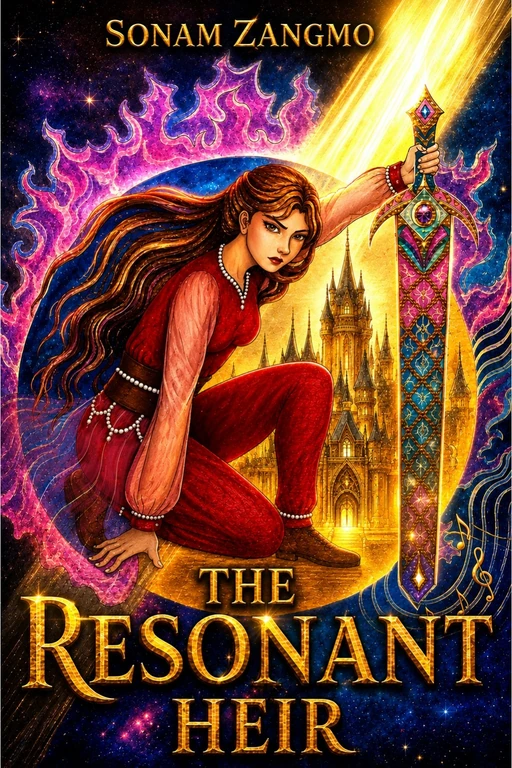
 Explore The Resonant HeirYA crossover royal fantasy · inherited magic · female heir · exile · adventure · Book I Complete
A Literary Commentary on Chapter Thirty-Nine of The Resonant Heir
When Mourning Begins After the Funeral: Grief, Companionship, and the Will to Go On in The Mourning Fire
A town burns the last signs of mourning just as a daughter learns her father has died. Between a broken cup, a remembered sword, and a friend's trembling hand, grief reveals a time of its own.
Spoiler Notice: Contains spoilers for Chapter Thirty-Nine.
Explore the 17 themes in this commentary
- The End of Mourning, the Beginning of Grief
- The King Everyone Knew, the Father Who Did Not Return
- The Shattered Cup and the World That Continues
- Fire in the Streets, Snow on the Face
- The Father Who Cleaned the Blade
- The Blade That Was Already Broken
- The Frozen Lake and the Sword in the Snow
- Sion’s Hand and the Ethics of Not Fixing
- Three Days Outside of Time
- The Map Without a Destination
- A Mother and Daughter Grieving Apart
- The Scar That Pulls
- Bread Before an Answer
- Shadow as an Entrance
- A Friend Who Asks Before Following
- The Door That Does Not Heal
- Conclusion: A Fire Without a Deadline
Theme 01 · Philosophical commentary
The End of Mourning, the Beginning of Grief
The first profound contradiction in Chapter Thirty-Nine of Sonam Zangmo’s The Resonant Heir arrives as a public ceremony concludes. White strips hang from the doors of Drazhune. Residents remove them, press them to their foreheads, and consign them to violet flames. Their mourning period for King Eryndar has ended. For his daughter Lyra, who has only just reached the town, grief has not yet begun—because she does not know he is dead.
The ritual gives collective loss a visible duration. For a community, this is useful: death can be acknowledged, shared, and marked by actions everyone understands. Yet the convenience of a ceremonial ending should not be mistaken for an ending to every individual’s suffering. The same moment belongs to different emotional calendars.
When the server explains that the strips are burned once the mourning period is over, Lyra must first ask which king has died. The answer shatters the distance between the public event and her private life. The town has been living with the news for seven days. She receives it as a fresh wound.
A society can agree that its mourning is finished without having the authority to declare that anyone’s grief must be finished. The chapter’s title, The Mourning Fire, acquires its force through this mismatch: one fire closes a ceremony while another kind of burning begins in the person who has arrived too late to take part.
Theme 02 · Philosophical commentary
The King Everyone Knew, the Father Who Did Not Return
The server’s bewildered response to Lyra is ordinary from his point of view. Why would he lie? Everyone in town knows. He cannot know that the young visitor holding a teacup is the King’s daughter.
There is a painful asymmetry in that exchange. The fact is socially established before it becomes personally imaginable. News has circulated, white cloth has been displayed, the days have passed, and the local ritual is ending. Lyra, whose relationship to Eryndar is intimate, has not been present for any of this knowledge becoming public.
The chapter does not establish that the server intends cruelty or that the Drazhune townspeople have deliberately excluded her. Nor does it explain here who could have reached her sooner. The cruelty is in the circumstances: the world has already adjusted its vocabulary to her father’s death while she still remembers leaving him alive.
This is one of grief’s isolating features. A community may speak confidently of what happened, but the person who loved the dead can experience the same information as something almost impossible to understand. Public certainty does not produce private acceptance on command.
Theme 03 · Philosophical commentary
The Shattered Cup and the World That Continues
When the name Eryndar is spoken, Lyra does not deliver a speech. Her hand trembles; the teacup slips; shards scatter across the floor and hot tea spreads beneath them. Her body reacts before she can decide what to say.
She asks whether the server is lying, then when it happened. These are questions with factual answers, yet their emotional purpose is more desperate: perhaps some detail can make the catastrophe less real. Seven days ago, the server says. The factual answer closes rather than opens an escape.
Lyra places a gold coin on the table to pay for the cup and leaves. The payment is a remarkable little gesture. It does not signify that she has regained her composure. It is one of the ordinary social acts a person may still perform after inwardly losing all sense of order.
A broken cup can be compensated for. A father’s death cannot. The coin pays a debt small enough for the world to recognize and settle, while the enormous loss beside it remains beyond any transaction. The teahouse stays a teahouse; another customer can be served. Lyra’s life, however, has divided into before and after.
Rather than explaining the meaning of grief in abstract terms, the scene places an irreparable event beside a reparable accident. The contrast lets the everyday world appear almost unbearable in its persistence.
Theme 04 · Philosophical commentary
Fire in the Streets, Snow on the Face
Lyra rides past house after house where strips of white cloth burn in purple fire. Snow begins to fall. The wind cuts against her face, and the narrative makes a brief distinction between the cold moisture outside and the salt of tears.
Fire and snow offer a natural contrast, but the chapter’s emotional organization is subtler than simply calling one warmth and the other coldness. The public flames consume the material sign of mourning in a prescribed act. Lyra’s grief, newly awakened, has no comparable mechanism for being disposed of.
Her movement through the town is urgent, almost instinctive. She drives the horse on, as if distance might alter what she has heard. Yet there is no destination where the news will be untrue. The ride does not restore the father she remembers.
The scene reaches a frozen lake in the middle of town, quieter than the streets. Lyra dismounts, drives her sword into the snow, and collapses to her knees. Where the collective ceremony had fire and participation, this personal beginning has ice, silence, and the raw incapacity to stand.
The images need not be reduced to a rigid system of symbols to affect us. Their arrangement is enough. The community burns away a sign; the daughter cannot yet release anything at all.
Theme 05 · Philosophical commentary
The Father Who Cleaned the Blade
In the midst of Lyra’s shock, the narrative returns not to the throne room but to the training yard, rides at dawn, and quiet hours at the northern outpost. Then comes a particularly intimate memory: Eryndar used to clean his daughter’s blade.
The distinction between king and father is essential. To the kingdom, Eryndar’s death is a political and ceremonial fact, one with consequences for succession and rule. To Lyra, he is also a man who cared for a piece of her equipment, an ordinary act repeated often enough to remain with her after he is gone.
Such details are how love often survives in memory. A royal title can be announced, inherited, or transferred. The precise history of a father caring for his daughter cannot be handed over to a successor.
It would be easy in a fantasy adventure to make the death of a ruler matter primarily because of the conflict it unleashes. The remembered blade resists that reduction. Eryndar’s death is not merely the removal of a figure from a political arrangement. It is the end of a relationship lived through private, specific gestures.
A crown can have another wearer. The person who once cleaned Lyra’s sword cannot simply be replaced.
Theme 06 · Philosophical commentary
The Blade That Was Already Broken
The memory is followed by a small temporal reversal: the blade Eryndar once cleaned had broken long ago. The object no longer exists in its former condition, but the tenderness associated with it remains intact in Lyra’s mind.
This detail complicates the idea that mourning means holding on to something physically present. The sword had already been lost to another phase of her life. Lyra had continued to travel and change afterward. Yet the memory of care persisted beyond the material thing.
The earlier break now acquires a different poignancy, although it should not be mistaken for a prediction deliberately planted by fate. Objects break; people continue; relationships accumulate meanings that outlast those objects. Then the person who gave those meanings dies, and ordinary memories suddenly become precious beyond calculation.
The blade’s absence also locates grief in time. Lyra is not grieving only what she has lost today. She is confronting the knowledge that no future morning will add another memory of her father to the ones she already possesses.
That is among death’s most difficult consequences: it does not erase the past, but it closes possibilities that once seemed indefinitely available.
Theme 07 · Philosophical commentary
The Frozen Lake and the Sword in the Snow
The horse stops by the frozen lake. Lyra puts her sword into the snow, falls to her knees, and begins to sob so violently that she folds in on herself. Tears strike the snow and leave little dark dents.
There is no attempt here to make grief noble by presenting it as serene. Lyra’s body is overwhelmed. The sword, usually an extension of her capacity to act, stands apart from her while she cannot rise. The scene gives her neither an opponent to defeat nor a problem that can be solved through the skills she has practiced.
That matters for a protagonist accustomed to confronting danger. An external enemy can be resisted, but the fact of a father’s death cannot be fought in the same way. Lyra’s strength has no direct application to it.
The small marks left by tears offer an extraordinarily restrained image of scale. To the silent landscape, they are slight impressions in the snow. To Lyra, the pain is total. The mismatch expresses something grief can feel like: an event that overtakes an entire inner world while leaving the physical world around it nearly unchanged.
The narrative does not punish Lyra for falling apart. It lets the collapse occupy the page without immediately converting it into new determination.
Theme 08 · Philosophical commentary
Sion’s Hand and the Ethics of Not Fixing
Sion does not rush in with a lesson about courage. At first she stays back, then approaches very slowly. Her hand rises and hesitates. A tear escapes her, too. When she finally touches Lyra’s cheek, the tears she tries to wipe away keep coming.
The detail refuses the familiar fantasy that comfort must succeed at stopping pain. Sion cannot change what has happened. She cannot make Lyra speak, stand, or stop crying. Even the simplest gesture—wiping a cheek—cannot be completed in the way she might wish.
Then the narrative says of Lyra, “But she didn’t pull away.” She does not look up or thank her friend. The absence of rejection is the only response she can give. Sion places a hand on her shoulder, gentle enough not to demand anything in return.
The scene presents care as an offer rather than a conquest. Sion does not try to make Lyra’s grief obey a timetable. She does not measure friendship by whether her touch produces improvement. She stays nearby so that Lyra need not suffer in complete isolation.
Compassion is not always the power to lessen pain. Sometimes it is the willingness to remain present when pain cannot be lessened. The trembling hand is more persuasive than a perfect consoling speech would have been.
Theme 09 · Philosophical commentary
Three Days Outside of Time
At the inn, Lyra does not eat or speak for three days. She lies facing the wall, eyes open, tears continuing after the sobs have stopped. The text observes that day and night no longer feel different to her.
This is not the literal suspension of time. Food is brought, water is changed, the room receives light and darkness. But the ordinary movement of hours has ceased to organize Lyra’s inner life. The future no longer arrives as a series of plans worth anticipating.
Grief can transform time without changing the clock. The person who has died is no longer moving forward with the living, yet the living are forced to keep moving into mornings the dead will never share.
The three days should not be read as a dramatic countdown to an inevitable recovery. The narrative does not claim that Lyra will have finished mourning by their end. Instead it dwells on the weight of time that passes without offering relief.
Sion keeps attending to the necessities of life while Lyra cannot respond. The untouched tray is as revealing as any dialogue: survival continues to demand small acts even when the reasons for undertaking them have become inaccessible.
Theme 10 · Philosophical commentary
The Map Without a Destination
On the third night, Lyra removes three map fragments from her pouch. They belong to her pursuit of the Awakening Spring, a quest that once gave direction to her travel. She traces their lines but cannot decide whether to continue or turn back.
The maps have not changed. Their lines remain where they were. What has changed is the relationship between a route and a reason to take it. “Every direction felt the same,” the narration observes.
Here the chapter touches a distinctly existential problem. Information about where one can go is not the same as knowing why one should go there. A map can organize space; it cannot restore a life whose purpose has collapsed.
Lyra thinks that the Awakening Spring no longer matters and that she wants only her father alive. This need not be treated as a permanent philosophical verdict on the Spring. It is the truth of her experience at that moment. No destination that once attracted her can compete with the impossible wish that Eryndar still lived.
The novel lets the central adventure lose its urgency without treating Lyra as a defective heroine. A quest is meaningful to someone, in a life shaped by relationships and values. When those relationships are shattered, the quest itself can become unreadable.
Theme 11 · Philosophical commentary
A Mother and Daughter Grieving Apart
The preceding chapters offer a quietly devastating parallel. In the sealed Turquias Chamber, the Queen tells Obewich she sees no meaning in eating or carrying on. He brings soup she refuses. When Haris visits with the intention of finding Lyra, she gives him guidance and begins playing her harp again.
In Drazhune, Lyra refuses the food Sion brings and seems unable to imagine a direction worth following. The two women grieve the same man, but their losses are not interchangeable. One has lost a husband; the other, a father. Their separateness is part of the tragedy.
Both are accompanied by someone performing the unspectacular work of care. Obewich carries soup. Sion changes water and sets down food. Neither caretaker possesses a remedy for bereavement. Both continue doing what can be done.
There is also an instructive difference in the events that interrupt their stillness. The Queen receives a credible possibility that someone may find her daughter, and she herself gives concrete instructions. Lyra feels an unexplained pull from her scar. One is offered human news and a chance to participate; the other encounters a supernatural summons of unknown origin.
It is therefore too simple to say that both women have now recovered hope in the same way. Neither is shown healed. The parallel lies in the fragile return of movement and in the care that sustains them until movement becomes possible.
Theme 12 · Philosophical commentary
The Scar That Pulls
A new movement begins not with a declaration of resolve but with the scar on Lyra’s left wrist. It twitches, pulses, grows hot, and seems to draw her toward something. The sensation is different from pain. She feels as though someone is calling.
The text does not identify the caller, explain the force, or promise that obeying it will be safe. Its significance is immediate rather than fully understood: when Lyra has lost the ability to distinguish one destination from another, an otherwise inexplicable sensation gives her a direction.
That creates a real tension between freedom and compulsion. Lyra is not choosing a goal she completely understands. Neither is she simply carried along without decision. She notices the pull, interprets it, and later chooses to follow it into darkness.
Fantasy makes visible a question that also exists in less magical forms. How much of our forward movement begins with something we did not choose—a memory, a need, a summons, an event—and how much is made our own by the decision to answer it?
The chapter does not settle that question. It allows the heroine’s next action to arise from a mixture of agency and uncertainty. An unexplained call is enough to get her attention, but not enough to establish what awaits her.
Theme 13 · Philosophical commentary
Bread Before an Answer
When Lyra tries to rise, she collapses because she has gone without food. Sion catches her and, instead of demanding an explanation, presses dark bread into her hand. Lyra eats quickly. Sion puts the rest into her coat in case they need it later.
This is one of the chapter’s clearest expressions of practical love. Sion does not need to understand the scar’s mystery to recognize Lyra’s weakness. Her response joins the future adventure to the present requirements of a human body.
The bread does not end mourning. Its role is humbler and more exact: it helps make the next action physically possible. Earlier trays returned untouched, not because nourishment lacked importance, but because Lyra could not bring herself to participate in ordinary living. Now, a reason to move makes eating conceivable again.
The order matters. Sion first shares grief without trying to alter it; later she gives food without insisting that grief has ended. At neither point does she claim ownership of Lyra’s decisions.
Good companionship does not replace another person’s will. It helps that person retain the strength to exercise it. The bread is a small act, yet it accomplishes something no solemn lecture could have guaranteed.
Theme 14 · Philosophical commentary
Shadow as an Entrance
The opening of the chapter establishes an unfamiliar truth about Drazhune: a man steps into the shadow beneath a hovering house and appears on its balcony. Lyra realizes that what she regarded as darkness at the base of the building is also an entrance.
Later, after the scar awakens, a black mirror shimmers into being before the two companions. They touch it, and space twists, carrying them beneath the inn’s shadow. The chapter does not identify the origin of this mirror or give a complete account of how the local magic operates.
Still, the reversal is worth considering. What seemed an absence of light becomes a means of passage. Drazhune’s strangeness is not merely atmospheric. It asks Lyra to revise the assumptions by which she understands what a door can be.
This extends the question raised by Chapter Thirty-Eight, Where the Sun Cannot Reach. A landscape without familiar sunlight need not be a landscape without paths. But the fact that an unexpected path exists does not make it benevolent. Shadow can open a route to help, danger, or something not yet classifiable.
Lyra’s encounter with this architecture therefore offers an image of learning under uncertainty: she begins by watching, later participates, and still does not fully understand what she has entered.
Theme 15 · Philosophical commentary
A Friend Who Asks Before Following
The scar leads Lyra and Sion beyond the town, up a vast slope toward a circular opening that emerges from dark mist. Lyra secures the horse and tells Sion to come. Sion catches her wrist and asks, “Are you sure about this?”
It is a brief question, but it preserves the moral individuality of the companion. Sion has nursed Lyra through three days of silence; she has followed her into a realm neither understands. None of that obliges her to suppress concern when they approach an ominous doorway.
Lyra answers that if the opening leads anywhere, she will follow. That is a statement of resolve, not evidence of knowledge. It contains the urgency of someone who has suddenly been offered a direction after a period in which every direction felt equally empty. Such urgency may be understandable without being unquestionably prudent.
Sion hesitates, then follows. Her decision is therefore not simple obedience. She voices doubt, receives an answer, and elects to accompany her friend despite the uncertainty.
Friendship in this scene is neither unconditional agreement nor unilateral control. The two characters are not equally certain, but both remain participants in the choice. The question at the threshold makes their shared journey more credible than silent acquiescence would have made it.
Theme 16 · Philosophical commentary
The Door That Does Not Heal
Beyond the dark opening, sound disappears first, then the familiar weight of their bodies. They find themselves in a vast chamber between black carved columns. A tall, pale-handed figure stands ahead, facing away. His posture seems strangely formed. When his head begins to turn with a faint crack, Sion recoils behind Lyra.
The chapter does not reveal the figure’s identity or intentions. It would be premature to call him an enemy or a savior. What the scene does establish is that Lyra’s return to movement has brought her to another encounter with something she cannot explain.
There is a refusal of easy consolation in this ending. After a devastating loss, Lyra is not rewarded with instant clarity, safety, or a solution to grief. The unknown does not become gentle merely because she has suffered.
Yet the scene is not meaningless repetition of danger. Lyra has moved from collapse, to silence, to a new decision. The return of action is real even if the destination is uncertain. Going on is not the same as having been healed, and encountering another hardship does not erase the significance of having stood up.
That distinction may be the chapter’s most important restraint. The narrative allows grief and adventure to coexist without requiring one to cancel the other.
Theme 17 · Philosophical commentary
Conclusion: A Fire Without a Deadline
The Mourning Fire is built around a painful difference between public time and personal time. A community marks the end of its mourning while the King’s daughter is only beginning hers. The violet flames consume white strips of cloth; nothing in Lyra’s heart is so easily gathered, burned, and finished.
The chapter’s deepest memories are ordinary: dawn rides, quiet time with a father, a sword he once cleaned. Its deepest act of kindness is also ordinary: Sion approaching with an uncertain hand, staying beside Lyra, and later giving her bread. Amid shadow-doors and a mysterious scar, these simple gestures preserve the human scale of the story.
The loss does not teach Lyra a convenient lesson. She does not decide that the Awakening Spring has regained its former meaning, or that Eryndar’s death was necessary for her growth. She cannot make peace with the world merely because the plot requires a new scene. She begins moving because something draws her attention, because she decides to follow, and because a companion helps her find enough strength to go.
The result is a thoughtful refusal to treat resilience as the absence of pain. What survives is not certainty, and not consolation, but the possibility of an action undertaken while sorrow remains.
The town can declare its mourning over. Lyra cannot. But the chapter leaves room for a life that continues without requiring her grief to obey the town’s calendar.