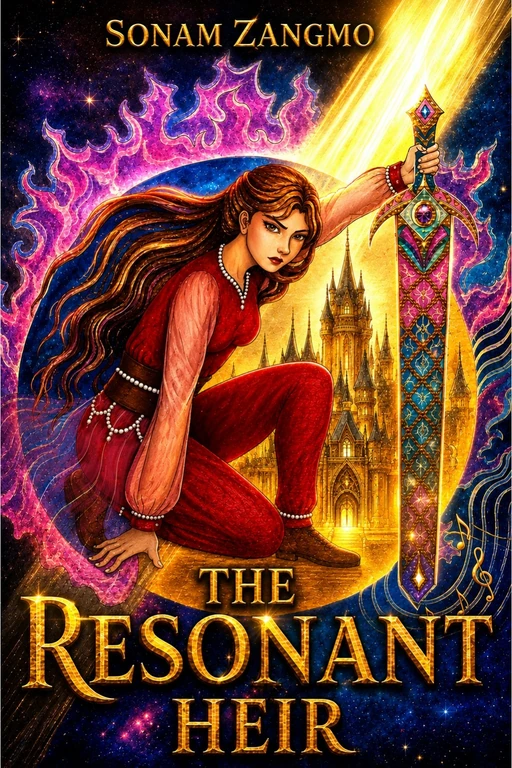
 Explore The Resonant HeirYA crossover royal fantasy · inherited magic · female heir · exile · adventure · Book I Complete
A Literary Commentary on Chapter Forty of The Resonant Heir
When Grief Becomes a Weapon: Guilt, Agency, and Moral Courage in Hooks of Grief
A young princess escapes the hooks that feed on her pain—only to discover that an enemy can threaten what she loves without needing her to believe a single lie.
Spoiler Notice: Contains spoilers for Chapter Forty.
Explore the 17 themes in this commentary
- The Wound Carried Through the Door
- The Double Face and the Displaced Voice
- Summoned, but Not Invited
- Vael’Kharoth and the Risk of Believing an Enemy
- A Wedding Gift, a Relic, and the Economy of Power
- The Father’s Death as an Accusation
- Hooks Without Blood
- Tomorrow as a Threat
- Becoming What You Fight
- Why the Hooks Tighten When She Reacts
- “Let It Go”: The Breath and Its Limits
- Sion’s Second Kind of Courage
- The Sword’s Note and the Return of Action
- Two Brothers, One Outburst of Power
- When a Friend Becomes a Hostage
- What Self-Control Cannot Solve
- Conclusion: The Hooks and the Hand
Theme 01 · Philosophical commentary
The Wound Carried Through the Door
Chapter Forty of Sonam Zangmo’s The Resonant Heir resumes at the instant the preceding chapter left unresolved. Lyra and Sion have followed an unexplained pull into a chamber of black columns, where an unfamiliar figure is turning his head toward them. They arrive not as confident adventurers but as two travelers only recently shaken by the news of King Eryndar’s death.
In The Mourning Fire, Lyra spent three days barely speaking or eating. Her companion stayed with her, tending to the basic necessities of life until a sensation in the scar on her wrist gave her a direction. Movement returned before understanding or consolation. This distinction now becomes crucial: Lyra can walk into the chamber without having ceased to grieve.
The beings inside recognize something of her distress almost immediately. Eirios says he can smell pain. The High Lord of Drazhune later speaks of the grief of many souls. They do not first ask how to help the visitor. They register her suffering as information.
The chapter’s central danger begins in that difference. To be seen in pain can mean being met with tenderness, as Lyra was by Sion. It can also mean being exposed to someone who knows how to make the pain worse. The ability to recognize another person’s vulnerability is morally neutral until we see what the observer chooses to do with it.
Theme 02 · Philosophical commentary
The Double Face and the Displaced Voice
Before any hook strikes Lyra, the scene makes identity difficult to locate. The tall man facing her opens his mouth, yet the voice appears to come from behind him. There hovers a shifting mass without stable limbs, at one moment thick as flesh, at another thin as smoke. Black hooks sway from it with a faint metallic sound.
The man and the creature even tilt at the same unnatural angle, as if their movements have a common axis. Later a second man enters, sharing the first man’s face, hair, and build but not his eyes. The first is Eirios; the newcomer is the High Lord, whom Eirios addresses with deference. The text subsequently makes clear that these two men are brothers.
The effect recalls the earlier chapter Borrowed Face, in which Haris wore Orlas’s appearance without acquiring his life or loyalties. Here similar faces coexist, but what distinguishes their bearers becomes a question of voice, power, and conduct. Eirios’s relation to the hook-bearing entity remains incompletely explained; resemblance and synchronized movement should not be mistaken for a full account of how the magic works.
The dislocated voice creates an unsettling philosophical question: how easily do we assume that the person we see speaking is the source of the words we hear? In this chamber, the outward signs by which we identify an agent are deliberately unstable. The uncertainty prepares us for a confrontation in which words will also pretend to carry authority they have not earned.
Theme 03 · Philosophical commentary
Summoned, but Not Invited
Lyra explains that she was pulled to the chamber. Eirios’s answer is disconcerting: he did not call her. He was reaching toward the darkness in Vael’Kharoth; something within Lyra apparently answered that summons instead.
The scar on her left wrist flickers when shadow passes over it. The creature asks why she bears Vael’Kharoth’s mark. These events establish a connection, but not its complete nature. The chapter does not tell us what answered within her, whether it possesses an intention of its own, or whether the pull was benevolent.
This ambiguity complicates the usual language of destiny. Lyra followed a sensation she could not explain because, after her father’s death, she could no longer find a reason to continue along the known route. She chose to follow it. Yet she did not create the signal, and she did not know to whom—or to what—it belonged.
A person may exercise agency while responding to circumstances never freely chosen. Our past encounters, injuries, and inheritances can present us with possibilities before we fully understand them. The scar becomes a literal expression of that predicament: something Lyra has carried from a previous experience now participates in deciding which doors open before her.
What it does not do is relieve her of the need to judge what happens after she enters. Being summoned is not the same as being obligated to submit.
Theme 04 · Philosophical commentary
Vael’Kharoth and the Risk of Believing an Enemy
The High Lord claims that anyone who touches Vael’Kharoth stirs darkness within and loses the ability to distinguish reality. He further says it was once a Drazhune relic, given by his father to his sister when she married Aethrador. These statements open an important connection to the Umbral Tower, where Lyra recalls having been with Orlas.
But the source of the information is not disinterested. The High Lord is already studying the girls and their reactions, and the encounter soon becomes openly violent. Readers should not convert his account into unquestioned fact simply because it provides a plausible explanation for the scar.
Lyra’s mind immediately returns to Orlas. Did he know what he was leading her into? The narrative makes the emotional consequence explicit: her trust begins to crack. Yet a newly troubling explanation of an old event does not prove another person’s intention. It can create a reason to investigate without delivering a verdict.
Here the antagonist exploits a genuine tension between knowledge and trust. We ought to revise our understanding when new evidence appears. We ought also to ask whether the supposed evidence is reliable, complete, or being selected to produce a particular reaction.
An accusation can be disturbing without being established; a question can be necessary without its most frightening answer being true. That distinction is exactly what Lyra is least equipped to maintain while grieving and under attack.
Theme 05 · Philosophical commentary
A Wedding Gift, a Relic, and the Economy of Power
The account of Vael’Kharoth as a wedding gift is striking because it places a supposedly dangerous relic inside a familiar form of familial exchange. Something described as capable of unmaking a person’s grasp on reality once moved between houses in connection with a marriage.
The text does not reveal the motives of the giver, nor all the terms of that marriage. The gift may have expressed alliance, affection, calculation, or obligations the reader does not yet understand. To select one explanation as definitive would be speculation.
What the High Lord makes clear is his current interest. He calls Syveris his nephew, notes that the Chancellor holds the regency, and wonders whether a future accession might return Vael’Kharoth to Drazhune. The possibility of a throne changing hands matters to him as a route by which an object might be recovered.
That calculation becomes chilling in its timing. Lyra has just learned of her father’s death and can scarcely endure the news. Her interlocutor treats the same death and the uncertain succession as pieces in a discussion of property and power.
For one person, Eryndar is an irreplaceable father. For another, the political situation following his death presents an opportunity. The difference is not simply that politics are less emotional than family life; it is that power can tempt a person to regard other people’s deepest losses as useful circumstances.
Theme 06 · Philosophical commentary
The Father’s Death as an Accusation
The High Lord next makes the cruelest possible use of Eryndar’s death. He tells Lyra that her father died because of her. Nothing in this scene provides evidence for that claim. It arrives as a calculated blow, after the antagonist has already noticed what unsettles her.
The distinction between guilt as a feeling and guilt as responsibility becomes indispensable here. Bereaved people may find themselves imagining what they should have known, prevented, or done differently. Such counterfactual questions can be painful even when they do not describe the actual causes of an event.
The High Lord turns that uncertainty into a sentence pronounced upon Lyra. He supplies a conclusion before establishing a cause. The accusation hurts because it attaches itself to a real attachment: her love for her father and her anguish at having been absent when he died.
Lyra’s suffering is not evidence of her culpability. The strength of a wound cannot prove the truth of a weaponized explanation offered by an enemy. Indeed, his decision to make the allegation while attacking her gives the reader a powerful reason to question its purpose.
Moral responsibility must be examined through actions and causes, not measured by how much pain an accusation produces. The scene shows what happens when an adversary tries to collapse those two things into one.
Theme 07 · Philosophical commentary
Hooks Without Blood
When the High Lord flicks his hand, a black hook lashes from the creature and pierces Lyra’s shoulder. More follow, sinking into her other shoulder and below her collarbone. There is no blood, yet cold force plunges into her chest, opening an agony she describes as something reaching and grinding inside her.
The imagery is memorable because the assault is both material and inward. These are not merely cutting remarks that a reader is asked to imagine as weapons; the hooks exist in the physical action of the fantasy world. Sion tries to wrench one free and fails.
Yet their location and effect align them with the cruelty of the speeches. The antagonist speaks of the King, Lyra’s relationships, and her nature as if probing for places where a hook might catch. His language and the creature’s attack converge upon a person who is already hurt.
The unusual absence of blood directs attention away from ordinary battlefield injury and toward invasion of the inner life. Violence here does not need a visible wound to be real. Nor does the supernatural mechanism mean that actual grief is the victim’s fault.
A useful reading of this magic is therefore not that all emotional pain can be escaped through perfect mental discipline. It is that a particular attacker has found a method of exploiting reactions and vulnerabilities, and the heroine must discover how to interrupt it.
Theme 08 · Philosophical commentary
Tomorrow as a Threat
After blaming Lyra for her father’s death, the High Lord threatens the moral meaning of her future. He warns that one day she may be the one to drive a blade into people close to her. The movement is from supposed past guilt to anticipated future harm.
The warning has a distinctive cruelty. It makes affection itself appear dangerous. A person who believes that closeness will inevitably end in their betrayal or violence may begin to distance themselves from the people they most want to protect.
Yet possibility is not inevitability, and the High Lord offers no basis for treating this alleged future as settled. The words are effective because Lyra has recently lost her father and is still struggling with trust in Orlas. She knows that bonds matter, and therefore knows how terrible it would be to injure those bound to her.
A threat of future wrongdoing can govern a person before the wrongdoing ever occurs. The victim is pressed to treat an imagined fate as a present identity. The danger is not only fear of what might happen but surrendering the freedom to become someone other than what the enemy predicts.
The chapter does not ask us to dismiss every ethical worry about the effects of power. It asks us not to confuse an adversary’s prediction with a moral certainty.
Theme 09 · Philosophical commentary
Becoming What You Fight
The High Lord’s final verbal strike points toward Lyra’s sword and scar: she is becoming more like the thing she is trying to fight. Unlike the unsupported claim about her father, this sentence contains an unsettling question that can matter even if the speaker is untrustworthy.
Stories about resistance often explore the risk that a person will adopt the very methods of the power they oppose. Anger may make cruelty feel justified. The need for victory may tempt the fighter to disregard the people or principles for whom the fight began.
But a serious question is not the same as a proven verdict. The chapter has not established that Vael’Kharoth is changing Lyra exactly as the High Lord claims, nor that she has already become morally equivalent to her enemies. He is using an existential fear as a tactic.
The most responsible reading holds both possibilities in view: Lyra may have genuine reasons to examine what her experiences and growing power are doing to her, and she has equally good reason to distrust a man who weaponizes that uncertainty to inflict pain.
Self-examination is necessary; allowing a tormentor to define the self is something else. The moral difficulty is to preserve the first without yielding to the second.
Theme 10 · Philosophical commentary
Why the Hooks Tighten When She Reacts
Lyra discovers a pattern during the attack. When she grabs the hooks or reacts sharply to the accusations, the assault becomes more unbearable. She recognizes that the more she responds, the deeper the hooks seem to bite.
This realization does not arrive as an effortless revelation. She is in pain. Her pulse climbs. Her throat constricts. She is trying to think while an enemy deliberately strikes at the things that matter most to her.
The chapter’s magic therefore turns an inward discipline into visible action. A person may not control the initial shock of an insult, a terrifying accusation, or a threat. But sometimes they can influence what happens next by refusing to follow the emotional path an aggressor has prepared.
That is not a universal rule of victimhood; many forms of violence continue regardless of how a victim reacts. In this particular encounter, the text gives Lyra grounds to believe her response is connected to the hooks’ continued hold. Her discovery is tactical and local before it is a philosophical lesson.
The antagonist’s apparent advantage is his ability to convert her reaction into renewed injury. Interrupting that conversion becomes her immediate path toward a measure of agency.
Theme 11 · Philosophical commentary
“Let It Go”: The Breath and Its Limits
Lyra begins to breathe deliberately and tells herself to let the words go. She repeats the instruction as her grip steadies and her pulse slows. Eventually the creature stops firing hooks; those already embedded loosen and slip free.
The key achievement is not a sudden disappearance of grief. Eryndar is still dead. The doubts concerning Orlas remain unanswered. Lyra has not learned the truth about her scar or Vael’Kharoth. She has learned how, for a moment, not to make the tormentor’s words the center of her immediate response.
Her thought that it does not matter should be read within that moment of danger. A father’s death matters; a friend’s safety matters; the integrity of her choices matters. Treating these things as permanently meaningless would be a radically different, and deeply impoverished, conclusion.
Instead, the passage distinguishes the significance of a wound from the permission another person receives to aggravate it. Lyra can refuse the enemy’s claim upon her attention without denying that the things named in the attack are precious to her.
Emotional restraint is not the refusal to care. It is, sometimes, the refusal to let another person determine what caring will make us do. The chapter makes that distinction possible, then immediately tests how far it can go.
Theme 12 · Philosophical commentary
Sion’s Second Kind of Courage
Sion’s behavior offers an essential counterweight to the High Lord. She begins the confrontation frightened, clutching Lyra’s coat and recoiling from the unnatural figure. Yet when a hook strikes, she tries to remove it. When the High Lord accuses Lyra, she tells her not to listen.
Sion’s courage is not the absence of fear. Her hands and movements show fear plainly. But she refuses to abandon the person being targeted. The distinction recalls the lakeside scene in The Mourning Fire, where she approached Lyra cautiously and tried to wipe tears that would not stop.
At the frozen lake, Sion acknowledged sorrow without claiming to cure it. In the chamber, she disputes an accusation without claiming to possess a full explanation for the King’s death. In both scenes, her moral stance begins with attention to the person before her.
Lyra reaches for Sion’s hand while the hooks are embedded in her. This is a subtle reversal of their earlier contact. The friend who first extended an uncertain hand is now the person Lyra actively holds to while under attack.
The High Lord reads vulnerability as an opportunity for mastery. Sion reads it as a reason to stay. Those are not different quantities of the same feeling; they are opposing ethical responses to someone else’s dependence.
Theme 13 · Philosophical commentary
The Sword’s Note and the Return of Action
When the hooks release her, Lyra rises and draws her sword. Its movement produces a clear whistling note, compared in the text to wind over a taut harp string. The sound invites a quiet comparison with the Queen’s harp earlier in the novel.
In Chapter Thirty-Seven, music began again after Haris gave the grieving Queen a possibility for action. Her return to the harp did not mean the death of Eryndar had ceased to hurt. It marked an ability that suffering had temporarily suspended.
Lyra’s blade sounds after she has recovered some ability to regulate her reaction and stand. The musical resemblance does not establish a magical connection between the harp and the weapon. It does suggest two different kinds of resumed agency: one expressed in music, the other in readiness to fight.
The difference is equally important. Music in the Queen’s chamber did not create a battlefield; the sword in Lyra’s hand can. Her regained capacity to act will have consequences for others as well as for herself.
The scene is therefore less a declaration of victory than a transition from endurance to decision. Once Lyra can stand and choose again, the moral quality of what she chooses becomes newly urgent.
Theme 14 · Philosophical commentary
Two Brothers, One Outburst of Power
Lyra threatens the brothers, then moves. The High Lord answers by throwing Eirios aside with a burst of shadow, even as the hook-bearing creature stirs behind him. This brief act distinguishes the brothers’ relationship in a way their almost identical faces cannot.
Eirios addressed the High Lord with deference upon his arrival. Now, in an instant, the High Lord treats his brother’s position as expendable when Lyra attacks. The chapter does not explain the family’s full history, so one should not construct a complete political hierarchy from this single gesture. Still, the action is revealing.
The High Lord is prepared to move a close relation out of the way with force to manage the confrontation. His previous speeches about loyalty, betrayal, and danger to one’s companions look particularly suspect in the light of his own casual use of another person’s body as an obstacle to be displaced.
That mismatch sharpens the characterization. The man eager to tell Lyra what kind of threat she may become demonstrates his own readiness to subordinate someone near him to immediate advantage. The chapter invites us to notice the conduct of the accuser, not merely the content of his accusations.
Theme 15 · Philosophical commentary
When a Friend Becomes a Hostage
The High Lord’s decisive move comes after Lyra has escaped the hooks. He coils darkness around Sion’s throat and lifts her off the ground, threatening to kill her unless Lyra stops. The mechanism of control changes completely.
He no longer needs Lyra to believe that her father’s death is her fault, or that she will betray her loved ones. He presents an immediate, concrete danger to someone she cares about. Whatever Lyra thinks of his earlier claims, Sion is now visibly at risk.
This is the hardest turn in the chapter’s philosophy. The earlier lesson about refusing manipulation through emotional reaction cannot be stretched into a command to feel nothing. If Lyra ceased to care whether Sion lived, she would lose something central to the moral purpose of her journey.
The High Lord takes a real relationship and attempts to make it an instrument of obedience. He creates the threat, then makes his victim’s response seem to determine whether that threat will be carried out. It is a recognizable structure of coercion: another person’s wrongdoing is placed on the hostage-taker’s target as a burden of choice.
A threatened person can have responsibilities toward a companion without being responsible for the aggressor’s decision to threaten that companion. Holding on to this distinction is necessary if the scene is not to repeat the High Lord’s own false logic of blame.
Theme 16 · Philosophical commentary
What Self-Control Cannot Solve
The progression from the hooks to Sion’s strangulation prevents an easy therapeutic moral. Lyra’s breathing and composure worked against one mechanism of assault. They cannot by themselves make a physically threatened friend safe.
There are wrongs whose solution cannot be located entirely inside the wronged person. A victim may gain clarity, resist shame, or keep panic from dictating a response and still face an enemy with overwhelming external power. The High Lord’s new tactic exposes that distinction with brutal efficiency.
The point is not that Lyra’s achievement is meaningless. It mattered: she broke the hooks’ hold and stood again. But an inner victory does not automatically dismantle an oppressive situation. Sometimes what is required next is negotiation, strategy, assistance, or a choice among options none of which is unambiguously safe.
The story ends before Lyra chooses how to respond to Sion’s peril. That restraint is essential. The reader is not given permission to applaud a decision the character has not yet made or condemn her for an outcome that has not happened.
Instead, the final threat asks a more difficult question than whether Lyra can suppress a reaction. How does a person preserve moral agency when an adversary uses the people they love as instruments of coercion?
Theme 17 · Philosophical commentary
Conclusion: The Hooks and the Hand
Hooks of Grief derives its force from a simple but disturbing contrast. In one chapter, Sion sees Lyra’s suffering and offers a trembling hand. In the next, Eirios and the High Lord perceive suffering and make it the opening of an attack. The recognition of pain is common to both encounters. The moral choices are opposed.
The hooks make visible the attempt to fasten blame, suspicion, and fear to a wounded person. Lyra’s escape from their hold demonstrates a limited but real capacity to refuse the enemy’s control over her reaction. It does not prove the accusations false by magic alone; nor does it answer the unresolved questions about Vael’Kharoth, Orlas, or the source of her summons.
Just when Lyra appears to have learned how not to be caught by one kind of hook, the High Lord uses another: Sion herself, a person rather than a supernatural weapon. The gesture forces us to see why detachment cannot be the whole answer. The attachment that makes Lyra vulnerable is also what makes her life and resistance matter.
The novel does not demand that its heroine stop grieving her father, stop trusting others, or stop loving her companion in order to be strong. It confronts her instead with the difficulty of protecting those attachments from someone determined to exploit them.
The most lasting question in Chapter Forty is not whether Lyra can become invulnerable. It is whether she can remain answerable to love without surrendering her choices to the person threatening it.