
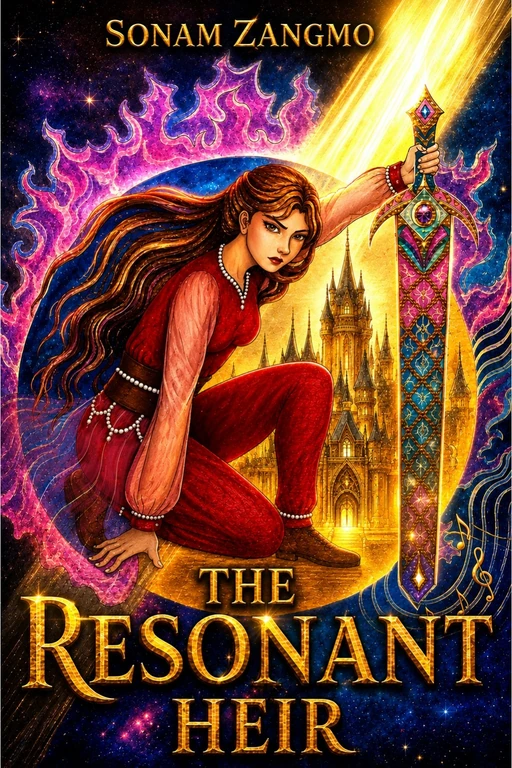
 Explore The Resonant HeirYA crossover royal fantasy · inherited magic · female heir · exile · adventure · Book I Complete
A Literary Commentary on Chapter Forty-One of The Resonant Heir
The Freedom to Think: Time, Fate, and the Hidden Logic of The Skull’s Riddle
An enchanted skull asks a question about time while denying two travelers the time to think. Lyra's answer opens a door—and raises a deeper question about how we divide the world we seek to understand.
Spoiler Notice: Contains spoilers for Chapter Forty-One.
Explore the 17 themes in this commentary
- A Test After a Hostage
- “Driven by Fate”: A Welcome Without a Choice
- Worthy by Whose Measure?
- Sion Refuses to Be Belittled
- The Danger of Speed
- The Body Still Remembers the Hooks
- “Not Alive”: Lyra’s First Hypothesis
- From Chaos to Cycle
- What Has—and Does Not Have—a Past, Present, and Future?
- “We Divide It”: The Power and Limits of Names
- The Three Days When Time Lost Its Shape
- Three Chapters, Three Forms of Pressure
- Thinking While Fighting
- The Door and the Change in Possibility
- The Hand Through the Threshold
- “We Lost the Horse”: A Return to Ordinary Consequences
- Conclusion: The Right to Understand
Theme 01 · Philosophical commentary
A Test After a Hostage
Chapter Forty-One of Sonam Zangmo’s The Resonant Heir begins with a surrender of one kind of control and the sudden appearance of another. At the end of Hooks of Grief, the High Lord of Drazhune held Sion by the throat and threatened her life. Now Lyra lowers her sword. A rectangular gate opens before Sion, who is pushed through it; Lyra leaps after her before it closes.
The new chamber is stale and airless, with an old stone pillar supporting a black skull whose hollow eyes bleed fine strands of smoke. It seems constructed for a purpose, but the visitors have little idea what purpose. Almost immediately they are told that to proceed they must prove themselves worthy. Failure will leave them trapped until the place consumes what remains of them.
This shift is important. Lyra has just escaped supernatural hooks designed to exploit emotional reactions. She now faces an apparatus that punishes answers and creates pressure to produce more. The mode of coercion changes from torment through grief to something resembling an examination, but the essential inequality remains: those being tested did not consent to the rules and cannot safely leave.
The episode is therefore more than a pause between battles. It asks what becomes of thought when another power controls not only the danger around a person but the terms on which a person must demonstrate understanding.
Theme 02 · Philosophical commentary
“Driven by Fate”: A Welcome Without a Choice
The skull’s first words describe its visitors as people driven by fate. This pronouncement sounds authoritative, but the chapter never proves that the skull knows the future or can discern some fixed destiny.
Lyra’s route has indeed been shaped by forces outside her control. Her father’s death brought her to a standstill. A strange pull in the scar on her wrist drew her farther into Drazhune. The High Lord then used Sion’s life to force a change in her behavior and sent her companion through this gate. Lyra’s choices matter, but they are made inside circumstances she did not design.
The greeting makes those circumstances feel predetermined. Yet being called a servant of fate is not the same as being one. A declaration uttered by a threatening object is still a declaration whose authority can be questioned.
Perhaps the most interesting philosophical issue is not whether fate exists in the world of the novel. It is whether someone facing severe constraints can still exercise agency in how those constraints are answered. The skull can choose the question and the threatened punishment. It cannot, as Lyra will demonstrate, prescribe the way she must reason her way toward an answer.
Freedom may be narrowed without being extinguished; the remaining space in which to judge can become the very ground of resistance.
Theme 03 · Philosophical commentary
Worthy by Whose Measure?
The skull demands proof that the girls are worthy. Worthy of what? Passage, perhaps. Survival, perhaps. It does not explain. The phrase has the grandeur of moral judgment but is attached to a single riddle and a merciless penalty.
An institution can call a test fair because everyone encounters the same problem. But fairness also depends on the stakes, the clarity of the rules, the opportunity to learn, and the legitimacy of the authority imposing it. Here a wrong guess can bring immediate pain, and failure threatens confinement until destruction.
The skull’s claim is therefore worth resisting at the level of language. Answering a riddle may demonstrate resourcefulness. It cannot establish the total worth of a person. Sion is not less deserving of life or respect because her first attempts are incorrect.
This is a powerful question for fantasy, a genre often filled with trials that determine who may pass a threshold or possess an artifact. Such scenes need not endorse their own gatekeepers. The drama can depend upon a test while still exposing the cruelty of its conditions.
In this chapter, the mechanism’s authority to punish is obvious. Its moral authority is not.
Theme 04 · Philosophical commentary
Sion Refuses to Be Belittled
Sion takes the skull’s question seriously enough to answer it. She tries “Nothing,” then “death,” and starts another guess before finishing. Each attempt is met not by explanation but by a sharp, invisible blow. One cheek reddens, then the other; the final strike catches her from behind.
There is rough comedy in the absurdity of arguing with a skull that retaliates by slapping you. But the physical consequences are not imaginary. Sion is punished for using the ordinary method of trying possibilities and seeing which one fits.
When Lyra tells her to stop, Sion protests that she will not let the thing speak down to her. The line gives her response its emotional truth: she wants more than the correct answer. She wants to refuse humiliation.
That wish is understandable, yet the test exploits it. The more urgently Sion feels compelled to prove she cannot be dismissed, the more likely she is to offer the next guess on the skull’s terms. Her pride does not cause the injustice; the blows remain the skull’s doing. But pride can make it harder to withdraw from a contest whose rules are hostile.
Declining an opponent’s demand for an immediate answer is not necessarily submission. Sometimes it is the first act of refusing to play by that opponent’s rules.
Theme 05 · Philosophical commentary
The Danger of Speed
Lyra’s first useful instruction is surprisingly modest: do not answer too quickly. Even before the chamber turns openly violent, she recognizes that the demand for an answer is not the same as an invitation to think.
Soon smoke becomes a sharper form of pressure. When she moves closer, the skull releases crescent-shaped attacks that Lyra must catch with her sword or avoid. They arrive faster. Sion sees anger in the escalation, but Lyra interprets it differently: the assault is making them feel compelled to answer sooner.
That interpretation is Lyra’s; the chapter does not provide a separate explanation of the skull’s inner intentions. Nonetheless, it gives her a productive way to understand the effect of the attack. The room is trying to reduce the interval between question and response.
The paradox is almost elegant. To solve a riddle about time, the girls need time to consider it. The test’s escalating violence attempts to deprive them of that very resource.
This is a recognizable form of pressure beyond fantasy. Urgency can be real, but urgency can also be used to make deliberation seem impossible. A person who controls the pace of a conversation, transaction, or threat may acquire influence over what judgments another person feels able to make.
The challenge is not to slow every decision without exception. It is to distinguish circumstances that genuinely require immediate action from pressure intended to prevent clear thought.
Theme 06 · Philosophical commentary
The Body Still Remembers the Hooks
One detail makes Lyra’s composure more convincing: the ache from the hooks in the preceding chapter has not disappeared. She backs against the wall, sits, and breathes while Sion paces. Later, as she dodges the smoke blades, the cold within her chest stirs again.
This is not an abstract puzzle solved in the comfortable privacy of a study. The person reasoning through it is physically exhausted, recently bereaved, and still carrying the sensations of an assault that tried to turn her grief against her.
Her method does not erase those conditions. Instead, she acts amid them. She protects herself with a sword while keeping enough attention free to look for a pattern. It is a restrained picture of courage: the ability to continue reasoning does not depend upon feeling wholly restored.
That continuity matters across Chapters Thirty-Nine through Forty-One. Lyra has neither finished mourning Eryndar nor received an explanation for Vael’Kharoth. To portray her as completely healed because she can answer a question would flatten the emotional history the novel has taken care to establish.
A person can recover a capacity without recovering from everything that has happened to them. The chapter makes that distinction visible in her breathing, her fatigue, and her pain.
Theme 07 · Philosophical commentary
“Not Alive”: Lyra’s First Hypothesis
When the skull ignores attempts to converse and merely repeats its question, Lyra concludes that it is not alive but some kind of mechanism. Her inference does not require a full account of its construction. She needs a way to regard the room as an operating system rather than a person whose approval must be won.
The distinction matters because an insult may demand emotional attention, whereas a mechanism invites investigation. Sion reacts to humiliation; Lyra begins to ask what the device does and under which conditions it changes.
It would be too strong to declare that the skull has definitively been proved mindless. The chapter presents Lyra’s judgment and then her successful response to the test. The practical usefulness of the model is clear; its metaphysical completeness is not established.
This is also a sound picture of intelligence. An explanation need not settle every possible question in order to help us act. A provisional hypothesis can be valuable if it directs attention toward features that can be observed and tested.
By treating the skull’s behavior as something with rules, Lyra creates space for reasoning in a setting designed to make reasoning feel like a luxury.
Theme 08 · Philosophical commentary
From Chaos to Cycle
For a time, the attacks appear to have no pattern. Blades of smoke come faster; Lyra changes her footing and parries them as they arrive. Then she narrows her attention to the smoke itself and notices a sequence: beginning, continuation, dissolving.
This is the chapter’s most persuasive account of insight. Lyra does not discover a secret inscription on the wall or recall a lesson that simply supplies the right answer. She looks again at something already happening before her.
What seemed like a succession of separate assaults becomes, at another level of description, a recurring process. The sharp crescents are not the only features of the phenomenon. The smoke forms, persists, changes shape, and comes apart.
Her insight does not mean the attacks were harmless or that their exact timing suddenly became predictable. It means she has found a different level of order beneath the pressure that first absorbed all her attention.
Sometimes the difficulty is not a lack of evidence but a way of looking that prevents the evidence from becoming intelligible. Her achievement is a shift of perspective while the danger remains real.
Theme 09 · Philosophical commentary
What Has—and Does Not Have—a Past, Present, and Future?
The skull asks what both has and does not have a past, present, and future. The formulation seems contradictory if these three categories are treated as separate possessions that a thing must either contain or lack.
Lyra approaches the contradiction through the smoke’s cycle. She thinks of past, present, and future not as three isolated objects, but as names applied to one continuing flow. The answer is time, and within the narrative the chamber immediately recognizes it as correct.
This is an important distinction between the riddle’s working answer and a final theory of time. Philosophers have disagreed for centuries about whether temporal divisions name objective features of reality, relations among events, or aspects of human experience. The chapter need not settle those debates to make its idea compelling.
Lyra’s thought is narrower and more dramatic. What we divide in thought may not be divided in the same way as a thing in the world. Our categories are useful, but taking them as independent substances can obscure the continuity they help describe.
The apparent contradiction of something both having and not having temporal divisions becomes intelligible once the relation between the process and its names is reconsidered. It is a solution found through how the question is framed, not by collecting more possible answer words.
Theme 10 · Philosophical commentary
“We Divide It”: The Power and Limits of Names
The key to Lyra’s reasoning lies in her recognition that people make distinctions. Past, present, and future are indispensable terms for recollection, decision, and anticipation. Without such distinctions it would be hard to tell stories, keep promises, or make plans.
Yet a word can become so familiar that we forget it marks a perspective rather than delivering an exhaustive account of reality. The usefulness of a classification is not proof that the world must be divided into exactly the compartments our language suggests.
The smoke makes this accessible. We can speak of a beginning, a continuation, and a dissolution. We can distinguish them for the purpose of explaining what happens. But in the scene they are phases of a transformation, not three unrelated things occupying separate worlds.
One may hear an affinity with philosophical traditions that emphasize becoming or experienced duration. Such comparisons are interpretive analogies, not evidence that the chapter deliberately quotes a particular thinker.
The most compelling point remains internal to the story: Lyra finds the exit when she stops asking which of three separated pieces of time a thing belongs to, and asks instead what holds those pieces together.
This is one of the chapter’s philosophical pleasures. The answer seems suddenly simple, but only after the question has been rebuilt.
Theme 11 · Philosophical commentary
The Three Days When Time Lost Its Shape
The solution has an emotional resonance because of the chapter that preceded the visit to the Citadel. In The Mourning Fire, Lyra learned that Eryndar had died seven days earlier, while the town of Drazhune was concluding its mourning rites. She spent the next three days at an inn, scarcely eating or speaking. Day and night no longer felt distinct.
That earlier passage showed time continuing in the world without offering Lyra a corresponding sense of progress within herself. The community had a public calendar for grief, but the daughter’s mourning began after that calendar had nearly run its course.
Now she articulates a picture of time as one flow beneath the labels past, present, and future. The link is meaningful, though the text does not claim that her grief taught her the answer. It is a thematic echo rather than a demonstrated cause.
Lyra cannot step back into a moment before her father died. She cannot erase what happened by redefining time. Her insight is not a cure for loss. But it belongs to the same developing inquiry: how can the mind navigate a reality that continues even when an individual feels unable to continue with it?
The riddle gains depth because its answer is not remote from her life. The concepts being questioned are the very ones through which she has recently experienced the rupture between a remembered father, a painful present, and an unknown future.
Theme 12 · Philosophical commentary
Three Chapters, Three Forms of Pressure
There is a structural conversation among Chapters Thirty-Nine, Forty, and Forty-One. In the first, grief makes Lyra’s future seem directionless. In the second, the High Lord manipulates that grief through accusations and hooks that bite more deeply as she reacts. In the third, the skull attempts to force hurried answers under threat of pain.
These are not identical trials. Loss cannot be solved with the same method as coercion, and an enchanted riddle does not have the moral gravity of a father’s death. But each asks whether Lyra can find a way to act without allowing the pressure of a moment to determine everything she understands.
In Hooks of Grief, she slows her breath and refuses to let the attacker’s words seize her reaction. That victory remains limited when Sion becomes a hostage. In The Skull’s Riddle, she again preserves room to think, but now turns the recovered attention toward interpreting a real phenomenon.
The progression is credible because no single technique is offered as a universal remedy. Self-command helps against the hooks. Observation and inference help against the skull. Neither restores Eryndar, nor guarantees that future threats can be met by calmness alone.
Lyra’s development is therefore less about acquiring an invincible mindset than about learning to recognize what kind of problem she faces.
Theme 13 · Philosophical commentary
Thinking While Fighting
The scene’s practical construction prevents its philosophical conclusion from becoming detached from action. As Lyra studies the smoke, she must keep moving. One blade shears a lock of her hair; others strike at the space where she stood an instant earlier. She cannot safely sit and contemplate until the danger is over.
Nor can she merely fight harder and hope the question disappears. The room offers no sign that endless parrying will create a passage. The sword protects the time required to think; it does not replace thought.
This is a useful account of the partnership between physical ability and judgment. The capacity to defend oneself makes attention possible under attack. Attention then identifies a path that defense alone could never supply.
There is also a discipline of waiting in Lyra’s repeated refusal to answer prematurely. She is active without being impulsive, and reflective without being motionless.
In a story built partly upon swords, magic, and dangerous crossings, a victory reached through comprehension rather than domination matters. The chapter broadens what competence looks like for its heroine.
Theme 14 · Philosophical commentary
The Door and the Change in Possibility
When Lyra answers, the smoke freezes, the crescents unravel, and the hollow eyes of the skull go dark. A rectangular opening appears in the wall. Lyra senses that the chamber itself has shifted, almost as though the way out has moved.
The phrasing is careful. The text does not tell us that the exit was physically relocated from some previously visible point. It reports the uncanny change as Lyra experiences it. The mechanism has responded, and the previously closed situation now admits a route.
This is an apt image for what knowledge can do. Understanding does not always remove a wall. It can reveal which action a system permits and under what conditions. A place formerly experienced as a trap becomes navigable because the traveler has recognized something true of how it operates.
There is a danger in overextending the metaphor. Not every prison opens when a person thinks differently; the High Lord’s coercion made that plain. Within this particular trial, however, a changed understanding is materially consequential. It gives the characters access to an exit they could not obtain by guessing or swinging a sword.
The episode celebrates intelligence without pretending that intelligence can remedy every injustice.
Theme 15 · Philosophical commentary
The Hand Through the Threshold
As the door appears, Lyra tightens her hold on Sion’s hand and tells her to go. It is a small gesture at the close of a chapter concerned with abstract categories, but it preserves the personal meaning of their escape.
Across the previous chapters, hands have carried the developing intimacy between the girls. At the frozen lake Sion touched Lyra’s cheek and shoulder without asking her grief to end. When the hooks struck, Lyra found Sion’s hand while struggling to withstand them. Here the handclasp accompanies a decision to leave danger together.
Sion has been impulsive in the riddle chamber, and her frustrated guesses have provoked punishment. That does not make her expendable, or transform the correct answer into a solitary triumph in which only the solver matters. Lyra does not leave her companion to find an exit of her own.
The gesture recalls that thought exists within relationships. Someone can reason alone, but the meaning of the answer may lie in whom that reasoning enables them to protect or accompany.
Lyra’s discovery becomes an escape for two people. The thought opens the door; the hand makes it a shared crossing.
Theme 16 · Philosophical commentary
“We Lost the Horse”: A Return to Ordinary Consequences
The exit deposits the girls on a cliff overlooking the far side of the Citadel of Drazhune. After the stale chamber, the blows, the smoke blades, and the riddle about time, Sion supplies the final observation: they have lost their horse.
The line is funny because it returns an adventure of high metaphysical stakes to its practical conditions. The girls have survived a coercive trial and emerged elsewhere, but they still need to travel. Their means of transport has been left behind.
This is not a dismissal of Lyra’s achievement. It is an acknowledgment that one solved problem does not settle the rest of existence. A person who grasps a profound idea about time remains a person who must go somewhere, find food, protect a companion, and deal with inconvenient consequences.
The humor also gives Sion a distinctive final voice. Where Lyra has been attending to the inner logic of a threatening chamber, Sion now notices the mundane loss the crossing has caused. Neither kind of attention is useless.
A chapter about the relation between categories and reality ends by reminding us that reality never reduces itself to an elegant answer.
Theme 17 · Philosophical commentary
Conclusion: The Right to Understand
The Skull’s Riddle offers a philosophical adventure whose form mirrors its question. Lyra must discover a view of time as continuous while a dangerous mechanism attempts to deny her the time needed to arrive at that view. Her success comes not from answering sooner but from declining the demand for haste.
The story does not establish a complete metaphysics of time, prove that a skull speaks for fate, or claim that calm reasoning can overcome every source of harm. It shows something more grounded: under pressure, an individual can sometimes recover agency by reconsidering the categories through which a problem is being understood.
The answer arises from smoke in motion, from a mind alert to cycles beneath apparent chaos, and from a sword used to keep that mind alive long enough to notice. Lyra’s thought and her courage collaborate rather than compete.
The result matters to her as a grieving daughter, too, though it does not heal that grief. She has lived through days in which time ceased to feel meaningful; she can now recognize a way through one room by seeing beyond the divisions she was first tempted to accept.
The gate opens. Sion’s hand is in hers. The horse is gone. The world still demands another step. That is the humane scale of this victory: understanding can open a way forward without pretending to solve the whole journey.