
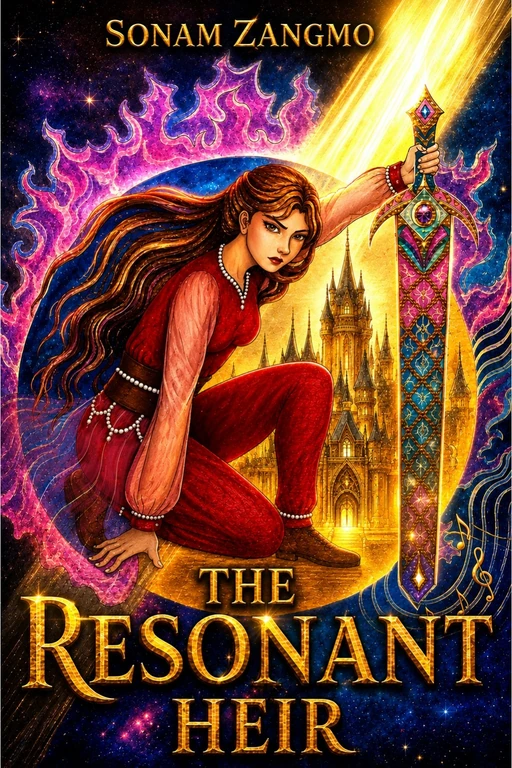
 Explore The Resonant HeirYA crossover royal fantasy · inherited magic · female heir · exile · adventure · Book I Complete
A Literary Commentary on Chapter Forty-Two of The Resonant Heir
What Holds Us and What Lets Us Go: Power, Friendship, and Freedom in The Root-Born Boat
A cruel ruler turns fear into entertainment. A frightened companion discovers she can shape the roots that saved them. Between hooks and roots, the novel asks what power is for.
Spoiler Notice: Contains spoilers for Chapter Forty-Two.
Explore the 18 themes in this commentary
- Freedom Without a Horizon
- A River Before It Exists
- The Bread That Survived
- The High Lord and the Pleasure of Power
- “My Children”: A Name Is Not a Relationship
- The Leap Without Guarantees
- The Fall Outside Time
- The Predator Who Imagines an Ending
- The Fear Inside the Rescue
- The Light Bought With a Bonus
- Recognition, Not Revelation From Nowhere
- “Tell It What You Want”: Command and Responsiveness
- “I Did It”: The Friend Becomes an Agent
- Roots That Let Go
- The Hooks and the Roots
- Drazhune Used Grief
- No More Map Fragments, No More Answers
- Conclusion: A Vessel for Two
Theme 01 · Philosophical commentary
Freedom Without a Horizon
Freedom arrives in Chapter Forty-Two of Sonam Zangmo’s The Resonant Heir without the relief one might expect. Lyra and Sion have escaped the Skull’s Riddle, but wind strikes them on a mountainside and the sky over Drazhune becomes black—not the ordinary darkness of night, but a darkness without stars or a visible horizon. Immense mountains dwarf them. Lyra feels suddenly small.
The contrast with the previous chamber matters. An enclosure can take away freedom by limiting movement; an enormous, open landscape can leave a traveler no less helpless when it offers no intelligible direction. Having escaped the Citadel’s immediate trial, the girls have not obtained a plan for what comes next.
Sion asks where they should go, and Lyra turns to the simplest available thought: water. If there is a river, following it will lead somewhere. This is not knowledge of a destination. It is a rule of thumb, a tentative way to make movement possible when the familiar guideposts have disappeared.
Being released from confinement does not automatically mean knowing what to do with freedom. The chapter begins by making that distinction physical: there are no walls before Lyra, and still she must invent a direction.
Theme 02 · Philosophical commentary
A River Before It Exists
Lyra’s suggestion that they follow a river is an unusually modest exercise of intelligence. The previous chapter offered a riddle with a right answer. Here there is no questioner and no assurance that the landscape contains what she hopes to find.
What Lyra possesses is judgment under uncertainty. She chooses a practical feature of the world that, if found, might organize their travel. It is not a prophecy or an unexplained leap to the correct location; she does not even know whether a river lies nearby.
Later, roots will lower them into water and make the hoped-for route real. That development gives her early speculation an elegant structural echo without proving she somehow knew what would happen. The river is first an idea for orientation and later an actual current capable of carrying them.
The difference is worth preserving. Good judgment may create a plausible next step rather than deliver a final answer. A young heroine need not be omniscient to be competent. Indeed, one of the chapter’s most human qualities is the way practical thinking persists when grand plans have become unusable.
Theme 03 · Philosophical commentary
The Bread That Survived
The girls have lost their horse, and hunger announces itself with Sion’s growling stomach. She finds the dark bread in her pocket, breaks it in half, and gives some to Lyra as they walk. It is a brief action, but its history runs through the preceding chapters.
In The Mourning Fire, Sion pushed food into Lyra’s hand after days of refusal. At that point nourishment was an act of care offered to someone who had nearly stopped participating in daily life. Now both girls are hungry, and the surviving food is shared between companions who must help one another continue.
The bread carries no enchantment in this scene. That is precisely why it matters. Ordinary provisions coexist with extraordinary danger. Without the small arrangements of eating, carrying food, and noticing another person’s needs, no heroic quest can proceed for long.
This is also a vision of friendship that does not require a permanent rescuer and a permanent dependent. Sion has been cared for and has cared for Lyra; neither role defines her completely. In the chapter’s later revelation, the interchange of strengths becomes even more pronounced.
Companionship is not only sharing a destination. It is sharing what sustains the journey while the destination remains uncertain.
Theme 04 · Philosophical commentary
The High Lord and the Pleasure of Power
The High Lord reappears astride a monstrous wolf, followed by a pack whose fangs and saliva turn the ridge into a threat. He observes that the girls survived his ancestors’ trials. One might expect grudging respect or a decision to let them pass. Instead he says that he has not finished being entertained.
He surrounds them with violet fire, releases blue smoke, and urges them to be afraid. Then he calls to his wolves and sends them hunting. In this sequence, danger is not presented as an unfortunate necessity of government or defense. It is arranged for the ruler’s amusement.
The distinction changes the ethical character of his power. A person may have to use force to protect others or ward off immediate attack, though such acts remain open to scrutiny. Here the stated reward is the fear he can provoke. Other people’s suffering becomes something to savor.
The High Lord’s appetite for frightened reactions continues what Chapter Forty revealed about his manipulation of Lyra’s grief. He does not fail to perceive vulnerability. He recognizes it well enough to make it entertaining.
The frightening failure is not an absence of understanding but an understanding severed from compassion. His magic amplifies what is already present in his chosen relation to other people: a desire to dominate rather than assist.
Theme 05 · Philosophical commentary
“My Children”: A Name Is Not a Relationship
When the High Lord orders the wolves forward, he addresses them as his children. The phrase carries an echo of intimacy and belonging, but the immediate action is the dispatch of predators against two fleeing girls.
The story does not say whether the wolves are literally related to the High Lord, whether they possess independent wills, or how they came under his control. The familial label should therefore not be converted into a fact about their origin. It does, however, reveal how he chooses to speak to the creatures he commands.
Words of affection can exist alongside relationships organized by use. A name may imply care without showing it. This does not mean the High Lord necessarily mistreats the wolves themselves; the chapter offers too little evidence for that judgment. The point is narrower: he places the language of family in the service of an attack he admits is entertainment.
The contrast with Lyra and Sion is sharp. Their bond is not certified by a grand title. It appears in shared food, a hand held under pressure, an embrace after survival, and later in a discovery that enables the two of them to escape together.
The measure of a relationship lies less in what it is called than in what its members do when another person is vulnerable.
Theme 06 · Philosophical commentary
The Leap Without Guarantees
The girls run through the ring of fire, ripping away their burning cloaks as the wolves close in. Ahead is a cliff. Lyra does not know whether there is a survivable route below. She knows only that staying appears certain to end in death, or in something she considers worse.
She tells Sion to jump and pulls her over the edge. There is no time for the carefully paced inquiry that saved them in the Skull’s Riddle. The physical situation has changed the ethics and mechanics of choice.
The decision is understandable without being risk-free or morally uncomplicated. Lyra acts for both girls in an emergency. Sion has no opportunity for prolonged discussion or a separate appraisal of the drop. This is part of the cost of their predicament, not a general license for Lyra to decide every danger on another person’s behalf.
The previous chapter emphasized the right to postpone a conclusion while thought remained possible. This one asks what wisdom looks like when delay itself may close the only remaining opportunity.
Practical intelligence is not perpetual hesitation or perpetual decisiveness. It requires some judgment about when further thought helps and when waiting becomes its own dangerous choice.
Theme 07 · Philosophical commentary
The Fall Outside Time
During the plunge, the prose narrows to the immediate experience of falling. There is no reliable ground beneath them, no useful future to plan, and no past they can attend to—only the drop.
The lines resonate with The Skull’s Riddle, where Lyra had just solved a puzzle by treating past, present, and future as names for a continuous flow. In that room time was an object of reflection. Here bodily peril consumes attention so completely that such reflection becomes impossible.
This is not a claim that time physically stops in the chasm. It is a description of what consciousness can become during extreme danger. The mind that articulated an elegant idea about time still inhabits a vulnerable body falling through an unknown distance.
The juxtaposition prevents philosophical insight from becoming magic of its own. Understanding the concept of time does not protect a person from gravity, hunger, exhaustion, or the consequences of an uncertain leap.
What carries the pair safely through the fall will come from another source, one whose existence neither girl yet clearly understands. The scene keeps intellect and dependence together: Lyra can decide to jump, but she cannot personally guarantee the landing.
Theme 08 · Philosophical commentary
The Predator Who Imagines an Ending
From the cliff, the High Lord sees the wolves halt and the girls disappear below. He imagines shattered bodies against stone, decides the chase has ended in a dull disappointment, and leaves with his pack.
The distinction between observation and imagination is important. He has not actually witnessed their deaths. He supplies an ending because it fits what he expects to find at the bottom of such a fall.
His powerful magic has not made him all-knowing. Indeed, his indifference now assists the girls: once their suffering is no longer available for him to watch, he loses interest before discovering what truly happened.
There is an irony in a character devoted to control being defeated, at least for this moment, by what he fails to see. He can surround his victims with flames and wolves, yet he cannot direct events that fall outside his attention.
The chapter does not imply that all cruel rulers are similarly careless. It shows this particular ruler’s vanity and appetite shaping a mistaken conclusion. Power can extend a person’s reach without expanding their willingness to notice what does not flatter their expectations.
Theme 09 · Philosophical commentary
The Fear Inside the Rescue
When awareness returns below, Sion cannot move freely. Something wraps around her; her chest cannot expand properly; the space is oppressively tight. The sensation recalls the earlier collapse in the mine. She has survived the fall only to find herself inside what feels like another trap.
This passage refuses to give rescue the immediate appearance of safety. The same roots that have kept the girls from being dashed against stone are packed against their bodies so closely that Sion cannot initially understand them as protection.
The fear is psychologically plausible. An experience resembling a previous disaster can call the earlier terror back before the mind has assembled an accurate picture of the present. Sion’s body recognizes confinement faster than she can determine its purpose.
Lyra does not simply dismiss that fear. The roots are in fact restrictive at first; they tighten when Sion attempts to move. Nor does the scene suggest every frightening confinement must secretly be for someone’s good. This is one specific rescue whose mechanism begins by looking dangerous.
What protects us is not always recognizable as protection at the instant we encounter it. Understanding must come after sensation rather than replace it.
Theme 10 · Philosophical commentary
The Light Bought With a Bonus
Sion manages to pull a Lume stone from the bag squeezed between them. It is a new one, purchased with her bonus in Gemariel. Light fills the cramped space, and the girls finally see roots pressed around them on every side.
The purchasing detail is easy to overlook, but it grounds a dramatic magical escape in Sion’s prior material life. She has earned money, made a decision about what to buy, and kept an object that now enables both girls to examine their situation.
The stone does not independently free them. What it offers is visibility. Without it, the unknown enclosure remains only pressure and fear. With it, Lyra can identify the material surrounding them and recall earlier encounters with roots and newly green fields.
This is an understated defense of preparedness and ordinary competence within a fantasy world. Survival is not always the reward for possessing a legendary object. It may depend on someone carrying a useful tool bought with her own wages.
It is also a reminder that Sion exists beyond her immediate role as Lyra’s companion. She has a history in Gemariel, resources of her own, and habits of preparation. Those details make her emerging agency more substantial than the sudden appearance of a convenient power would be.
Theme 11 · Philosophical commentary
Recognition, Not Revelation From Nowhere
Seeing the roots, Lyra connects them to earlier events. Roots appeared during the mine collapse. Fields in Aulith turned green again. She tells Sion that these events were not random and concludes that Sion can trigger plant magic.
The distinction between inference and proof should be maintained. Lyra is interpreting a pattern in the adventures they have shared; the chapter does not yet account for every mechanism underlying those earlier phenomena. Her recognition is convincing as a hypothesis about Sion, but it need not close every question about their magical history.
What happens next provides something more immediate. At Lyra’s encouragement, Sion puts her hands on the roots, concentrates, and directs them toward what she wants. They respond by shifting, loosening, and bearing the girls downward.
This turns a tentative pattern into observable ability. The question is no longer only whether prior events might be connected to Sion. It is whether Sion can intentionally affect plants in the present, and the scene shows that she can.
The process recalls Lyra’s method in The Skull’s Riddle. She once recognized a cycle in apparently chaotic smoke. Here she finds a relationship among seemingly separate incidents. Yet this second recognition has a distinctive ethical effect: it helps another person discover what she can do.
Intelligence can be generous. It can identify not only a solution for oneself but a possibility in someone else that neither has yet fully named.
Theme 12 · Philosophical commentary
“Tell It What You Want”: Command and Responsiveness
Lyra’s instruction to Sion is simple: focus, and tell the roots what she wants. Sion presses her hands against them and concentrates. The roots begin to move, slowly at first, then more decisively. They loosen and lower the girls rather than dropping them.
In another chamber of Drazhune, black hooks fastened themselves to Lyra’s shoulders and deepened her helplessness. On the ridge, the High Lord sent wolves hunting for his amusement. Here plant magic also changes the position of bodies, but the practical outcome is different: restriction gives way to guided movement.
It would be premature to argue that the roots possess consciousness, have chosen to consent, or are acting as ethical beings. The text shows that they respond to Sion’s focused intention; it does not settle their inner nature.
The moral contrast lies primarily among the human agents and the uses to which power is put. The High Lord's power creates terror as its aim. Sion’s newly discovered ability is directed toward preventing harm and finding a way out.
The passage invites a question larger than whether one element of magic is good and another bad. What does the use of power make possible for those who were previously unable to act? In Sion’s hands, the answer is movement, safety, and another chance.
Theme 13 · Philosophical commentary
“I Did It”: The Friend Becomes an Agent
When the roots lower them into cold river water, Sion opens her eyes and realizes she has done what Lyra asked. Her brief declaration is one of the chapter’s emotional high points. Lyra pulls her into an embrace, responding to Sion’s discovery with delight rather than jealousy.
The scene changes the texture of their partnership. Lyra has commonly been the one to draw a sword, decide the route, and drag Sion from immediate threats. Sion has not been passive—her care and loyalty have repeatedly required courage—but the present escape depends upon an ability that belongs to her.
That matters especially in a royal fantasy where inheritance, magical talent, and political status exert so much influence. The princess does not monopolize the ability to transform the situation. A companion with her own history and resources becomes the source of their next passage.
Sion’s joy is not framed as a promotion to Lyra’s level of importance. It is the joy of recognizing her own agency. She has affected the world in a way she could not previously explain, and the result is visible to both of them.
Friendship is richer when one person’s growing strength does not threaten the other’s identity, but enlarges what they can do together. The embrace is as important as the successful spell: it confirms that the change is welcomed.
Theme 14 · Philosophical commentary
Roots That Let Go
Under Sion’s continuing influence, the roots weave themselves into a covered, rounded vessel. The fibers curl inward and close around the girls, providing a new kind of enclosure. Then, in a subtle but striking detail, the roots leave the mountain’s core not by being torn away, but by being released.
The title The Root-Born Boat turns on a paradox of form. Roots ordinarily anchor a plant to a place. A boat is made to travel. Something associated with holding fast has become the material of departure.
The story does not explain whether the roots remain alive in the same way as before or what rules make their release possible. What matters for this scene is the absence of violent rupture in the description. A structure that belonged to the mountainside changes shape and becomes capable of bearing two travelers onto the river.
There is a suggestive analogy here for growth. Leaving does not always require the destruction of everything that once held a person in place. An attachment, an old experience, or a previously unrecognized ability can be transformed into the very condition of movement.
The image remains an analogy, not a moral rule that every attachment should be preserved. Some bonds are coercive and need to be broken. The boat’s power comes from its specific action: the roots cease to confine and begin to carry.
Theme 15 · Philosophical commentary
The Hooks and the Roots
Across Chapters Forty and Forty-Two, the novel creates a remarkable visual opposition. The hooks and the roots both fasten onto bodies. Both can make movement difficult. Both emerge from a fantasy landscape that the girls do not fully understand. Yet they belong to profoundly different encounters.
The hooks were directed by an enemy who exploited Lyra’s grief, using accusation and pain to reduce her agency. The roots initially frightened Sion and restricted movement, but they had already prevented a fatal fall. When Sion learned to influence them, they loosened and guided rather than tightening in punishment.
The difference therefore cannot be judged solely by the sensation of being held. We must consider who is acting, for what purpose, with what effects, and whether those being held can recover or exercise meaningful choice.
It would be an error to turn the contrast into a universal defense of restriction that claims to be protective. The chapter gives us a particular set of events, not permission to redescribe coercion as care. Indeed, the High Lord’s conduct supplies the very warning against trusting such language.
The deepest opposition is not between darkness and plants, nor between force and gentleness. It is between power that narrows another person’s possibilities and power that helps restore them.
Theme 16 · Philosophical commentary
Drazhune Used Grief
As the vessel drifts away, Lyra reflects that Drazhune did not need chains to hold them: it used grief. The thought is a sharp retrospect on what happened after she learned of Eryndar’s death. In the Citadel, the High Lord studied that wound and tried to make it serve his own purposes.
This is Lyra’s understanding of her recent experiences, not a proven claim that every inhabitant or institution of Drazhune shares the High Lord’s methods. The town where the girls first arrived contained ordinary citizens performing mourning rites. The antagonist’s behavior should not erase the fuller, still partly unknown nature of the place.
Nevertheless, Lyra’s insight is important. A person in pain can be influenced by suggestions that reach the place already hurting. An attacker need not invent all the feelings he exploits; sometimes he merely supplies a cruel story about their cause or meaning.
The High Lord tried to use Eryndar’s death, doubt about Orlas, and fear for Sion to govern Lyra’s behavior. What Lyra learns is not that grief must be eliminated. The lesson is that genuine suffering can be manipulated through explanations and demands that deserve skepticism.
Responsibility for such manipulation remains with the manipulator. Vulnerability does not make the injured person guilty. The ethical achievement is to begin recognizing the mechanism without deciding that love, memory, or grief themselves are mistakes.
Theme 17 · Philosophical commentary
No More Map Fragments, No More Answers
The chapter’s closing lines refuse a tidy rescue. The root-woven vessel is on the river, and the current carries it toward somewhere unknown. Lyra has no more map fragments to guide her and no answers to the large questions still shaping her quest.
The manuscript does not explain in this scene precisely how the map fragments ceased to be available, so the moment should not be expanded into an invented account of their destruction or loss during the fire and fall. What the ending stresses is that Lyra can no longer rely on them for direction.
That makes the river more than a convenient escape route. It is movement without a guaranteed destination. The girls have chosen to build and launch a vessel, yet once it is on the water they are also being carried by a current they do not control.
There is no contradiction in those two facts. Agency rarely means determining every subsequent event. One can act deliberately while remaining subject to conditions, companions, and unforeseen turns.
Lyra has not restored her father to life, settled the mystery of Vael’Kharoth, or learned where this water will lead. What she has gained is a new partner in the capacity to move forward. Sion’s magic has made a route possible where neither girl had one.
Theme 18 · Philosophical commentary
Conclusion: A Vessel for Two
The Root-Born Boat begins with an open sky that offers no direction and ends with a covered vessel traveling along a river. Between them stands a ruler who delights in fear, a desperate leap, a rescue mistaken at first for another prison, and the discovery that Sion can shape plant life.
The contrast at the heart of the chapter is ethical rather than elemental. The High Lord’s power is exercised to produce helplessness for his enjoyment. Sion’s power, imperfectly understood and only newly recognized, becomes a means of survival shared with another person. Lyra contributes not by performing the spell but by remembering earlier evidence and helping her friend trust the ability beginning to emerge.
This is an important correction to the solitary-hero fantasy. A protagonist’s strength need not consist in being the answer to every crisis. Lyra can lead during a chase, reason through a riddle, and still need Sion to save their lives. Their friendship becomes more equal not because they become identical, but because they discover that each carries capacities the other lacks.
The roots that first surround them eventually let go of the mountain and become a boat. The final image does not promise that the river leads to safety, only that a path remains. The girls are still grieving, still uncertain, and still together.
The achievement of Chapter Forty-Two is therefore neither total control nor complete healing. It is a shared ability to continue when certainty is gone, sustained by a kind of power that carries rather than captivates.