
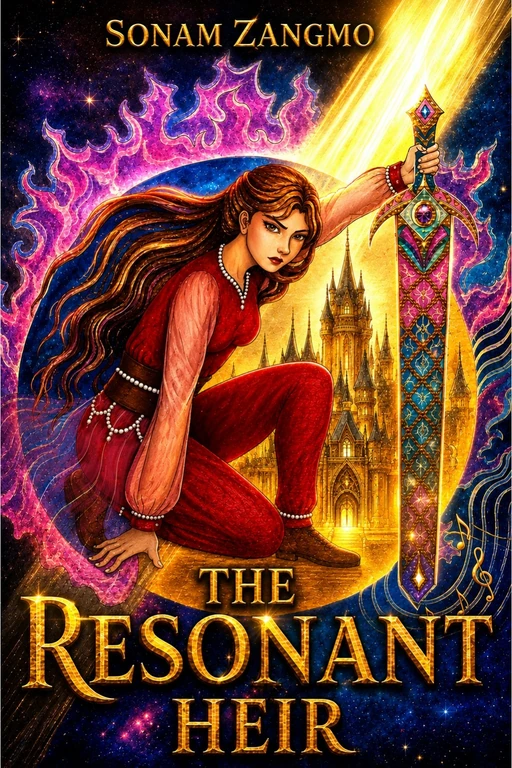
 Explore The Resonant HeirYA crossover royal fantasy · inherited magic · female heir · exile · adventure · Book I Complete
A Literary Commentary on Chapter Forty-Four of The Resonant Heir
When Every Duty Has a Deadline: Moral Choice, Mercy, and Power in A Moonless Madness
A friend loses control, a stranger weighs compassion against her family’s safety, and a princess learns that every possible road could cost someone she loves.
Spoiler Notice: Contains spoilers for Chapter Forty-Four.
Explore the 23 themes in this commentary
- The Night Market and the Unseen Moon
- Sand in Her Mouth: A Fractured Inner World
- Harm Without Ordinary Agency
- Restraint Without Punishment
- The Bucket of Water and the Limits of Heroic Power
- When a Crowd Has Reasons to Be Afraid
- The Person Who Cannot Remember What She Did
- The Danger Does Not Stop at the Two Girls
- A Kind Woman Has Reasons to Refuse
- A Cough Behind the Curtain
- Consent Under Economic Pressure
- A Promise Beyond Lyra’s Control
- Sion’s Apology and the Mercy She Receives
- Haris’s Loyalty Begins With Finding Her
- Voxath as a Message From an Absent Mother
- When Order Becomes a Closing Hand
- The Borrowed Face and the Cost of Honest Access
- The Awakening Spring or Sonareth?
- Forty-Nine Days and Fifty Days
- “You’re Right” Is Not Yet a Plan
- The Serpent Tomorrow, the Kingdom Still Waiting
- “I’m Coming With You”: Loyalty That Can Disagree
- Conclusion: No Perfect Road Through the Dark
Theme 01 · Philosophical commentary
The Night Market and the Unseen Moon
A chapter titled A Moonless Madness begins not in an enchanted dungeon but in an ordinary market. Oil lamps sway over the stalls of Sarrakha, and smoke from cooking drifts across the sand. Lyra has her arm around Sion, whose weight is already sagging against her. They want only shelter for the night.
The familiar activity of buying food and finding lodging becomes threatening when Lyra notices the moonless sky. A healer warned in the preceding chapter that the venom in Sion could alter her behavior on such nights. The prediction begins to feel immediate, yet knowledge of a threat gives Lyra no power to prevent it.
The marketplace is important to the ethics of this chapter. The danger will not remain private between two adventurers. It spills into a street occupied by merchants, strangers, and families, each of whom must make decisions with incomplete information.
The chapter’s darkness is therefore both literal and interpretive. Lyra can see the people beside her, but she cannot see a safe course through what is about to happen.
Theme 02 · Philosophical commentary
Sand in Her Mouth: A Fractured Inner World
Sion grips Lyra’s shoulder. Her breathing turns frantic, her eyes seem empty, and she begins speaking of sand in her mouth. Then she begs not to be buried. To everyone watching, these words belong to a crowded street where no burial is taking place. To Sion, they appear terribly urgent.
There is a suggestive echo of the earlier mine collapse. In The Root-Born Boat, being trapped among the roots reminded Sion of confinement and suffocation. Her new words carry similar imagery, though the chapter does not explain whether she is reliving a memory, hallucinating, or experiencing some other magical distortion.
The difference matters. A compassionate reading need not claim access to Sion’s inaccessible experience. The reader knows what she says and how frightened she becomes, but not precisely what world she thinks she inhabits.
Care is often required at the very moment understanding fails. Lyra cannot correct Sion’s experience simply by describing the market around them. She has to respond to a person whose perception has moved beyond her reach.
Theme 03 · Philosophical commentary
Harm Without Ordinary Agency
Sion bites Lyra’s shoulder and claws at her neck. The two crash against a stall, sending glass vials into the sand. There is nothing imaginary about the damage. Lyra bleeds, strangers scatter, and anyone close enough could be hurt.
But the narrative has already established a rupture in Sion’s awareness. When a bucket of water eventually brings her back, she surveys the wreckage and asks what she has done. That question separates the harmful act from the ability to recognize or intend it.
Moral judgment becomes difficult when the actor lacks ordinary control. It would be unjust to treat Sion’s fit as a deliberate betrayal of her friend. It would be equally irresponsible to pretend that a person unable to choose an attack cannot endanger other people.
The chapter asks us to hold two truths together: injury can be real even when cruelty is absent, and protection may be necessary even when blame is not.
Theme 04 · Philosophical commentary
Restraint Without Punishment
Lyra grabs Sion’s wrists and tries to pin her without hurting her. Haris, who has just arrived, uses ice to interrupt the attack. When Sion lunges at him and crashes into a wall of ice, Lyra rushes back to hold her and pleads with Haris not to injure her.
The scene makes restraint a moral problem rather than a simple combat technique. Sion must be stopped, but stopping her should serve her safety and the safety of others, not a desire to punish her for what she does not appear able to control.
This is the difference between defensive force and treating a person in crisis as an enemy. Lyra cannot afford to let Sion continue. Yet even while injured herself, she insists upon seeing the struggling girl as her friend.
Neither Lyra’s strength nor Haris’s ice can restore Sion’s awareness. They can only contain the immediate danger. Knowing how to overpower someone is not the same as knowing how to help that person recover.
Theme 05 · Philosophical commentary
The Bucket of Water and the Limits of Heroic Power
A woman steps forward, tells the others to move, and throws cold water across Sion’s face. Sion stiffens, blinks, gasps, and recognizes Lyra. A local resident has accomplished something that a sword and magical ice could not.
The episode is a quiet rebuke to any hierarchy that makes rank or spectacular power the measure of useful knowledge. Haris can create barriers. Lyra can fight. The woman knows an intervention suited to this particular affliction.
The text shows that water ends the immediate episode. It does not show a cure for the venom itself, and the woman’s subsequent warning makes further danger likely in her view. The success should not be inflated into medical or magical certainty.
There is also bravery in acting where the crowd hangs back. Her intervention is practical, not grandiose. The story gives competence to someone outside the royal adventure, and then gives that person a complicated life and a choice of her own.
Theme 06 · Philosophical commentary
When a Crowd Has Reasons to Be Afraid
The market onlookers retreat as Sion attacks. A few step away with the look of people who recognize the symptoms. Later the woman warns that Sion’s bite can spread the venom. The scene then becomes more complicated than a familiar accusation that bystanders lack compassion.
The chapter does not tell us precisely what each spectator knows or feels. Some may fear being bitten; others may be frightened by a condition they recognize but cannot treat. Their withdrawal does not establish that they are uncaring.
Nonetheless, the result is painful. Someone in urgent need of assistance becomes the person others are least willing to approach. The symptoms that make Sion vulnerable also make her appear threatening.
Here the obligations of care collide with the legitimacy of self-protection. The story offers no morally convenient crowd of villains. It shows how an individual’s suffering can isolate her even among people who have reason to fear for their own bodies.
Theme 07 · Philosophical commentary
The Person Who Cannot Remember What She Did
After the water, Sion sees the damaged stall, Lyra’s bitten shoulder, the people watching her, and Haris standing close by. Her question is simple: what did she do? No one answers immediately.
Her bewilderment is one of the chapter’s most affecting details. She is confronted with consequences that other people remember, but which are absent from her own accessible experience. The moral embarrassment of the scene arrives before she even understands its facts.
Only a chapter earlier Sion discovered that her will could shape roots into a boat. She celebrated the ability to act upon the world. Now the venom threatens to separate her actions from her conscious choices.
That reversal does not mean Sion has already lost herself permanently. She recognizes Lyra and responds with concern. Indeed, her distress helps reveal that the person who values others remains present when the fit has passed.
Her suffering includes the dread of becoming someone whose behavior she cannot anticipate. The question of selfhood is no longer philosophical abstraction. It has appeared in public, alongside broken glass and a wound on her friend’s body.
Theme 08 · Philosophical commentary
The Danger Does Not Stop at the Two Girls
The market woman says the venom may be passed on by a bite. That warning throws new light upon the wound already on Lyra’s shoulder. It raises a possibility; the chapter does not confirm that Lyra has become infected or that the same symptoms will follow.
More importantly, the warning widens the circle of people whose lives are implicated. The woman is worried about herself and her husband. A sick man lies in the house behind the stall. His safety matters no less because he is not part of Lyra’s quest.
Love can impel Lyra to stay beside Sion despite danger, but her willingness to accept a risk for herself does not automatically entitle her to impose that risk on strangers.
This is a crucial change of scale. An adventure centered on the young heir must still recognize other households, other vulnerabilities, and other responsibilities. The chapter becomes ethically richer because the heroine’s need is not the only need in the room.
Theme 09 · Philosophical commentary
A Kind Woman Has Reasons to Refuse
Haris asks whether the woman can shelter the travelers. She hesitates: there is no spare room, Sion has just experienced a violent episode, and everyone witnessed it. She calls the situation trouble.
Her reluctance follows an act of help. She is not a simple figure of hard-hearted indifference. She knows enough to interrupt Sion’s fit, yet she must consider what sheltering her may mean for a household she is responsible for protecting.
Lyra’s plea is genuine. Sion can barely walk and badly needs rest. The woman’s worry is equally genuine. Her husband is unwell, and an infection would carry consequences the girls may not be able to repair.
A refusal may be painful without being cruel. That principle does not make the travelers’ need less urgent; it grants moral reality to the people from whom they are asking help.
Theme 10 · Philosophical commentary
A Cough Behind the Curtain
As Haris offers one gold coin, the sound of a terrible cough emerges from the nearby house. The woman turns toward it, and her expression changes. Haris notices the change before offering another coin.
The prose does not deliver a lecture on poverty. It shows a damaged chest, a woman holding a bucket, and a sum of money that Haris says could buy the household food for months. These details are enough to make the offer morally complicated.
Haris is not shown threatening the woman. He is attempting to solve an urgent problem with resources he has. Yet his ability to increase the offer meets a household whose needs may make refusal difficult.
Money does not remove the possibility that Sion will have another fit. It changes what the woman stands to gain if she accepts that possibility.
The woman’s expression does not ease when she finally takes the coins. The transaction makes the night’s shelter possible, but it does not make the risk feel safe.
Theme 11 · Philosophical commentary
Consent Under Economic Pressure
The woman agrees after weighing a danger she understands against money that may help her sick husband. Formally, the decision is hers. Practically, the alternatives are shaped by scarcity.
This raises a question familiar to moral and political philosophy: how free is a choice when the cost of refusing an offer is painfully high? An offer can be sincere and generous from the giver’s perspective while taking on a different meaning for the person who needs it.
It would be too easy to label Haris an exploiter. His intention appears to be securing a place where Sion can rest, and he has only just found Lyra after a difficult search. But sympathy for him does not erase the vulnerability of the person accepting his payment.
There need be no villain for a transaction to contain an unequal distribution of risk. The scene asks us to examine not just whether agreement occurred, but what circumstances made agreement possible.
The woman’s ongoing fear is the story’s strongest evidence that the moral dilemma survives the exchange.
Theme 12 · Philosophical commentary
A Promise Beyond Lyra’s Control
Lyra tells the woman that they will not let Sion hurt anyone. The promise arises from desperation and loyalty. Yet only minutes earlier Sion bit Lyra despite her attempts to stop her, while Haris’s ice could not end the episode.
A guarantee has a different moral weight from an intention. Lyra can commit herself to watch Sion carefully. She cannot yet demonstrate an ability to prevent every recurrence or control every consequence.
In Chapter Forty-Three she trusted a familiar form of resonance that failed to reveal danger beneath Sarrakha’s sand. Now she expresses certainty about a future episode she does not understand. The pattern is not an indictment of her love but a test of its realism.
The woman will be relying on that promise when she opens her home. Responsibility includes the difficult task of distinguishing what we earnestly intend from what we can honestly assure another person will happen.
Care does not become more trustworthy by pretending to be omnipotent.
Theme 13 · Philosophical commentary
Sion’s Apology and the Mercy She Receives
The woman lays an old blanket in the corner of her cramped home. Her husband lies coughing on the bed. Sion sits on the blanket, avoids everyone’s eyes, and apologizes. Lyra gently presses her shoulder and tells her to rest.
The gesture is not a claim that the bite or broken stall did not matter. It is an acknowledgment that Sion is already frightened, exhausted, and ashamed of something she could not ordinarily direct.
The scene also mirrors Lyra’s self-accusation after the original venom bite. Both girls are tempted to carry the pain of the other as their personal fault. Yet Lyra’s dismissive decision in the desert and Sion’s action during a fit do not involve the same degree of awareness or control.
Careful moral reasoning requires such distinctions. We can repair damage where possible, acknowledge what happened, and still avoid treating a suffering person as morally identical to actions performed without ordinary agency.
Sion remains someone who needs compassion, not just supervision.
Theme 14 · Philosophical commentary
Haris’s Loyalty Begins With Finding Her
Haris enters without ceremony, dusty from travel and leading a horse. He says how difficult it was to find Lyra. Later, by the fire, he explains that he moved through Gemariel and Aulith, following rumors of two girls traveling with a white horse. Sarrakha was a guess until Voxath began vibrating near the town.
This history is a portrait of loyalty as persistence rather than proclamation. Haris had partial clues, no guarantee of success, and enough uncertainty that his final destination depended on an informed guess.
When he finds Lyra, he does not immediately deliver a royal message and demand an answer. He helps protect the frightened travelers, secures shelter, pays the woman, and builds a fire. Only once Sion sleeps does the political conversation begin.
That order of operations gives his mission a humane scale. The kingdom’s crisis matters, but the person standing beside him is injured and exhausted. The great task cannot be advanced responsibly by ignoring the smaller acts on which its participants depend.
The scene also allows Haris to be more than a convenient messenger. His care has practical costs, and he accepts them before asking Lyra to confront new dangers.
Theme 15 · Philosophical commentary
Voxath as a Message From an Absent Mother
At the fireside, Haris places Voxath in Lyra’s palm. It shines and vibrates, as if recognizing her. He tells her that the Queen directed him to find the artifact in Lyra’s chamber.
The power of the moment is relational. Lyra’s father has died. Her mother is confined in the Turquias Chamber with Obewich. They cannot meet. Yet the Queen has managed to send a trusted person, a direction, and a meaningful object toward her daughter.
The artifact’s reaction is observable; its apparent recognition is presented as a simile, not proof of consciousness. Still, the physical contact makes the Queen’s otherwise distant concern suddenly tangible. An imprisoned parent has acted even while her movements are restricted.
Haris is therefore a link between two lives that the current regime has separated. The object he carries is less important as a spectacle than as evidence of a relationship that has continued to operate across barriers.
Sometimes love takes the form not of an embrace but of a plan entrusted to someone who can travel when we cannot.
Theme 16 · Philosophical commentary
When Order Becomes a Closing Hand
Haris originally thought the palace’s confusion after Eryndar’s death called for order. A dead king leaves institutions vulnerable, and guards must still protect a household. But Syveris replaced guards, sealed doors, and isolated the Queen from those who might reach her.
Haris describes the change as something closer to a hand closing than a system being steadied. The image distinguishes legitimate coordination from the concentration of control.
The explanation is rooted in acts rather than slogans. The decisive question is not whether a ruler calls restrictions necessary, but whom those restrictions isolate, what contact they prevent, and whose discretion they expand.
The scene belongs beside the cruelty of Drazhune, though its mechanism differs. The High Lord sought to govern Lyra through pain. Syveris appears to govern through physical access, guards, and political timing. Neither form of power can be assessed simply by its claim to keep things orderly.
A regime may speak the language of protection while reducing the people under it to silence.
Theme 17 · Philosophical commentary
The Borrowed Face and the Cost of Honest Access
Haris tells Lyra that he reached the Queen by disguising himself as Orlas. He admits that he could not approach openly as himself.
There is a moral cost to impersonation: it deliberately invites people to trust a false identity. Yet the sealed corridors also make an honest approach to the captive Queen impracticable, at least according to Haris’s account.
The chapter does not transform every deception into virtue. It asks what rules of honesty mean when the people administering access may themselves be preventing legitimate communication. The purpose of a disguise, its risks, and those affected by it remain relevant.
There is an additional structural echo in a story where faces have repeatedly failed to reveal the person behind them, whether through Haris’s borrowed appearance or the look-alike brothers of Drazhune.
Moral action in compromised institutions can require choices that are defensible without being pure.
Theme 18 · Philosophical commentary
The Awakening Spring or Sonareth?
The Queen wants Lyra to go to Sonareth. Lyra immediately refuses. She says she has three map fragments and only one left to find before she can fully awaken her magic. She fears Syveris will kill her if she returns without becoming strong enough to resist him.
Haris argues that a more powerful Lyra would still be vulnerable if she came back too late. Sonareth may offer the last external force capable of challenging the regent. He reminds her that the Queen, Obewich, and his father are within Syveris’s reach.
Neither position is foolish. Lyra recognizes a danger in appearing prematurely before a politically entrenched enemy. Haris recognizes the danger of treating strength as purely personal while institutions, guards, and alliances remain controlled elsewhere.
Their disagreement raises a fundamental question of leadership: is power what one person can accomplish alone, or what people can accomplish together through relationships, authority, and organization? A warrior and a monarch need overlapping but different kinds of strength.
The text does not decide that Sonareth is certain to succeed or that the Awakening Spring would guarantee victory. The discussion becomes serious because both paths retain risks after their advantages have been named.
Theme 19 · Philosophical commentary
Forty-Nine Days and Fifty Days
The preceding chapter introduced the masked healer’s warning that Sion could lose her mind after forty-nine days. Haris now introduces a political clock: he says a regent can take the throne if the heir has not appeared within fifty days of the King’s death.
The numbers nearly match, inviting a feeling of convergence. But their starting points do not. Eryndar died before Lyra reached Drazhune and learned the news. Sion’s poisoning took place later. The chapter does not establish that the clocks expire on the same day.
Their parallel is ethical rather than mathematical. One seems to measure the time in which Sion’s threatened agency might be protected. The other measures the time Lyra may have to defend her family’s position and the political future of the kingdom.
Both claims also reach Lyra through people reporting knowledge she cannot wholly verify in this scene: the healer and Haris. Nevertheless, their possible consequences make delay dangerous.
The tragedy is not that Lyra lacks anything worth doing. It is that she has several things worth doing, each drawing on days she can spend only once.
Theme 20 · Philosophical commentary
“You’re Right” Is Not Yet a Plan
Haris questions whether fully awakened magic would save Lyra if Syveris retains power, and whether the delay itself could cost the throne. Lyra eventually admits he is right.
The concession does not solve the problem. She remains uncertain whether to continue toward the Awakening Spring or return toward a political alliance. She can acknowledge a good argument without discovering a guaranteed course.
This is a credible picture of developing judgment. A confident young heir need not cling to her first proposal to prove strength. But neither should she pretend that agreeing with someone else makes the competing obligations disappear.
Haris offers her information and dissent rather than mere reassurance. Her willingness to hear him marks a shift from personal determination toward shared deliberation.
The ability to revise a judgment is not weakness. It is what allows a leader to avoid turning conviction into blindness.
Theme 21 · Philosophical commentary
The Serpent Tomorrow, the Kingdom Still Waiting
Lyra stands and says she needs rest. In the morning, she intends to hunt a great serpent, seeking the fang that the masked healer said could become a comb for Sion. She chooses a concrete task while the larger argument remains unresolved.
That choice has a moral rationale: Sion is present, ill, and endangered by further fits. Yet the treatment remains a reported remedy rather than a confirmed cure, and the hunt itself may consume time that Lyra also needs for her family and kingdom.
The chapter does not award her the best possible strategy. It shows an attempt to act when no overall strategy is yet secure. The difference is crucial.
After Eryndar’s death, Lyra spent days unable to choose any direction. Here she can admit the scale of her responsibilities and still name a step she means to take tomorrow. Her uncertainty has not disappeared, but it no longer prevents every action.
Courage sometimes means accepting that a necessary next step is not the same as a complete solution.
Theme 22 · Philosophical commentary
“I’m Coming With You”: Loyalty That Can Disagree
The final words belong to Haris: he is coming with Lyra. He has just challenged her confidence in a solitary magical quest and made a forceful case for Sonareth. His willingness to join the serpent hunt does not erase that disagreement.
This is a more substantial form of loyalty than obedience. He can think independently, name risks Lyra would rather avoid, and still share the burden of protecting someone she loves.
Likewise, Lyra does not have to be correct about every destination in order to deserve help. Sion does not lose her value because she temporarily loses control. The market woman does not become unkind merely because she worries for her household. Each character’s moral situation extends beyond a single choice or failing.
That is the humane core of the chapter: responsibility is distributed among people whose needs conflict and whose knowledge is incomplete. The work of helping one another cannot wait for perfect certainty.
The novel leaves the serpent uncaught, the Queen confined, and the political path unresolved. But it leaves Lyra with a companion who will accompany her without surrendering his own judgment.
Theme 23 · Philosophical commentary
Conclusion: No Perfect Road Through the Dark
A Moonless Madness belongs to the more mature ethical territory of The Resonant Heir. Its central conflicts cannot be settled by identifying a villain in each disagreement. Sion causes harm without ordinary control. A market woman hesitates to help because her family could be harmed. Haris offers a needed warning without possessing a foolproof alternative. Lyra makes promises and plans while still learning what she cannot guarantee.
The chapter’s most powerful images are modest: cold water from a bucket, a cough beyond a curtain, a blanket in a corner, Voxath resting in a daughter’s hand, and a small fire illuminating a conversation about the future of a kingdom.
The two countdowns give the story urgency, but their purpose is not merely suspense. They force Lyra to confront the limits of time, power, and attention. She cannot devote every day to every person who needs her, and she cannot know in advance which sacrifice would prove justified.
For a future queen, the task is not to become a person incapable of error. It is to become a person who listens, admits uncertainty, takes other people’s interests seriously, and recognizes when carrying the burden together is itself a form of strength.
Lyra has not found a perfect road. Tomorrow she will seek a serpent; afterward, the unanswered questions will still be there. Yet in the dark, Haris offers to go with her. Moral courage does not guarantee that everyone will be saved. It begins with making a responsible choice while refusing to forget those it cannot yet protect.