
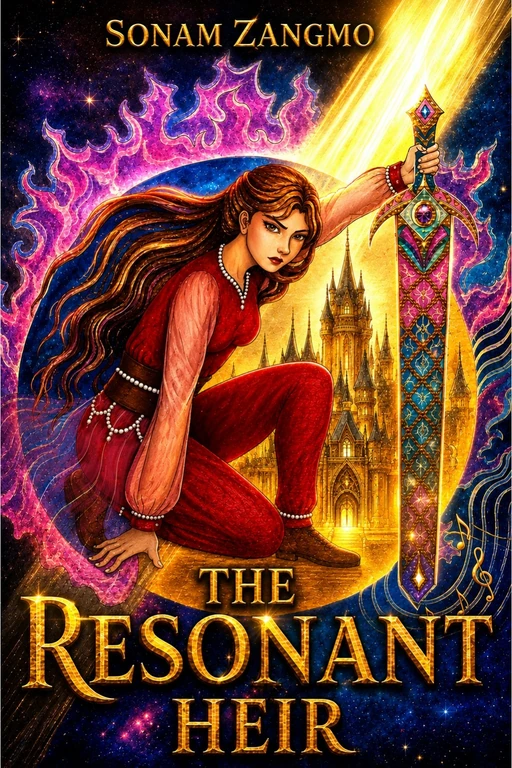
 Explore The Resonant HeirYA crossover royal fantasy · inherited magic · female heir · exile · adventure · Book I Complete
A Literary Commentary on Chapter Forty-Five of The Resonant Heir
The Price of Saving Someone: Power, Consent, and Moral Responsibility in A Comb of Serpent Bone
Lyra and Haris retrieve a serpent's fang and save Sion for another night. But a craftsman forced to make the comb abandons his home. Whose freedom is sacrificed when one person is saved?
Spoiler Notice: Contains spoilers for Chapter Forty-Five.
Explore the 25 themes in this commentary
- A Victory and Its Shadow
- The Family Made on the Road
- The Promise to Return
- Three Coins for Another Household
- The Truth That Hurts to Hear
- The False Oasis and the Useful Illusion
- The Missing Skin Beneath the Jaw
- She Was Not Missing
- Choosing the Risk Inside the Mouth
- The Friend Who Must Fire
- No Aura Does Not Mean No Strength
- “I Came Back”
- The Thirst No One Saw
- The Fang That Becomes a Comb
- The Grinder Has a Life Outside Their Quest
- “This Is Someone’s Life”
- Two Versions of Haris in a Single Day
- The Princess Who Receives the Benefit
- Sion’s Last Clear Wish
- One More Night, Not a Cure
- The Man Who Will Not Take More Money
- A Road That Haris Chooses
- Strength Alone Would Never Be Enough
- The Shop Closed Before Dawn
- Conclusion: Whose Price Was Paid?
Theme 01 · Philosophical commentary
A Victory and Its Shadow
A familiar kind of fantasy quest runs through Chapter Forty-Five of Sonam Zangmo’s The Resonant Heir: the travelers must defeat a great serpent, take a fang, and fashion it into a remedy before night falls. They succeed. Lyra and Haris return with the fang, a grinder cuts it into a comb, and Sion recovers from her next fit.
But A Comb of Serpent Bone does not treat success as an excuse to forget how it was obtained. Lyra bleeds from the fight. Sion is safe only temporarily. The craftsman who shaped the fang was threatened with a sword and leaves his shop before dawn.
That last detail makes the story’s moral problem larger than the combat. We are given ample reason to want Sion saved. We are also invited to see a stranger who had no part in causing her affliction and who may no longer feel safe in his own home.
The difficult question is not whether Sion deserves rescue. It is what those seeking to rescue her are entitled to demand from other people. The serpent is defeated; that question remains unanswered.
Theme 02 · Philosophical commentary
The Family Made on the Road
The chapter quietly explains the emotional stakes before the hunt begins: Sion has become more than Lyra’s traveling companion. She has become family. No ceremony or lineage established the relationship. It has been made through repeated acts of trust and care.
In The Mourning Fire, Sion remained beside Lyra as she grieved Eryndar. In Hooks of Grief, she tried to free her from the High Lord’s cruel hooks. In The Root-Born Boat, Sion’s newly discovered plant magic shaped roots into the vessel that saved both girls.
The bond is therefore neither an ornament of the plot nor simply another reason for the heroine to be brave. It has a history of mutual dependence, and the loss of Sion would destroy something irreplaceable in Lyra’s life.
Yet the claims of family create a difficult tension. We may legitimately feel special obligations toward those we love. Such obligations do not necessarily grant us the right to ignore the equally real lives of strangers. The chapter’s second half tests the boundary between devotion and the use of others as instruments.
Theme 03 · Philosophical commentary
The Promise to Return
Lyra has barely slept. Her eyes burn as she explains where Sion can find cold water if another episode begins. She promises to return before sunset, even though she does not know the serpent’s appearance, how its fang might be taken, or whether she and Haris will survive.
The narration observes that Lyra no longer trusts the word “safe.” That is a significant change after Sarrakha’s hidden snakes and the failure of her familiar warning signs. She makes the promise not because she possesses certainty, but because Sion needs to know she intends to come back.
A promise is sometimes heard as a guarantee about the future. Under grave uncertainty, it is better understood as a commitment to an effort: I will not willingly abandon you; I will do what I can to return. Love cannot simply manufacture a safe outcome.
When Lyra eventually returns wounded and tells Sion that she came back, the words achieve their emotional force precisely because survival was never assured.
Theme 04 · Philosophical commentary
Three Coins for Another Household
As Lyra and Haris prepare to leave, the woman sheltering Sion asks what she is supposed to do if the girl suffers another fit. Her husband is already sick. Keeping Sion in the house is an act of hospitality with possible consequences for both of them.
Haris offers three additional gold coins. If they return that night, she must give two back; otherwise she may keep the money, enough, he says, to move her husband away. He adds that if Sion loses control and cannot be held, the woman should save her household first.
The contingency is painful. Sion lowers her eyes, feeling the weight of being regarded as a danger. The woman protests that she did not mean to abandon her. Lyra answers gently that she knows.
Haris’s directness is not simply coldness. He is acknowledging a possibility Lyra cannot honestly rule out. In Chapter Forty-Four she promised the woman that they would prevent Sion from hurting anyone; Haris now admits the possibility of failure and provides resources for escape.
Compassion becomes more responsible when it considers who will bear the danger if our reassuring plan collapses. That principle will become difficult for Haris to follow when the travelers meet the grinder.
Theme 05 · Philosophical commentary
The Truth That Hurts to Hear
Haris speaks a terrible practical possibility into the open: if the girl they are sheltering becomes uncontrollable, the couple may need to flee. His proposal gives the householder a choice. It also makes Sion hear exactly how much fear her condition causes.
The woman’s reply and Lyra’s acknowledgment preserve the difference between a person who is frightened and a person who wishes harm on the source of that fear. She has legitimate reasons to protect her husband without thereby ceasing to care about Sion.
This is a subtle moment in the ethics of truth-telling. Avoiding every distressing statement can leave people unprepared. Yet saying something necessary without noticing whom it wounds can also fail the demands of care.
The scene points toward a difficult ideal: name the danger honestly while refusing to let the person at its center become merely a burden in the eyes of everyone around her.
Theme 06 · Philosophical commentary
The False Oasis and the Useful Illusion
Deep in the desert, the travelers see trees gathered around a shining lake. An oasis seems improbable this far out on the sand. Lyra does not trust the appearance. She throws a stone, which passes through the seeming water without a ripple or a splash.
The lake is an illusion, yet finding it confirms the clue given by the masked healer in the previous chapter: seek water where no water should be. Something false as a lake can still be meaningful as a sign.
The distinction is a small triumph of observation over assumption. In The Venom in Her Heart, Lyra dismissed Sion’s warning about a strange movement beneath the sand. Here she tests what she sees before drawing her conclusion.
Nothing in the chapter establishes who created the illusion or why. The lesson lies in Lyra’s method: she can refuse an appearance as literal fact while still asking what its presence reveals about the world.
Theme 07 · Philosophical commentary
The Missing Skin Beneath the Jaw
When the serpent rises, its dark-gold body is so immense that most of it remains underground. Lyra notices a bare, old-looking strip under its jaw, where the scales have given way to exposed skin. Something about the shape seems familiar.
Later, as blows turn aside, she remembers the old woman’s snakeskin mask. Its size and curve resemble the missing patch. Lyra concludes the woman had somehow touched the creature before, and that its seeming invulnerability therefore has limits.
The detail invites speculation, but it does not settle the healer’s history. The chapter does not reveal how she obtained the mask, whether she fought the serpent, or whether she is related to it in some supernatural way. Lyra’s recognition is an inference under pressure.
This is an effective use of mystery: an old image acquires new significance without being fully explained. Knowledge can become useful long after an encounter, when an apparently incidental detail turns out to belong to a larger pattern.
Theme 08 · Philosophical commentary
She Was Not Missing
Lyra’s blade approaches the serpent’s scales and slides away. Haris’s ice spear veers at the last instant. Dozens of shards follow the same course, striking sand and stone rather than their intended target. Increasing force does not change the result.
Lyra stops long enough to recognize the pattern. She is not simply missing. Something is making each blow turn aside. That observation changes the question from how to attack harder to where the serpent’s protection does not operate in the same way.
The moment recalls The Skull’s Riddle, where Lyra discerned an underlying cycle within the movement of smoke. There and here, her intelligence appears not as sudden possession of a secret answer but as the willingness to reconsider the problem’s structure.
Repeated failure may be evidence about the method, not proof that the person using it is inadequate. Her blade will become effective only after she stops treating the scales as the inevitable place to strike.
Theme 09 · Philosophical commentary
Choosing the Risk Inside the Mouth
Lyra sees that a few of Haris’s ice fragments reached the open mouth before being diverted. She reasons that the inside of the serpent may offer a weakness. Haris is being forced back, and Sion cannot wait indefinitely. Lyra makes an extreme decision.
She draws the serpent toward her, leaps between its fangs, lands on the lower jaw, and buries her sword in its tongue. Blood sprays as the huge head thrashes. She clings to the hilt and cries for Haris to attack.
The act involves frightening danger, but it is not courage without thought. The narrative shows a sequence of observation, inference, and deliberate exposure. Lyra has identified a chance where direct blows have failed.
Its moral character also depends on whose body is being risked. Lyra knowingly offers herself as the opening through which Haris can strike. Her decision to risk her own life for someone she considers family will later stand in contrast to forcing a stranger to bear a danger he has explicitly refused.
Theme 10 · Philosophical commentary
The Friend Who Must Fire
Haris hesitates. The opening Lyra has created places her directly in the path of his ice. She shouts again, and he sends spears through the serpent’s mouth and into its throat. The cold stiffens the creature until it collapses, still twitching, onto the sand.
The strike succeeds, but Lyra is wounded. Smaller ice shards have cut her shoulder and ribs. Haris pulls her from the jaws, covers her with his cloak, takes the fang, and carries her toward the horse.
The scene refuses the fantasy of perfectly costless teamwork. Two companions can cooperate successfully and still hurt one another while facing a threat neither can defeat alone.
Here Lyra actively calls for the dangerous attack and understands its proximity to her body. That does not make her injuries meaningless, but it matters when assessing the choice. Her voluntary exposure is different from the later coercion of the grinder.
The distinction is not that one danger has value and another has none. It is that people have a moral claim to some control over which dangers are imposed on them in the service of other people’s goals.
Theme 11 · Philosophical commentary
No Aura Does Not Mean No Strength
After the battle, Haris tells Lyra that he had been wrong about her. Having no aura, he now understands, does not make someone weak. The acknowledgment recalls the cruel judgments made about the young princess at the very beginning of the novel.
Lyra’s lack of visible royal magic had been treated as a defect, even as a reason to doubt her place as heir. Haris was among those whose behavior revealed this prejudice. In the desert he sees what that single measure failed to capture.
He has powerful ice magic, yet the serpent turns his attacks aside. Lyra, seemingly lacking what others consider the defining sign of strength, observes the limitation of its defense and devises the tactic that makes their combined assault possible.
The most important words may be Haris’s admission that he was wrong. It locates the failure in his assessment, rather than suggesting Lyra only became worthy when she nearly died proving herself.
Recognition does not create a person’s value. Sometimes it only corrects the narrow judgment that prevented another person from seeing it.
Theme 12 · Philosophical commentary
“I Came Back”
The riders return as sunset approaches. Lyra is barely conscious in Haris’s arms, his cloak soaked in her blood. She has kept her promise, but only with the assistance of a friend who must hold her upright and later carry her inside.
When Sion appears and calls her name, Lyra answers that she came back. The words resolve the small promise made that morning, not the larger problem of the venom.
Their force comes from the contrast between intention and cost. Lyra is no invulnerable rescuer. Her hands and body have achieved something difficult, and she now needs bandages from the woman who has been keeping Sion safe.
In these chapters, care repeatedly passes from one person to another. Sion once nourished Lyra when grief had nearly stopped her; now Lyra risks herself for Sion; Haris brings the injured rescuer home. Family is a pattern of mutual dependence rather than a permanent distinction between strong and weak.
Theme 13 · Philosophical commentary
The Thirst No One Saw
While Lyra’s wounds are being tended, Sion reaches for a cup of warm water meant for her friend. A strange thirst grips her and she drinks it herself before she can think. The narrator remarks that no one saw.
The placement of the detail is unsettling. Everyone’s attention is on the bloodied heroine and the newly won fang. Something unexplained is happening to the girl whose welfare motivated the journey, beyond the awareness of those trying to protect her.
The chapter does not clarify whether the thirst is caused by the venom, by Sion’s plant magic, or by some other process. It should not be given a diagnosis that the narrative has withheld.
What the moment does establish is another gap between the reader’s knowledge and the characters’ attention. Rescue from one recognized danger does not make every other development visible.
Theme 14 · Philosophical commentary
The Fang That Becomes a Comb
The fang is immense, cloudy white and stained with blood. The travelers want a craftsman to reshape it into an object of care. A fang is associated with puncture and injury; a comb touches someone’s hair in an intimate, almost domestic ritual.
The conversion resembles the root-born boat. Roots that once held fast to the mountain became a means of travel. Here the serpent’s fang is made to serve the preservation of Sion’s awareness rather than the infliction of harm.
But this transformation is morally more complicated. The fang has been taken in a violent encounter that wounded Lyra. The act of turning it into a comb will require a skilled worker who is unwilling to accept the task.
The object can be tender in its use and troubling in its history at the same time. Its final purpose does not erase the decisions that brought it into existence.
To judge an instrument of rescue fully, we must ask not only what good it accomplishes, but what happened to the people involved in obtaining and making it.
Theme 15 · Philosophical commentary
The Grinder Has a Life Outside Their Quest
The grinder is closing his shop when the exhausted travelers arrive. Curved knives, saws, and bone combs hang on the walls. He plainly possesses a relevant craft. Yet the sight of the serpent’s fang makes him recoil.
He believes grinding it down will bring something terrible to his house. Haris insists the serpent is dead, but the craftsman is unmoved. He orders them to remove the fang and find someone else.
The fear may arise from a supernatural reality, a local belief, or a mistaken idea. The chapter does not decide which. What it does show is a person who genuinely believes he is being asked to endanger his livelihood and home.
Lyra and Haris need his skill, but they have not earned ownership of his hands. He did not travel with them, participate in the fight, or choose Sion’s emergency as his own.
The narrative’s moral strength lies in permitting this refusal to have substance, even as the fading daylight makes it increasingly painful for the protagonists to hear.
Theme 16 · Philosophical commentary
“This Is Someone’s Life”
Lyra says Sion will lose her mind without the comb. The grinder still refuses. Haris brings his sword down on the table near the man’s hand and orders him to work. As Sion’s next fit begins, he lowers the blade near that hand again and demands greater speed.
Haris’s reason matters: Sion’s continued awareness may be at stake. He is trying to protect a friend, not entertain himself through fear, as the High Lord of Drazhune did. The pressure of time is genuine.
Yet the truth of the purpose cannot supply the missing consent. The craftsman is no longer being asked to accept a commission. He is being compelled under the threat of injury.
The chapter thereby introduces a troubling symmetry. Haris acts to preserve Sion’s capacity to remain herself while overriding another person’s ability to refuse a task he regards as dangerous.
A noble end does not automatically authorize every means, especially when the means require treating a stranger’s autonomy as disposable. The narrative allows us to understand Haris without making what he does morally uncomplicated.
Theme 17 · Philosophical commentary
Two Versions of Haris in a Single Day
At dawn Haris had made a contingency plan for the woman sheltering Sion, giving her money and openly affirming her right to protect her husband if the fit became uncontrollable. By evening he is threatening a craftsman who also fears for his household.
The difference in circumstances is real. The sun is sinking, Lyra is wounded, Sion is deteriorating, and the travelers know of no alternative grinder. The urgency helps explain Haris’s escalating response.
But the juxtaposition remains challenging. When there was time to negotiate, he could acknowledge the limits of what the household owed Sion. When time appears to run out, he no longer honors an outsider’s refusal.
The same young man who has grown enough to apologize for judging Lyra by her aura can still fail a different test of moral strength. Growth in one dimension does not confer immunity against harmful choices in another.
This is what keeps Haris a credible character rather than a lesson about good or evil. He can be loyal, brave, capable of correction, and dangerously willing to force someone weaker when a friend’s life is at stake.
Theme 18 · Philosophical commentary
The Princess Who Receives the Benefit
Lyra calls Haris’s name when his sword first strikes the table near the grinder’s hand. He does not turn toward her. The text leaves open what else she intended to say, though the interruption suggests at least some discomfort with his action.
Her condition is severe. She has been wounded, is struggling to stand, and knows Sion’s awareness is slipping away. It would be unfair to treat her as though she planned the intimidation. Yet the completed comb will serve her goal, and she will take it from the threatened worker’s hands.
The scene raises a problem of complicity. How responsible are we when another person uses morally questionable methods to accomplish something we urgently need? The answer depends upon knowledge, available alternatives, and capacity to intervene; the novel does not supply enough to pronounce a final verdict upon Lyra.
But her future role as heir gives the question unusual relevance. Leaders must examine not only the harms they personally inflict, but also those committed in service of their aims. A powerful ally’s sword can advance a good cause while injuring the moral basis on which that cause is pursued.
Theme 19 · Philosophical commentary
Sion’s Last Clear Wish
As the grinder’s tools turn the fang into a comb, Sion feels the fit approaching. Her eyes still recognize Lyra, but their awareness is fading. She says she does not want to bite anyone again.
The declaration is heartbreaking because it makes her moral will explicit an instant before that will loses control of her actions. She understands the harm that an episode can cause and dreads being the cause of it. Then she lunges toward the grinder, and Haris must raise an ice shield.
The attack remains dangerous to its target. But it cannot be treated as proof that Sion wants to attack him. Her own words point in the opposite direction.
The moment develops the chapter’s broader concern with autonomy. The grinder’s ability to refuse is taken from outside by a sword. Sion’s ability to direct her behavior is being taken from within by the venom. These are different injustices and vulnerabilities, but both make the freedom to choose morally visible by placing it under threat.
Theme 20 · Philosophical commentary
One More Night, Not a Cure
The grinder completes the comb just as Sion loses control. Lyra grabs it, holds her companion, and draws the teeth slowly through Sion’s hair. The girl stills; her grip loosens; she blinks and recognizes Lyra. The answer Lyra gives to her name is a simple promise of presence: she is here.
This is the emotional counterpoint to the sword at the worktable. An object produced under intimidation becomes an instrument of intimate care. The gesture restores Sion’s awareness without presenting that restoration as a defeat of Sion herself.
The prose is explicit about the limit. The comb works against the immediate fit. It is not a cure. It holds Sion in herself for another night. The longer threat remains.
One of the most humane aspects of the chapter is that it does not dismiss limited relief as worthless. A single safe night matters enormously to someone who fears losing control, even if it is not the ending of the illness.
Yet the necessity of repeated care means the quest is not concluded. The remarkable act of obtaining a fang has produced a method of ongoing support, not a miraculous restoration that relieves everyone of future responsibility.
Theme 21 · Philosophical commentary
The Man Who Will Not Take More Money
Afterward the grinder refuses further coins. He is pale and shaken, as though he believes his work has put his home at risk. The money that might have made a voluntary commission attractive cannot erase what happened under the sword.
His reaction contrasts with the woman’s acceptance of shelter payments. Financial aid gave her a possible way to protect her household. For the grinder, money is not the central question; the danger he believes has been attached to his home is.
A payment after forced work does not retroactively make the initial choice free. The refusal of more money preserves this moral difference and prevents the encounter from being tidied away as an exchange of useful goods.
What the characters take away is the comb. What the craftsman is left with is a fear the story does not make vanish on command.
Theme 22 · Philosophical commentary
A Road That Haris Chooses
Haris hires a small cart, and Sion falls asleep with her head on Lyra’s shoulder. As they leave Sarrakha, he tells Lyra that he needs to go to Hemaliel, where his father wants him to meet a High Lord in hopes of reviving an old alliance.
Lyra considers the suggestion. Hemaliel may offer a clue about the final map fragment; it may not. She knows the remaining fragment is still somewhere ahead, but the immediate alternatives are unclear.
She agrees to go. The decision extends the previous chapter’s debate about strength, succession, and alliances. It is no longer only the map’s course that matters. Haris has a task of his own, and its political purpose may also serve the larger struggle.
The story makes no promise that Hemaliel will provide a clue or an agreement. It is a chosen road under uncertainty, not a revelation of destiny.
A future ruler must sometimes recognize that leadership includes following another person’s workable direction, particularly when her own plan offers no safer next step.
Theme 23 · Philosophical commentary
Strength Alone Would Never Be Enough
As the cart travels into darkness, Lyra looks at Sion and thinks of the things that have preserved her own life: hearing, instinct, swordsmanship, and the experience she has accumulated on the road. This time, the danger did not first strike her. It struck someone beside her.
The realization changes the measure of success. Lyra may be able to keep herself alive. But others travel with her, trust her choices, and face hazards they may be less prepared to withstand.
For a princess who may someday govern, that is a serious extension of moral imagination. A leader’s strategy cannot be measured only by what it accomplishes for the leader. It must also consider the price carried by companions and strangers who may never have chosen the same risks.
That does not mean Lyra caused the venom by sheer force of will or that she could have prevented every misfortune in Sarrakha. Responsibility is not omnipotence. The question is how fully a person takes other people’s exposure into account before asking them to follow.
Protecting ourselves is a skill; deciding how our decisions expose others is an obligation. Lyra has begun to recognize the difference.
Theme 24 · Philosophical commentary
The Shop Closed Before Dawn
The chapter ends away from Lyra’s cart. By morning the grinder’s shop is closed, and the man has packed everything and left before dawn. He has a future outside the protagonists’ company, and their success has altered it.
The story does not confirm that the dead serpent, its kin, or any curse has actually come for him. Nor does it reveal where he goes or how long he will remain away. We know only that his fear is real enough to make him leave the place where he practiced his craft.
The ending’s power comes from its refusal to let the rescuer’s perspective be the only one that counts. For Lyra, the comb means Sion has been restored for a night. For the worker, making it under threat has coincided with the loss of a safe home and trade.
Both outcomes deserve attention. The reader is not being asked to wish Sion had remained untreated. We are being asked to resist the convenient idea that once the heroine’s objective is met, everyone else’s losses are narrative debris.
The moral cost of a victory may be paid by someone who never wanted to join the quest. The grinder has scarcely any time on the page, but he receives its final words.
Theme 25 · Philosophical commentary
Conclusion: Whose Price Was Paid?
A Comb of Serpent Bone joins a genuine act of rescue to a troubling account of its making. Lyra and Haris risk their lives and accomplish what seemed impossible in the desert. Haris corrects his old prejudice about a princess without an aura. The comb they obtain truly helps Sion return to herself.
But a stranger is compelled to shape that comb against his will. The urgency of saving Sion explains the protagonists’ desperation; it does not make the craftsman’s fear and refusal meaningless. The wounded rescuer and the coerced worker inhabit the same moral story.
The central distinction is between danger voluntarily assumed and danger imposed through superior force. Lyra risks herself for family, and Haris acts at her request even though it may injure her. The grinder never offers the same consent, and the sword near his hand deprives him of the freedom to decline.
As Lyra chooses the road to Hemaliel, she begins to understand that her skills may not be enough to protect those who accompany her. The narrative asks the reader to go one step further: the obligations of power reach even people who do not accompany the heroine and who may wish only to continue their ordinary lives.
The comb preserves Sion for one more night. The grinder has fled by morning. True heroic responsibility must reckon not only with the person it manages to save, but with the rights and lives it places at risk along the way.