
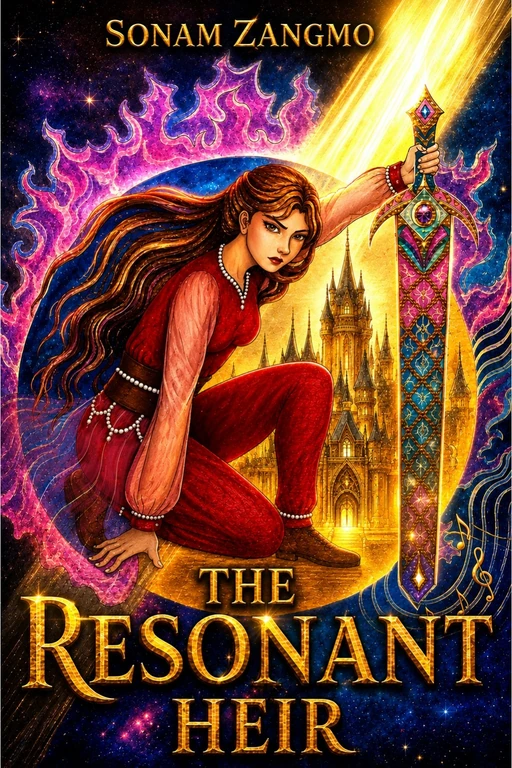
 Explore The Resonant HeirYA crossover royal fantasy · inherited magic · female heir · exile · adventure · Book I Complete
A Literary Commentary on Chapter Forty-Six of The Resonant Heir
What the Land Remembers: Blood, Belonging, and the Ethics of Care in The Blood of Hemaliel
In a city rebuilt after a flood, a broken levee brick remembers an act of rescue, while a serpent-fang comb remembers a far less innocent one. Between them, Sion encounters a place that seems to know her before she knows herself.
Spoiler Notice: Contains spoilers for Chapter Forty-Six.
Explore the 21 themes in this commentary
- A Green Made by Human Hands
- The Promise and the Danger of Beauty
- A Broken Brick as a Monument
- Gratitude Is Not a Contract
- The Soldier Who Rebuilt and the Son Who Threatened
- The Gate Recognizes Haris, Not Lyra
- The Cousin and the Princess
- “It Feels Like It Knows Me”
- The High Lord’s Interrupted Composure
- The High Lady Who Cannot Remain
- What Does the Blood of Hemaliel Mean?
- Where the Walls Have Fewer Ears
- A Seat Closer to the High Lord
- Sion, Being Sion
- A Likeness Is Not a Family Tree
- Two Bites Do Not Establish One Cause
- The Comb Carries More Than a Remedy
- “No”: The Courage to Admit Uncertainty
- The Right to Be Helped—and to Refuse
- Who Owns the Story of a Life?
- Conclusion: What the Land Remembers
Theme 01 · Philosophical commentary
A Green Made by Human Hands
In Chapter Forty-Six of Sonam Zangmo’s The Resonant Heir, the travelers leave Sarrakha’s desert and enter a landscape that seems to have changed the terms of their journey. The sand gives way to damp, firm earth. Trees follow canals. Water crosses orchards and drying yards, while people carry buckets, open stalls, and lead animals through sunlit lanes.
The beauty of Hemaliel is not presented as untouched wilderness. Lyra notices that the green is tended, watered, shaped, and kept. Its existence depends upon the attention of many people who may never appear as named characters. The landscape is not simply a gift received from nature; it is a condition maintained by labor.
This is a striking choice after the previous chapters’ emphasis on survival through daring and magical action. Sion made roots into a boat in an emergency. Lyra and Haris fought a huge serpent to obtain a fang. Here the image of strength is continuous care: channels must be kept open, water directed, trees tended, and fields made productive.
There are forms of power whose greatest achievement is not victory over an enemy, but the creation of conditions in which ordinary life can continue. Hemaliel’s cultivated green provides a visual language for such power before its political history is explained.
Theme 02 · Philosophical commentary
The Promise and the Danger of Beauty
The citadel rises among terraces, pale walls, delicate arches, and flowing water. The description culminates in three spare impressions: beautiful, prosperous, alive. Lyra wants to believe that a place like this might nurture almost anything.
The wording matters. The story does not establish that Hemaliel can heal Sion. It says that Hemaliel’s beauty makes such a hope tempting. The distinction between a landscape that invites trust and a situation in which trust has been earned will become increasingly important.
In Sarrakha, Lyra learned that daylight and an apparently quiet surface did not guarantee safety. Now she stands before flourishing gardens with an exhausted friend whose breathing is still thin. Her willingness to hope is deeply human; she has been holding the serpent-fang comb without letting it go.
The chapter lets hope have its dignity without allowing it to become certainty. To recognize beauty is not the same as knowing what lies beneath it. The citadel can be genuinely splendid and still house anxieties, secrets, and people who do not understand one another.
Theme 03 · Philosophical commentary
A Broken Brick as a Monument
Haris presents the High Lord of Hemaliel with a small object wrapped in golden silk. Its contents are almost comically modest for a royal audience: a dark shard of levee brick. But the fragment summons the memory of a great flood, drowned fields, broken defenses, and Rogan arriving with hundreds of soldiers to help rebuild.
The object is materially unimpressive because its value is not monetary. It carries a remembered act. To the High Lord, the broken brick does not announce ruin alone; it also recalls the people who came when the levees failed. The shards of a damaged public structure become evidence of solidarity.
That memory changes how we see the flourishing landscape introduced at the chapter’s opening. The gardens and canals are not necessarily the untouched inheritance of a wealthy citadel. The High Lord remembers a time when the land and its defenses had been broken. What appears permanent now has survived vulnerability.
The symbolism is unusually precise. The shard does not simply say that Rogan is powerful. It says that his power once helped restore the material basis of other people’s lives. A military commander’s reputation is grounded, in this memory, in rebuilding rather than conquest.
A society may remember a benefactor most enduringly through what was repaired, not through what was defeated. The brick transforms an old disaster into the beginning of a possible new political relationship.
Theme 04 · Philosophical commentary
Gratitude Is Not a Contract
The High Lord’s expression softens when he unwraps the shard. He folds it carefully into the silk and tells Haris that he understands. This is the scene’s entire overt political response. It is enough to demonstrate recognition and feeling; it is not yet a treaty.
Haris comes to Hemaliel carrying his father’s history because Rogan once came when this land needed help. It is reasonable to hope that past assistance has established trust. It would be unreasonable to conclude that the High Lord now owes any and every favor requested by Rogan’s son.
Gratitude can create a moral reason to listen, remember, and offer support. It need not erase judgment about the present. An alliance would still concern Hemaliel’s people, its risks, and the High Lord’s duties to those who depend on him.
This makes the shard a more interesting diplomatic object than a bribe. It does not buy permission. It calls on a shared memory of voluntary aid and asks whether that history can matter again.
The distinction points to an ethical principle that will echo at the end of the chapter: past help can make trust possible without turning the person once helped into property or obligation without limit.
Theme 05 · Philosophical commentary
The Soldier Who Rebuilt and the Son Who Threatened
Rogan’s remembered rescue casts an illuminating light backward upon Chapter Forty-Five. Haris, Rogan’s son, recently held a sword near a frightened grinder’s hand and compelled him to fashion a serpent fang into a comb. He acted to save Sion, but he overrode the craftsman’s refusal.
The circumstances were different from those of the flood. Haris had been racing against an approaching fit, while Rogan had brought organized aid to a devastated territory. The contrast should not be forced into a simple verdict about father and son. Still, it allows us to compare uses of available power.
Rogan commanded hundreds of soldiers and employed them to help restore houses, fields, and levees. Haris possessed the strength to make an unwilling worker obey. He was moved by a worthy purpose, yet his means left another person frightened enough to abandon his shop.
Now Haris benefits from Rogan’s name. The guard recognizes the House of Rogan; the High Lord remembers a generous act. That inheritance may open a gate, but it cannot itself guarantee that the heir to a reputation possesses every virtue that created it.
To inherit honor is not necessarily to have learned the ethics by which that honor was earned. Haris is growing, and the novel lets his growth remain incomplete.
Theme 06 · Philosophical commentary
The Gate Recognizes Haris, Not Lyra
At the entrance to Hemaliel, Haris gives his name and identifies himself as the son of High Commander Rogan. The guard examines the palace token, relaxes, bows, and opens the gate. Haris then rises into the air and glides beside the cart so that the guards may remember the standing of his house.
The gesture has a public meaning. Flight is useful as movement, but here it functions as a display. Haris deliberately makes himself visible as someone whose family should command recognition. A title, a token, a supernatural ability, and a sequence of bows work together to establish his position.
Beside him, the person with the most directly threatened dynastic claim must conceal it. Lyra is the royal heir, yet she cannot announce herself safely. Haris’s family identity opens doors; Lyra’s true identity could expose her to danger.
The contrast separates legal or inherited status from the social power of having that status recognized. Rights may continue to exist even when exercising them openly has become perilous.
The scene quietly prepares a future ruler for an uncomfortable truth: the ability to be seen as legitimate can depend upon institutions, witnesses, and political conditions, not merely on what one knows oneself to be.
Theme 07 · Philosophical commentary
The Cousin and the Princess
When the High Lord turns to ask who Lyra is, she answers before Haris can speak: she is his cousin. He gives a small nod. The narration notes that she has not exactly lied, but that letting others know she is the princess would be unsafe.
The phrase “not exactly” is important. The chapter does not invite us to invent a family tree in order to prove or disprove the claim. What it clearly shows is selective self-presentation: Lyra offers a relationship that is safe enough to explain her presence while withholding the politically dangerous fact of her birth.
This maneuver resembles earlier deceptions in the journey, but the moral stakes change according to their purpose and their effects. In Sarrakha she improvised a story about trading handicrafts to protect her mission. In Hemaliel she enters a diplomatic encounter under a diminished public identity.
A person can know who she is and still be unable to tell others. The resulting distance between inward identity and outward role can be protective, but also lonely. Lyra is received as a guest close to Haris rather than as the heir whose future is under threat.
The secrecy also makes Sion’s strange response to Hemaliel more intriguing: one girl is deliberately hiding a known identity, while the other may be approaching a connection she cannot yet identify at all.
Theme 08 · Philosophical commentary
“It Feels Like It Knows Me”
Inside the pale hall, Lyra catches a faint scent, floral but not quite floral, clean and cool as though it had passed through stone. Beside her, Sion stops walking. She surveys the walls, arches, and light with an expression of recognition she cannot explain.
Asked whether she has visited before, Sion says she does not remember. Her next words reverse the ordinary language of familiarity: it feels as though the place knows her. The reversal is the chapter’s first intimate mystery.
Memory and familiarity are not identical experiences. A person may feel an unexpected connection to a place without being able to summon a specific event or narrative that explains it. Fantasy can expand the range of explanations, but it does not relieve us of the need to distinguish feeling from historical fact.
The text has not established that Sion grew up in Hemaliel, that her memory was erased, or that the building is conscious. It has established that she experiences a powerful sense of recognition, and that the other characters cannot yet make sense of it.
Belonging can be felt before it can be understood—but a feeling of belonging is not yet proof of a particular origin. The story allows that uncertainty to remain meaningful.
Theme 09 · Philosophical commentary
The High Lord’s Interrupted Composure
The High Lord enters with practiced calm and takes his seat beneath the arches. The guests bow. Sion lifts her head, and for a single heartbeat the High Lord goes still. Lyra notices the interruption before he turns to Haris and resumes the formal exchange.
The scene depends on a tiny departure from ritual. High-ranking hosts know how to receive visitors. Their expressions and gestures are part of public authority. An instant of visible surprise can therefore carry more dramatic weight than an overt declaration.
But we should resist making the surprise into a confession. The High Lord may recognize a face, recall an event, or react for some reason not yet available to the reader. The chapter supplies no explicit identification of Sion.
Lyra’s attentiveness is what permits the moment to become narrative evidence. She does not hear a revelation. She sees a person fail briefly to remain composed, and she stores that observation while other events continue.
The scene turns political reception into a test of interpretation: what is spoken is carefully controlled, while the first suggestion of a hidden relationship appears in what cannot be fully controlled.
Theme 10 · Philosophical commentary
The High Lady Who Cannot Remain
The High Lady enters in black, a mother-of-pearl sheen catching the collar of her dress. She offers a gracious welcome, then looks toward Sion. Her smile falters. Her hand tightens on the chair. She announces that she is unwell and leaves quickly enough to disturb the grace of her entrance.
The reaction parallels the High Lord’s sudden stillness, but the two responses are not identical. He continues receiving the visitors. She removes herself from the room. The juxtaposition invites the reader to ask whether both have encountered the same unexpected recognition.
The chapter does not prove that they have. Nor does it establish that the High Lady is angry at Sion, frightened of her, or concealing a specific family secret. We are witnessing a visible change in behavior, not direct access to a motive.
What the scene does reveal is the fragility of public composure. A formal greeting can be practiced; a face encountered at the wrong moment can interrupt it. The High Lady’s abrupt departure turns the polished hall into an interior space where someone has reasons to avoid being seen.
Her absence will later occupy the story almost as strongly as her brief appearance.
Theme 11 · Philosophical commentary
What Does the Blood of Hemaliel Mean?
The chapter’s title naturally encourages a reading concerned with ancestry. Sion senses an unexplained connection to Hemaliel, both of its ruling figures react unusually to her appearance, and Lyra later notices a likeness between Sion and the High Lord.
Those clues justify a question about kinship. They do not yet answer it. The chapter does not confirm that Sion is the daughter, relative, or descendant of either ruler. It would be a failure of literary criticism to turn an inviting theory into an established plot fact.
“Blood” can also evoke inheritance as something broader than biological descent. A place carries a history of suffering and survival. A military family carries a remembered public action. Sion carries an uncertain past and a body newly afflicted by venom. The title gathers these possible forms of continuity without declaring how they fit together.
This breadth is what makes the title effective. It can point toward an eventual revelation of family origins while also raising the question of how a place becomes part of a person’s identity—through kinship, memory, work, and the actions of those who came before.
The reader is not required to choose an answer prematurely. The most faithful response is to acknowledge how carefully the chapter has made that answer matter.
Theme 12 · Philosophical commentary
Where the Walls Have Fewer Ears
After the High Lady withdraws, the High Lord orders rooms for the guests and invites Haris to ride with him. They will speak somewhere the walls have fewer ears. The invitation belongs naturally to the political mission that has brought Rogan’s son to Hemaliel.
It would be unjustified to label the private conversation a conspiracy. Diplomacy often requires discretion, and the chapter has not revealed what the two men say. Their departure nevertheless adds to a growing pattern in which the people who might explain Sion’s presence do not explain it in front of her.
The High Lord can decide whom to include, whom to exclude, and which matters are discussed privately. Those powers are ordinary aspects of leadership. They may protect legitimate interests, or they may obstruct someone’s access to knowledge relevant to her life.
The moral question remains suspended because the motives are unknown. Privacy is not itself wrongdoing. Yet when a stranger feels recognized and two rulers respond unexpectedly, the control of information becomes ethically charged.
Knowledge is a form of power when the truth concerns a person who cannot yet name what she needs to ask.
Theme 13 · Philosophical commentary
A Seat Closer to the High Lord
At breakfast the next morning, the servants arrange the chairs before the guests enter. Lyra and Haris sit on one side of the table; Sion is placed opposite, a little closer to the High Lord. The seat seemingly intended for the High Lady remains empty.
The arrangement may be mere hospitality, or it may be deliberate. The chapter does not identify who ordered it or what intention lies behind it. But its placement in the narration encourages us to notice the change in Sion’s position.
In most of the journey, Sion has been physically close to Lyra: sharing food, leaning on her when weak, traveling at her side or asleep against her. Now she is separated across a formal table and positioned near a ruler who appears unusually interested in her.
Spatial arrangement can express social possibility before speech acknowledges it. A chair is not proof of kinship, but the chair places Sion in a new visual relationship with the High Lord. Lyra sees the scene and begins looking again at the two faces.
The ordinary furniture of a meal becomes part of the chapter’s language of recognition and concealment.
Theme 14 · Philosophical commentary
Sion, Being Sion
While the room is full of cautious looks, Sion is more interested in breakfast. A little color has returned to her face, and she is eating well again. The narration’s affectionate aside—Sion being Sion—matters more than its lightness might suggest.
Across the previous chapters Sion has been bitten, weakened, frightened of hurting others, and brought back from fits by a strange comb. A story could easily let those events reduce her to a condition needing treatment or a secret needing revelation.
Instead, the pleasure of eating gives her an ordinary desire, and the return of color offers a small measure of recovery. The girl at the table is still a person whose identity includes appetite, curiosity, affection, and moments of unworried attention.
The human stakes of the potential mystery depend on this reminder. If Sion has a hidden past, discovering it would not replace the Sion Lyra already knows. If she remains vulnerable to venom, the vulnerability does not exhaust who she is.
People deserve to be seen as more than the harms they have suffered or the secrets others may hold about them. This brief breakfast scene protects that truth.
Theme 15 · Philosophical commentary
A Likeness Is Not a Family Tree
The High Lord speaks sparingly over breakfast, occasionally asking Haris about the palace or his father. Again and again, his gaze returns to Sion. A small smile softens his expression when it does. Lyra lowers her eyes, studies the pair, and recognizes a strange resemblance.
The revelation here is modest but important: Lyra finally has a visible feature to connect with the earlier reactions. Sion’s sensation of familiarity was subjective; the High Lord’s stillness was observed behavior. Now there is an apparent similarity of appearance.
The accumulation raises the plausibility of a relationship. It does not settle which relationship, if any, exists. People can resemble one another without sharing the familial history a reader expects, and responses to a face can have many causes.
Lyra’s intellectual growth in the series is partly visible in the way she gathers signs. In the skull’s chamber she looked for a pattern within smoke; against the serpent she identified why attacks were deflected. Here she looks for a pattern in human faces, gestures, and seating.
The difference is that human motives may not yield to a single mechanical solution. A good observation is a reason to inquire, not a substitute for a person’s own account of what she knows.
Theme 16 · Philosophical commentary
Two Bites Do Not Establish One Cause
The absent High Lady has refused visitors and a physician since the previous day. When the physician finally reports back, he displays clear bite marks on his hand. She attacked him and would not allow an examination.
Sion immediately asks whether the High Lady was bitten by a sand snake as she was. The inference is understandable. Sion’s own venom-induced fits have involved biting people, and the newly reported behavior looks disturbingly familiar.
But two outwardly similar actions may arise from entirely different situations. The High Lady has not been shown with a snake wound or Sion’s dark spreading marks. We have not watched her lose awareness. The physician describes her as unlike herself, but he has been unable to examine her.
Lyra suspects the woman’s mind may not be disturbed at all. That suspicion is not a diagnosis either. It may arise from the High Lady’s earlier reaction to Sion, her departure, and her refusal to see anyone. It is still a character’s interpretation under uncertainty.
The scene stages a vital discipline of reasoning: recognizing a pattern is useful only when we remain willing to ask what evidence would distinguish a true recurrence from a superficial resemblance.
Theme 17 · Philosophical commentary
The Comb Carries More Than a Remedy
Lyra takes the comb from her pocket and offers its possible help. It was fashioned from the fang of a great serpent and has steadied Sion during a fit. From her perspective, refusing even to consider it could mean overlooking a chance to assist someone in distress.
Yet the reader knows the comb’s history. Lyra and Haris risked their lives to obtain the fang. A frightened grinder refused to shape it, and Haris used a sword to force him to work. By the next morning, that man had abandoned his shop.
The comb can function as an instrument of care without being innocent of the actions that produced it. In Hemaliel, it stands opposite the broken levee brick in the same chapter. The brick recalls work undertaken to help a community rebuild. The comb recalls help achieved through both courage and coercion.
Neither object can be defined by only one property. The brick is physically broken and socially precious. The comb has practical value and a morally troubled origin. The question is not whether objects themselves bear guilt, but whether people remember the histories that made their benefits possible.
A prosperous court may now receive assistance through a thing made by a tradesman whose own security was sacrificed. The text does not say that Lyra intends to make the High Lord indebted to her. The contrast belongs first to the reader’s moral perspective.
Theme 18 · Philosophical commentary
“No”: The Courage to Admit Uncertainty
Haris asks Lyra whether she is certain the comb can help. She replies that she is not. Then she reasons that without trying, they will not know. This brief answer contains a real improvement in the way she presents what she understands.
Earlier, in Sarrakha, Lyra relied on the apparent quiet of her resonance and called the path safe enough. Sion saw an odd disturbance in the sand, but Lyra dismissed it as wind. The hidden danger proved costly.
Here Lyra does not make certainty out of familiarity. The comb worked for a particular condition in Sion; she cannot know whether that result extends to the High Lady. Her stated ignorance is an honest limit on her claim.
Yet truthfulness about uncertainty does not finish the ethical inquiry. A tool that benefits one person may not suit another, especially when the second person’s condition is still unknown. “We cannot know without trying” is a reason to investigate, not automatically a permission to act on someone else’s body.
Intellectual humility is the beginning of responsible help; respect for the person being helped must shape what comes next.
Theme 19 · Philosophical commentary
The Right to Be Helped—and to Refuse
The High Lady has already declined the physician’s examination with frightening force. We do not know whether she is fully aware, under some magical influence, terrified, or acting for a private reason. Consequently, we cannot yet determine the meaning of her refusal with confidence.
If she understands the situation and can decide for herself, her right to decline intervention deserves serious attention. If she cannot control herself or is in immediate danger, the ethical circumstances would differ. The chapter ends before any such distinction can be established.
This makes the proposal to use the comb more than a hopeful fantasy device. Lyra has just witnessed the consequences of overriding another person’s refusal in the grinder’s shop. Here she faces a possibility that could require care without repeating coercion.
The novel has not shown her forcing the comb upon the High Lady. She has suggested a way to help, acknowledged she does not know whether it will work, and agreed to go to the woman’s room. Any verdict about the next step belongs to a chapter not yet read.
But the moral question is already clear: wanting to restore another person’s freedom does not automatically give us a right to set aside that person’s present voice.
Theme 20 · Philosophical commentary
Who Owns the Story of a Life?
A quiet symmetry holds Lyra and Sion together. Lyra knows her political identity and hides it. She knows she is the heir but cannot safely announce that fact in this hall. Sion, by contrast, feels an unexplained affinity for Hemaliel and may be approaching a history she cannot yet articulate.
The High Lord and High Lady both react in ways that may suggest knowledge unavailable to Sion. But the chapter does not establish that either ruler possesses a secret about her origins, nor does it prove deliberate concealment. What it establishes is an unequal distribution of clues.
If a truth about Sion’s past does exist here, the ethically important question will not only be whether someone finally announces it. It will be whether Sion is treated as the person whose life it concerns, rather than an object to be repositioned within the interests of powerful families.
The fear created by the venom adds poignancy. Sion has been fighting to retain self-recognition in the present. She may now be standing before people and places that could change her understanding of the past. Neither process should make her a passive prize in someone else’s narrative.
The right to a life story is not simply the right to have facts told about us, but the right to participate in what those facts will mean for the life we are still living.
Theme 21 · Philosophical commentary
Conclusion: What the Land Remembers
The Blood of Hemaliel brings the travelers into a beautiful place whose beauty has a history. Water channels run through tended gardens because people have worked to sustain them; a broken brick recalls a time when soldiers arrived to rebuild after a flood. The region’s prosperity carries the memory of vulnerability and assistance.
Within that cultivated landscape, Sion encounters an unsettling sense of belonging. A ruler goes still, his wife withdraws, a chair places Sion unusually near him, and Lyra notices a resemblance. The signs point toward a possible explanation of identity without authorizing the reader to announce one before the narrative does.
The chapter’s two most important objects expose contrasting histories of help. Rogan’s brick opens a conversation through gratitude for rebuilding. Lyra’s serpent-fang comb opens a possible intervention through a remedy purchased with danger and a craftsman’s lost freedom. Both objects work upon the present because people remember—or fail to remember—the conditions of their making.
At the end, Lyra offers help without claiming certainty. The High Lady has bitten a physician, but the cause is unknown, and whether she will accept the comb has not yet been shown. The group follows the physician toward her chamber. A threshold has been reached; it has not yet been crossed in any ethical or diagnostic sense.
For all its hints of hidden bloodlines, the chapter’s most searching concern is not merely who belongs to whom. It is what people owe one another when they hold different parts of a shared history, when a stranger may need help, and when the power to offer that help exceeds the knowledge to use it safely.
A place becomes worthy of the word “home” not simply because it recognizes our blood, but because the people within it make room for our truth, our choices, and our continued life.