
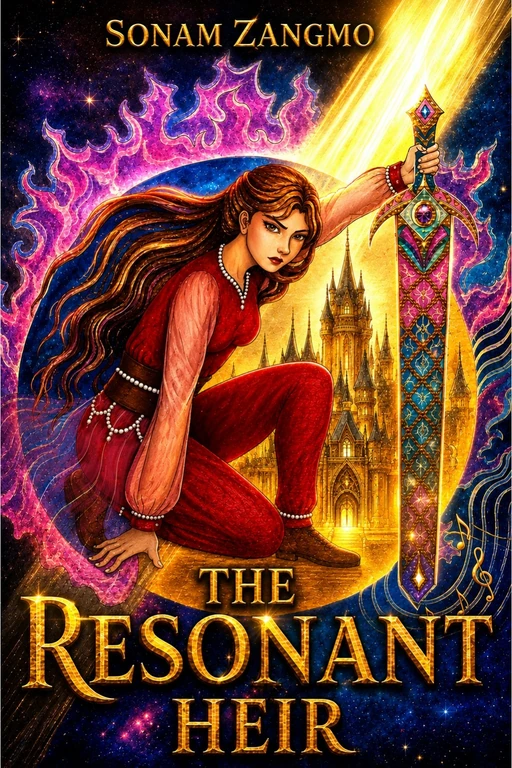
 Explore The Resonant HeirYA crossover royal fantasy · inherited magic · female heir · exile · adventure · Book I Complete
A Literary Commentary on Chapter Forty-Eight of The Resonant Heir
What It Costs to Be Found: Truth, Power, and Identity in The Daughter Who Lived
A daughter thought dead is recognized after sixteen years. But the truth emerges through a deliberate bluff, a confession of withheld care, and an interrogation enforced by vines. Who is saved when the buried past is uncovered—and who gets to decide what the discovery means?
Spoiler Notice: Contains spoilers for Chapter Forty-Eight.
Explore the 25 themes in this commentary
- A Reunion With an Unsettled Price
- Three Days of Gentleness
- The Blue Gown and the Visibility of Status
- Jasmine, a Necklace, and the Past Kept Close
- “You Are Dead”: The Past Mistaking the Present for a Ghost
- A Conscience That Does Not Sleep
- Lyra Stages an Encounter With the Dead
- “We Have Proof”: The Lie That Breaks the Silence
- A Successful Bluff Is Not a Method of Proof
- The Terrible Word “Only”
- A Bracelet and a Professional Betrayal
- Responsibility Shared Is Not Responsibility Erased
- “Find the Midwife”: Investigation and Rage
- Vines That Bind, Roots That Carry
- When the Search for Justice Becomes Coercion
- The Child Was Given Away
- The Red Leaf on the Right Shoulder
- Sixteen Years of Being Alive
- “I Felt It”: Recognition After Belief
- One Embrace, Two Different Timelines
- Lyra Loses a Father; Sion Finds One
- The Daughter Must Have a Voice
- Truth Is Not the Same as Repair
- “Greed Had Bought Sixteen Years of Silence”
- Conclusion: A Life Not Returned, but Recognized
Theme 01 · Philosophical commentary
A Reunion With an Unsettled Price
At the heart of Chapter Forty-Eight of Sonam Zangmo’s The Resonant Heir lies a discovery many readers will have hoped for since the travelers first reached Hemaliel. Sion, raised as an orphan and troubled by a place that seemed to recognize her, is confronted with compelling evidence that she is the High Lord’s daughter, believed dead for sixteen years.
It is a deeply affecting turn. A father who has carried the loss of a wife and child reaches toward a young woman he never watched grow up. But The Daughter Who Lived does not present the reunion as a morally uncomplicated victory. The discovery is forced into the open by Lyra’s deliberate falsehoods and a second interrogation conducted under the pressure of the High Lord’s plant magic.
Meanwhile Sion, the person most directly affected, has barely had the chance to understand what everyone is saying about her. The people around her recognize possibilities, confess actions, exchange accusations, and finally embrace her. She is still catching up.
This is why the chapter’s central question is larger than whether a hidden child survived. Recovering a truth can restore a stolen relationship, but it does not automatically justify the means by which the truth is extracted or restore the years that were taken.
Theme 02 · Philosophical commentary
Three Days of Gentleness
For three days Hemaliel receives the travelers with meticulous hospitality. Haris rides with the High Lord in the mornings. Lyra visits the High Lady each afternoon to ease her distress with the serpent-fang comb. Servants bring tea and cakes, and the region’s renowned performers are summoned for an evening’s entertainment.
The detail that matters most is quieter: Sion laughs again, without the fear that has shadowed her since the venom began disrupting her awareness. The palace gives her a brief experience of safety and delight, even while the larger threats to the kingdom and her own future remain.
Lyra observes that nearly every kindness seems to gather around Sion first. The pattern is affectionate and puzzling at once. The reader can later reconsider the High Lord’s attention in light of his recognition, but the chapter does not claim that every gesture was part of a prearranged scheme to reveal her identity.
Hospitality can be sincere even when its giver has feelings the guest does not yet understand. For Sion, the pleasant days are real. Their meaning changes after the revelation, but her laughter does not become less genuine because it preceded her knowledge.
Theme 03 · Philosophical commentary
The Blue Gown and the Visibility of Status
At the farewell dinner, the High Lord remarks on Sion’s worn clothes and offers her something new. She accepts with an entirely Sion-like eagerness, confessing that she has worn the old outfit for nearly a year. A servant leads her away.
She returns in a deep-blue gown, awkward in the unfamiliar stays but startlingly at home among the carved ceilings and candles. The narration observes that she no longer looks like a forgotten orphan. She looks as though she has always belonged to the place.
The transformation reveals something about the social reading of identity. Nothing essential about Sion has changed in the minutes required to dress her. Her courage, hunger, kindness, and ability to shape roots remain what they were. Yet the gown allows others, and perhaps the reader, to picture her occupying a rank that formerly seemed unavailable.
Across the novel Lyra has been judged by the absence of an aura despite her royal birth. Sion has been read through the material signs of abandonment. The parallel is revealing: a society may treat clothing, magical display, or inherited position as evidence of a person’s worth, even when those signs are poor measures of character.
The gown may fit a newly discovered identity. It has not created the person who wears it.
Theme 04 · Philosophical commentary
Jasmine, a Necklace, and the Past Kept Close
The High Lord has arranged jasmine at the center of the table with his own hands. Beside the flowers lies a necklace he has kept for many years. After Sion returns, he rises and fastens it around her neck with a tenderness that catches Lyra’s breath.
In the previous chapter, a gardener remembered that the first High Lady loved jasmine. That association gives the flowers a history beyond their beauty. They carry the possibility of affection maintained through loss. The necklace similarly seems weighted with the passage of time, although the text has not established who originally owned it or for whom it was intended.
The High Lord says little after fastening it. Lyra recognizes a look that is not simply a host admiring a guest. He seems to see someone loved and lost. The silent gift becomes more eloquent than a speech could be.
Objects kept after bereavement often occupy a strange place between past and future. They may be preserved because their original purpose has vanished, yet still seem too meaningful to discard. The chapter does not solve the necklace’s history, and it does not need to. Its emotional role is the visible tenderness of a man who has not forgotten.
This is a reunion beginning before it can be named: a dress makes belonging imaginable, and a familiar flower and long-kept necklace make the past present at the table.
Theme 05 · Philosophical commentary
“You Are Dead”: The Past Mistaking the Present for a Ghost
The High Lady enters carefully dressed, apparently calmer than she has been in days. The sight of Sion in the blue gown and necklace breaks that composure. She turns pale, withdraws against the doorframe, and repeatedly insists that Sion is dead.
She tells the frightened girl to stay away and asks whether haunting her dreams has not been enough. We should not flatten this into proof of a supernatural visitation. The text shows a living woman speaking as though the person before her were someone she believed lost. The scene’s terror is psychological and moral before it is anything else.
Lyra’s response strongly suggests that she understands the High Lady to be reacting to the first wife’s likeness, not making a reasoned identification of the child who survived. She kneels before Sion as though the girl were someone else entirely, inviting the High Lady to confront the person the face recalls.
The scene captures how guilt and memory can distort recognition. Sion has done nothing to threaten the High Lady, yet her resemblance calls up an accusation the High Lady has apparently carried in dreams. A person’s face becomes the meeting place of two different lives: the young woman who is here, and the dead woman whose image another character cannot bear.
The living should not have to become ghosts of the dead to be recognized for who they are. The chapter’s eventual challenge will be to let Sion emerge from that mistaken vision as herself.
Theme 06 · Philosophical commentary
A Conscience That Does Not Sleep
The High Lady’s cries cast new light on her earlier confession that she had not slept peacefully for years. She speaks of being haunted in her dreams; shortly afterward she admits that she once told the midwife not to stop another woman’s bleeding.
The sequence provides grounds to connect her unrest to guilt, but it does not supply a complete account of her inner life or the content of every dream. Nor does it prove that wrongdoing always produces remorse. Here, this particular person appears unable to endure the return of a face associated with what happened.
In the preceding chapter, Lyra’s comb brought her enough calm to sleep. That relief was real, but it did not erase the history behind her distress. The recurrence at dinner illustrates the difference between quieting a troubled body and resolving a moral wound.
An act may be successfully concealed from others without becoming absent from the perpetrator’s own experience. The woman’s distress does not undo the harm she helped set in motion; it also does not need to be dismissed as theatrical simply because she has done wrong.
The novel asks us to consider the exhausting, unsteady coexistence of guilt and secrecy—an inner cost that can endure long after the external world has accepted another story.
Theme 07 · Philosophical commentary
Lyra Stages an Encounter With the Dead
When the High Lady recoils from Sion, Lyra recognizes an opening. She goes to the girl’s side, kneels as though before a different lady, and asks whether the person being addressed has been wronged. Her position on the floor is part of the argument she is making.
This is a sophisticated act of reading and performance. Lyra does not merely ask why the High Lady is afraid. She adopts the High Lady’s apparent vision and gives it a form: the person believed dead is present and may demand an account.
Readers have seen Lyra solve an enchanted riddle by noticing patterns and defeat a serpent by recognizing that her attacks were being diverted. Here observation becomes theatrical persuasion. A bowed head, a chosen address, and a carefully timed question shape what another person thinks she is confronting.
The power of this method comes with an ethical complication. Lyra is now deliberately intensifying the woman’s fear. The aim is to uncover a serious injustice, but the action is not simply passive listening or innocent curiosity. It is an attempt to direct another person’s mind under extreme distress.
Intelligence that understands people deeply may be used to help them—or to make them easier to control. The chapter deliberately places Lyra’s growing skill at that uncomfortable boundary.
Theme 08 · Philosophical commentary
“We Have Proof”: The Lie That Breaks the Silence
Lyra declares that she has proof. The narrator immediately corrects her: she has none. Not yet. The bluntness is one of the chapter’s most important literary decisions. The reader is not encouraged to mistake a successful bluff for an evidence-based accusation.
The claim lands because the High Lady is already frightened. Lyra then invents statements supposedly made by the midwife: that the High Lady smothered the child, and that she poisoned the High Lord’s first wife. The actual midwife has not yet been questioned in the scene. These are assertions fabricated for the confrontation, not testimony Lyra can quote.
The deception works. It prompts denials and eventually a narrower, devastating admission. But effectiveness is not equivalent to moral justification. An innocent person put under comparable pressure might also speak wildly, agree with false premises, or try to invent an explanation that stops the ordeal.
This is an especially important limit on the reader’s admiration. Lyra’s reasoning proves useful in this story, but success here does not demonstrate that false accusations are a reliable way to find truth.
A lie can expose a truth without ceasing to be a lie. The chapter gains maturity by allowing us to admire Lyra’s audacity and question the ethics and epistemic reliability of her tactic at the same time.
Theme 09 · Philosophical commentary
A Successful Bluff Is Not a Method of Proof
The High Lady denies having poisoned the first wife and denies killing the child. Her most consequential statement arrives when she says the first wife bled and would not stop bleeding. Pressed by Lyra, she admits that she told the midwife not to stop it.
The confession is significant because it reveals a specific act of interference in the care of a woman in danger. It does not establish that the other allegations Lyra invented—poisoning or personally smothering a baby—were true. Indeed, the speaker continues to reject them.
This distinction prevents the interrogation from turning into a scene in which every accusation becomes retrospectively validated. The narrative supports one dreadful admission, then tests further claims through another source. It does not authorize a wholesale assumption that the High Lady committed every wrong Lyra named.
That matters for justice. An accusation can lead toward a real offense without itself providing a trustworthy description of the offense. The investigation must still distinguish what was alleged, what was admitted, and what can be corroborated.
A future monarch who learns to manipulate a conversation must also learn when to stop treating her own persuasive success as evidence of accuracy.
Theme 10 · Philosophical commentary
The Terrible Word “Only”
The High Lady’s defense narrows her role to a single instruction: she “only” told the midwife not to stop the bleeding. The word attempts to separate her from the physical act of leaving a laboring woman without help.
The story gives us a serious moral wrong without depicting a knife, a poison bottle, or a direct attack. The accused person uses another person’s professional duty as the point of intervention. Rather than providing care, the midwife is instructed to withhold it while the mother continues to bleed.
We do not know from this chapter whether timely medical intervention would certainly have saved the woman. That causal question remains distinct from the wrongness of deliberately obstructing an attempt to protect a vulnerable person. What the confession establishes is the will to prevent the bleeding from being stopped.
The smallest word in the sentence exposes an ancient strategy of evasion: reducing responsibility to whatever one personally touched. But arranging for someone else not to act can be consequential. A decision not to permit aid may be a form of agency, not the absence of it.
Responsibility does not always end at the boundary of one’s own hands. That insight applies both to those who gave the instruction and to those who chose to follow it.
Theme 11 · Philosophical commentary
A Bracelet and a Professional Betrayal
The High Lord summons the midwife, who arrives trembling and is made to face Sion. She recognizes a likeness, then admits that she was ordered to leave the first wife bleeding and was given a gold bracelet for complying.
The moral injury here extends beyond greed in the ordinary sense. A midwife is present because a woman and newborn may depend upon skill, attention, and timely decisions at a moment when they have little capacity to protect themselves. The woman who should have received care was especially vulnerable to betrayal by the person entrusted with providing it.
Money has occupied many roles in recent chapters. Haris used coins to give a poor household options for safety; later he paid for transport and provisions. In Hemaliel, the bracelet purchases the abandonment of a professional obligation. It is not the metal itself that makes the transaction reprehensible, but the human duty exchanged for it.
The High Lord’s incredulous repetition of the word “bracelet” exposes the disproportion between the reward and the irreversible loss. One item of jewelry enters the servant’s possession; a mother dies, a father grieves, and a child grows up outside her family.
Some of the gravest betrayals occur when the person trusted to protect someone at their weakest chooses a private benefit instead.
Theme 12 · Philosophical commentary
Responsibility Shared Is Not Responsibility Erased
The High Lady’s admission and the midwife’s testimony form a chain. One woman directed that bleeding not be stopped. Another accepted a bracelet and complied. Neither account, taken alone, contains every detail of the medical event; together they reveal how abandonment could be organized through more than one person.
The story does not yet establish every pressure operating on the midwife sixteen years earlier. She now calls herself foolish and greedy, but the precise balance of authority, fear, and choice at that time is not separately reconstructed. Those uncertainties do not make her stated acceptance of payment disappear.
Similarly, the High Lady cannot escape responsibility by insisting she did not personally touch the patient. The instruction she describes was not a neutral observation. It sought to redirect the conduct of someone whose role was to help.
The philosophical question is how blame works when wrongdoing is distributed. Each participant may try to point toward someone else. The command giver did not perform the omission with her own hands; the midwife did not originate the command. Both can nevertheless have contributed to a serious failure of care.
Divided participation is not the same thing as innocence. Yet careful judgment still requires distinguishing each person’s knowledge, choices, and conduct rather than treating them as identical.
Theme 13 · Philosophical commentary
“Find the Midwife”: Investigation and Rage
The High Lord is visibly shaken by the admission. For a time he cannot move; then he orders the midwife brought to him. This is the turning point at which an old, apparently settled bereavement becomes an active search for facts.
He has reason to investigate. A woman has admitted interfering with the attempt to help his first wife; he has heard the child’s death invoked; the young guest before him carries a face that evokes his loss. The account accepted by the household for sixteen years can no longer remain unquestioned.
The demand for the midwife also shows that a confession made under Lyra’s improvised pressure has not answered everything. Someone else was present at the birth. Someone else may know what happened to the child.
The moral promise of an investigation is that it can replace rumor with accountable testimony. Its danger is that the injured party may have more power than patience. The High Lord does not appoint an independent inquiry or take time to separate anger from authority. He summons a woman into a room that he controls.
What follows dramatizes the difference between having good reasons to seek the truth and exercising power in a way that preserves the conditions for truthful answers.
Theme 14 · Philosophical commentary
Vines That Bind, Roots That Carry
The High Lord’s anger takes visible form. Thin green vines unwind from beneath his hand, spread across the table, seize the midwife’s wrists, arms, and waist, and drag her upright. They tighten when his questions sharpen. The material is alive, but its immediate function is restraint.
The image summons a precise memory from The Root-Born Boat. There Sion, discovering her plant magic, shaped roots into a vessel that held her and Lyra above danger. Her roots opened a route of escape and carried two vulnerable people to safety. The High Lord’s vines remove another person’s freedom to move.
The parallel does not establish a formal law of magical inheritance, although their related abilities may be suggestive within the new family context. The text has not said that everyone of their blood has the same power or must use it in the same way.
Its clearest meaning is ethical rather than genealogical. One form of plant magic supports a body; another coerces a body. The same kind of natural imagery can be made to stand for rescue or domination depending on the intentions and decisions of the user.
Inheritance may explain where a power comes from. It cannot decide how a person must use that power. Sion’s character was already visible in her choices before she learned whose daughter she might be.
Theme 15 · Philosophical commentary
When the Search for Justice Becomes Coercion
The High Lord has suffered an immense possible wrong. He was told that his wife and child died; now he hears a confession about withheld treatment and learns that the child may have been passed to someone else. His anger is comprehensible.
But the midwife gives her account while vines are wrapped around her and tightened painfully. Her own admitted wrongdoing does not erase the ethical question created by this method. Coercion can produce answers, but it can also produce fear-driven statements intended to stop pain, regardless of accuracy.
This is not precisely the same situation as Haris threatening the innocent grinder. The midwife has admitted accepting payment to withhold care, while the grinder refused an unfamiliar and frightening task. Their circumstances and responsibilities differ. What recurs is the dangerous assumption that a sufficiently compelling purpose authorizes whatever force a stronger person can command.
It is especially revealing that the interrogation yields a checkable detail: the child’s birthmark. That fact can be investigated apart from the pressure of the vines. The chapter’s emotional resolution follows its connection to Sion, rather than resting solely on a forced confession.
Justice must concern itself with how truth is sought, not only with the punishment of those who have done wrong. A ruler has the power to compel. That is precisely why limits matter.
Theme 16 · Philosophical commentary
The Child Was Given Away
Asked whether she killed the infant, the midwife denies it. She says that the young mistress ordered her to give the baby to a servant. She complied, and claims to know nothing of what happened afterward. The account breaks apart the story that the child died and was buried during the night.
This is the revelation at the narrative hinge. In Chapter Forty-Seven, a gardener recalled the death and a quiet nocturnal burial as facts known in the household. Here a participant in the birth says she handed a living child away. The two accounts cannot be taken as complete descriptions of the same event without further explanation.
The chapter does not tell us who the receiving servant was, where that person took the baby, what was placed in the grave, or how Sion later reached Gemariel. It does not show the birth directly. The midwife’s account is powerful, but it leaves a route of missing years and missing witnesses.
Those gaps matter because a moving recognition scene is not the same as a complete historical reconstruction. The girl’s survival and probable identity can become convincing long before anyone knows who organized the burial story or the journey away from Hemaliel.
The title of the previous chapter now changes its resonance: perhaps the most important thing buried that night was the public truth of a child’s continued existence. That symbolic reading is available without inventing the contents of any grave.
Theme 17 · Philosophical commentary
The Red Leaf on the Right Shoulder
The High Lord demands a distinguishing mark. The midwife remembers a red birthmark shaped like a leaf, on the right shoulder blade. Sion raises a hand to that part of her body and says quietly that she has one too.
In a chapter otherwise filled with frightened words, disputed stories, and pressure-filled questioning, the leaf-shaped mark offers a concrete point of correspondence. The midwife names its color, shape, and position before Sion states that she bears the same mark.
The narration does not describe an independent inspection, and a birthmark alone would not reconstruct the entire chain by which the baby was taken away. Yet as part of the accumulated evidence—Sion’s sense of familiarity, the High Lord’s reaction, the portrait, the reported birth, and the midwife’s account—it gives the recognition substantial narrative force.
There is an elegant possible echo in the leaf shape and Sion’s ability to command roots, especially once the High Lord’s own plant magic becomes visible. The story does not define the mark as an inherited magical sign, so its symbolic appeal should not be confused with a stated rule.
A small detail carried in the body becomes the point at which a story believed by others can no longer contain the living person standing in front of them.
Theme 18 · Philosophical commentary
Sixteen Years of Being Alive
For the High Lord, Sion’s survival transforms sixteen years of loss. For Sion, those years have already existed in full. She has eaten, laughed, gone hungry, formed friendships, helped Lyra through grief, and discovered an ability that saved two lives.
This creates an asymmetry at the center of the reunion. In the household’s story the child was dead. In the world beyond its walls, the child lived. What is new is not Sion’s existence; it is the recognition of that existence by people who believed otherwise.
The distinction matters for a novel that has often asked how people are valued. Lyra was dismissed because she lacked an aura. Sion was treated as an orphan with worn clothes, a modest place in the world, and no visible family standing. Neither set of outward signs captured the person’s worth.
The discovery may confer a place in a noble family and change other people’s behavior toward Sion. It does not retroactively create the kindness, ingenuity, and courage she displayed before Hemaliel.
To recover a lineage is to learn part of a person’s history, not to manufacture the value of the life she had already lived.
Theme 19 · Philosophical commentary
“I Felt It”: Recognition After Belief
When the vines loosen, the High Lord approaches Sion as though a sudden gesture might make her vanish. He touches her cheek and gathers her into his arms. He says he felt the connection from the first time he saw her.
That claim sends the reader back to Chapter Forty-Six, when he went still at her first appearance and repeatedly watched her at the table. Sion herself had felt that Hemaliel somehow knew her. These intuitions now acquire emotional coherence with the revelation.
But the story has also shown that intuition was not enough. A face resembling someone beloved can awaken recognition without specifying who that person is. The household’s missing account of the birth, the midwife’s description, and the birthmark are what allow a stronger conclusion to form.
The father’s restraint as he comes toward Sion is moving because it registers disbelief alongside joy. He has not merely found a person. He is confronting the failure of a reality he lived inside for years.
Feeling can guide a search, but evidence changes what people are justified in believing. The scene becomes powerful because both are present: a long-suppressed affection and a new basis for letting that affection take a living form.
Theme 20 · Philosophical commentary
One Embrace, Two Different Timelines
The High Lord’s response is immediate and deeply felt. Sion’s is not. She stands still, unsure where to place her hands or what to do with the arms around her. The narrator makes this difference explicit rather than forcing a perfectly synchronized reunion.
For the father, the young woman embodies someone he loved and believed he had lost from infancy. He has carried a relationship in memory and grief for sixteen years. For Sion, the man embracing her was a kindly High Lord she met only days before. She has had seconds to understand what he has spent years missing.
A biological relationship may be recognized in an instant; a lived relationship cannot be supplied retroactively. Sion does not remember being cared for by him. He cannot remember raising the girl she became. The gap is neither person’s failure to love.
This is why her bewilderment is a more generous literary choice than an automatic declaration of filial devotion. It respects the reality of the years outside his household and the possibility that becoming family in practice will require time.
A reunion may begin with the return of a name, but it must continue through new acts of listening, patience, and care.
Theme 21 · Philosophical commentary
Lyra Loses a Father; Sion Finds One
The emotional structure also reaches back toward Lyra’s grief for King Eryndar. Lyra knew who her father was, lived within the relationship, and then lost him. Sion grew up without knowing the High Lord as a father and now discovers that he may have been alive and grieving throughout her childhood.
The two movements are not interchangeable forms of compensation. Sion’s reunion does not restore Eryndar to Lyra. Lyra’s knowledge of her own origins cannot replace the years Sion has spent without a known family. Each girl has endured a distinct absence.
Yet the juxtaposition enlarges the novel’s understanding of family. There is the family into which one is born, the family lost through death or separation, and the family created through chosen acts of loyalty. Sion became family to Lyra before Hemaliel revealed anything about blood.
That earlier chosen bond matters more than ever. New relatives and titles will change the circumstances of Sion’s life, but they need not erase the relationship that helped sustain her through the journey.
The best version of a restored family will make room for the person who grew in its absence, rather than treating the intervening years as though they belonged to nobody.
Theme 22 · Philosophical commentary
The Daughter Must Have a Voice
At the dinner table, Sion is at the center of every revelation without directing most of them. The High Lady recoils from her. Lyra advances accusations. The High Lord orders an investigation. The midwife is forced to explain the birth. Sion’s direct contribution is the simple statement that she, too, bears the birthmark.
Everyone else’s urgency is understandable. A secret affecting several lives seems to be opening at once, and a long-lost child has appeared before her father. Still, Sion is not a token passed from one family story into another. She is a living person whose preferences and questions have not yet been heard.
The narrator respects this by depicting her frozen uncertainty. She has not chosen the new title or determined what it means to belong to the High Lord’s house. She has not decided what to do about the mother she never knew, or the people who may have separated her from her family.
Her agency will matter as the reunion develops. She may wish to learn, grieve, stay, depart, embrace the new relationship, or take time before doing any of those things. Her right to choose does not require that she immediately know the answer.
To be found should not mean losing the freedom to decide how one will live after being found.
Theme 23 · Philosophical commentary
Truth Is Not the Same as Repair
The discovery promises a profound change. A father can begin to know his daughter. Sion may learn about the household, the first High Lady, and the missing years of her infancy. People implicated in the old events may be held to account.
But the revelation cannot restore the woman who died after giving birth. It cannot give Sion the childhood she did not spend in Hemaliel, or give the High Lord the experience of watching his child grow up. Those years are no longer available for recovery.
This is the difference between correcting a false account and repairing every consequence the false account has produced. Truth is necessary for many forms of justice and reconciliation, but it does not reverse time. Survivors remain responsible for building a future with the people who exist now.
The High Lord’s happiness, therefore, need not be read as the end of grief. A daughter’s life has been returned to his knowledge. A wife’s death remains. Joy and sorrow can coexist without canceling one another.
A credible continuation of this reunion will have to attend to the years the characters cannot reclaim as carefully as it celebrates the relationship they can now begin.
Theme 24 · Philosophical commentary
“Greed Had Bought Sixteen Years of Silence”
The final image is not the embrace but Lyra’s gaze returning to the midwife on the floor. The narrator says that greed purchased sixteen years of silence, and that it will not purchase another night.
The conclusion delivers a satisfying moral rupture. The bracelet has long since changed hands, but the concealment it supported has endured. The midwife’s admission and Sion’s birthmark mean the accepted story can no longer pass unchallenged.
Yet the last line should not be confused with a completed inquiry. We still do not know the identity of the servant who received the baby, how the child reached Gemariel, who arranged the reported night burial, or what else the High Lady and midwife knew. The chapter breaks the central silence without closing every factual gap.
Nor is justice finished merely because the guilty have been frightened or exposed. Accountability will require decisions about the people harmed, the people who took part, and the boundaries of the High Lord’s authority. Lyra’s own invented accusations remain part of the route by which truth was obtained.
The ending works because it marks a threshold. A story that denied a daughter’s existence can no longer govern the household unopposed. What the characters make of that truth is now a responsibility, not simply a triumph.
Theme 25 · Philosophical commentary
Conclusion: A Life Not Returned, but Recognized
The Daughter Who Lived resolves the mystery of Sion’s apparent death with a scene that is both emotionally generous and ethically unsettled. Lyra’s strategic falsehood leads to a real confession about withheld care. The High Lord’s forceful interrogation yields the account of a child given away and a birthmark that closely matches Sion’s. A father embraces the daughter he believed lost.
But the chapter has been careful to leave the reader with more than the pleasure of discovery. A lie can expose wrongdoing without becoming trustworthy evidence in itself. Righteous anger can seek justice while using methods that threaten the reliability and dignity of the people questioned. A daughter can gain a family history without instantly knowing how to inhabit it.
The most meaningful reversal is not that Sion has suddenly become important. She was important long before this dinner. The reversal is that an important life, denied in one household’s understanding of the world, has become visible there at last.
The deep task ahead is to build relationships around that living person rather than around an imagined child preserved in grief. Her father must learn who she has become. Lyra must consider how truth should be sought and shared. The household must confront both what happened and the years during which it was concealed.
Sion was never returned from death; she was alive throughout the years in which others believed her lost. The truth restores recognition, not time. Whether that recognition becomes healing will depend upon how much freedom, honesty, and care the living are willing to offer one another now.