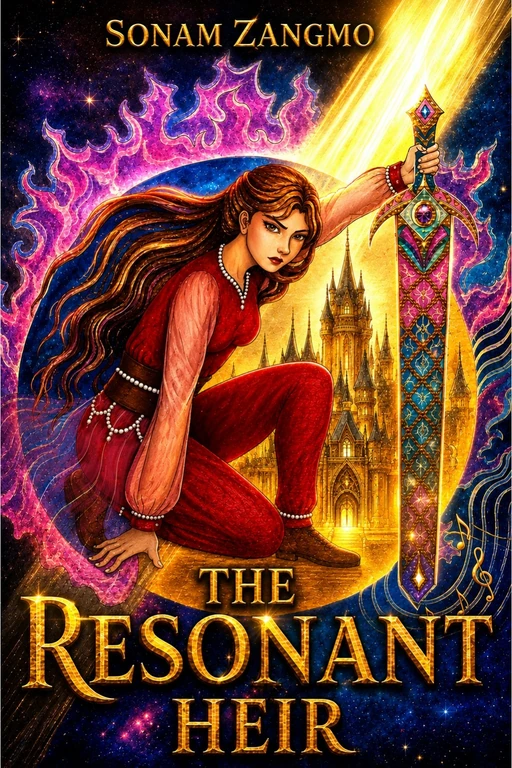
 Explore The Resonant HeirYA crossover royal fantasy · inherited magic · female heir · exile · adventure · Book I Complete
A Literary Commentary on Chapter Forty-Nine of The Resonant Heir
The Courage to Let Someone Stay: Love, Legacy, and the Last Fragment
Lyra leaves Sion with the father she has only just found, then rides toward an ancient tree that may change whoever enters it. Yet the chapter’s final decision belongs to the friend left behind: love can continue its work even when two people travel different roads.
Spoiler Notice: Contains spoilers for Chapter Forty-Nine.
Explore the 27 themes in this commentary
- What the Title Promises—and Withholds
- The Night After the Revelation
- “But I Don’t Know Anything”: The Burden of a New Name
- Finding a Father Does Not Cancel a Friend
- “Don’t Follow Me Anymore”: Protection and Paternalism
- When Grief Speaks as Advice
- “While You Still Can”: The Ethics of Limited Time
- A New Gown, the Same Hand
- “Come Find Me Again”: A Promise Beyond Proximity
- The Comb Is Given Back to the Person Who Needs It
- A Pouch of Dust, a Store of Memory
- Two Gifts, Two Kinds of Protection
- The Father’s Gratitude and Its Limits
- Sion Asks the Question That Changes the Route
- Knowledge Given in Gratitude
- A Grandfather’s Secret and the Inheritance of Knowledge
- A Tree at the Seam Between Worlds
- An Eye Sealed in Sap
- “If It Still Exists”: The Difference Between Direction and Certainty
- “They Do Not Always Return as They Were”
- What Would Awakening Power Complete?
- “Yes”: Courage Without a Guarantee
- The Road Narrows to Two
- “She Had Given Back”: Repair Without Erasure
- “She Is the Princess”: When Loyalty Shares a Secret
- “We Need to Be a Strong Ally”: Sion’s New Agency
- Conclusion: The Fragment Still Missing, the Friendship Still Whole
Theme 01 · Philosophical commentary
What the Title Promises—and Withholds
Chapter Forty-Nine of Sonam Zangmo’s The Resonant Heir is called The Last Fragment, a title that seems to promise completion. Lyra has collected three pieces of the map that may lead her to the Awakening Spring. A fourth remains. We might expect a chapter devoted to locating and claiming it.
Instead, most of this brief chapter is about a farewell. Sion has found her father in Hemaliel; Lyra wants her to remain with him rather than follow the next dangerous road. They exchange objects that have traveled with them, part in the great hall, and face the possibility of a friendship sustained at a distance.
Only after this does the High Lord reveal where his father hid the remaining fragment: inside the amber of the Myrren Tree, near a crossing between fae territories and the divine realm. Even this information is conditional. He does not know whether the fragment still exists, and no one has returned from the amber bearing it.
The distinction is important. The chapter does not give Lyra the last piece. It gives her a possible route, a warning, and a reason to proceed. What it brings to completion is something else: Sion’s place beside Lyra as a constant traveling companion.
Before the heroine can approach the missing object that might restore her power, she must decide what it means to let someone she loves stop walking beside her.
Theme 02 · Philosophical commentary
The Night After the Revelation
The High Lady and the midwife are imprisoned before the evening ends. After the uproar of the previous chapter, the household retreats to its chambers. Sion lies beside Lyra in the darkness and admits that she never expected her life to become what it has become.
The restrained opening matters. The revelations about a mother who died, a child believed buried, and a living daughter recognized after sixteen years could easily have been followed by ceremony, punishment, or elaborate political announcements. Instead the chapter stays with a young woman looking at a ceiling and trying to understand her life.
The imprisonment also has limits as an ending. The narrative does not show a trial, determine sentences, or resolve every unknown concerning the infant’s journey to Gemariel. The revelation has altered what can be believed, but the consequences of the alleged wrongdoing remain part of the future.
Sion is not offered the luxury of fully processing the upheaval before a new decision arrives. Should she stay with the father she has barely met, or continue the road with the friend she knows intimately?
The question is quiet, but it is not small. The discovery of a family is not simply a benefit awarded to her. It changes the claims that different relationships now seem to make upon her time.
Theme 03 · Philosophical commentary
“But I Don’t Know Anything”: The Burden of a New Name
Lyra tells Sion that life is better now: she is the heir of Hemaliel. Sion responds that she knows nothing. Lyra pinches her cheek and assures her that she will learn.
The exchange distinguishes a title from the capacity to inhabit it. A new family identity may be revealed within an evening; the habits, knowledge, loyalties, and obligations associated with that identity cannot be acquired at the same speed. Sion did not grow up in the citadel, learn its customs, or receive the political education others might expect of a noble heir.
Lyra’s reassurance is generous because it does not demand instant transformation. She does not insist that Sion has somehow become a fully prepared court figure simply because the truth of her parentage is known.
Yet the reassurance also holds a tension. Lyra seems ready to imagine a future for Sion in this household before Sion herself has discovered how she feels about living there. The girl has a father, a name, and a place to begin, but she is still learning what any of those things mean.
Identity can be recovered in a moment; belonging must still be made livable. The novel wisely gives Sion uncertainty instead of immediate mastery.
Theme 04 · Philosophical commentary
Finding a Father Does Not Cancel a Friend
When Lyra asks her to stay, Sion sits up immediately. She wants to go with Lyra, and she says that she will be lonely without her. The protest returns us to a truth established long before the visit to Hemaliel: Lyra and Sion became family through their shared journey.
Sion tended Lyra’s grief after the death of Eryndar. Her root magic rescued them from a deadly fall. Lyra fought to obtain the serpent fang that could keep Sion herself during her venom-induced fits. They have developed a history of mutual care that no revelation of ancestry can undo.
A recovered biological family does not make this chosen bond redundant. Sion’s father can offer her a relationship she has lacked, but he cannot provide memories of the days she and Lyra spent hungry, frightened, joyful, and dependent on one another.
Her loneliness is therefore not a childish refusal to accept good fortune. She is being asked to leave one form of family in order to begin another, with no certainty that the two can be held together in the same way.
Love does not obey the logic of replacement. To gain a father is not to stop needing a friend. The chapter’s emotional truth begins in Sion’s refusal to make that substitution.
Theme 05 · Philosophical commentary
“Don’t Follow Me Anymore”: Protection and Paternalism
Lyra’s words are direct: stay here; do not follow me anymore. She is speaking with the authority of a friend who has seen what the road can do, and perhaps with the reflexes of a princess accustomed to making decisions under pressure.
Her reasons are serious. Sion is still threatened by venom. The comb controls an episode without supplying a complete cure. Ahead lies an unknown borderland where those who enter an ancient amber may be changed, and where success is far from assured.
Wanting Sion to avoid that danger is an intelligible form of care. But Sion has already voiced her own wish to continue. The disagreement raises a question that has followed the recent chapters: when does protecting another person begin to mean choosing their future for them?
Lyra does not use force to make Sion remain. The text presents an intimate conversation and, the following morning, a parting. It does not show every thought through which Sion arrives at accepting the separation. That gap matters when assessing how fully the decision is shared.
The ethical challenge is not to declare Lyra selfish for worrying. It is to see that love may have to protect someone without assuming ownership of that person’s choices. The final scene will show Sion reclaiming a form of agency within the life Lyra has urged her to choose.
Theme 06 · Philosophical commentary
When Grief Speaks as Advice
Lyra tells Sion that she has a father now and should stay with him while she can. She turns toward the window, where Hemaliel sleeps beneath pale towers and jasmine scents the air. A small ache opens in her chest. Then she warns that if Sion loses him one day, she will wish she had stayed.
The emotional source of the advice is unmistakable. Lyra has lost King Eryndar. She knows the finality of days that can no longer be spent with a parent, conversations that cannot be resumed, and a home that does not contain the person it once did.
The insight may be wise. The opportunity to know someone beloved is finite, and the loss of such an opportunity can become a lasting regret. Yet the advice is not a universal law. Sion is not Lyra; she is entering a relationship rather than mourning its end, and she has other obligations and affections that matter too.
Here empathy and projection nearly touch. Lyra wants to spare her friend a pain she understands. At the same time, her own bereavement inevitably shapes what she imagines Sion should value most.
Suffering can deepen our understanding of another person’s vulnerability while also tempting us to give that person the answer we wish we had been given. The chapter lets Lyra’s care be sincere without making her perspective omniscient.
Theme 07 · Philosophical commentary
“While You Still Can”: The Ethics of Limited Time
The phrase “while you still can” carries more weight than an ordinary invitation to remain at home. Lyra has learned that time with a loved one is not a possession. No rank, magic, or loyalty could make Eryndar’s life indefinitely available to her.
In fantasy adventures, urgency often comes from external deadlines: the kingdom’s succession clock, a poisoning’s progression, a gate about to close. This urgency is quieter. There is no declared date by which Sion must know her father. The limit is the ordinary fragility of human life.
Recognizing that limit can make companionship precious. It can also make every separation feel dangerous, as though choosing another duty were already an irrevocable mistake. Lyra is struggling between these possibilities.
The chapter is careful not to say that every person should stay beside a parent at the expense of every other commitment. It gives us the particular grief that leads Lyra to urge this particular friend toward a newly recovered relationship.
What makes the sentence affecting is precisely its asymmetry: Lyra cannot use the advice to recover her own time with Eryndar. She can only offer what she learned from losing it.
One of the hardest forms of love is wanting another person to have the opportunity we can no longer give ourselves.
Theme 08 · Philosophical commentary
A New Gown, the Same Hand
In the morning, Sion comes to the great hall wearing soft pale green. Her sleeves are no longer torn, the hem no longer frayed, and a jeweled clip catches the light in her neatly brushed hair. The changes are visible signs of the household that has welcomed her.
The costume echoes her blue gown at the dinner in Chapter Forty-Eight, when she first appeared capable of belonging beneath the citadel’s carved ceilings. Yet the chapter refuses to treat new clothing as proof of effortless adaptation. Sion grips Lyra’s hand tightly.
In the same image we see two truths. The social world now recognizes a different Sion, a girl with a family and the resources of Hemaliel. But emotionally she remains attached to the companion who shared the journey before anyone knew her lineage.
Clothing can announce an identity to observers, but it cannot instantly reorganize attachment. Sion may look like someone who belongs in the hall while still feeling that the person about to leave is the person who knows her best.
The detail guards against the illusion that an externally improved life cancels grief over what it costs. A person can be grateful for a new home and sorrowful about the separation it brings.
Theme 09 · Philosophical commentary
“Come Find Me Again”: A Promise Beyond Proximity
Sion asks Lyra to take care of herself and makes her promise to return to Hemaliel. Lyra nods. The request changes the meaning of the farewell. Sion has accepted the physical separation, but she has not agreed to its becoming permanent.
The girls have known closeness through shared movement: riding, hiding, fighting, eating, and surviving together. Now their friendship will need another form. They must be willing to carry an absent person into their plans rather than assuming that affection requires constant proximity.
A promise to return is not certainty that every danger ahead will be survived. Lyra knows this from the promise she made before hunting the serpent. Yet the act of promising says something meaningful about intention. It gives the relationship a place in an uncertain future.
The request also reveals that Sion is not simply allowing Lyra to choose the terms of departure. She asks for a commitment in return. She is shaping the future of the bond even as she lets the journey continue without her.
Friends may stop sharing a road without ceasing to make room for one another. The promise is the first small structure built across the distance.
Theme 10 · Philosophical commentary
The Comb Is Given Back to the Person Who Needs It
Lyra places the serpent-fang comb in Sion’s hands. She tells her to use it often and expresses belief that they will someday find a way to cure the venom completely. There is neither a discovered cure nor a guarantee that every fit will be harmless; the remedy remains limited.
The exchange changes how care can operate. Lyra used the comb to bring Sion back when awareness failed. By leaving the object with Sion, she makes it available in her own household instead of tying its use to Lyra’s constant presence.
We cannot infer from this scene that Sion will always be capable of using it alone during a severe episode. The chapter does not specify a new treatment protocol. It shows a practical act of preparation and hope in a situation where the danger has not ended.
The comb’s history also remains ethically complicated. It was made after Lyra and Haris fought the serpent and Haris forced a terrified craftsman to work. Passing it tenderly to Sion does not erase what happened to that man. But neither does that history negate the object’s ability to give someone relief.
Care can involve making a useful resource available while acknowledging that the need for further help continues. Lyra is letting go of the duty to personally accompany Sion every night, not declaring that Sion no longer needs anyone.
Theme 11 · Philosophical commentary
A Pouch of Dust, a Store of Memory
Sion remembers the magic dust the friends took from Gemariel and presses the pouch into Lyra’s hand. She thinks Lyra may need it someday. The chapter does not say what exact task it will perform at the Myrren Tree or whether it will become decisive there.
Lyra closes her fingers around it and feels memories return: beautiful ones, meaningful ones. The narration does not catalogue those moments. The two brief phrases give the reader room to remember the friendship’s particular history without turning the farewell into a list of previous adventures.
The gift thus works in two directions. It might become a practical resource in the future. It is already a reminder of a shared past. The pouch belongs to the material world of the quest, but its immediate effect is emotional.
Objects like this often accumulate more than their designed purpose. A small thing handled by two people during important days can become a record of what those people were together, even without inscription or ceremony.
The tenderness lies in Sion’s thought: when she can no longer accompany Lyra, something she can give may still travel. A gift can be both a tool for the road ahead and a way of refusing to let the road erase what came before.
Theme 12 · Philosophical commentary
Two Gifts, Two Kinds of Protection
The exchange of comb and dust is not a trade. No one measures price or asks to be repaid. Each girl recognizes a different vulnerability in the person about to go elsewhere and gives something that may help.
The comb is associated with Sion’s recurring danger in the present: she needs a way to keep hold of herself when the venom threatens awareness. The magic dust is offered to Lyra for an unknown future need, somewhere beyond the northeast border.
This reciprocity is all the more affecting after the previous chapters’ troubling transactions. Haris paid a householder to shelter Sion and later compelled a grinder under threat. A gold bracelet bought the midwife’s betrayal of a patient in Hemaliel. Here objects pass between friends without coercion, reward, or the transfer of another person’s freedom.
The gifts cannot remove danger. Their value is that they acknowledge it without requiring both friends to confront it in the same place. They are provisions for independent lives still linked by concern.
Generosity sometimes means giving another person what she will need when you are not there to give it again. The chapter finds a quiet visual form for that kind of love.
Theme 13 · Philosophical commentary
The Father’s Gratitude and Its Limits
The High Lord thanks Lyra for bringing his daughter back to him. In emotional terms, it is an understandable acknowledgment. Lyra noticed clues others left unexplained and helped uncover the account that connected Sion to his household.
The debt, however, should not be treated as proof that every step taken during the previous chapter was ethically unproblematic. Lyra claimed to have evidence that she did not have, and the High Lord used vines to compel the midwife’s testimony. Both actions helped lead toward recognition, and both remain open to critical scrutiny.
Neither should the chapter’s opening imprisonment be confused with the completion of justice. The text does not describe a formal trial or a full investigation of who moved the child and created the burial story.
What the thanks can recognize is a specific good achieved amid unresolved questions: a father once convinced of his daughter’s death now knows the young woman before him may be the child he lost.
The emotional scene does not require us to forget the complexity of the means. It is possible to be grateful for a rescue and still take seriously the moral costs of how a rescue came about.
Theme 14 · Philosophical commentary
Sion Asks the Question That Changes the Route
As the farewells draw to a close, Sion suddenly asks her father whether he knows where the final map piece leading to the Awakening Spring can be found. The question is her initiative. Lyra did not request it in this scene.
When he asks why, Sion points toward Lyra and explains that her friend needs the fragment to restore her magic. The High Lord looks at Lyra and agrees to share what he knows in return for what she has done for his family.
This is the chapter’s first clear sign that Sion can help without traveling. She has identified a person with knowledge, understands that the information matters to Lyra, and uses the opportunity available through her newly recovered relationship.
Earlier, Sion protected Lyra with roots and shared provisions during hardship. Here she contributes through conversation. The action is simple, but its consequences are considerable: a route that seemed impossible begins to acquire a location and a purpose.
Help is not always a matter of possessing the answer ourselves. Sometimes it consists in recognizing who might know and asking the question they need to hear. Sion is already doing more than waiting safely at home.
Theme 15 · Philosophical commentary
Knowledge Given in Gratitude
The High Lord explains that the Awakening Spring is not in Hemaliel itself. It lies near a convergence of three fae territories, where Hemaliel reaches toward the divine realm. The last fragment was hidden by his father near that crossing.
He chooses to provide this information as a response to Lyra’s role in restoring his daughter to him. The act resembles his reaction to the broken levee brick in Chapter Forty-Six, when Haris reminded him of Rogan’s help during a flood.
In both episodes, care given at one moment shapes the trust or generosity available at a later one. That pattern is different from a transaction in which the beneficiary is compelled to provide whatever is demanded. A shared past can create reasons to respond generously without turning gratitude into slavery.
There is a reason not to overclaim. The High Lord does not hand over the map piece, pledge his entire territory to Lyra, or guarantee the Spring will work. He gives a location that his father knew, together with a warning about it.
Still, the gesture shows a social source of strength that Lyra cannot obtain simply by awakening magic. Information and alliances often become available because of relationships built through earlier acts of care.
Theme 16 · Philosophical commentary
A Grandfather’s Secret and the Inheritance of Knowledge
The High Lord says that his father concealed the fourth fragment at the Myrren Tree. That makes the route to the Awakening Spring dependent upon information passed from one generation to another within a ruling family.
Chapter Forty-Eight restored a lost relation between generations: a father recognizing a daughter who grew up elsewhere. This chapter shows another inheritance, knowledge whose meaning may not become clear until long after the person who first acted has gone.
Yet an inherited secret is not inherently benevolent. The chapter gives no reason why the High Lord’s father hid the fragment in the amber. Perhaps the intention was protective, perhaps restrictive, perhaps connected to dangers the current characters do not yet understand. The text withholds that history.
We can therefore examine the structure without inventing a motive. An earlier generation placed something important where it is difficult to retrieve; a later generation receives a clue but must bear the dangers of acting upon it.
We inherit not only wealth, titles, and obligations, but also decisions we did not make and obstacles we may not fully understand. Lyra’s future is being shaped by a choice taken before she reached Hemaliel.
Theme 17 · Philosophical commentary
A Tree at the Seam Between Worlds
The Myrren Tree stands in the borderlands near a crossing of three fae territories, a place the High Lord describes as touching the divine realm. Lyra thinks of the tree not merely as a destination but as a thin seam between worlds.
This geography is more than a picturesque obstacle, although it must not be confused with a map the reader has already been shown in detail. The chapter does not establish the mechanics of the crossing or tell us exactly what happens to someone who enters the amber.
As a literary image, the seam is apt for Lyra’s present situation. She is between being a princess in exile and becoming someone who might be able to return with awakened magic. She is between the company that has sustained her and a harder road to be traveled with Haris alone.
Borderlands mark places where ordinary categories stop working comfortably. Here the categories are physical, political, and perhaps metaphysical: fae domains, divine territory, and the threshold of power Lyra has not yet reached.
The image allows the quest’s exterior route to echo an interior uncertainty. Crossing into a new kind of power may require entering a place where the traveler can no longer assume that familiar rules will explain what she finds.
Theme 18 · Philosophical commentary
An Eye Sealed in Sap
Within the ancient trunk, the High Lord says, lies a great mass of amber that resembles an eye sealed in sap. If the fragment still exists, he believes it is inside that amber.
The simile is striking. Amber suggests preservation: something held, suspended, and protected—or trapped—over time. An eye suggests perception. Together they make the place feel like a repository of old sight, though the story does not say the amber is a literal eye or a conscious being.
The image connects to the novel’s recurring concern with memory and recognition. At Hemaliel, a hidden portrait preserved the face of a woman from the past; Sion’s birthmark helped connect testimony to a living person. Now another secret appears to be sealed inside a natural substance that has endured beyond ordinary human time.
There is also an intriguing tension between seeing and possession. Lyra may be able to find the tree and confront the amber without necessarily being able to take what she needs. The High Lord’s warning ensures that the image does not become a simple treasure chest with an exotic covering.
Something may be visible enough to attract a seeker and still remain beyond her grasp. The sealed eye gives the unfinished quest a symbol of knowledge that resists easy ownership.
Theme 19 · Philosophical commentary
“If It Still Exists”: The Difference Between Direction and Certainty
The High Lord’s information is explicitly conditional. He knows where his father hid the fragment, but he cannot confirm that it remains there. Nor has anyone returned from the amber carrying it. The discovery of a location is therefore not the same as securing the object.
For Lyra, even a possible direction is a profound relief. She has crossed three territories to obtain three pieces. One more would bring her closer to the full awakening she hopes for. After days of uncertainty, the road no longer seems impossible.
But the chapter resists a false sense of closure. What is known, what has been reported, and what is merely hoped for occupy different levels of certainty. Lyra has a report about an old hiding place, not direct knowledge of the fragment’s present condition.
This resembles the epistemic restraint she struggled toward in recent chapters. A pattern of clues can justify a new course of action without guaranteeing the destination or outcome. She can take the information seriously and remain uncertain at the same time.
Sometimes hope begins not with proof of success, but with the discovery of a plausible next step. The chapter allows that relief before making its cost plain.
Theme 20 · Philosophical commentary
“They Do Not Always Return as They Were”
The High Lord warns that travelers who enter the amber do not always return unchanged. Some have entered and later refused to speak about what they saw. None has come back with the fragment.
The statement is deliberately limited. It does not say the travelers are all dead, that the amber steals memories, or that it transforms bodies. It describes uncertain effects and silence after an encounter whose nature remains undisclosed.
The distinction creates a more disturbing threat than a monster waiting to strike. Lyra may survive the journey and still find that survival has cost her something difficult to name. She may emerge with altered knowledge, relationships, or capacities—or experience a change of some other kind the novel has not yet defined.
The warning also resonates with the story we have already read. Lyra is no longer the impulsive girl who crossed the line into the forbidden garden. Loss, exile, responsibility, and the use of power have changed her. A new trial promises another possible transformation without telling us whether it would be wanted.
We often seek power because we want it to change what we can do, while overlooking the possibility that acquiring it may change who we are. That uncertainty is the true weight of the journey ahead.
Theme 21 · Philosophical commentary
What Would Awakening Power Complete?
Lyra has spent much of the novel seeking the restoration or awakening of magic whose absence made her a target of royal contempt. At first glance the fourth fragment promises to complete what others have called deficient in her.
But the intervening journey has already complicated that judgment. Lyra interpreted the skull’s riddle, found a way past the serpent’s defenses, cared for Sion, and helped uncover a lost family history. Haris has admitted that lacking an aura did not make her weak.
If she awakens her magic, she will gain capabilities she believes necessary for confronting Syveris. The chapter does not guarantee that the Spring will work exactly as she hopes. More importantly, the magic would not retroactively create the intelligence and moral commitments she has been practicing all along.
The Myrren Tree’s warning therefore poses a question beyond success or failure. Will the pursuit of a missing capacity preserve Lyra’s understanding of responsibility, or test it in ways she cannot anticipate?
Her worth is not on hold until a supernatural system certifies it. Power may help a person carry out a purpose, but it cannot substitute for the reasons the purpose deserved to be pursued.
Theme 22 · Philosophical commentary
“Yes”: Courage Without a Guarantee
The High Lord observes that Lyra still intends to go. It is not a question. She answers yes. There is no speech promising that she will conquer the tree, no display of a new ability, and no attempt to pretend the warning has disappeared.
The economy of the exchange is persuasive because the reader knows what Lyra has already endured. She has seen a companion poisoned, lost her father, escaped dangers that exceeded her power, and made choices whose consequences have reached people beyond her own party.
She can now proceed with greater awareness that strength does not guarantee safety. Yet resolve should not be confused with certainty that the decision is right. The chapter has not established what entering the amber will require or whether another route exists.
What her answer establishes is an orientation toward responsibility. Lyra believes the missing fragment matters enough to justify going forward despite incomplete knowledge. The reader is allowed to admire the courage while remaining alert to the possibility of unforeseen costs.
Mature resolve is not the conviction that nothing can go wrong. It is a willingness to act without inventing a guarantee that the world has not given.
Theme 23 · Philosophical commentary
The Road Narrows to Two
The High Lord promises a guide as far as the northeast border. Beyond it, Lyra and Haris must continue alone. The practical limit echoes the emotional boundary drawn earlier in the chapter: Sion will remain in Hemaliel.
For a time the friends traveled together through Drazhune and Sarrakha. Sion’s root magic gave them escape where Lyra’s own efforts could not. Lyra, in turn, made Sion’s survival urgent enough to risk her life hunting the serpent. Haris became another essential companion when he reached them in the desert.
The new configuration is neither proof that Sion has become unimportant nor proof that Haris can simply replace her. Relationships are not interchangeable instruments. Different companions bring different gifts, knowledge, fears, and obligations.
The narrowed party asks Lyra to accept that a meaningful alliance can change its form. Sion’s place in the friendship will now be expressed from somewhere behind them rather than from the same saddle or campfire.
The road to the border is thus also a threshold of separation. Sometimes the next stage of a journey begins only after we stop asking everyone we love to accompany us through every danger.
Theme 24 · Philosophical commentary
“She Had Given Back”: Repair Without Erasure
Lyra holds Sion one final time, and some of the tightness in her chest eases. Her friend now has a home, a father, and a name that had been waiting before the two girls met. Lyra cannot undo what happened on the road, but she feels that she has given something back.
This is an affecting movement beyond guilt. Lyra has blamed herself for failing to recognize the danger that poisoned Sion. She cannot make the bite disappear or guarantee a permanent cure. But she has helped Sion reach a place where her lost family can begin to know her.
The formulation must be read carefully. Lyra has not literally created Sion’s family or restored sixteen missed years through her own effort. Others contributed to the discovery, and Sion has been a living person with independent claims throughout it. Lyra’s role matters without making the entire reunion her possession.
The comfort she receives is reparative, not absolving. One good outcome need not cancel every harm or settle every responsibility. It can nonetheless change what Lyra understands herself to have made possible.
We cannot always repair the past, but we can sometimes help create a future that the past had seemed to deny. The chapter lets that partial good be enough for a moment of peace.
Theme 25 · Philosophical commentary
“She Is the Princess”: When Loyalty Shares a Secret
The most surprising moment comes after Lyra and Haris have ridden out of sight. Sion turns to her father and informs him that Lyra is the princess. The High Lord is startled and asks whether it is too late for him to know. Sion answers that it is not.
The revelation reopens a question from Chapter Forty-Six, when Lyra introduced herself in a safer capacity rather than exposing her royal identity. The concealment was intentional and connected to her precarious political position after Eryndar’s death.
Sion appears to disclose the truth because she wants her father and Hemaliel to support Lyra. Her intention is loyal, and the High Lord has personal reasons to feel grateful to the girl who helped him recognize his daughter.
Yet the scene does not state that Lyra gave permission for her identity to be revealed. Nor does it demonstrate that the disclosure is without risk. A friend can be genuinely devoted while making an independent choice that concerns someone else’s safety.
The scene should not be condemned in advance or excused solely by the good result Sion hopes for. Friendship creates reasons to act for another person, but also reasons to take that person’s boundaries and confidences seriously. The political consequences have only begun.
Theme 26 · Philosophical commentary
“We Need to Be a Strong Ally”: Sion’s New Agency
Sion’s last words are not an appeal to be reunited with Lyra immediately. She tells her father that she has much to explain, but that from now on they need to be a strong ally for the princess. The crucial word is “we.”
At the start of the chapter, Sion has insisted she knows nothing about being Hemaliel’s heir. At the end, she identifies a purpose for the position: helping the friend whose courage, attention, and loyalty have shaped her life.
There is no formal alliance concluded on the page. The High Lord has not yet answered this proposal. Sion has not suddenly gained the expertise to govern a territory. What has changed is her willingness to exercise initiative within the relationship she has just recovered.
This gives the chapter’s farewell its richest reversal. Lyra has urged Sion to stop following because the road is dangerous and her father deserves time with her. Sion accepts the distance but does not accept that she must become a passive beneficiary of Lyra’s protection.
She can stay, learn, and help build a place from which Lyra might receive support. A girl once dependent upon a traveling companion begins to imagine political solidarity as an extension of personal love.
Theme 27 · Philosophical commentary
Conclusion: The Fragment Still Missing, the Friendship Still Whole
The Last Fragment ends before Lyra finds its namesake object. The map piece is reportedly hidden in the amber of an ancient tree where territories meet. It may no longer exist. Those who have entered the amber return changed or unwilling to speak, and none has retrieved it. Lyra says yes to a danger she does not yet understand.
At the same time, a different story reaches a turning point. Sion finds a father and a home, but cannot instantly acquire the memories or habits of an heir. Lyra wants her to remain and learn what their road has not allowed. Her advice bears the shape of her own grief for Eryndar: she knows the cost of postponing time with a parent until no time remains.
The farewell is enriched by its tension. Lyra’s wish to protect could become paternalistic; Sion’s wish to help could risk revealing Lyra’s secret without permission. Their care for one another does not make either girl immune to difficult judgments. It does, however, give them reason to keep learning how to love without control.
The comb and the dust embody that learning. They carry the past into different futures, allowing each friend to provide for the other across distance. The High Lord’s information and Sion’s final offer suggest that help need not end when companionship changes its location.
The title can thus be read in more than one register. There is a missing piece of a map, a partly recovered history of Sion’s family, and an unfinished education in how Lyra will bear the power she seeks. None is simply completed by a formal revelation.
Lyra rides toward the last fragment to find the strength she believes she needs. Sion stays behind to begin using the family and place she has found as a source of strength for her friend. Their roads separate, but the work of their friendship continues.