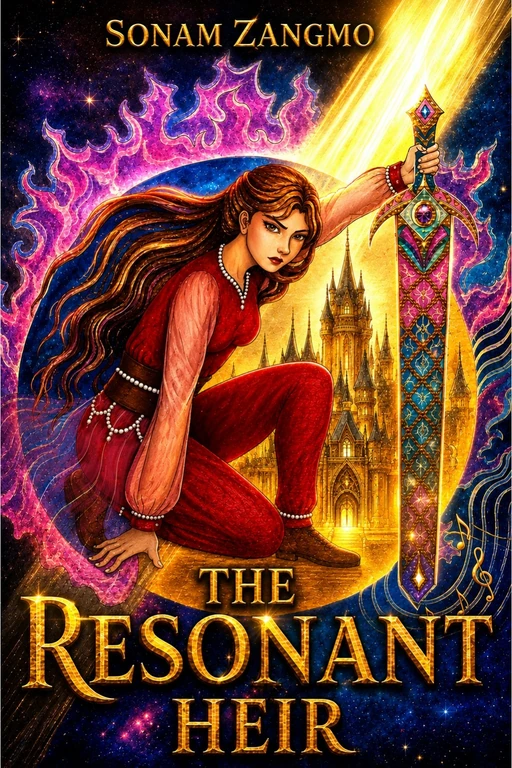
 Explore The Resonant HeirYA crossover royal fantasy · inherited magic · female heir · exile · adventure · Book I Complete
A Literary Commentary on Chapter Fifty of The Resonant Heir
The Part of Us That Runs: Fear, Free Will, and Becoming Whole in The Amber Road
In an ancient tree, Lyra loses familiar roads, the memory of her companion, and the assurance that loved voices speak the truth. The last fragment demands not fearlessness, but the courage to know that fear is only part of her.
Spoiler Notice: Contains spoilers for Chapter Fifty.
Explore the 33 themes in this commentary
- The Border Without a Gate
- The Instruction to Hear Silence
- The Scar That Answers the Road
- The Barrier That Isn't Hard
- Two Kinds of Being Lost
- The Road Home That Feels Wrong
- Two Guides and the Burden of Trust
- The Father She Forgets Is Dead
- The House on the Only Way Back
- Only Herself
- Syveris Becomes an Atmosphere
- The Wish to Be Protected
- She Runs, and the Novel Does Not Excuse It Away
- A Person Who Is Actually There
- The Corridor That Will Not Admit Haris
- “This Is Mine”: The Task No One Can Do for Her
- “I’ll Watch for You”: What Loyalty Can Do
- Eryndar Without a Crown
- The Father Who Would Have Let Her Choose
- The People Who Beg Her Not to Go
- From Concern to Contempt
- “If I Stop Now, I Will Never Move Again”
- “Part of Me Is Running. But Not All of Me.”
- A Truth That Does Not Need to Become a Verdict
- She Chooses to Fall
- The Fourth Fragment and the Quiet Pulse
- An Inner Journey Without an Outer Distance
- “This Time, Lyra Was Not Lost”
- Four Pieces Made Whole
- No Crown, No Coin, No Name
- Remembering the Cost of Arrival
- The Road Changed the Seeker
- Conclusion: The Part That Runs Is Not the Whole
Theme 01 · Philosophical commentary
The Border Without a Gate
At the northeast edge of Hemaliel, where Sarrakha and Drazhune also meet, there is no wall marking the frontier. A guard directs Lyra and Haris along a path of old pines, toward a silence that will tell them when they have reached the ancient tree. The landscape alters gradually rather than announcing a crossing.
This is a fitting beginning for a story of inward transformation. A border can change a person's circumstances even when nothing visible announces the precise instant at which the previous world ends. The trees grow dense, daylight thins, and pine needles swallow the horse's tracks.
Lyra is no longer the eleven-year-old we met in the forbidden garden. By this point she is about sixteen or seventeen. Yet some of her original determination remains: she moves toward a forbidden or uncertain place because she believes something necessary waits there. The intervening years have changed what she knows about the cost of doing so.
Maturity often begins at a threshold we cannot see, when the signs that once made life feel navigable slowly fall away.
Theme 02 · Philosophical commentary
The Instruction to Hear Silence
The guard tells the riders to follow birdsong until the forest grows quiet. It is a wonderful reversal: the sound guides them, but the disappearance of the sound marks arrival. A missing signal becomes information.
Lyra's development has repeatedly depended upon noticing what differs from expectation. A riddle's smoke behaved according to a discernible pattern; her sword strokes against the great serpent were not simply missing, but being redirected; small changes in a noble family's composure suggested a history involving Sion.
Here the clue is simpler and stranger. The birdsong thins and stops. The scene does not imply that all silence in the novel contains a message; the guard has specifically explained how to use this one. But it prepares the reader for a region where perception, interpretation, and trust will become the actual sources of danger.
The absence of a familiar sound can be more unsettling than a new noise. We learn our world through repetition, and we notice that something has changed when the ordinary background stops reassuring us.
Theme 03 · Philosophical commentary
The Scar That Answers the Road
Once the forest falls silent, Lyra's scar begins to pulse. It beats lightly and steadily, and she takes the sensation as reassurance that they are moving in the right direction. The chapter does not explain exactly why the scar responds or establish an infallible magical guidance system.
The physical image nonetheless carries emotional meaning. A scar records harm that has already happened. It is what remains when the event is over but the body cannot return entirely to its former state.
Lyra's journey has left far more than one mark. Some losses cannot be converted into benefits, and the novel does not need to pretend that suffering was necessary or desirable. Still, the person who has endured those experiences may have become capable of new forms of recognition and judgment.
Our wounds are not gifts in themselves, but they can remain part of the history through which we learn to find our way.
Theme 04 · Philosophical commentary
The Barrier That Isn't Hard
The ancient pine contains a mass of amber that appears sealed and solid from far away. Up close its surface moves like mist behind glass. Lyra reaches forward; her fingers pass through, and Haris follows her into the golden veil.
The barrier's physical permeability is an important surprise. The object that seems most difficult to penetrate offers no resistance at all. The real trial lies beyond the apparent boundary, in an experience whose shape neither traveler has been told to expect.
A weapon can cut solid material, and skill can help cross dangerous terrain. Neither will be of obvious use against lost memory, misleading familiarity, or a beloved face uttering words its owner would not have spoken.
This reversal establishes the chapter's central method: what appears impassable may be easy to enter, while what seems familiar may prove hardest to cross.
Theme 05 · Philosophical commentary
Two Kinds of Being Lost
The moment the amber closes, Haris stands alone on a road with no echo. He calls Lyra and searches for her. His problem is clear: the person who entered with him has vanished.
Lyra suffers a more disorienting loss. She does not hear his calls and does not even remember that he had been beside her. Her separation is partly a loss of knowledge about her own immediate past.
Relationships persist in consciousness when the other person is out of view. We know whom we miss, and that knowledge helps us orient ourselves. Lyra is temporarily deprived of even that anchor. She cannot look for someone whose presence she no longer recalls.
The novel does not explain the mechanism of this lapse. It is enough that the amber makes companionship unavailable not just to Lyra's body, but to her memory. Its trial starts by narrowing what she knows she can rely upon.
Theme 06 · Philosophical commentary
The Road Home That Feels Wrong
Lyra opens her eyes at a crossroads near a town at sunset. A bell rings; children laugh in the grass. One road seems to lead to the royal palace, yet the place does not feel familiar. She chooses the direction that feels nearer and eventually realizes she has taken the wrong way.
Home is both an actual destination and an emotional idea. The palace once meant the presence of a father, a mother, a steward, and protection. The place to which Lyra wishes to return no longer exists in exactly that form.
The vision puts a fracture between knowledge and feeling. She knows a road ought to be familiar; her senses do not agree. When she follows what merely feels right, the landscape betrays her confidence.
The scene does not supply a dependable map of real palace roads. It shows a dreamlike experience changing under her feet. Wanting to recover a former safety does not ensure that the old directions will still lead there.
Theme 07 · Philosophical commentary
Two Guides and the Burden of Trust
An elderly juice seller points Lyra in one direction. Later, after the surroundings transform, Eryndar appears and directs her toward the road she first chose, warning that the stranger's way is full of thorns. The instructions conflict.
There is no neutral evidence in the vision to determine which advice is true. The dramatic question is therefore not simply which route a competent traveler would select. It is what makes one voice more persuasive than another.
The stranger is unfamiliar, while the image of Eryndar arrives clothed in remembered authority and affection. Lyra has reason to distrust the road she originally took, but she longs to believe a father who seems miraculously present.
We often judge advice by the person giving it, not solely by its content. Love can make a speaker trustworthy in real life. It can also make the mere appearance of that speaker exceptionally powerful in a place designed around unreliable recognition.
Theme 08 · Philosophical commentary
The Father She Forgets Is Dead
In her first encounter with Eryndar inside the amber, Lyra does not remember his death. She sees the father she knows, stern and warm, and relief overwhelms her. The vision briefly gives her the one thing ordinary reality cannot.
This moment is more complex because Lyra is sixteen or seventeen, not eleven. She has endured years of losses, travel, responsibilities, and political danger. She is old enough to know a great deal about duty, yet she still longs for the time before her father's death.
That longing is not a regression to childishness. The wish to see a dead parent again does not vanish when a person grows older. Indeed, knowing what has been lost can make the imagined reversal unbearably sweet.
The chapter does not confirm Eryndar's spirit is present. It presents a familiar image in a space already capable of disrupting memory. Its poignancy lies in an impossible possibility briefly allowed to feel real.
Theme 09 · Philosophical commentary
The House on the Only Way Back
After Eryndar disappears, an unfamiliar house appears beside the altered road. Lyra is frightened, but with the certainty peculiar to dreams she knows she must enter through one door and exit through another to reach the palace.
The place she wants to reach is associated with shelter; the place she must cross is associated with dread. Safety seems available only on the other side of what terrifies her. The geometry is deliberately psychological, not ordinary.
This should not be translated into a real-world injunction to seek danger for its own sake. The chapter is representing a particular fantastic ordeal in which movement is inseparable from confronting what Lyra fears.
The image captures a difficulty of growing older after loss: we may want to return to a time before danger, but the way forward cannot simply restore the conditions of an earlier life.
Theme 10 · Philosophical commentary
Only Herself
At the threshold of the house, Lyra looks down and realizes her sword has disappeared. The narrator reduces her resources to a blunt formulation: only herself.
The missing weapon matters because the story has not treated the sword as an effortless possession. Bramor paid with his life in the chain of events that made it possible. It represents both power and the reality of other people's sacrifices.
Neither its sharpness nor its history can answer the questions inside the house. A sword cannot cut the remembered authority of a father or explain why a young woman still wants to be protected. The journey must temporarily move beyond combat.
Having only herself at this moment does not mean she made it to the tree alone. Other people can make our choices possible, but they cannot finally choose our relationship to fear in our place.
Theme 11 · Philosophical commentary
Syveris Becomes an Atmosphere
The house is dark and cold, and laughter rises from within it. Lyra recognizes Syveris, yet the voice has no location: it comes from the walls, behind her, above her, and below the floor. There is no visible enemy she can strike.
The scene gives spatial form to intimidation. Syveris is powerful and cunning, as Lyra understands him, but here the immediate danger is the way her fear fills every direction and destroys the sense of a safe exit.
It would be inaccurate to conclude that Syveris himself is physically inside the ancient tree. The chapter presents the laugh within a shifting vision and does not explain who or what creates it.
The wider insight is that threatening power can continue to operate through anticipation. An adversary need not stand before someone for fear of that adversary to shape where she believes she can move.
Theme 12 · Philosophical commentary
The Wish to Be Protected
Lyra wants to be home. The narration names her father, mother, and Obewich, and the desire for walls, arms, and someone stronger to stand between her and the dark.
This yearning should not be read as the instinct of an eleven-year-old still living in the opening chapter. Lyra is now roughly sixteen or seventeen, a young woman who has spent years confronting dangers and making consequential choices. The wish is that of someone who has been forced to carry more than she wanted.
The longing makes her courageous acts more convincing, not less. Someone who is never afraid or never needs tenderness may be impressive, but is harder to believe. Lyra can want a protector and still have real reasons to protect others.
Strength does not require the disappearance of the need to be cared for. The tragedy is that some of the people she most wants beside her can no longer stand there.
Theme 13 · Philosophical commentary
She Runs, and the Novel Does Not Excuse It Away
The laughter surrounds Lyra. She feels hollowed out by fear, doubts that she can defeat Syveris, and runs through the house. The narration does not pretend the flight is an elaborate maneuver designed to outwit an enemy.
This is necessary preparation for the confrontation that follows. When voices accuse her of always running away, they will touch something the reader has actually seen: she did run because she was frightened.
But the leap from one action to an entire identity is too great. Lyra has also stood her ground, endured pain, cared for Sion, and chosen to enter dangers that were not hers alone. The moment of flight is real; the claim that flight explains her whole life is false.
The courage of this writing lies in allowing an imperfect action to remain imperfect. Lyra does not have to be rewritten as fearless so that readers can continue respecting her.
Theme 14 · Philosophical commentary
A Person Who Is Actually There
Lyra bursts from the vision and collides with Haris. The text is careful to establish that he is not another shadow or trick. She throws her arms around him and holds on as though the amber might separate them again.
Haris freezes; a hand rises and then stops short of her back. Lyra releases him, blushes, and apologizes. Relief crosses his face before he says simply that she is here.
There may be a growing tenderness in the scene, but the novel has not declared a romance. What is unmistakable is the contrast with the imitation of Eryndar. Haris's presence belongs to the moment they are actually living, not to a past the amber offers to restore.
His quiet recognition does not make Lyra's fear disappear. It gives her something stable after a reality in which even memory could fail. A trustworthy human presence can be a kind of orientation without being a solution to every danger.
Theme 15 · Philosophical commentary
The Corridor That Will Not Admit Haris
The ground opens onto a spiral corridor leading down toward a point of light that looks like the map fragment. Haris offers to go with Lyra. She enters, but when he tries to follow, his foot meets empty air. A second attempt changes nothing.
His exclusion is not a choice to abandon her. The path itself refuses him. That distinction matters after Chapter Forty-Nine, when Sion remained at Hemaliel while Lyra continued toward the Myrren Tree.
Haris can be loyal without being omnipotent. The fact that someone cannot accompany us through a particular experience does not mean that person is indifferent to it.
The magical boundary places the limits of companionship in concrete form. It asks what help can mean when presence itself is no longer possible.
Theme 16 · Philosophical commentary
“This Is Mine”: The Task No One Can Do for Her
Across the gap Lyra tells Haris that this part of the journey is hers. She understands the path's refusal and stops trying to make their shared determination overcome it.
The line does not cancel the long record of help on which she depends. Sion saved her through the roots; Haris fought alongside her and brought knowledge from the palace; strangers and friends have repeatedly made progress possible.
But no amount of support can become Lyra's own decision about how she interprets the voices ahead. Her worth, her grief, and her motives cannot be adjudicated by the companion waiting at the entrance.
We may depend upon others without surrendering the responsibility to answer for ourselves. The corridor is solitary without making the larger journey an achievement of solitude.
Theme 17 · Philosophical commentary
“I’ll Watch for You”: What Loyalty Can Do
Haris stops trying to enter and promises to stay where he is and watch for Lyra. The sentence is less spectacular than a battle promise, but it deserves attention.
He could demand that she return because he cannot go. He could insist on proving his strength against a boundary that has already refused him. Instead he accepts the limit and chooses a useful role within it.
This resembles Sion's decision to remain at Hemaliel while still seeking ways to help Lyra. The forms of staying differ: Haris is physically barred; Sion has found a new home. Both scenes nevertheless refuse the idea that devotion requires identical movement.
Sometimes the most loving thing someone can do is wait where the other person may need to find them again.
Theme 18 · Philosophical commentary
Eryndar Without a Crown
Farther down the spiral Lyra meets Eryndar again, this time wearing ordinary clothes rather than royal robes. The figure is recognized not through a crown or official authority but through the familiar presence of the man who raised her.
He tells her not to continue and insists the place is not meant for her. The words are especially sharp for a girl who has long endured doubts about her eligibility as heir because she lacked an aura.
A stranger using that language might provoke her defiance. A loved father's face makes the same message dangerously soft. It seems to transform a judgment of exclusion into protective concern.
But the scene remains part of the amber experience. Nothing proves that Eryndar has returned from death or that these are words he would truly choose. Lyra must discover which parts of the encounter belong to memory and which betray it.
Theme 19 · Philosophical commentary
The Father Who Would Have Let Her Choose
Lyra remembers that her father is dead. Then she remembers what she believes about him: if he were still alive, he would allow her to make the choice. That understanding becomes her reason for rejecting the figure.
The decisive discovery is ethical rather than visual. The image has Eryndar's familiar form and voice, but its demand does not fit Lyra's knowledge of the relationship. It uses a father's tenderness to close the future that his love, as she remembers it, would have let her consider.
She tells the image that it is not him. It wavers and loses shape. She has not conquered a ghost by force; she has distinguished imitation from fidelity to a real person's character.
The passage shows how remembering someone truthfully can require refusing an appearance that seems to give them back. Love can guide choice without demanding obedience in its own name.
Theme 20 · Philosophical commentary
The People Who Beg Her Not to Go
Lyra hears a sob and finds images of her mother and Obewich. Her mother warns that she may never return. Obewich says they could not bear losing her. Lyra freezes and even moves a step toward them.
Their first appeal is powerful because it resembles an understandable concern. The High Lord has warned that the amber changes those who enter it. The danger is not invented merely by the figures' anxiety.
But these are appearances within the trial, not proof that the real mother and steward have arrived or spoken those words. The voices borrow authority from Lyra's affection for the people they resemble.
This confrontation reverses Chapter Forty-Nine's dilemma. Lyra urged Sion to stay with her new father because she knew what losing a parent could mean. Here voices that sound like family ask Lyra to stop because they fear losing her. The parallel makes concern recognizable while leaving the question of choice unresolved.
Theme 21 · Philosophical commentary
From Concern to Contempt
When Lyra says she must know what lies ahead, her mother's image stops crying. It asks who she thinks she is, then challenges her to see how far she can get. Obewich's image laughs and says she always runs when something hurts.
The shift matters. First they try to stop her by inviting her to feel the pain their loss would cause. When that fails, they accuse her of weakness. The apparent message changes from “we need you safe” to “you are not courageous at all.”
That is a recognizable pattern of manipulative pressure, though the novel has not established a particular sentient manipulator behind the vision. If care does not win compliance, shame may. Both appeals borrow strength from the faces Lyra trusts.
The words should not be attributed to the real mother or Obewich. They are part of an ordeal that has already produced a false version of Eryndar. Their dramatic truth is the hold such accusations can have on Lyra.
Theme 22 · Philosophical commentary
“If I Stop Now, I Will Never Move Again”
Lyra says that if she stops now she will never move again. The declaration is intense and must be read as her experience of this moment, not a general rule against rest, reassessment, or sensible retreat.
People need to pause, and leaving danger can be the right choice. Indeed, Lyra's own history has demonstrated the costs of ignoring a threat. What she fears here is not the act of resting, but becoming immobilized by voices that claim the right to determine her future.
The distinction lies between choosing to stop after judgment and no longer being able to continue because shame or terror has acquired control over one's choices. Lyra senses the second possibility.
Her wish to know what lies ahead is therefore not simply curiosity. It is an attempt to preserve a future in which she remains capable of deciding.
Theme 23 · Philosophical commentary
“Part of Me Is Running. But Not All of Me.”
The mother and steward figures accuse Lyra of escape rather than courage. She listens. The narrator does not give her an effortless rebuttal: part of her believes them. The memory of fleeing Syveris's laughter is still fresh.
Then she says, “Maybe.” She accepts that part of her wants to run. She refuses the claim that it is all she is. The precision of this response gives the scene its philosophical depth.
A person can act from mixed motives. Lyra wants shelter and also wants answers. She fears Syveris and still hopes to restore the capacity she needs for her duties. She longs for the lost ease of childhood and nevertheless continues the responsibilities of someone now sixteen or seventeen.
Calling those motives contradictory does not make one of them unreal. Nor does an unheroic impulse invalidate every act of courage that accompanies it. To recognize the part of ourselves that wants escape is not to grant it authority over our entire life.
The chapter proposes an alternative to an impossible standard of purity. Lyra can choose to go on without pretending every piece of her desire is noble. That is a more credible courage than fearlessness.
Theme 24 · Philosophical commentary
A Truth That Does Not Need to Become a Verdict
When Lyra acknowledges a limited truth in the accusation, a crack moves through the space. The words lose their hold on her, and the images fall silent as she turns away.
This resolution is subtler than simply proving that the accusation was false. It is not wholly false. She ran, and part of her is still tempted to run. The error was the effort to turn a part of her experience into a definitive verdict on the whole person.
The scene does not offer a universal psychological treatment in which an affirmation dissolves trauma. It is a fantasy representation of a particular recognition: self-knowledge can be more freeing than either denial or surrender.
We do not have to refute every painful description of ourselves to reject its claim to be the final word. Lyra wins back the right to decide what her complicated motives will mean for her actions.
Theme 25 · Philosophical commentary
She Chooses to Fall
A narrow passage opens, and Lyra steps into it. This time she lets herself fall. The narration distinguishes the movement from the running that carried her out of the dark house.
Earlier her body fled because terror seemed stronger than her judgment. Now she deliberately accepts descent into an outcome she cannot fully control. The sensation may be similar; the relationship between choice and movement has changed.
This is an important way of understanding agency. It is not always mastery over events, the elimination of uncertainty, or the capacity to dictate what happens next. Sometimes it is the choice to encounter what cannot be guaranteed.
Lyra has neither found perfect safety nor learned every secret of the tree. But she moves on her own terms. Consent to uncertainty can be an act of freedom rather than a failure to control.
Theme 26 · Philosophical commentary
The Fourth Fragment and the Quiet Pulse
At the bottom of the spiral the last fragment shines. Lyra closes her fingers around it. No light explodes from the object, and no force drags her away. Instead she feels one pulse, clear and complete, as though something inside has settled into place.
The restraint is one of the chapter's finest artistic choices. After a vision of unstable worlds and painful accusations, the reward is tangible and small: a piece of silk with a path upon it.
The fourth fragment has truly been obtained, but the Awakening Spring has not yet been reached. Neither the chapter nor the pulse confirms that Lyra's full magic has now awakened. The object is a completion of the map, not the fulfillment of the entire quest.
The pulse may evoke inner coherence, but that metaphor should not be made into an asserted magical mechanism. What readers can confidently see is a young woman holding the result of a choice she had to make for herself.
Theme 27 · Philosophical commentary
An Inner Journey Without an Outer Distance
Lyra finds Haris and realizes that they are still inside the ancient tree. Thick amber walls surround them, holding light in frozen layers like memories under glass. The apparent roads, town, palace route, and dark house have not been ordinary travels outside.
The revelation gives the chapter its strange spatial elegance. An entire emotional journey has taken place inside a bounded material space. The reality of the fourth fragment remains, though the mechanism of the visions is unexplained.
We need not invent a conscious judge within the amber or insist that the figures were literal spirits. The text supplies experiences and their effects, not a final explanation of who authored them.
The episode becomes a vivid figure for inward change. A person may travel very little in physical space while moving far in her capacity to understand herself.
Theme 28 · Philosophical commentary
“This Time, Lyra Was Not Lost”
Outside, the air is clean, the forest winds sound real, and the ancient pine stands quiet behind them. Lyra can still remember the shape of the path: the fear, the voices, and the choice. Then she breathes out and is no longer lost.
The sentence answers the earlier crossroads, where familiar roads led to unfamiliar turns and the image of a dead father contradicted the instability of the world. This time her orientation comes from knowing something about her own motives rather than trusting every offered direction.
The story does not say she will never feel frightened or confused again. Syveris remains dangerous; her mother and the kingdom still face grave uncertainty. The relief concerns this passage and the agency she has recovered within it.
To find one's way does not always mean knowing what will happen. It may mean knowing how to move without letting the strongest fear become the only voice worth hearing.
Theme 29 · Philosophical commentary
Four Pieces Made Whole
Lyra places the last fragment beside the previous three. They join into a single path. The narrator imagines each land she crossed placing a hand upon the gate and opening it.
This image turns the map into more than a completed collectible. Every piece belongs to a different sequence of encounters, difficult decisions, help received, and costs borne by people other than Lyra. No single fragment would have been enough.
The metaphor of hands from different lands does not establish a literal alliance of magical forces. It conveys a history of accumulation. The way forward exists because many partial experiences have finally become legible together.
There is also an echo of Lyra's answer inside the spiral. Her motives are multiple and imperfect, yet she need not discard them to continue. Wholeness is not necessarily the elimination of differences; it can be the discovery of a form in which distinct parts belong together.
Theme 30 · Philosophical commentary
No Crown, No Coin, No Name
The closing reflection does not celebrate Lyra's lineage as the source of the completed map. It says no crown, no coin, and no name brought her to this place. Instead it remembers the sword forged at the cost of Bramor's life, the three tempting cups, grief used as a leash, Sion's venom, and a reunion in which joy and sorrow lived together.
This is not a denial that money, names, or political status have mattered. Haris used his father's reputation to obtain an audience, gold secured practical help, and Lyra's royal birth continues to shape the stakes of her mission.
What those resources cannot replace is the series of decisions that made the journey meaningful. A crown cannot tell her whether the fatherly image is true. A coin cannot buy her way past the accusation that some of her motives are fearful.
The passage shifts attention from privilege to experience while refusing to erase the contributions of others. A life is built not solely by what we inherit, but by how we respond to what that inheritance requires.
Theme 31 · Philosophical commentary
Remembering the Cost of Arrival
Bramor is important even though the sword does not accompany Lyra through the dark house. The narrator remembers the price paid for its forging. Sion's suffering and the losses surrounding Hemaliel are also present in the final inventory.
Such memories complicate the rhetoric of solitary triumph. Lyra's final inward decision is hers alone, but the conditions that made the decision possible were not hers alone to create. Other people fought, sacrificed, cared, and sometimes suffered from the risks she and her companions took.
The chapter does not make every earlier choice morally uncomplicated. Its references to grief as a leash and venom attacking a friend preserve the fact that power and good intentions have brought difficult consequences.
To take responsibility for one's own courage is also to remember those whose lives have become part of its cost. The map's wholeness should not make their histories disappear.
Theme 32 · Philosophical commentary
The Road Changed the Seeker
The narrator closes by observing that the map is not merely the route to the Awakening Spring; the journey has changed Lyra enough to stand before it. This is the deeper meaning of the chapter's title.
A heroine who began by wanting magic because others questioned her worth has shown courage, intelligence, compassion, stubbornness, occasional overreach, and a capacity to revise her understanding. Those qualities do not depend upon whether the Spring ultimately grants her full power.
Lyra has grown from an eleven-year-old princess into a young woman around sixteen or seventeen. Her adventurous will remains recognizable, but she now has a history that asks her to distinguish determination from denial and responsibility from control.
The next question is not only whether magic will awaken. It is what she will do with power if it does. The road toward a missing capacity has already taught her forms of self-knowledge that no spell can simply confer.
Theme 33 · Philosophical commentary
Conclusion: The Part That Runs Is Not the Whole
The Amber Road can be read as an adventure about retrieving the last map fragment, but its deepest struggle is an argument over identity. Lyra is stripped of her sword, of reliable directions, and for a time of the memory that Haris arrived beside her. She longs for home and runs from the laughter of the enemy she fears.
The amber then places familiar faces in front of her. They speak in the language of protection and later of contempt. Their claim is effective because it contains something Lyra recognizes: she does want to escape pain. The decisive insight is not a denial of that truth but a refusal to let it explain her entire journey.
Haris cannot accompany her down the spiral, but he can stay and watch. Eryndar's image cannot reclaim a father's authority simply by resembling him; Lyra remembers that the real father she loved would have allowed her to choose. Both encounters separate love from control.
When she finally takes the fragment, nothing spectacular announces the awakening of magic. The map becomes whole, and the girl who set out to restore her power finds that she has already changed through the effort to reach it.
Courage is not the proof that no part of us wants to run. It is the freedom to acknowledge that part, refuse to let it speak for everything we are, and choose the road ahead anyway.