
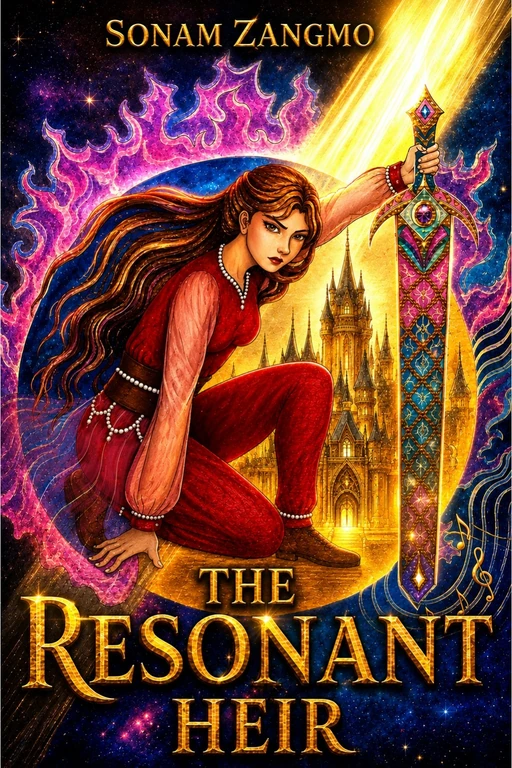
 Explore The Resonant HeirYA crossover royal fantasy · inherited magic · female heir · exile · adventure · Book I Complete
A Literary Commentary on Chapter Fifty-One of The Resonant Heir
The Price of Becoming Whole: Restoration, Freedom, and Loss in What the Spring Took
The Awakening Spring restores the resonance Lyra possessed before birth. But the same water takes a mark that once opened other doors. What does becoming whole mean when the recovery of one freedom costs another?
Spoiler Notice: This commentary discusses Chapter Fifty-One. A separate, collapsed Book I retrospective below includes spoilers through Chapter Fifty-Five.
Explore the 38 themes in this commentary
- A Title That Counts the Cost
- A Road That Looks Ordinary
- A Nettle Scratch Before a Greater Price
- The Map Is Right, Yet the Stream Is Missing
- Four Stones and a Revised Hypothesis
- “She Was Standing Wrong”
- The Two Clocks of the Chapter
- “It Was Never Gone”
- Kathareia and a Story From Childhood
- Purification Is Not the Creation of Magic
- The Childhood Mistake and the Court's Mistake
- The Tower and the First Fracture
- Resonance Was Already a Practice
- Syveris: The Culprit Revealed at Different Times
- Velaria's Question About Peace
- “Every Seal Inside Me Undone”
- “Even the Doors That Opened for You”
- Freedom to Choose, Without Perfect Information
- The Danger in “One More Price”
- Haris's Hand, Not His Command
- Purification Through the Body
- The Darkness That Was Never Hers
- Memory, Not Conjecture
- Bitterness, Sweetness, and Limited Repair
- The Aura Was Never a Test of Her Worth
- “Between Me and Myself”
- The Sword and the Music of Resonance
- The Ancient Trees and the Ethics of Force
- The Empty Place on Her Wrist
- What Else Has Been Taken?
- A Sacred Source That Fades Again
- Ten Days, Five Fae Clans, and Legal Right
- Why Haris Calls Her Worthy
- No Longer Returning to Prove Herself
- “Even If It Killed Her”
- Conclusion: Restoration and Its Unfinished Moral Work
- Book I Retrospective: The Door Beneath Rubiad
- Book I Retrospective: A Promise Without Its Key
Theme 01 · Philosophical commentary
A Title That Counts the Cost
The chapter in which a fantasy heroine recovers her full magic might conventionally be titled for triumph: The Awakening, The Return, The Gift. Sonam Zangmo instead calls Chapter Fifty-One of The Resonant Heir What the Spring Took. Before the reader even reaches the water, the title insists that the meaning of the experience must be counted not only in what Lyra gains but in what she loses.
The restoration is genuine. A magical obstruction imposed before Lyra's birth is finally removed. Her resonance, already emerging through cracks in the seal, returns in full, and she can now use her sword with a force that astonishes Haris. But immediately after that spectacle, the narrative directs her eyes to her bare left wrist. Vael’Kharoth's mark is gone. The triumph cannot be understood without that subtraction.
This is the chapter's central philosophical tension. Recovering what rightfully belonged to a person may be essential and just, but a long life under constraint develops its own history. New capacities, bonds, and obligations can grow during the very years one wishes to undo. The Spring restores Lyra; it does not preserve every door her complicated past opened.
Lyra's earliest sense of home included Obewich, her steward, and Eryndar, her father. The later trial at the four stones does not erase those relationships, any more than restoring resonance erases Bramor's sacrifice.
Theme 02 · Philosophical commentary
A Road That Looks Ordinary
The approach to the Awakening Spring is remarkably unceremonious. Lyra and Haris follow the completed map until roots and branches make riding impossible. They dismount, lead the horse, and work through nettles. There is no monumental avenue or immediate vision of sacred power. An experience about to change Lyra's existence is concealed beyond a trail that could belong to an ordinary forest.
The visual modesty recalls a mistake that shaped her childhood. In the royal court, a visible aura was taken as evidence of capacity, and its apparent absence became a verdict about a young princess. Here an extraordinary place gives little visible warning of what lies within. The parallel is symbolic rather than a claim about identical enchantments. It invites caution toward the assumption that important realities must advertise themselves.
Theme 03 · Philosophical commentary
A Nettle Scratch Before a Greater Price
A thorn draws a little blood from Lyra's hand. Haris turns, sees that the injury is shallow, and tells her to be careful. She dismisses it. The small scene matters because this is pain she can understand: she can look at the mark, judge its seriousness, and continue without uncertainty about its immediate effects.
At the water's edge, the price is different. Lyra will know that something can be taken but not what or how much. The nettle is not a magical offering, and the story does not call it one. It establishes a contrast between a minor wound whose limits are visible and a sacrifice whose limits are concealed. Experience may have made Lyra unusually able to endure discomfort, but repeated endurance can also make the idea of paying another price dangerously familiar.
Theme 04 · Philosophical commentary
The Map Is Right, Yet the Stream Is Missing
Four hard-won fragments bring Lyra to a shallow hollow. The completed line has no break and points to no other location, but she sees only grass and stone. Haris checks the map and agrees that they have reached the right place. The apparent contradiction permits a subtle lesson: an answer can be accurate without being sufficient.
The map explains where to go. It does not explain how to gain access to something hidden at that place. Lyra has completed a long task but still must think, observe, and revise. Her intelligence does not become irrelevant when the objects have been collected. Indeed, the novel refuses the common adventure logic that a completed inventory automatically unlocks its reward. Knowledge of a destination and understanding the conditions under which it can be reached remain distinct.
Theme 05 · Philosophical commentary
Four Stones and a Revised Hypothesis
Lyra notices four stones arranged with too much regularity to seem accidental. Perhaps they are directional markers or a compass. Perhaps a cave lies somewhere beyond them. She examines the hollow, tries to make sense of its proportions, and steps into the center. Her scar pulses, and a strange ticking begins in the air.
The angle of the sunlight and the behavior of her shadow tell her that her first theory cannot be right. She abandons the compass hypothesis and understands the arrangement as a clock. This is the novel making the process of intelligence visible. Lyra does not succeed because her first guess is always correct. She succeeds because she is prepared to be wrong and attentive enough to know when the evidence requires a better explanation. That quality will matter as much in a royal court as in a hidden valley.
Theme 06 · Philosophical commentary
“She Was Standing Wrong”
The narrator states the solution plainly: the place was not wrong; Lyra was standing wrong. She adjusts her position in small increments until her shadow falls where it must. Then the hidden water reveals itself. At the threshold of a new level of power, Lyra reaches the Spring without forcing the ground or breaking the stones.
The scene is a valuable image of changing perspective, but it should not be inflated into a general claim that all obstacles result from the individual's mistaken attitude. Lyra's original seal was imposed by another person's wrongdoing. Within the puzzle, however, the proper response is not domination but understanding. The heroine proves that she can alter her own stance when the world gives her reason to do so.
Theme 07 · Philosophical commentary
The Two Clocks of the Chapter
The clock formed by the stones opens the way to the Spring. Later, the approaching coronation of Syveris imposes a different countdown: ten days. The story does not say the two clocks are linked by magic, but their appearance within one chapter gives time two contrasting roles.
One kind of time offers a solution through patience and precise observation. The other makes continued patience almost impossible. Lyra has spent years searching for a way to restore her magic, yet once the restoration occurs, political events leave her little opportunity to understand every consequence. The clock that reveals the hidden stream is followed by the clock that requires a rapid departure. Preparation can occupy years; responsibility may demand action within days.
Theme 08 · Philosophical commentary
“It Was Never Gone”
When the water appears among luminous gemstones and lilies, Haris is astonished. Why were they unable to see it before? Lyra answers that it was never gone. It had existed while remaining outside their ordinary perception. The statement is apt for a heroine who spent much of her childhood believing an important capacity was absent from her nature.
The stream and the seal do not have identical magical explanations, but they invite a common distinction between absence and inaccessibility. Lyra's resonance existed from before birth. The court saw no aura because the capacity was obstructed, not because she had no claim to it. Even more importantly, her moral worth never depended on observers finally being able to verify the power. The novel's criticism of prejudice would be weaker if recognition became deserved only once the aura became visible.
Theme 09 · Philosophical commentary
Kathareia and a Story From Childhood
When Lyra touches the water, Kathareia rises from it. Haris recognizes the goddess, while Lyra remembers the myth books given to royal children. The old stories spoke of a hidden spring connected to the soul's first truth and of a goddess able to wash away what did not belong.
The scene gives inherited knowledge a useful but limited role. The books supplied a name and a partial idea, not the map that led to the place or the method of aligning the stones. Lyra's years outside the palace have been an education in the incompleteness of official stories: Ravok's suffering, political betrayal, and hidden family histories were not fully contained in the accounts presented by authority. Here tradition proves valuable, but only in conversation with experience.
Theme 10 · Philosophical commentary
Purification Is Not the Creation of Magic
The Awakening Spring is revealed as a place of purification rather than indiscriminate magical amplification. Its water removes corruption so that the soul can return to the strength it possessed at birth. This is not the creation of Lyra's resonance magic. It is the completion of the release from an imposed obstruction.
The distinction reaches back through Book I. In Chapter One, eleven-year-old Lyra thought she had been born without magic. By Chapter Five a High Lord recognized that the seal was loosening. Chapter Six gave her an account of sealing before birth, and she learned to use partial resonance through later training and danger. The Spring restores that existing capacity fully; it does not make the earlier eruptions of resonance unreal.
To call this an ordinary power-up would also miss the ethical core. The central wrong is not that Lyra was insufficiently impressive but that someone interfered with her body before she could consent, then society judged her by the visible consequences. Restoration corrects an injury. It does not manufacture the dignity that ought to have been recognized throughout her life.
Theme 11 · Philosophical commentary
The Childhood Mistake and the Court's Mistake
The girl first seen in the forbidden garden believed she was magicless and feared that one mistake might give others grounds to challenge her inheritance. She was too young to know the truth of her condition, but old enough to feel the force of the court's contempt. The absence of aura became a public label that threatened to organize her identity.
The later discovery of a hostile seal exposes the factual mistake of those who thought they knew what she was. But their moral mistake was present even before the revelation. A child actually born without aura would still deserve kindness, education, and a fair assessment of her capabilities. It is therefore crucial not to celebrate the Spring as though magical power finally makes Lyra worthy of human respect. The worth was always there; the power was blocked.
Theme 12 · Philosophical commentary
The Tower and the First Fracture
The Umbral Tower in Chapter Two introduces Vael’Kharoth's mark on Lyra's left wrist. It is a later event than the seal placed before birth. In Chapter Five, the High Lord of Sonareth recognizes that the old seal is loosening, and Queen Velaria says Lyra's magic is returning. In Chapter Six, Velaria suspects the Tower incident may have opened a crack in the original restraint.
The characters' knowledge at that stage is incomplete. They do not know the culprit or all of the mechanics. But the chronology is clear enough to prevent an important confusion: the original prenatal seal and the later Vael’Kharoth mark are distinct magical developments. The Spring eventually cleanses the obstruction and removes the mark, but their disappearance in the same scene does not make them the same thing.
Theme 13 · Philosophical commentary
Resonance Was Already a Practice
At Lake Lyrenthis and elsewhere, Lyra learned to attend to rhythm, vibration, and sounds others could not hear. Resonance became a discipline rather than a silent promise of some future superpower. She made use of its incomplete expression, often while encountering problems that could not be resolved by force alone.
The role of Voxath in Ravok's story is especially significant. A creature whose voice had been violently denied could be helped through Lyra's growing ability to listen and intervene. This made the development of magic an ethical education as well as a technical one. The Spring does not replace those lessons; it allows her now to use fully a capacity she has been struggling to understand for years.
The significance of this arc is not that incomplete magic forced Lyra to become morally good. Suffering is not an educational benefit the story must endorse. Rather, the long interval between first fracture and final cleansing allowed her to encounter the human consequences of what power can and cannot accomplish.
Theme 14 · Philosophical commentary
Syveris: The Culprit Revealed at Different Times
In Chapter Thirty-Five, the reader hears Syveris acknowledge to Eryndar his role in depriving Lyra of the strength she should have possessed from birth. Lyra is not there. The novel therefore gives the audience knowledge that its heroine still lacks, and the imbalance affects how the ensuing quest is read.
At the Spring, the pain of purification brings images of the divine apple garden, a bulging-eyed demon, and the attack made while Lyra was in Velaria's womb. The narration says this is memory, not merely a guess or a fear. She finally discovers what the reader has had reason to know.
This is not just an identification of a villain. It is the return of an explanation to someone who lived for years with consequences but without a name for their cause. The origin of the injustice predates Lyra's ability to speak or defend herself. Remembering does not return those years, but it changes the account of them she can now tell.
Theme 15 · Philosophical commentary
Velaria's Question About Peace
Early in the novel, when Lyra asked whether she might regain all her magic, Velaria suggested an even more important question: would her daughter find peace on the path of power? The young princess could not fully appreciate that warning. By Chapter Fifty-One she is about sixteen or seventeen and has spent years shouldering dangers much greater than those of the forbidden garden.
The restoration answers the practical question about her full native capacity. It does not answer her mother's question about how to live with responsibility. Near the chapter's end Lyra resolves to defeat Syveris even if the effort kills her. The determination is stirring, but it also suggests a young woman who may have learned to regard sacrifice as the natural price of every worthy objective.
Power can enlarge the capacity to act without creating the wisdom to act proportionately. Velaria's earlier counsel returns as a warning against confusing a recovered ability with a completed moral education.
Theme 16 · Philosophical commentary
“Every Seal Inside Me Undone”
Before Kathareia, Lyra asks that every seal within her be undone. She is not asking to dominate everyone else. She wants the removal of a restraint that has always stood between her and the full use of her own resonance. The desire is grounded in justice: an intrusion that was never hers should no longer control her.
Yet the word every is expansive. Lyra has lived under unusual magical conditions for years, and later encounters have added connections she does not entirely understand. She cannot know all the consequences of removing everything the Spring identifies as incompatible with restoration. The goddess's answer is therefore not a simple blessing but a warning. What is rightly sought may still change other parts of the seeker's life.
Theme 17 · Philosophical commentary
“Even the Doors That Opened for You”
Kathareia warns that Lyra may lose things she thought belonged to her, even doors that once opened for her. This is a difficult thought, because a life spent under an imposed condition is not made only of the condition itself. It contains relationships, learned skills, and opportunities that arose along the way. Not every useful thing acquired after birth is corruption.
The Vael’Kharoth mark is an especially charged example. It appeared after the Tower and became associated with strange contact and access, including the connection through Rubiad. Its utility does not prove it was an uncomplicated blessing. Nor does the justice of removing the prenatal seal prove that the disappearance of this later mark has no cost. The goddess's warning holds both possibilities open until events reveal more.
Theme 18 · Philosophical commentary
Freedom to Choose, Without Perfect Information
The goddess disappears before Lyra can ask exactly what the Spring will take. She knows that the water can restore her power and that loss may accompany purification. She does not know the scale or identity of the loss. No one forces her to drink, but her choice is made without full information.
The difference matters ethically. A voluntary act need not be a choice whose consequences are completely understood. Nor does uncertainty automatically make action irresponsible. Much of meaningful life is decided without the benefit of perfect foresight. The chapter allows Lyra to choose while remaining exposed to outcomes she could not weigh in detail. The absence of complete knowledge is not erased by the authority of the goddess who delivers the warning.
Theme 19 · Philosophical commentary
The Danger in “One More Price”
Lyra thinks of her mother, the palace, the people of Tharion, and the cost of the journey. She wonders what one more price could matter after all the prices already paid. The line expresses resolve, yet it also reveals a danger in the mind of a person who has spent years enduring hardship.
Past sacrifice does not by itself justify additional sacrifice. Otherwise a person may continue taking risks simply because stopping would make previous losses feel wasted. Lyra has forward-looking reasons to act, especially the threat Syveris poses to her kingdom. Those reasons make her decision intelligible. But they do not eliminate the possibility that she has learned to treat her own pain as a limitless resource. The chapter asks us to admire her courage without overlooking this risk.
Theme 20 · Philosophical commentary
Haris's Hand, Not His Command
Haris places a hand lightly upon Lyra's shoulder and reminds her that she has come this far. He does not order her to drink or promise the price will be small. This restraint is striking in a story where the companions have sometimes used coercion in pursuit of good ends, including Haris's treatment of the craftsman who made Sion's serpent-fang comb.
Here Lyra's body and future are at stake, and Haris does not attempt to possess her decision. His encouragement might carry emotional weight, especially for someone desperate to finish a difficult journey. Yet the narrative allows her hesitation to remain visible. His true role becomes clearest after she chooses: he catches her when the water overwhelms her, offering care without pretending he can undergo the purification in her place.
Theme 21 · Philosophical commentary
Purification Through the Body
The water is bitter. Pain passes through Lyra's blood, muscles, and bones, and she doubles over in Haris's arms. The supernatural process that promises liberation is not felt as gentle renewal. It is physically extreme, leaving her unable to answer when he asks whether she can breathe.
This should not be converted into a universal claim that pain is necessary before anyone can become whole. Lyra is undergoing a specific magical intervention against an imposed seal. The bodily violence gives the event weight without making suffering inherently virtuous. A restoration may be worth seeking even if its process is hard; that does not mean every hardship is a form of restoration.
Theme 22 · Philosophical commentary
The Darkness That Was Never Hers
The narrative identifies an old blackness being forced out of Lyra, a darkness that never belonged to her. Its long presence within her had genuine consequences. It restricted magic, shaped how she was treated, and affected the way she understood her place in the world. Yet none of those effects made the intrusion an original part of her nature.
The distinction is central to the chapter's philosophy of identity. A condition forced upon a person may shape decades of experience without becoming a fair measure of who the person is or what she deserves. The Spring removes the magical wrong, but cannot retroactively excuse those who treated its effects as evidence of Lyra's inferiority. Restoration changes what she can now do; it does not erase the ethical history of what happened before.
Theme 23 · Philosophical commentary
Memory, Not Conjecture
In the pain of cleansing, Lyra sees the divine apple garden and remembers Syveris's role in the prenatal attack. The text distinguishes this recognition from suspicion: it is memory. She receives a missing part of her own history rather than merely inferring another explanation from the information available to her.
The revelation gives Syveris's political threat a deeper personal dimension. He did not begin harming her when he sought the throne. The injustice reached her before she had any capacity to understand or resist it. The chapter does not provide every technical detail of the original spell, and the commentary should not invent those details. Knowing the culprit is enough to change Lyra's relation to her past without determining in advance what form of justice she should seek.
Theme 24 · Philosophical commentary
Bitterness, Sweetness, and Limited Repair
Dark violet liquid seeps away. The bitterness fades, a faint sweetness follows, and Lyra begins to feel lighter. Her restoration is first experienced from within, before the aura offers Haris a visible sign of the change. In a world obsessed with visible magic, that ordering is quietly moving.
But the sweetness does not mean every sorrow is erased. Eryndar remains dead. Bramor's sacrifice remains part of the sword's history. Sion's injuries and family ordeal have not been undone. The Spring cleanses a particular interference and allows resonance to return fully. It does not rewrite the relationships and losses of the years spent under the seal. The scale of the healing is significant precisely because the story refuses to call it total.
Theme 25 · Philosophical commentary
The Aura Was Never a Test of Her Worth
Haris sees Lyra's aura and knows that her full magic has returned. The reversal is striking because he was among the boys who once mocked the apparently magicless princess. But the decisive change in his assessment occurred earlier, during the serpent episode, when he admitted that lacking an aura did not make Lyra weak.
His respect now rests on conduct he witnessed before the Spring: bravery, intelligence, resilience, care for Sion, and refusal to surrender under pressure. If respect arrived only with the visible aura, the novel would risk confirming the standard used to humiliate her. Instead magical restoration and recognition of personal worth follow different timelines. The capacity returns; dignity was never absent.
Theme 26 · Philosophical commentary
“Between Me and Myself”
When Haris asks how she feels, Lyra says something has stood between her and herself all her life. It is an answer about identity rather than about the size of her power. She does not say she has finally become someone else. She recognizes that she has been prevented from fully accessing something that was hers.
Placed beside Chapter Fifty, the thought becomes richer. In the amber Lyra admitted that part of her wanted to run. She did not need to purge that ordinary human fear; she needed to refuse its claim to define her entire person. At the Spring she confronts something else, a darkness explicitly described as never belonging to her. The two chapters distinguish complex motives that must be acknowledged from imposed violations that may rightly be removed.
Theme 27 · Philosophical commentary
The Sword and the Music of Resonance
Lyra's sword trembles within its sheath. Her touch softens the vibration; drawing the blade releases a clear sound like wind across a taut harp string. That musical language is apt for magic built over many chapters around vibration, listening, and the meanings of sound.
The sword is not a new gift from the goddess. It carries the history of Bramor's sacrifice and Lyra's journey. The exact magical mechanics of its response need not be invented to recognize the image's literary coherence. Her fully restored native power now meets a tool and a set of skills acquired while that power was incomplete. Restoration transforms the use of past experience instead of making the past unnecessary.
Theme 28 · Philosophical commentary
The Ancient Trees and the Ethics of Force
Lyra swings, a ripple of force crosses the valley, and several ancient trees are severed with astonishing precision. Haris sees undeniable evidence that the magic has returned. Yet the trees are not shown as enemies threatening the travelers. The strike is a test of newly restored strength, not a defensive action during battle.
That distinction opens a question for a future ruler. The capacity to make something happen is different from the judgment that determines whether it ought to happen. The chapter does not portray Lyra as intentionally cruel, but its visible consequences need not be ignored. A person may discover the reach of a new ability before she has learned its safe limits. Great force only increases the importance of restraint and proportion.
Theme 29 · Philosophical commentary
The Empty Place on Her Wrist
Before Lyra can smile, she looks at her left wrist. Vael’Kharoth's mark is gone. Smooth skin remains in its place. The interruption makes the goddess's warning concrete: something that had accompanied Lyra through significant parts of her journey has disappeared during purification.
The mark reacted near the Myrren Tree and at the four stones, and earlier it had opened a distinctive connection through Rubiad. Its loss is not equivalent to erasing an unused decoration. Yet the mark is not the prenatal seal, and the two must not be conflated simply because both are affected by the Spring. One represents an original obstruction being removed; the other is a later connection whose disappearance may close paths Lyra learned to use.
Theme 30 · Philosophical commentary
What Else Has Been Taken?
Lyra asks herself what else may be gone. The chapter deliberately withholds an exhaustive answer. She knows that the mark has vanished, but does not know which other capacities or opportunities, if any, have been changed. It would be inaccurate to identify specific further losses before the narrative supplies evidence for them.
The uncertainty helps explain the title. Acquired power declares itself: the aura shines and the sword moves the world. Lost access may remain silent until its owner reaches for something once familiar and finds nothing responds. The book resists the simple arithmetic of power as a quantity that only increases. Some dimensions of freedom become visible only when the ordinary route back to them closes.
Theme 31 · Philosophical commentary
A Sacred Source That Fades Again
As the companions leave the middle of the stones, the gemstones dim, lilies sink, and the water disappears. The hollow returns to an ordinary appearance. The chapter does not explain whether Kathareia chooses to hide it or whether the timing mechanism once again makes it inaccessible.
The image is fitting without that answer. Lyra can take the consequences of purification with her but cannot seize the Spring itself as a permanent supply of healing. A transformative encounter need not become property. The nature of political power will shortly make that difference significant: not every source of help should be imagined as something the person who benefited can now own or command.
Theme 32 · Philosophical commentary
Ten Days, Five Fae Clans, and Legal Right
Only ten days remain before Syveris's expected coronation. Lyra and Haris ride through Hemaliel, Sarrakha, and Aulith toward Thrudor. Syveris controls the palace, court machinery, and mages loyal to him. Lyra has another source of authority: she is Eryndar's only heir and has support from five fae clans, sufficient under the kingdom's law to assert her claim.
The distinction is vital. Restored resonance may provide the strength needed to confront the usurper, but strength does not create the legal foundation of her claim. Conversely, a rightful claim does not automatically guarantee wise government. The chapter keeps physical capacity and political legitimacy separate, leaving the ethical quality of future rule as something Lyra must continue to demonstrate.
Theme 33 · Philosophical commentary
Why Haris Calls Her Worthy
Haris has seen stronger magic than Lyra's. Yet he believes that something she has demonstrated through hardship matters more: she has faced pain, humiliation, and difficult truth without relinquishing her purpose. The judgment completes a striking change from the boy who mocked her missing aura.
He is right to look beyond a display of force, but determination alone is not the whole of political wisdom. A ruler must sometimes accept a correction, listen to a person she dislikes, and restrain her own power. Lyra's decision to revise her theory of the four stones offers another valuable sign of leadership. The strength to stand firm and the intelligence to change one's mind may be equally necessary.
Theme 34 · Philosophical commentary
No Longer Returning to Prove Herself
The narrator says Lyra is not returning to prove herself. At eleven, she feared each mistake might deepen the court's judgment that she was unfit. Now at sixteen or seventeen she has a lawful claim, powerful allies, hard-earned skills, and her full resonance. The objective before her is no longer merely personal vindication.
She wants to stop Syveris and reclaim what he has taken from her family and kingdom. Private anger and the desire to be recognized need not have vanished, but her mission extends beyond them. A person can spend years trying to prove an unfair judgment wrong, then discover a responsibility more important than obtaining the approval of the people who judged her.
Theme 35 · Philosophical commentary
“Even If It Killed Her”
The final promise is fierce: Lyra will win even if the effort kills her. It gives the story urgency as the political deadline approaches. But a sympathetic criticism should not treat unlimited readiness to die as the final definition of courage.
Earlier, Lyra wondered what one more price could matter. Here the potential price becomes her own life. A lawful and morally serious cause may require great risk, but it does not make every sacrifice proportionate. A ruler must survive to govern, protect, and repair the damage left by conflict whenever survival is possible. Velaria's question about peace on the path of power remains unresolved. The seal is gone, but Lyra may still need to learn that her life is something worth guarding.
Theme 36 · Philosophical commentary
Conclusion: Restoration and Its Unfinished Moral Work
The Awakening Spring completes a history that began when an eleven-year-old girl believed an imposed seal was a fact of her birth. The Umbral Tower fractured that obstruction, partial resonance emerged, and years of practice helped Lyra learn to use what she could access. The goddess finally purifies the seal and restores her native magic fully.
Yet the missing wrist mark reminds us that recovery does not rewind time. The friends made, the losses suffered, and the promises given while Lyra was sealed remain part of her life. One kind of power returns while another route may be lost. The Spring does not settle every question about what she owes to others, how she should use power, or how she should value her own survival.
The title therefore holds both justice and uncertainty in a single image. Becoming whole can mean recovering what was always ours without preserving everything that helped us survive when it was unavailable. The moral work begins again when the water has disappeared.
Book I retrospective — reveal spoilers through Chapter Fifty-Five
Theme 37 · Philosophical commentary
Book I Retrospective: The Door Beneath Rubiad
Spoilers through Chapter Fifty-Five. The later ending supplies a concrete meaning for the lost Vael’Kharoth mark. Lyra returns to the Wind-Crystal Garden, where the red gemstone Rubiad hangs above the fountain. A prisoner remains beneath it, and she has promised that she would not abandon him when her magic returned.
Earlier, while the mark was present, Lyra could reach the captive and receive information about the Awakening Spring. Now, after regaining her throne and her full resonance, she tries to turn Rubiad as she once did. Nothing answers. The missing mark had been the only key the gemstone recognized. Her new strength does not replace the connection taken by the Spring.
This is why the chapter's title extends beyond the moment of purification. A doorway closed by the restoration becomes visible only when Lyra attempts to use it again. The victory remains real, but its price is no longer an abstract possibility.
Theme 38 · Philosophical commentary
Book I Retrospective: A Promise Without Its Key
The imprisoned figure is identified in the ending as the High Lord of Sarrakha. Lyra returns to him, so her failure to release him is not an act of indifference. She has lost the means of contact she knew. This is different from deliberately breaking a promise, but the obligation does not vanish simply because the original method has become impossible.
The final irony of Book I is that Lyra has more power and less access at the same time. Her fully restored resonance cannot replace every permission, magical connection, or history of trust. That is a profound limit to the fantasy that strength eventually solves every problem.
A victory can be deserved, a restoration genuine, and a debt remain. The philosophical challenge is whether the heroine who has returned to her own power will continue to remember the life left waiting beyond the door her restored magic cannot open.