
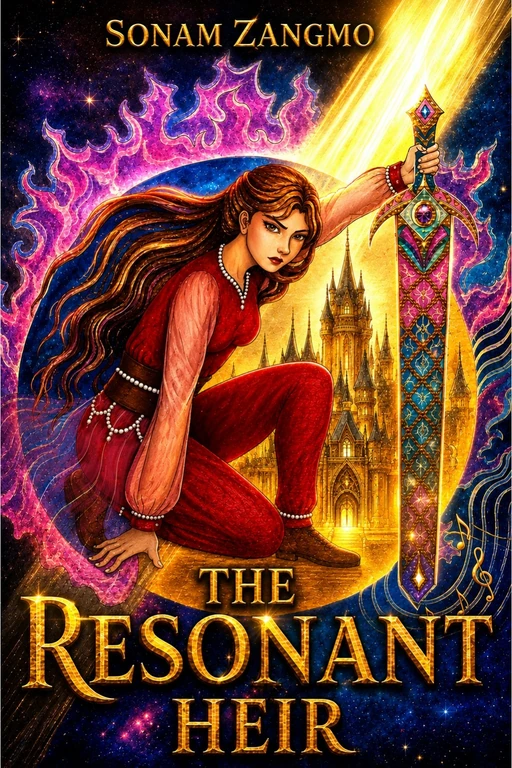
 Explore The Resonant HeirYA crossover royal fantasy · Book I Complete
The Resonant Heir · Literary Comparisons · 02
What Is The Resonant Heir Beside The Cruel Prince?
When the powerless gain power, what do they become?
A Comparative Literary Commentary
Literary comparison
The Desire to Be More Than Powerless
What happens when someone who has spent years being treated as inferior finally acquires the power to resist?
In Holly Black's The Cruel Prince, Jude Duarte is a mortal girl raised among the dangerous inhabitants of Faerie. Her humanity makes her vulnerable in a society where extraordinary abilities, long lives, and inherited status shape the balance of power.
In Sonam Zangmo's The Resonant Heir, Princess Lyra grows up apparently without magic in a royal family where magical ability is closely associated with legitimacy and worth.
Both girls know the humiliation of being judged by something they lack. Both respond with determination rather than surrender.
Yet their stories begin from opposite positions.
Jude seeks a place within a world that refuses to recognize her as an equal. Lyra already possesses a place of extraordinary privilege, but fears she lacks the qualities necessary to deserve it.
Their journeys therefore invite a comparison beyond the familiar story of an underestimated heroine.
When power has been used to humiliate us, does gaining power free us from that experience—or merely give us the opportunity to reverse it?
The question is compelling because neither protagonist is morally simple. Both possess pride and courage. Both are capable of anger and difficult choices.
And both eventually confront what happens when the balance of power begins to change.
Literary comparison
Two Outsiders, Two Different Kinds of Exclusion
Jude's story begins with a violent loss.
At seven years old, she witnesses Madoc, a faerie general, murder her parents. He then takes Jude, her twin sister Taryn, and their older sister Vivi to Faerie, where he raises them.
For Jude, Faerie becomes both the place where her former life was destroyed and the home in which she grows up.
She fears its inhabitants, yet admires them. She recognizes their cruelty, yet longs to belong among them.
Her mortality makes her vulnerable. Her position as Madoc's adopted daughter gives her proximity to privilege without granting her the abilities or acceptance that others take for granted.
Jude trains in swordsmanship and aspires to become a knight, hoping that achievement will secure her place in the High Court.
But Holly Black complicates the meaning of her apparent weakness.
Unlike the faeries around her, Jude can tell outright lies. The fae may deceive through carefully chosen truths, but Jude possesses a different freedom.
Prince Dain recognizes its usefulness when he recruits her as a spy.
The very nature that makes Jude seem inferior in one context becomes an advantage in another.
Lyra's exclusion begins from the opposite direction.
She is already the lawful heir to a kingdom. Her ancestry and position are established before she has done anything to earn them.
But she appears to possess no magic.
In a royal culture where magical ability signals worthiness, that absence becomes a source of public doubt and private shame.
In Chapter One, The Forbidden Garden, Lyra's insecurity appears beneath her outward confidence.
After other princes humiliate her, she picks up a stone and throws it at one of them.
Her justification is revealing:
I'm the heir. I set the rules.
Lyra can invoke an authority that Jude does not possess. Yet doing so cannot protect her from feeling powerless.
Instead, her declaration suggests that she has begun confusing inherited status with the right to act upon her wounded pride.
The distinction between the girls matters.
Jude lacks recognized authority and struggles to acquire it.
Lyra possesses recognized authority but has not yet learned what should govern its use.
One is fighting to enter a hierarchy.
The other must learn to question the assumptions of a hierarchy that already favors her.
Literary comparison
Learning the Methods of Power
In The Cruel Prince, Jude's desire for strength emerges from an environment in which danger is ordinary.
The powerful can threaten, enchant, humiliate, and injure her. Her fear is not imaginary.
She therefore seeks more than the ability to endure mistreatment. She wants the means to prevent others from harming her without consequence.
As she enters the politics of the High Court, she discovers forms of power that do not depend upon physical superiority.
Information can become a weapon. A secret can create leverage. An apparently harmless person can influence events that stronger opponents fail to anticipate.
Yet the opportunities offered to Jude also carry dangers.
Prince Dain recruits her into his service and grants her protection against the enchantments of other faeries. But he deliberately retains the ability to enchant her himself.
The protection that makes Jude less vulnerable to others also leaves her vulnerable to the person who provided it.
Later, Dain demonstrates that control by placing Jude under an enchantment. He then releases her and demands that she stab her own hand as proof of loyalty.
Jude complies.
The scene is disturbing precisely because Dain does not need to compel her through magic at the decisive moment. He has placed her in a position where she feels compelled to prove her devotion willingly.
Jude also gradually exposes herself to poisons in an effort to develop resistance.
These choices reveal her extraordinary determination, but also the demands placed upon someone desperate to become indispensable.
The world that offers her a path toward influence teaches her to accept suffering as part of the price.
Her twin sister Taryn responds to the same environment differently.
Rather than pursuing knighthood or a position among the court's spies, Taryn hopes to secure her place through love and marriage.
Her choices lead her to conceal her relationship with Locke, even as his involvement with Jude threatens the bond between the sisters.
The contrast matters.
Jude and Taryn are not simply strong and weak versions of the same person. They are young women adapting differently to a society in which neither possesses the advantages of its dominant inhabitants.
Jude's methods gradually become more dangerous.
She kills Valerian while defending herself against his attack. She also becomes involved in deadly work as a spy.
Those circumstances should not be treated as morally identical. Self-defense against an immediate threat differs from participation in political violence.
Yet together they reveal how profoundly the court is changing her understanding of what survival may require.
Her growing ruthlessness does not erase her compassion.
Jude also attempts to rescue Sophie, a mortal servant held under faerie enchantment. She helps Sophie escape Hollow Hall, but the rescue ends tragically when Sophie takes her own life.
The episode reveals both Jude's willingness to help someone vulnerable and the terrible limits of what her good intentions can accomplish.
The Resonant Heir explores the desire for strength through a different progression.
In Chapter Two, The Umbral Tower, the Vael'Kharoth Stone appeals directly to Lyra's insecurity. It promises power, recognition, and an end to the humiliation she has endured.
But its promises grow darker, urging her toward domination rather than simple acceptance.
Lyra recoils from what the Stone ultimately demands, even as she is drawn into its influence.
Much later, in Chapter Thirty-Two, The Three Poisoned Cups, an old woman offers another temptation.
She claims that three enchanted drinks can grant immortality, knowledge of any mind, or strength without end.
Lyra refuses.
Her refusal does not mean she has stopped wanting power. She still wants to overcome the disadvantage that has shaped her life.
But she recognizes the danger concealed within an offer that promises too much while demanding her trust.
When the woman presses her, Lyra answers:
Every ambition has its price. You're welcome to it.
The two stories thus reveal different responses to vulnerability.
Jude learns how to use the mechanisms of a dangerous society to protect herself and those she loves.
Lyra gradually learns to question whether obtaining more power is always worth the conditions attached to it.
Neither response can be judged without considering the circumstances.
Jude cannot simply withdraw from the political dangers surrounding her. Lyra cannot fulfill her obligations by rejecting every form of strength.
Both must determine which compromises they are willing to make.
Literary comparison
The Family That Shaped Us
The relationship between Jude and Madoc is among the most morally complicated elements of The Cruel Prince.
Madoc murders Jude's parents.
Yet he also raises her, provides for her, and teaches her much of what she knows about combat and strategy.
His affection for the children in his care does not erase his violence.
Nor does fulfilling certain parental responsibilities give him an unquestionable right to their loyalty.
Jude must live with both realities.
The man responsible for destroying her childhood is also someone who has shaped her identity and helped prepare her for survival.
This becomes especially troubling as Jude begins using the skills he taught her to resist his ambitions.
She is not simply trying to defeat Madoc.
She is confronting the influence of someone whose methods she understands because she has learned from him.
A related contradiction appears in The Resonant Heir through Orlas and Syveris.
Syveris pursues power through manipulation and cruelty. His son Orlas eventually recognizes those wrongs, but recognition does not remove his love for his father.
When Syveris dies, Orlas grieves.
The novel expresses the contradiction in a single sentence:
But truth did not make grief obedient.
Madoc and Syveris are not interchangeable characters, just as Jude and Orlas respond differently to the men who raised them.
But both stories recognize something that moral judgment alone cannot resolve.
A person can commit terrible acts and still be loved.
Someone can reject those acts without becoming emotionally free of the person who committed them.
And the children of powerful, violent people may inherit habits and expectations they never consciously chose.
For Lyra, this question extends beyond her own parents.
In Chapter Four, The Voice Beneath, Ravok accuses her grandfather, King Aethrador, of betrayal.
Lyra cannot immediately determine how much of Ravok's account is true. But the accusation forces her to consider whether the celebrated history of her family conceals wrongdoing.
Her inherited position makes this possibility particularly difficult.
If Aethrador's legacy contains injustice, she must decide whether honoring her ancestry requires defending that injustice.
The two novels approach family inheritance from different directions.
Jude must decide what parts of Madoc's influence she will carry forward.
Lyra must decide what responsibilities follow from a royal history she did not personally create.
Both questions ask whether the people who shaped us must also determine who we become.
Literary comparison
The Price of Winning
The struggle over the throne in The Cruel Prince brings Jude's conflicting motives into sharper focus.
Following a violent upheaval at the royal court, she discovers that her younger brother Oak has a legitimate claim to the crown.
But placing a child on the throne would expose him to the ambitions of those who want to rule through him, including Madoc.
Jude wants to protect Oak while preventing a dangerous seizure of power.
She forms an alliance with Cardan, who believes he is helping her arrange Oak's coronation.
Cardan swears to serve Jude for one year and one day.
At the decisive moment, however, Jude reveals that she has concealed her true plan.
She orchestrates Cardan's coronation instead of Oak's.
Cardan becomes High King.
Bound by his oath, he cannot simply refuse Jude's commands during the agreed period.
Jude has achieved an extraordinary reversal.
A mortal girl once subjected to the whims of powerful faeries now exercises control over the person occupying the highest position in their court.
Her plan also serves an understandable purpose. Oak can leave Faerie and grow older without immediately becoming an instrument of competing political ambitions.
Yet the means of achieving that protection are morally complicated.
Jude deceives Cardan and uses his oath to impose a role he did not agree to assume.
This does not make her original fears unreasonable, nor does it make her concern for Oak insincere.
It does, however, raise a difficult question.
Does the need to protect someone justify taking away another person's freedom to choose?
In The Resonant Heir, Chapter Twenty-Five, The Trial of Igsvar, presents a different kind of troubling victory.
Lyra must strike a High Lord with an arrow while soldiers stand between them.
She chooses to wound one soldier in the leg rather than shoot through his body to reach the target.
Her decision limits the harm.
But it does not eliminate it.
Lyra passes the trial and knows she has avoided killing the man. Still, she cannot ignore the suffering she has caused.
The narration concludes:
There was no clean win.
The situations are not morally equivalent.
Jude makes a political decision involving deception, protection, and coercion.
Lyra confronts the immediate physical consequences of a dangerous test.
But both scenes challenge the assumption that achieving an understandable objective removes responsibility for the methods used.
A victory can be justified in one respect and troubling in another.
That possibility gives both heroines a more complicated moral landscape than a simple division between good intentions and evil actions.
Literary comparison
Two Crowns, Two Unfinished Futures
By the end of The Cruel Prince, Jude has survived a society that repeatedly reminded her of her inferiority.
She has learned to navigate its customs, use its secrets, and challenge people with far greater inherited advantages.
Yet she does not become High Queen.
Her influence depends upon Cardan's temporary oath of obedience.
She controls a king, but she cannot be certain what will happen when that control ends.
The political victory is real.
Its stability is not guaranteed.
Lyra reaches a different ending.
Near the conclusion of The Resonant Heir: Book I, she discovers that her apparent lack of magic was never natural.
At the Awakening Spring, she learns that the source of her power has been obstructed by seals imposed upon her before birth.
As the spring purifies her, she recalls Syveris's involvement in the attack that caused her condition.
The spring does not grant her a power she never possessed.
It removes what did not belong, allowing her soul to return to the strength with which she was born.
This distinction transforms the meaning of her journey.
For most of her life, Lyra believed something essential was missing from her.
Now she discovers that someone deliberately prevented her from accessing it.
Jude, by contrast, remains mortal at the end of The Cruel Prince. Her new influence comes from political skill, alliances, secrets, and a binding oath rather than the recovery of an innate magical ability.
But the significance of Lyra's restoration is not simply that she can finally use magic.
By the time the seals are removed, she has already faced choices that required courage, restraint, and responsibility.
This creates an important question:
Was Lyra worthy of becoming Queen only after recovering her magic, or had the choices she made without it already begun establishing what kind of ruler she could be?
The novel's conclusion gives the question practical consequences.
Lyra defeats Syveris and reclaims the throne.
Yet her first decisions as Queen do not center upon celebrating her restored strength.
She orders care for the wounded, regardless of allegiance. She refuses to condemn families solely because of their bloodlines. She begins reviewing prisons, sealed chambers, and old judgments.
Her instructions contain a concise principle:
Names first. Judgment after.
The words stand in sharp contrast to her childhood declaration:
I'm the heir. I set the rules.
Earlier, Lyra used her inherited position to justify acting upon her anger.
Now she begins treating authority as an obligation to examine each case before passing judgment.
This does not establish that she will always rule wisely. Her mistakes remain part of her history, and her restored power cannot immediately repair every wrong.
Near the end of Book I, she is confronted with a promise that her new authority still cannot fulfill.
Her crown has not eliminated the kingdom's moral debts.
It has made her responsible for facing them.
The contrast between the two endings is revealing.
Jude becomes the power behind a throne she does not occupy.
Lyra takes the throne itself, but discovers that possessing it cannot settle every obligation.
For Jude, the immediate challenge is holding power in a world where powerful people have repeatedly threatened her.
For Lyra, the challenge becomes exercising power without repeating the injustices attached to her inheritance.
Neither ending should be treated as proof that one heroine is morally superior to the other.
Their stories arrive at different stages of the struggle between vulnerability and authority.
Literary comparison
Two Different Reading Experiences
The thematic connections between these works do not mean they offer identical reading experiences.
Holly Black builds The Cruel Prince around a dangerous Faerie court, political intrigue, conflicting family loyalties, betrayal, and the tense relationship between Jude and Cardan.
Its suspense frequently depends upon what characters conceal, what they believe about one another, and how quickly alliances can change.
The Resonant Heir follows a broader journey through magical communities, unfamiliar kingdoms, ancient grievances, personal trials, and shifting loyalties.
Its central movement concerns Lyra's changing understanding of herself, her companions, her ancestry, and the responsibilities of the throne.
The balance of romance also differs.
Jude and Cardan's relationship plays an important role in The Cruel Prince, although the novel should not be reduced to a romance.
In The Resonant Heir: Book I, friendship, family, adventure, and political responsibility are more central to the narrative.
Readers who enjoy one work should not automatically expect the same pacing, atmosphere, or character dynamics from the other.
But meaningful comparisons do not require identical stories.
Sometimes, their differences reveal why the same human question can lead to different kinds of fantasy.
Literary comparison
When the Powerless Gain Power
There is something deeply understandable about wanting to become strong enough that others can no longer hurt us.
That desire may begin in fear, grief, humiliation, or injustice.
It can inspire determination.
It can also make control seem more desirable than compassion.
Jude Duarte and Princess Lyra both resist the judgment that they are inadequate.
But neither story suggests that the desire to prove others wrong is a sufficient guide to using power.
Jude's choices reveal how survival can become entangled with manipulation and how protecting someone may require decisions that constrain others.
Lyra's journey reveals how the hunger for recognition can change into a recognition of responsibility—and how recovering stolen strength does not erase the consequences of earlier choices.
Their circumstances are different, but both stories leave us with a question worth considering:
When we finally possess the power to decide another person's fate, will we remember what it felt like to have so little control over our own?
The Cruel Prince examines this question within a dangerous court, where weakness can invite exploitation and strength often depends upon strategy.
The Resonant Heir follows it toward the responsibilities of a recovered crown and the injustices that remain after victory.
Neither offers a simple formula for moral perfection.
Power can protect.
It can liberate.
It can also become another instrument of fear.
Perhaps the distinction that matters most is not between those who possess power and those who lack it.
It is between believing that power justifies our decisions and recognizing that power makes the consequences of those decisions more far-reaching.
Gaining power may end one kind of helplessness. It does not, by itself, tell us what kind of person we will become.
Sources
Sources and Scope
This commentary compares The Cruel Prince (2018), the first novel of Holly Black's The Folk of the Air trilogy, with The Resonant Heir: Book I by Sonam Zangmo.
The discussion of The Cruel Prince draws upon Holly Black's official book page, the publisher's book club discussion guide, the published opening excerpt, and supporting plot analyses from SuperSummary and LitCharts.
The comparison with The Resonant Heir is grounded in its complete Book I manuscript.
The philosophical interpretations offered here are critical readings, not statements of either author's personal intentions.