
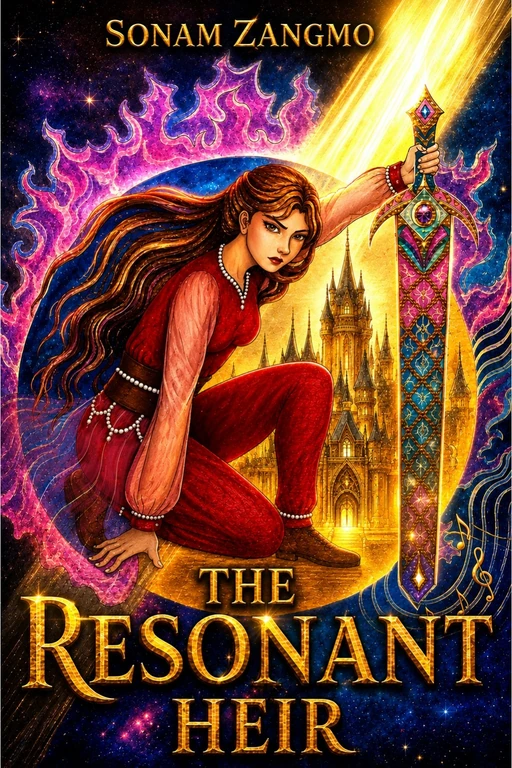
 Explore The Resonant HeirYA crossover royal fantasy · Book I Complete
The Resonant Heir · Literary Comparisons · 01
What Is The Resonant Heir Beside The Lord of the Rings?
On temptation, inner conflict, resilience, fellowship, and the moral weight of victory.
A Comparative Literary Commentary
The comparison
A Question Worth Asking
What is The Resonant Heir beside The Lord of the Rings?
J. R. R. Tolkien's The Lord of the Rings stands among the most influential works in fantasy literature. Its legacy has been shaped by generations of readers, writers, and scholars.
Sonam Zangmo's The Resonant Heir is a contemporary fantasy novel, with neither that history nor any claim to comparable literary achievement.
So why place these two works side by side?
Not to measure their greatness, but to explore the questions they raise about human nature.
What makes good people vulnerable to temptation? Can loyalty become an obstacle to truth? What does courage mean when strength reaches its limit? And what remains of a victory when its consequences cannot be undone?
These questions run through Tolkien's epic. They also emerge, through different characters and circumstances, across the fifty-five chapters of The Resonant Heir: Book I.
Perhaps the deepest struggle in an epic is not simply defeating an enemy, but deciding what one is willing to become in order to win.
Temptation
The Many Faces of Temptation
In The Lord of the Rings, Boromir desires the One Ring because he believes its power could save Gondor.
His love for his people is genuine, as is his courage. Yet his conviction that the Ring could serve a noble purpose leads him to attempt to seize it from Frodo.
Boromir's story does not end there. He recognizes his wrongdoing and dies defending Merry and Pippin, acknowledging his failure before Aragorn.
Tolkien presents a man whose admirable intentions leave him vulnerable to corruption, but who remains capable of repentance.
In The Resonant Heir, temptation first enters Princess Lyra's life through a different vulnerability.
Born without magic in a royal family where magical ability carries enormous significance, Lyra fears that she may never be considered worthy of the throne she is destined to inherit.
In Chapter Two, The Umbral Tower, the mysterious Vael’Kharoth Stone exploits this insecurity.
It does not begin by demanding cruelty. Instead, it offers recognition, reassurance, and the promise of power.
Lyra wants to prove that she matters. The Stone turns that understandable desire toward something far more dangerous.
The situation becomes more complicated through Orlas, the friend who brings her to the forbidden tower.
Orlas knows that his father's instructions are wrong, yet he complies. His affection for Lyra and his fear of disappointing his father become entangled until he helps lead someone he cares about toward danger.
Boromir and Orlas face very different circumstances. Yet both reveal how people may cross moral boundaries while believing that their intentions are reasonable.
The same theme returns later in Lyra's journey.
In Chapter Thirty-Two, The Three Poisoned Cups, an old woman claims that three enchanted drinks can grant immortality, knowledge of any mind, or strength without end.
She offers them to Lyra, knowing the princess has spent much of her life being judged for her lack of magic.
The temptation carries a practical cost. Refusing the drinks may mean losing a fragment of the map to the Awakening Spring, something Lyra has struggled to obtain.
Yet Lyra recognizes the danger hidden within the offer and chooses to leave.
This decision recalls Galadriel's refusal of the One Ring, though their circumstances and the nature of the offered powers differ.
Galadriel recognizes that accepting the Ring would expose her to its corrupting power. She refuses it, accepting the eventual fading of her own power in Middle-earth.
Lyra, too, refuses an offer that appears capable of fulfilling her desires.
The contrast between her encounter with Vael’Kharoth and her later refusal of the cups reveals a significant change.
Her longing for recognition has not disappeared.
What has changed is her willingness to let that longing govern her choices.
Loyalty & conscience
When Loyalty Challenges the Truth
Not every temptation promises power.
Sometimes, the temptation is to keep believing what makes us feel safe.
In Chapter Four, The Voice Beneath, Lyra discovers that Ravok, the imprisoned creature she wounded during the Royal Proving, possesses a history that contradicts what she has been taught.
Ravok accuses her grandfather, King Aethrador, of betrayal.
For Lyra, the accusation threatens more than her understanding of a historical event.
Aethrador is the celebrated founder of her kingdom. His achievements form part of her family's identity and the history she has been raised to honor.
To question him is to question the foundations of her own inheritance.
Lyra cannot immediately establish whether Ravok's account is entirely truthful. But she also cannot dismiss the possibility that the history she trusts may be incomplete.
Here, the novel explores a difficult distinction: curiosity is not necessarily the same as the courage to reconsider one's beliefs.
Tolkien also portrays a world in which the choices of earlier generations continue to burden those who follow. Isildur's decision to keep the One Ring rather than destroy it becomes part of a danger inherited by a distant age.
Neither story treats the past as something safely concluded.
Their emphasis, however, differs.
Tolkien shows how ancient failures continue to shape the struggle against evil. The Resonant Heir places that burden upon a young heir who must decide whether honoring her ancestors requires defending their actions.
The question is not whether family loyalty has value.
It is whether loyalty should prevent someone from recognizing wrongdoing.
Can we honor those who came before us without preserving their mistakes?
For Lyra, the answer eventually becomes inseparable from the kind of ruler she chooses to become.
Resilience
The Limits of Heroism
One of Tolkien's most compelling achievements is his treatment of Frodo's endurance.
Frodo carries the Ring through fear, exhaustion, and prolonged suffering. Yet at Mount Doom, when he finally reaches the place where it must be destroyed, he claims it for himself.
He cannot voluntarily complete the final act.
But Tolkien does not present this moment as a simple moral failure.
In his September 1963 letter to Eileen Elgar, Tolkien explains that Frodo has reached the limits of what anyone could reasonably endure under the Ring's overwhelming pressure.
Frodo has given everything within his strength.
The Ring is ultimately destroyed when Gollum attacks him, bites off his finger, and regains it. Rejoicing in his possession, Gollum loses his footing near the edge of the Crack of Doom and falls into the fire.
Gollum does not intend to save the world.
Yet his presence at that moment is partly the consequence of mercy shown to him by Bilbo and Frodo.
In Tolkien's understanding, mercy and Providence are essential to the outcome. The quest succeeds not because its hero possesses unlimited strength, but through a convergence of endurance, compassion, and events beyond his control.
The Resonant Heir approaches the limits of heroism through different moral difficulties.
In Chapter Twenty-Five, The Trial of Igsvar, Lyra must strike a High Lord with a single arrow while blindfolded.
A line of soldiers stands between them.
She could attempt to shoot through a soldier to reach her target. Instead, she deliberately wounds one man's leg, creating an opening without killing him.
Lyra passes the trial, but she cannot ignore the suffering she has caused.
The narration gives her victory a troubling qualification:
There was no clean win.
Lyra has chosen the less harmful course available to her, yet someone innocent has still been injured.
Her achievement does not erase that fact.
This is not the same moral situation Frodo faces at Mount Doom. Frodo reaches the limit of his capacity to resist an overwhelming evil. Lyra makes a deliberate choice between harmful possibilities.
But both situations challenge the assumption that a heroic outcome must be free from human limitation or suffering.
Later, in Chapter Fifty, The Amber Road, Lyra confronts another kind of weakness.
She faces manifestations of her fears and attachments, including an image of her mother accusing her of running away rather than confronting her pain.
Lyra does not respond by declaring herself entirely fearless or innocent.
She admits:
Part of me is running. But not all of me.
Her answer matters because she does not need to deny her weakness in order to continue.
She recognizes that her motives are mixed. She wants justice, but she also wants relief from grief and fear.
Those desires can exist together.
Courage does not always mean overcoming every weakness. Sometimes, it means recognizing weakness without allowing it to make every decision.
Tolkien's treatment of Frodo emphasizes the limits of endurance and the necessity of mercy. Lyra's struggle places greater emphasis on self-recognition and moral choice.
The experiences are distinct, but both challenge the idea that heroism requires perfection.
Fellowship
Fellowship Beyond Agreement
The Fellowship in Tolkien's novel is not a company of people who always agree.
Its members carry different histories, loyalties, fears, and responsibilities.
Boromir's attempt to seize the Ring deepens the crisis within the company. Frodo decides to continue toward Mordor apart from the others, though Sam insists on accompanying him.
Amid the subsequent Orc attack, Merry and Pippin are captured. Aragorn, Legolas, and Gimli choose to pursue their captors.
The Fellowship separates, but its shared purpose and personal loyalties continue to shape the members' actions.
Sam's devotion is particularly important. His friendship becomes a practical source of strength when Frodo can scarcely continue.
Yet Tolkien does not make the quest dependent upon the perfection of either character.
Its outcome is shaped by many actions, including acts of mercy whose full importance only becomes clear much later.
In The Resonant Heir, Lyra's journey also depends upon people whose contributions cannot be reduced to supporting a future queen.
Sion brings her own abilities, courage, and vulnerabilities. Their friendship involves mutual dependence rather than one person constantly rescuing the other.
Bramor gives Lyra a weapon she could never have made herself, but that gift is inseparable from sacrifice and the painful legacy of an earlier war.
Haris's changing relationship with Lyra demonstrates that childhood hostility does not have to determine a lifelong allegiance.
Orlas presents a more difficult form of loyalty. His growing recognition of his father's wrongdoing does not erase his love for him.
These relationships help shape Lyra long before her final confrontation with Syveris.
When that confrontation comes, her own skill is insufficient. Her mother's music and the power of Sonareth, the fae homeland of her mother's family, create the opportunity she needs.
The victory is made possible by relationships, knowledge, and sacrifices accumulated throughout the journey.
Yet the novel does not suggest that unity removes disagreement or pain.
People may share a purpose while holding different convictions. They may love one another while being unable to approve of one another's decisions.
And sometimes, helping one person achieve justice means witnessing another person's grief.
Unity is not the absence of disagreement. It is the willingness to remain responsible toward others despite it.
This gives fellowship a meaning beyond companionship or military cooperation.
It becomes a question of how people preserve their bonds when circumstances place those bonds under strain.
The cost of victory
The Victory That Cannot Heal Everything
Perhaps the most revealing comparison between these works appears after their decisive battles.
In The Lord of the Rings, Sauron is defeated and Aragorn becomes king.
His rightful rule is associated with more than military victory. Before his coronation, Aragorn enters the Houses of Healing, where he tends to Faramir, Éowyn, Merry, and others who have suffered during the war.
His ability to heal helps reveal the character of the ruler he is destined to become.
Yet Sauron's defeat does not restore peace everywhere.
When the Hobbits return to the Shire, they discover that their homeland has suffered under Saruman's influence.
In The Scouring of the Shire, they must confront the destruction and oppression that have reached the place they set out to protect.
Even after the Shire is liberated, Frodo cannot recover his former life.
His wounds endure. The home he helped save cannot fully heal him.
Eventually, he departs across the Sea in search of healing.
Tolkien allows victory and sorrow to coexist.
The Resonant Heir approaches its ending through a different but equally troubling question.
Lyra defeats Syveris and reclaims the throne.
For the kingdom, the victory ends a cruel regency.
For Orlas, it means the death of his father.
The novel does not attempt to erase this contradiction.
Orlas knows that his father committed terrible wrongs. He cannot honestly defend those actions.
But knowing the truth does not remove his grief.
The narration captures this distinction in a single sentence:
But truth did not make grief obedient.
Syveris was guilty.
He was also Orlas's father.
Lyra cannot ask Orlas to stop loving him, nor can she demand forgiveness simply because her actions were necessary.
Her victory has left a wound that her new authority cannot heal.
This moment gives particular meaning to Lyra's development across the novel.
In Chapter One, when she is still a child, Lyra declares:
I'm the heir. I set the rules.
Her title becomes a justification for acting according to her wounded pride.
By Chapter Fifty-Five, she has gained the crown, but her understanding of authority has changed.
Her first decisions as Queen are not celebrations of personal power.
She orders that the wounded receive treatment regardless of which side they fought for. Families are not to be condemned because of their bloodlines. Prisons, sealed chambers, and old judgments must be reviewed.
She is no longer simply demanding the recognition she once lacked.
She is beginning to recognize what the throne requires of her.
There is a meaningful connection here with Tolkien's portrayal of Aragorn, whose rightful kingship carries responsibilities of healing and restoration.
Both works suggest that defeating an unjust ruler is not sufficient to establish just rule.
But Lyra's story places special emphasis on the obligations that remain unresolved after her coronation.
Near the end of Book I, she returns to the forbidden garden where her journey began.
She has recovered her throne. She possesses the authority and recognition she once desired.
Yet she cannot fulfill a promise to someone still imprisoned beneath the garden.
The power she has gained cannot immediately correct the wrong.
Her victory has become the beginning of another responsibility.
In this sense, the contrast between Chapter Three, A Hollow Victory, and Chapter Fifty-Five, A Debt Without a Door, reveals the moral direction of her journey.
As a child, Lyra discovers that winning does not necessarily mean doing what is right.
As Queen, she must confront a harder truth: even a necessary victory may leave debts that cannot easily be repaid.
The crown does not free her from those obligations.
It makes them hers to face.
The enduring question
What Makes an Epic?
The differences between these two works remain considerable.
Tolkien's epic draws upon mythology, invented languages, ancient histories, and a distinctive moral and spiritual vision.
The Resonant Heir follows a young royal protagonist through a more direct narrative style, exploring personal identity, difficult choices, shifting loyalties, and the responsibilities of inheritance.
Their literary methods and achievements should not be treated as interchangeable.
But meaningful comparisons do not require works to occupy the same place in literary history.
They require questions worth examining.
Both stories portray temptation as something that can arise from understandable desires.
Both recognize that courage has limits and that goodness does not make a person immune to error.
Both give fellowship a role that extends beyond strength in battle.
And both question the comforting assumption that a great victory must repair everything that has been lost.
Perhaps one of the deepest questions epic fantasy can ask is this:
What is the value of defeating a powerful enemy if, in the process, we lose the very qualities that made the struggle worth undertaking?
There is no easy answer.
Justice can demand painful decisions. Loyalty can conflict with conscience. Good intentions can become dangerous. And even a necessary victory may leave suffering behind.
The weight of an epic, then, need not rest solely upon the power of its enemies or the scale of its battles.
It may also rest upon the struggle its characters endure within themselves—and their willingness to face what remains after the battle is won.
The Lord of the Rings has given generations of readers reasons to reflect upon these questions.
The Resonant Heir explores them through a different world and the journey of a young woman learning what it means to inherit, exercise, and answer for power.
Its place in literature is not something a comparison can determine.
But its questions can be examined.
And perhaps that is the most worthwhile reason to place these two stories beside one another: not to measure their greatness against the same standard, but to consider how fantasy, across different voices and generations, continues to explore the difficult business of being human.