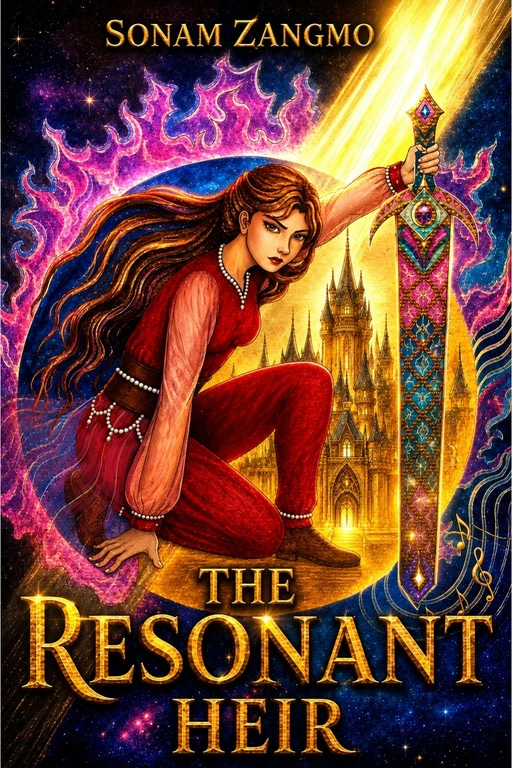
 Explore The Resonant HeirYA crossover royal fantasy · inherited magic · female heir · exile · adventure · Book I Complete
A Literary Commentary on Chapter Ten of The Resonant Heir
The Hunger Beneath Prophecy: A Philosophical Reading of The Spider-Eater in the Garden
On the burden of being chosen, the appetite for answers, and the danger of mistaking a promise shaped to one's deepest longing for the truth.
Spoiler Notice: Contains spoilers for Chapter Ten.
Explore the twelve themes in this commentary
- A Child Becomes a Question Before She Is Born
- Prophecy Does Not Abolish Responsibility
- The Heir to a Legacy—or Its Sins
- The Garden Has Not Changed. The Visitor Has.
- To Be Heard Is Not the Same as to Be Listened To
- The High Lord Who Disowns His Name
- The Spider-Eater and the Image of Appetite
- Does the Rubiad Reflect Greed?
- Turning Against the Current
- The Mark That Answers Without Explaining
- The Awakening Spring and the Power of Withheld Answers
- Conclusion: When the Desired Answer Feels True
Theme 01 · Philosophical commentary
A Child Becomes a Question Before She Is Born
Chapter Ten of Sonam Zangmo's The Resonant Heir, The Spider-Eater in the Garden, opens not with Lyra but with a man who has been thinking about her for fourteen years.
Under the Lyre constellation, Chancellor Syveris remembers visiting the Oracles of Tharion. He asked whether the child in Queen Velaria's womb was the one foretold. The central Oracle answered yes. Syveris then asked what would happen if that child died young, and what would happen if she were murdered.
The answers are terrible: the blessing would be withdrawn and plague would spread; a murder would bring shortened lives for those implicated and an ocean of blood upon the kingdom.
The scene establishes what Syveris was told, not everything he intended to do with that knowledge. It would be premature to read the questions as proof that he personally planned the child's murder, or as an explanation of who sealed Lyra's magic.
Yet the questions are chilling precisely because they treat an unborn child's fate in terms of consequences to others.
Long before Lyra could speak, someone was calculating the political and supernatural meaning of her survival.
That is the chapter's first moral unease: a person can become indispensable to a kingdom without being treated as a person whose life belongs to herself.
Theme 02 · Philosophical commentary
Prophecy Does Not Abolish Responsibility
There is a distinction worth preserving in the Oracles' language. They do not predict outright that Lyra will die or be murdered. They specify outcomes if certain events occur.
This conditional form does not settle the novel's metaphysics of fate. We do not know whether the prophecy describes fixed laws, possible futures, or something more complicated.
But it raises a recognizable question about human freedom.
When people are told that a particular life determines the welfare of a kingdom, they may begin making decisions for that person in the name of preventing disaster. Protection can turn into confinement. Reverence can become another form of possession.
The story has not identified the author of Lyra's prenatal seal. Nonetheless, the juxtaposition of the prophecy with her long history of magical absence makes the reader newly attentive to what adults may have decided before she could consent or resist.
A prophecy can give a child an extraordinary importance. It cannot establish that every action taken toward that child is morally justified.
The moral responsibility of those who hear the prediction remains their own. They cannot simply answer for their choices by pointing to a future they feared.
Theme 03 · Philosophical commentary
The Heir to a Legacy—or Its Sins
Fourteen years later, Lyra looks toward the same constellation from her balcony. Ravok has been free for nearly a month, the palace search is ending, and Voxath has mysteriously reappeared in the cabinet where Lyra did not expect to find it.
She wonders what else she has failed to understand about the palace. She still believes she had reasons to free Ravok. Then she thinks of herself as the heir mentioned in the prophecy.
Her next thought changes the meaning of inheritance: is she heir to Aethrador's legacy, or to his sins?
This question shows how far she has traveled from the child whose deepest anxiety was that her lack of magic made her unworthy of the crown.
She now understands that royal inheritance carries history as well as privilege. Aethrador may have founded a kingdom and ended a war, but allegations concerning Ravok have made his righteousness difficult to accept without examination.
The alternative Lyra formulates is painful, yet perhaps too narrow.
She may inherit institutions shaped by both achievement and wrongdoing. That does not make her personally guilty of actions committed before her birth. It does mean that a future ruler could be responsible for deciding what to preserve and what to repair.
An inheritance is not an endorsement. The question is whether Lyra can learn to distinguish what has been handed to her from what she ought to carry forward.
Theme 04 · Philosophical commentary
The Garden Has Not Changed. The Visitor Has.
When Lyra returns to the Wind-Crystal Garden, the narrative revisits the setting of her first forbidden adventure.
The invisible veil still trembles. The amethyst path remains. The narrow bend opens into the same crescent-shaped corner. Yet Lyra is alone. Obewich is not there to warn her, and she is physically taller.
The prose makes the contrast explicit: the place looks the same, but she does not.
The line is an economical measure of growth. The earlier Lyra entered the garden out of curiosity, defying a prohibition whose reasons she did not know. The older Lyra returns with questions about war, imprisonment, the scar on her wrist, and the limits of her own understanding.
The world has not become less mysterious because she has matured. The mysteries have grown more consequential.
She can also reach what she could not before. When she approaches the floating Rubiad, her hand can now touch it.
That detail gives growth a physical form. Increased ability creates new opportunities; it also makes new mistakes possible. A child once protected by the limits of her reach may become capable of disturbing something she has not yet learned to understand.
The garden is no longer merely a test of daring. It has become a test of judgment.
Theme 05 · Philosophical commentary
To Be Heard Is Not the Same as to Be Listened To
The talking tulips offer the chapter an odd and effective pause.
Many are missing. One has collapsed. The flowers complain that nobody listens to their stories and that they are dying of boredom. Their claim may be playful exaggeration; the text does not prove that a lack of attention is literally killing them.
But their complaint echoes a concern running through the novel: who is allowed to tell a story, and who receives it?
Ravok's mouth was sewn shut. Orlas struggled to speak honestly to Lyra. Syveris intercepted a private letter. Here the flowers still possess mouths, yet seem to have lost their audience.
Lyra promises to listen. The tulips offer to describe a war among the stars.
Almost immediately she redirects them toward the Great War of the Fae Clans. When they mention a trapped High Lord, she interrupts again to ask where he is.
The irony is gentle but revealing. Lyra is learning to attend to voices once dismissed as strange or inconvenient. Still, she often listens in order to obtain the answer she has already decided to seek.
There is a difference between letting someone speak and allowing their account to change the course of one's attention.
The scene suggests that Lyra's growth as a listener remains unfinished. The garden has stories of its own, not all of them arranged around her needs.
Theme 06 · Philosophical commentary
The High Lord Who Disowns His Name
The tulips describe a High Lord trapped forever beneath the Rubiad and declare that his greed brought the punishment upon him.
They offer an accusation, not a judicial record. The reader is not yet able to determine whether the imprisonment was deserved, excessive, or founded on a distorted account.
When the gaunt figure appears, his response to Lyra's question about his identity is stranger than a simple introduction: “Sarrakha. That name is no longer mine.”
The remark raises an important question about identity. Can a person step outside a former name, or do past actions continue to belong to the person who committed them?
We do not know whether Sarrakha has renounced the name, been stripped of it, or undergone some transformation. The chapter gives no basis to choose among those possibilities.
But the contrast with Lyra is striking.
Lyra is struggling with an identity she has inherited: princess, descendant of Aethrador, child of prophecy. The figure before her seems to have rejected—or lost—the identity that once named him.
One character is trying to discover what her titles oblige her to become. The other suggests that a title can cease to describe its bearer at all.
Neither is free simply because a name changes. Responsibility and desire may outlast the names through which they were once expressed.
Theme 07 · Philosophical commentary
The Spider-Eater and the Image of Appetite
The chapter's most disturbing image gives it its title.
In a dream, Lyra sees a gaunt man holding black spiders. He puts one into his mouth and chews. When she encounters him near the Rubiad, she witnesses the same act again, followed by dark green vapor and the painful collapse of the strange space around her.
The repetition links dream and waking encounter, but it does not explain the biological or magical purpose of eating the spiders.
There is no reason to assume that unfamiliar feeding habits alone establish evil in a fantasy world.
As literary imagery, however, the action makes appetite impossible to ignore.
The tulips have accused this High Lord of greed. He devours something alive while withholding the information Lyra seeks. His interest in her missing aura appears immediately after he identifies her mark.
Lyra is hungry too, though not in the same sense. She wants the truth about the seal placed upon her before birth, the power she has been told she should possess, and the role she may have been born to play.
Her desire is understandable and not inherently corrupt.
That is what gives the comparison its force. Appetite becomes dangerous not merely because someone wants something, but because wanting it can make other people easier to use.
Need is not greed. Yet a deep need can become the opening through which another person's greed enters.
Theme 08 · Philosophical commentary
Does the Rubiad Reflect Greed?
When Lyra asks about magical seals, the High Lord corrects her and says that the stone reflects greed. He then directs her attention toward another place, the Awakening Spring.
The word reflects is suggestive. A mirror does not necessarily create what it displays. It may expose something already present in the person who approaches it.
Read symbolically, the Rubiad invites an examination of what Lyra carries into the garden. Is she trying to recover a stolen possibility? To understand her own body? To become powerful enough never to be belittled again? These desires overlap but are not identical.
Wanting to reclaim what was taken from her is not proof of avarice. Nor does her longing automatically make her immune to the effects of power.
The crucial limit is that the explanation comes from the imprisoned stranger. He may possess genuine knowledge. He may be manipulating her. The chapter has not independently verified his account of the gemstone.
The reader therefore encounters two uncertainties at once: what the Rubiad actually does and what Lyra's desire means.
The stone is an apt object for this encounter because Lyra is not only asking what lies hidden in the garden. She is being drawn toward an answer about herself—and answers about ourselves are among the easiest to want too badly.
Theme 09 · Philosophical commentary
Turning Against the Current
The physical action at the fountain is carefully paced. Lyra's scar pulses. Its spiral turns clockwise, aligning with the spinning Rubiad. She reaches toward the jewel, unsure what she should do.
A single word intervenes: “Stop.”
The narrative does not identify whether this is her own thought, a warning from elsewhere, or something different. Assigning a speaker would resolve an uncertainty the scene deliberately maintains.
Lyra turns the Rubiad counterclockwise anyway.
Water freezes in the air. Lightning shoots through her palm and chest. A deep heartbeat rises from the earth, and the gaunt High Lord appears as if crossing from another layer of space.
There is a temptation to read the reversal as literal time travel, but the chapter does not establish that the jewel controls time.
The gesture is more securely read as an image of resistance to an established movement.
Lyra enters a world full of arrangements made before her birth: inherited authority, a prophecy, a seal, old imprisonment, and stories whose beginnings she never witnessed. Here, for once, she reaches into an existing mechanism and reverses its motion.
But disruption is not understanding.
As with her use of Voxath to release Ravok, Lyra acts without knowing every consequence. Her courage has increased. So has her capacity to trigger events for which courage alone may not prepare her.
Theme 10 · Philosophical commentary
The Mark That Answers Without Explaining
Vael'Kharoth remains a source of uncertainty throughout the chapter.
The mark on Lyra's wrist darkens after her dream, twists into spirals near the Rubiad, and reacts painfully during the encounter. The High Lord recognizes it and claims to have seen the mark on another person whose face he does not remember—or does not care to recall.
These details suggest a connection among the scar, the strange space, and knowledge older than Lyra's present understanding.
They do not yet establish what that connection is.
The High Lord warns that not everyone is strong enough to resist the mark. That may be an important warning, but its meaning remains elusive. We do not know whether he is describing the mark's power, its danger, or an encounter with it in the past.
A pattern emerges: Lyra's body responds before her knowledge catches up.
The scar pulses and hurts. Her surroundings change. The experience feels real and leaves her with questions she cannot settle.
There is a particular vulnerability in possessing a power that seems to know something about one's life while refusing to explain itself.
Power without understanding may offer new possibilities. It may also leave its bearer dependent on whoever claims to know what the power means.
This is why the High Lord's recognition is so compelling to Lyra: for a moment, someone appears able to name the mystery she carries in her own skin.
Theme 11 · Philosophical commentary
The Awakening Spring and the Power of Withheld Answers
The stranger offers Lyra a destination: the Awakening Spring, where, he says, magical seals can be broken.
The assertion should not be confused with a verified rule of the world. Velaria earlier suggested that the seal had been damaged at the Umbral Tower. A damaged seal and a fully broken one need not be the same condition, but neither conversation settles how Lyra's magic can actually be restored.
What matters here is the structure of the stranger's offer.
He names what Lyra lacks. He recognizes that she has no aura. Then he tells her that someone like her must be desperate to learn more.
The observation touches a wound that has shaped her childhood. She nearly refuses to answer him, but clenches her fist and asks where the spring is.
He refuses to tell her immediately.
“Why should I tell you?”
That question rearranges their relationship. He possesses—or claims to possess—knowledge that could change her life. She is now placed in the position of needing something from him.
The scene recalls the importance of information in the Chancellor's political maneuvering. One person need not force another into obedience when control over a coveted answer can make the other person move voluntarily.
We cannot yet say that the stranger has devised a complete trap. His purpose is hidden. But he has already found a way to make Lyra's deepest longing useful to him.
The promise of freedom can become a form of dependence when another person controls every step toward it.
Theme 12 · Philosophical commentary
Conclusion: When the Desired Answer Feels True
The encounter ends violently and abruptly. Green vapor leaves the stranger's mouth, pain grips Lyra's wrist, the spirals turn, and the distorted space snaps shut. Water falls into motion again. The High Lord is gone.
Lyra is left with one phrase: the Awakening Spring.
Her final questions are not about whether the man existed. She has seen him, recognized his appearance from the dream, and felt the reaction of the mark on her body.
The unresolved question is whether his explanation deserves her trust.
If he is lying, she wonders, why does it feel true?
That is where this chapter becomes more than a piece of fantasy mystery. It examines a familiar danger in the search for knowledge: the tendency to confuse the emotional force of an answer with the evidence that makes it reliable.
Lyra has good reason to desire the restoration of her magic. She may also have good reason to investigate the spring. Neither gives her reason to accept an unknown speaker's claims without further inquiry.
The dream's apparent correspondence with reality does not verify everything the stranger says. Knowing the name of her scar does not prove he knows what is best for her. Recognizing a need does not make him a trustworthy guide.
The novel's title has always linked Lyra's inheritance to resonance, an ability that requires attention rather than force. Here the more difficult form of attention may be directed inward: can she hear how much she wants an answer without allowing that wanting to decide whether it is true?
To be chosen by prophecy is not the same as being free to choose. And to be offered a path toward power is not the same as being offered freedom.
In the first chapter, Lyra crossed into the forbidden garden because she wanted to know what lay beyond a boundary. In the tenth, she returns with knowledge, courage, and questions born of genuine suffering.
She reaches farther than she once could. Yet she is also more exposed to anyone who understands precisely what she hopes to find.
Lyra has spent years believing that power would make her worthy of her inheritance. Now she must confront a more difficult possibility: that the longing to become powerful may itself place her future in someone else's hands.
The question is no longer simply whether she can break the seal. It is whether she can recognize the difference between a path to freedom and a promise designed to exploit her desire for it.