
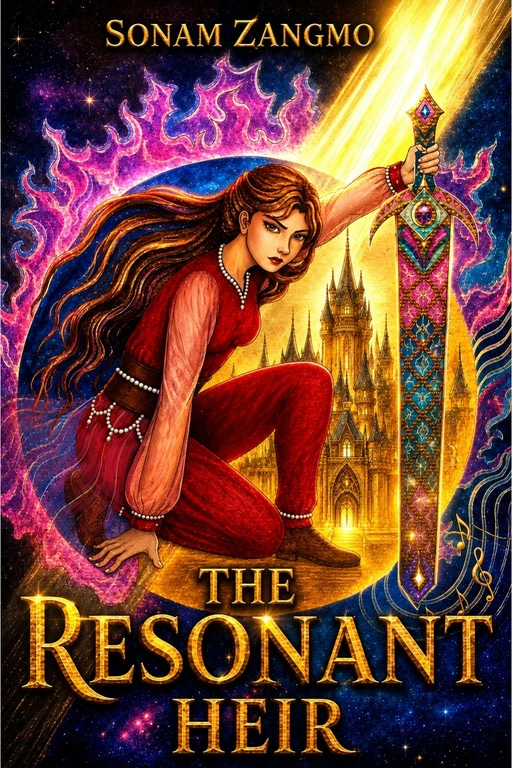
 Explore The Resonant HeirYA crossover royal fantasy · inherited magic · female heir · exile · adventure · Book I Complete
A Literary Commentary on Chapter Eleven of The Resonant Heir
The Price of Protection: A Philosophical Reading of The Hidden Covenant
On survival bargains, the cost of preserving a dynasty's memory, and what justice may owe to those still living under inherited obligations.
Spoiler Notice: Contains spoilers for Chapter Eleven.
Explore the twelve themes in this commentary
- When Protection Comes With a Price
- The Library's Missing Page
- A Bargain Made When There Is No Other Road
- Whose Souls Preserve Whose History?
- Five Faces, No Audible Testimony
- The Heir's Most Dangerous Question
- Equal Tribute, Unequal Hunger
- A Father's Law Is Not Its Own Defense
- A Community Can Occupy More Than One Moral Position
- The Chancellor's Conditional Mercy
- Three Incomplete Ways of Knowing
- Conclusion: What Would Be Gained, and What Lost?
Theme 01 · Philosophical commentary
When Protection Comes With a Price
A covenant sounds more honorable than a bargain. It suggests solemnity, trust, and obligations freely undertaken. Chapter Eleven of Sonam Zangmo's The Resonant Heir, The Hidden Covenant, asks what happens when such an agreement is made at the edge of extinction.
Lyra discovers that the Aulith clan once sought King Aethrador's protection. In return, the clan's High Lord and Elders were to sacrifice portions of their souls into a vessel meant to preserve the dynasty's memory. In the present, Aulith's High Lady challenges a tribute law that leaves her people struggling to eat. Behind closed doors, Chancellor Syveris raises the prospect of dissolving the old covenant—but only in connection with an agreement whose terms the reader cannot hear.
The chapter does not establish that the tribute law is itself a clause of the Soul Covenant, or that a single plan accounts for every hardship Aulith has suffered. Its force comes from a more careful juxtaposition.
Across different generations, representatives of the same people face powerful figures who can grant something urgently needed: survival, relief, perhaps release from an ancient bond.
That recurring imbalance gives the chapter its moral weight.
Protection may save a life without making every condition attached to it just. And gratitude for a rescue does not necessarily establish an unlimited debt for those born long after it.
Theme 02 · Philosophical commentary
The Library's Missing Page
The discovery begins with comedy. Lyra stretches from the highest rung of a rolling ladder for a heavy book and drops it on Obewich's head. She apologizes; he nurses a swelling forehead; her attention returns almost immediately to the volume.
The scene preserves Lyra's familiar mixture of curiosity, impulsiveness, and imperfect consideration. It also prepares a quieter image of how knowledge is obtained: a child straining to reach something stored high above her.
The book is History of the Tharion Dynasty. Lyra is looking for the Awakening Spring mentioned in the previous chapter, but she finds an account of the Binding Soul Covenant instead.
Then she reaches an absence.
The next page has been cut out with precision. Someone has removed it deliberately.
A library can contain thousands of books while still withholding the answer that matters most. Its authority comes partly from the assumption that what has been preserved is a faithful record. The clean edge of the missing page disturbs that assumption.
The reader cannot know who made the cut, when, or what the lost page said. The omission is evidence of intervention, not yet evidence of a particular crime.
Nevertheless, the absence has political meaning. A dynasty's history is not simply whatever happened. It is also what later generations have been allowed to read about what happened.
Lyra's task is no longer merely to find the right volume. It is to learn how to read a record that bears the marks of someone's decision to remove part of it.
Theme 03 · Philosophical commentary
A Bargain Made When There Is No Other Road
The Memory Orb shows an Aulith Elder kneeling before Aethrador on a battlefield littered with bodies and broken weapons.
His plea is devastatingly simple: his people need protection from extinction. “We have no path left.”
Those words matter more than the ceremony surrounding them.
The written account describes an exchange: Aethrador would provide protection, and Aulith's leaders would surrender portions of their souls. On paper it may resemble an agreement between parties with interests to negotiate.
But the Elder's desperation makes the idea of free consent difficult.
Consent is not meaningless merely because someone makes a choice in terrible circumstances. The leaders may have believed that sacrifice was preferable to the annihilation of their people. Their decision could have been both sincere and courageous.
Yet a choice made without a viable alternative is not equivalent to a choice made from security. When one party possesses the means of survival and the other fears extinction, the first holds an extraordinary advantage in setting the terms.
The scene does not disclose whether Aethrador demanded the covenant, why the vessel required souls, or whether other arrangements were possible. Those questions are essential before assigning complete blame.
Still, it invites an ethical distinction that the language of contracts can sometimes obscure.
An agreement can preserve lives and remain open to criticism because of the circumstances in which its terms were accepted.
A rescue should not become a means of claiming permanent moral ownership over those who were rescued.
Theme 04 · Philosophical commentary
Whose Souls Preserve Whose History?
The covenant's stated purpose is especially unsettling: pieces of Aulith souls are placed into a vessel to preserve the memory of Aethrador's dynasty.
Why must one people surrender part of themselves to keep another family's history intact?
There may be a magical necessity not yet explained. The Memory Orb may serve a purpose more complicated than the preservation of royal prestige. The chapter does not answer those questions.
But the image has a force independent of its eventual technical explanation.
Kingdoms record victories, founders, battles, and noble lineages. Such records often emphasize the people who commanded events rather than the many who endured their cost. Here the metaphor is made literal: the preservation of dynastic memory is tied to a surrender of soul.
The arrangement thus raises two different questions. Did the sacrifice help ensure Aulith's survival? And whose interests does the resulting memory most faithfully serve?
Those answers need not be identical.
The question becomes sharper because Lyra learned of the covenant in a damaged history book. An apparatus supposedly designed to preserve memory exists alongside a written record from which someone has deliberately removed a page.
Preservation does not guarantee completeness. Nor does it guarantee fairness to those whose suffering has been preserved—or omitted.
A dynasty may remember how it survived without adequately remembering who paid for its survival.
For an heir, understanding history means asking not only which achievements deserve honor but which costs were moved out of the frame.
Theme 05 · Philosophical commentary
Five Faces, No Audible Testimony
Lyra approaches the Memory Orb and asks to see Aethrador's memory of the Soul Covenant. Flowers wither around her, and a mournful melody rises as a battlefield appears within the sphere.
Then the vision becomes unstable.
Aethrador raises his hand. The image shudders. Five faces appear in overlapping succession. Their mouths open without sound. One Elder seems to look directly toward Lyra, as though trying to tell her something. Light is drawn from their chests and gathers into a point.
The visual sequence is horrifying, but its horror should not be mistaken for exhaustive evidence.
Lyra sees a rite involving souls. She does not hear the five figures explain their intentions. She does not learn what the missing page might have clarified. And the reader has not been given an account of how complete, selective, or interpretable this particular memory is.
The silent mouths recall Ravok, another figure whose experience reached Lyra only after an attempt to deny his voice. The magical mechanisms need not be the same for the literary parallel to matter.
In both cases, seeing suffering is easier than hearing its full history.
The Orb brings Lyra close to an event that she could never have witnessed directly. Yet proximity to an image does not remove the need for interpretation.
A memory can make an injustice visible while leaving essential questions about its causes, terms, and witnesses unanswered.
The chapter asks the reader to honor the pain in the scene without pretending that every uncertainty has thereby disappeared.
Theme 06 · Philosophical commentary
The Heir's Most Dangerous Question
After withdrawing her hands, Lyra wonders why Aethrador took the souls. Was there truly no other way? If order was built upon cruelty, would the strong always rule?
Then her thought reaches farther. If this is the kingdom's foundation, might she one day have to leave it behind?
This is a startling change in the moral direction of her ambitions.
The princess once feared that her lack of magic made her unworthy of becoming heir. She sought evidence of her own strength and acceptance. Now she begins to ask whether the institution that would recognize her is itself worthy of her loyalty.
That reversal matters.
There is a difference between rejecting a family because its past contains wrongdoing and recognizing that love of one's family cannot excuse everything done in its name. Lyra has not proved the covenant wholly illegitimate. She has encountered enough to question the easy confidence with which an inherited order presents itself as righteous.
Nor are abandoning a kingdom and reforming it from within the only two choices in every circumstance. She has yet to learn what can be changed, what binds the living, and what consequences reform would carry.
But she has crossed a threshold. Inheritance is no longer simply something she hopes to deserve. It is something she may have to judge.
A future ruler can inherit authority without inheriting personal guilt for the past. What she cannot necessarily inherit is the right never to examine that past.
Theme 07 · Philosophical commentary
Equal Tribute, Unequal Hunger
The chapter then shifts from ancient battlefield to present-day Throne Hall.
Aulith's High Lady challenges the grain tribute imposed on fae clans great and small. Her people have limited land, she says; since Aethrador's time, they have farmed their soil toward exhaustion while still going hungry.
Her complaint introduces a different but related kind of sacrifice: not a portion of the soul surrendered in one historical rite, but the accumulated labor and food taken from a community year after year.
The High Lady's account has not been independently audited by the reader. The exact quantities and administrative details of the tribute law are not given. It is therefore more precise to examine the principle behind her complaint than to presume a complete economic picture.
The principle is important.
A uniform requirement can produce profoundly different effects when imposed on communities with unequal resources. What looks equal from the throne may be unbearable in a small territory with depleted land.
This is a distinction between formal sameness and substantive fairness.
To judge a tribute solely by whether every clan is assigned the same requirement is to overlook what each can afford without jeopardizing its survival.
The High Lady does not speak in abstract legal theory. She speaks about exhausted soil and people without enough food.
Her challenge gives the old covenant a contemporary echo without proving the two belong to the same legal arrangement. Across generations, Aulith's survival remains a question brought before the dynasty that once promised protection.
If a government claims to protect its people, the ability of those people to continue living should count in its judgment of what they owe.
Theme 08 · Philosophical commentary
A Father's Law Is Not Its Own Defense
King Eryndar responds that the tribute law was established in his father's time and cannot simply be changed.
There is a reasonable point concealed within those words. Altering a long-standing tax or tribute system may require care. Other communities depend upon the existing arrangements; sudden reform may create unintended problems.
But the law's age is not, by itself, an answer to the High Lady's charge of injustice.
Eryndar offers no account, in this exchange, of how much Aulith can afford or why its current hardship is an acceptable consequence of the rule. Instead, he invokes the authority of the generation that established it.
That is where the scene touches Lyra's developing understanding of inheritance.
Aethrador's greatness has long served as a source of legitimacy for the dynasty. It may also make his choices unusually difficult for his descendants to reconsider.
An institution becomes fragile when preserving a founder's decisions is confused with preserving the principles the founder was supposed to serve.
Eryndar is not shown deliberately wishing starvation upon Aulith. His unease, anger, and eventual delegation to Syveris leave room for more than one interpretation of his character.
Nevertheless, his answer falls short of confronting the substance of the complaint.
The moral challenge for a successor is not to prove loyalty by leaving every inherited arrangement untouched. It is to discover which of those arrangements can still be defended to the people required to live under them.
Theme 09 · Philosophical commentary
A Community Can Occupy More Than One Moral Position
The earlier story of Ravok complicates any temptation to portray Aulith as purely innocent or purely guilty.
Lyra has been told that an Aulith mage helped silence Ravok on Aethrador's orders. Now an Aulith Elder appears as someone begging the king to protect his people, and a later High Lady protests that her community suffers under royal law.
These histories need not cancel one another.
People within a community may participate in harm while others in that community suffer exploitation or coercion. Descendants are not personally guilty merely because an ancestor or member of their clan committed a wrong. Nor does a community's present suffering mean every action taken in its name was just.
This complexity is valuable in a story about dynasties, clans, and wars. The history of a people is larger than a single moral label.
Aethrador may have provided genuine protection to Aulith and still have imposed, accepted, or preserved conditions worth examining. Likewise, Aulith's survival might have involved difficult actions whose consequences extended beyond its own borders.
The text has not yet given us a complete reckoning of those relationships. What it offers is a reason to resist reducing history to a division between entirely virtuous victims and entirely corrupt victors.
Justice requires attention to particular acts, responsibilities, and injuries—not the assignment of permanent innocence or guilt by ancestry.
Theme 10 · Philosophical commentary
The Chancellor's Conditional Mercy
When the king leaves, Syveris offers to speak privately with the High Lady. He turns the ring on his finger and says that he truly wants what is best for her people.
Later, Lyra hears a fragment through the closed doors: if the High Lady agrees to something, the possibility of dissolving the Soul Covenant can be discussed afterward.
The conditional form is everything.
Syveris does not promise that the covenant will be dissolved. He does not state the terms of the agreement Lyra has overheard. He does not establish that he has the authority or the means to release those bound by it.
He offers access to a future discussion, contingent upon cooperation in the present.
The reader has reasons to distrust his motives. His control of information and his manipulation of suspicion have already shaped other chapters. Yet the precise purpose of this negotiation remains unknown.
That uncertainty makes the power dynamic no less troubling.
A representative seeking relief for vulnerable people is especially exposed when someone with political influence suggests that the relief she needs may become available if she first grants him something else.
This is how a legitimate grievance can become bargaining material.
The ethical danger is not that every negotiation involves conditions. Public decisions often do. It is that an unresolved injustice may be kept in place as a lever, so those seeking its correction must surrender something before they are even promised a hearing.
A ruler—or a minister acting in the ruler's name—should not be allowed to disguise coercive dependence as generosity merely by speaking softly.
Theme 11 · Philosophical commentary
Three Incomplete Ways of Knowing
The chapter arranges its mysteries across three different kinds of evidence.
First, Lyra reads a document. The book records the covenant, but a page has been cut away.
Second, she witnesses a memory. The Orb depicts a desperate plea and a soul sacrifice, but the silent figures cannot explain what happened to them.
Third, she overhears a conversation. Syveris's remark establishes that dissolving the covenant has entered a political negotiation, but the condition attached to that remark remains concealed.
The three sources reinforce one another without adding up to a complete account.
The distinction matters because the reader has also seen the High Lady confront Eryndar over grain tribute. Lyra does not necessarily possess the reader's full vantage on that confrontation. Her most consequential direct discovery at the end is the fragment about dissolving the Soul Covenant.
A good investigator must distinguish the evidence personally acquired from events known only through other witnesses or a wider narrative view.
Lyra's temptation is to connect all the missing pieces at once. That impulse is understandable; the pieces share names, histories, and the shadow of Aethrador. But resemblance is not yet causation.
The challenge is no longer simply to find people who will tell her secrets. It is to test what different kinds of testimony can and cannot prove.
In a world where memory itself is magical, critical judgment remains indispensable.
Theme 12 · Philosophical commentary
Conclusion: What Would Be Gained, and What Lost?
At the end, Lyra wonders what dissolving the Soul Covenant would bring—and what it might destroy.
The question marks a change from the princess who used Voxath to free Ravok under the pressure of an imminent execution. That act had a compelling moral urgency and consequences she had not fully anticipated. Here she begins by asking about consequences before deciding that undoing an old bond must be the right thing.
What if the covenant continues to provide some form of protection? What becomes of the sacrificed soul fragments? Does the preservation of dynastic memory depend upon the bond remaining intact? Could it be dissolved without creating a new injury?
The chapter answers none of these questions. They are possibilities to investigate, not facts about how the spell operates.
This is precisely why Lyra's hesitation matters.
Rejecting unjust terms is not the same thing as knowing how to dismantle the structure those terms created. Reform requires both the moral courage to name harm and the patience to understand what else might depend upon the damaged institution.
The tension is personal as well as political. Syveris assures the High Lady that there is nothing Lyra can do, but the reader has already seen the princess act in ways that surprised powerful adults. That does not mean she is ready to solve the covenant. It means her possible role is not settled by his dismissal.
The novel has moved from the question of whether Lyra deserves the crown to the far harder question of what those under the crown have been made to give up.
Lyra once feared that she might be unworthy of the kingdom she was born to inherit. Now she faces the possibility that the kingdom has not been worthy of those who sacrificed themselves to keep it standing.
The covenant may have preserved a dynasty's memory. Memory alone cannot tell her whether its original bargain was just—or whether those still living should remain bound by it.
To become worthy of her inheritance, Lyra may have to learn that protecting a kingdom and preserving every debt imposed in its name are not the same thing.