
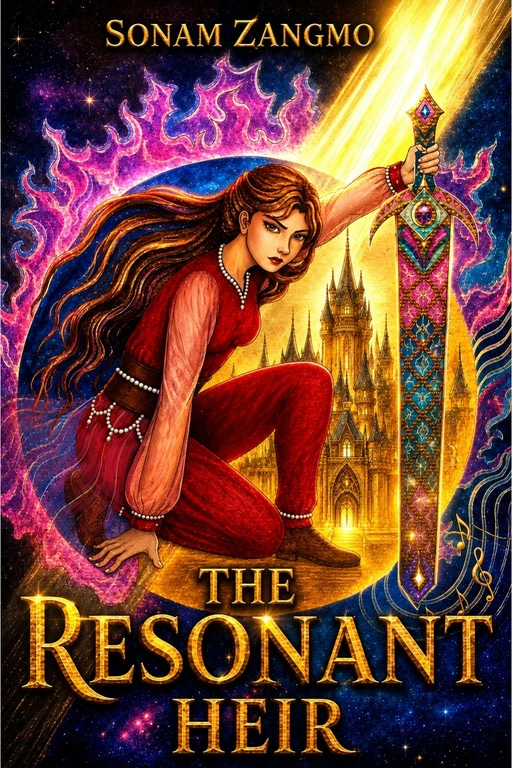
 Explore The Resonant HeirYA crossover royal fantasy · inherited magic · female heir · exile · adventure · Book I Complete
A Literary Commentary on Chapter Eighteen of The Resonant Heir
Beneath the Weight of Survival: A Philosophical Reading of The Mine That Breathed
On dangerous work, the unequal price of staying alive, and the strength two girls find in protecting one another.
Spoiler Notice: Contains spoilers for Chapter Eighteen.
Explore the seventeen themes in this commentary
- Not a Sword, but a Pick
- The Name That Escapes Before the Princess Can Stop It
- Bread with Dust on It
- A Waterskin Offered Without a Bargain
- Five Years of Childhood
- The Workers Who Know the Cost
- The Story Sion Was Never Told
- When Empathy Turns into Self-Reproach
- The Guide Who Has No Title
- A Warning Is Not a Safe Alternative
- Gold Below, Cracks Above
- A Rescue Neither Girl Could Have Managed Alone
- The Moment Lyra Makes Herself a Shield
- The Roots That Refuse an Easy Explanation
- The Mine That Breathed
- The Return She Wants to Make
- Conclusion: The Strength of Not Leaving Someone Behind
Theme 01 · Philosophical commentary
Not a Sword, but a Pick
Chapter Eighteen of Sonam Zangmo’s The Resonant Heir, The Mine That Breathed, opens with a reversal so simple that its significance could be missed.
Lyra stands in a sunlit mining pit surrounded by hundreds of laborers. Metal strikes stone. She looks down at the heavy wooden handle in her hands.
It is not a sword. It is a pick.
For much of the novel, the sword has represented Lyra’s attempt to compensate for her lack of magic. Training offered a way to demonstrate strength in a palace where her worthiness to inherit was questioned. But the tool she holds now measures another kind of ability: whether she can perform work that might earn the money she needs to live.
Her first efforts produce nothing but broken stone. Her shoulders burn. Dust works its way under her nails. She retreats to the shade, thirsty and exhausted.
The scene does not suggest that mining is more virtuous than swordsmanship or that practical labor is an automatic cure for royal privilege. It shows that skill belongs to particular situations. The confidence developed through one kind of training does not make a beginner competent in another.
More importantly, the need to work is not an educational exercise Lyra has voluntarily arranged. She has been driven from the palace, lost the money intended for her escape, and needs to recover the horse that will let her continue her journey.
The pick is therefore a symbol of both agency and constraint.
Lyra can choose to raise the tool, but she did not freely choose the circumstances that made raising it necessary.
What follows is a chapter about the price of survival—and about the different burdens hidden beneath a society’s ordinary working day.
Theme 02 · Philosophical commentary
The Name That Escapes Before the Princess Can Stop It
When Lyra sits down to eat, a palace habit betrays how much of her former life remains within her.
Her hands are covered in grime. She instinctively reaches for a napkin, then starts to call for Obewich.
The name catches in her throat.
There is only rock and dirt around her, no attendant ready to bring what she needs.
The moment is quietly comic, but not cruel. Lyra has not issued a deliberate command to another worker. Her body has simply repeated a routine acquired over years of being cared for.
Privilege is not only a belief about what one deserves. It is also a set of expectations that can become almost invisible through repetition.
A clean napkin appears. Meals are prepared. Someone notices what is missing before the person being served has to ask.
When those arrangements vanish, the absence can be felt in movements so small that they would ordinarily escape notice.
Yet the name Obewich carries affection as well as privilege. He has been Lyra’s worried companion since her first forbidden excursion and helped prepare her escape from the palace. Calling for him is also a reflex of homesickness.
Both readings belong in the scene.
The comfort Lyra once received was a social advantage, but it was also woven into a relationship she genuinely misses.
An honest understanding of her new circumstances need not require her to despise her past or pretend its love was unreal. It requires her to recognize how much that past supplied without her needing to arrange it herself.
Theme 03 · Philosophical commentary
Bread with Dust on It
The loaf Lyra has brought to the mine is covered in dust.
She looks at it for a moment, then eats. She is starving.
The gesture is easily mistaken for a lesson about becoming less delicate. But its deeper importance lies elsewhere.
In the palace, she could have expected food that was clean, plentiful, and served in comfort. In the mine, she does not have the resources or time to insist that the loaf be replaced.
What has changed is not the worth of cleanliness. It is the range of options available to her.
A person can accept something less than she wants because the alternative is going hungry. That acceptance tells us little about what she believes she ought to deserve.
This connects directly to the previous chapter, No Coin, No Crown, when Lyra discovered that a bed and a meal could become parts of a bargain she was poorly positioned to negotiate.
Here the bargain has moved from the innkeeper’s room into her own body. Hunger sets a deadline that arguments about dignity cannot postpone.
There is a difference between choosing a simple life and living under conditions in which even small comforts are difficult to obtain.
The distinction matters for Lyra because she has long fought to be recognized as worthy of the crown. Now the immediate question is not whether others recognize her importance, but whether she has enough to eat.
Material need does not erase dignity. It can, however, sharply limit a person’s ability to insist that dignity be respected in everyday life.
Theme 04 · Philosophical commentary
A Waterskin Offered Without a Bargain
The first person to offer Lyra water is a girl about her own age.
Sion has braided hair, a patched shirt, rough hands, and a worn waterskin. She holds out the water and tells Lyra to drink, joking that it is not poisoned.
The moment is small, but its placement matters.
In Gemariel, Lyra was recently guided by a friendly stranger shortly before discovering that her money had disappeared. She then received shelter and bread from an innkeeper who expected payment and spoke of her needing to buy back her horse.
The chapter does not establish that every earlier offer of help was fraudulent. But Lyra has already learned that assistance can carry costs she is unable to negotiate.
Sion’s first act is different. At the moment she extends the waterskin, she asks for no money, service, or promise.
The girl who owns comparatively little offers something immediately useful to another person.
This should not be expanded into a sentimental claim that poor people are naturally more generous than wealthy people. Sion is an individual, not a moral emblem for an entire class.
Nor does the initial gesture prove that she will always act without self-interest. She later shares the location of a promising mineral seam she has been working.
What the scene does establish is that care need not begin with a transaction.
In a place where survival has a price, one girl gives another a drink before asking what she can pay.
The offer creates the possibility of a relationship built on something other than rank or debt.
Theme 05 · Philosophical commentary
Five Years of Childhood
Sion tells Lyra that she has worked in the mines for five years.
They are approximately the same age.
The answer brings their lives into sharp relief. Lyra is struggling through her first day of mining. Sion has developed knowledge, calluses, and habits of survival over years of exposure to its risks.
The chapter does not give every detail of Sion’s age at the start or the circumstances under which she was employed. Still, the length of time and their similar present ages leave no doubt that her working life began remarkably early.
It is important not to turn the comparison into a contest over which girl has suffered more.
Lyra’s experiences are real: the stigma of being an heir without magic, pressure from her family and court, an attack upon her life, and the loss of her home. Sion has lived with dangers and responsibilities Lyra barely knew existed.
Their hardships are different in kind, duration, and social consequence.
What demands attention is not who has earned the right to be called strong. It is the distribution of childhood itself.
For one girl, much of the past five years involved training for a possible future as a ruler. For the other, those years were spent performing dangerous work in order to continue living.
Two children can belong to the same generation without having been given anything like the same opportunity to be children.
Sion’s competence deserves respect. The conditions that required her to acquire it so early deserve scrutiny.
Theme 06 · Philosophical commentary
The Workers Who Know the Cost
When Lyra asks why people do not last long in the mine, Sion points toward workers who are thin, hunched, and coughing.
She calls the danger poison. Families that remain too long, she says, eventually become like them.
The novel does not identify a particular toxin or provide a medical explanation for every worker’s condition. The combination of visible physical decline and Sion’s warning nevertheless establishes that she regards prolonged work here as a serious threat to health.
Lyra thinks that the workers know the cost and still come. She distinguishes them from herself: she came because she had no choice.
That distinction is psychologically revealing—and ethically incomplete.
How does she know that the others possess choices she lacks?
They may have families depending on their wages. They may have no other accessible work. Their individual circumstances are not disclosed.
The reader should not simply reverse Lyra’s judgment and assert that every worker is forced to remain. But neither should we treat continued participation as proof of free acceptance.
This is a recurring philosophical question in The Resonant Heir. Aulith’s leaders once accepted an extraordinary covenant in search of protection. Elena considered marriage for the sake of her people. Lyra entered mining because she needed resources.
These arrangements differ enormously in scale and form. All prompt a question about choice under necessity.
Knowing that something is dangerous is not the same as having a realistic opportunity to avoid it.
A worker may understand the risk with perfect clarity and still be unable to afford the safer alternative. That possibility complicates any easy celebration of endurance.
Theme 07 · Philosophical commentary
The Story Sion Was Never Told
When Lyra asks whether Sion works with her parents, Sion says she cannot remember them.
Her aunt brought her to the mines as a child and promised to explain everything when Sion was older. Then the shaft collapsed before that promise could be fulfilled.
There is no long lament. Sion recounts the event and continues leading the way.
The restraint of her telling does not make the loss less significant.
A death has taken from her more than a caregiver. It has also taken someone who held answers about her own beginnings.
Lyra knows a different kind of absence. Her search for the truth about her magic, her ancestry, and the old kingdom has repeatedly encountered silence and missing information.
The parallels are thematic, not proof that Sion’s family history and Lyra’s secrets have a common source.
In Lyra’s world, adults have withheld explanations while continuing to live nearby. In Sion’s, the person who promised an explanation died before she could provide it.
One girl confronts concealed knowledge; the other faces knowledge that may have disappeared with a loved one.
The right to understand one’s past can be thwarted not only by secrecy, but by the ordinary finality of loss.
Sion consequently enters the story as more than a guide who knows where to find gold. She has a past and a set of unanswered questions that matter independently of Lyra’s quest.
Theme 08 · Philosophical commentary
When Empathy Turns into Self-Reproach
Lyra considers Sion’s story and realizes that a girl her own age has lived through greater hardship in some respects and is still standing on her own.
Then she asks herself why she has been feeling sorry for herself.
It is understandable that the encounter changes her perspective. A sheltered person who comes to know another child’s difficulties may begin to recognize comforts she previously took for granted.
But the form of Lyra’s self-correction is worth questioning.
She has fled a threat to her life. She has been separated from her family, lost her money, and entered dangerous work while exhausted and unsure of the future.
Those experiences remain painful even if another person has endured more.
Compassion does not require a hierarchy in which only the person judged to have suffered most may acknowledge distress.
Indeed, making pain into a competition can undermine the mutual understanding that the scene otherwise offers. Sion’s history should broaden Lyra’s concern, not oblige her to deny what she herself has experienced.
Lyra’s reaction therefore suggests a developing conscience that still needs greater balance.
She is beginning to recognize the suffering of people whose lives differ from hers. She has not yet fully separated that recognition from the impulse to shame herself into being stronger.
To take another person’s hardship seriously, one need not declare one’s own hardship illegitimate.
The relationship between the girls may offer a better possibility: compassion that has room for both their vulnerabilities.
Theme 09 · Philosophical commentary
The Guide Who Has No Title
Sion understands the mine in ways Lyra does not.
She knows which open areas hold no gold. She has spent a month working a promising seam inside a shaft. She carries a Lume Stone and knows how to navigate the darkness.
Lyra follows.
Their roles are almost the reverse of what the princess might have expected in the palace. Rank does not decide who gives directions. Relevant experience does.
Sion does not recognize Lyra as an heir, and nothing about her assistance depends on royal status.
This is not to say that Sion is automatically wiser in every subject. Lyra has learned court customs, swordsmanship, and the burdens of dynastic responsibility. Both have knowledge that the other lacks.
But the mine belongs to Sion’s field of expertise.
A ruler who genuinely understands the limits of personal knowledge must be able to recognize this kind of authority: the credibility that comes from doing and surviving work oneself.
The novel has recently shown the failure of a king to know everything occurring within his own institutions. In a humbler setting, it shows a princess whose immediate safety and competence depend on listening to a miner of her own age.
Leadership is not the ability to know everything. It is partly the ability to recognize when someone else knows what matters.
Yet the chapter does not let expertise become invulnerability. Sion understands the mine, but her judgment and experience cannot make an unsupported shaft safe.
Theme 10 · Philosophical commentary
A Warning Is Not a Safe Alternative
Before they enter the tunnel, Sion gives Lyra an honest warning.
There are no supports. Lyra should not go in if she is afraid.
Sion does not hide the danger. That matters morally. She gives Lyra information relevant to the decision and leaves room for refusal.
But the existence of a warning does not transform the choice into one made without pressure.
Lyra needs money to reclaim her horse. She cannot remain in Gemariel indefinitely. She still hopes to pursue the Awakening Spring.
An opportunity to find gold therefore arrives at precisely the moment when she most needs it.
She hesitates, recognizes the structural risk, and decides to take the chance.
This is neither proof of helplessness nor evidence of fully unconstrained freedom.
She acts, but the circumstances give the hazardous option unusual weight.
The chapter has not identified who manages the mine, what safety standards exist, or who may bear formal responsibility for the unsupported tunnel. It would be irresponsible to invent a legal case from those omissions.
Yet one can still ask whether children should be exposed to potentially fatal conditions merely because the work promises needed income.
Being warned about danger does not by itself make the circumstances that lead someone toward that danger fair.
This is the distinction between an informed risk and a just arrangement. They can overlap, but they are not the same thing.
Theme 11 · Philosophical commentary
Gold Below, Cracks Above
Sion locates the quartz seam. Lyra holds the Lume Stone while Sion strikes the rock.
Metal rings sharply through the confined passage. White dust fills the air. Flakes in the quartz suggest that the vein may be rich.
For a moment, the discovery offers exactly what Lyra came to find: a possible way to recover the money and mobility she has lost.
Then she hears something else.
A fine scratching sound. A crack. The fissure above them widens.
The physical arrangement of the scene carries its own argument. Beneath them lies potential wealth. Above them lies a ceiling that may collapse.
The object of their hope and the source of their immediate danger occupy the same space.
The chapter does not establish that Sion knowingly caused the entire collapse through her strikes. The sequence of digging, widening cracks, and falling stone makes the risk visible without explaining every mechanical cause.
Nor does it show the girls collecting an actual haul of gold before fleeing.
The promise of wealth is interrupted by a more urgent question: will they survive long enough to leave?
This reverses the purpose of their work. They entered the tunnel in search of resources to support life. The effort now threatens to end those lives.
An income cannot secure a future for someone who must risk having no future in order to earn it.
That is not an argument that all dangerous work can instantly be eliminated. It is a reason to refuse the comforting assumption that people who undertake such work must find its risks acceptable.
Theme 12 · Philosophical commentary
A Rescue Neither Girl Could Have Managed Alone
Lyra first notices that the ceiling is failing. She catches Sion and tells her to run.
When the two flee, the Lume Stone falls from Lyra’s hand. Darkness and dust crowd the passage. The scar on her wrist flares with heat, and she turns toward a narrow gap, dragging Sion with her.
Sion knows the direction of the exit and calls it out.
A large slab shatters behind them. More rock falls. Then Sion slips.
Lyra catches her wrist.
In their escape, there is no permanent division between the capable rescuer and the helpless person being rescued. Sion supplied light, mining knowledge, water, and a route. Lyra sees signs of immediate danger and pulls her companion onward.
Each possesses something the other needs.
That mutuality matters because Lyra has spent much of the novel wrestling with the desire to become strong enough to protect people. She often imagines strength as something she must acquire and wield.
In the mine, survival is not secured by one girl’s superiority.
It depends upon communication, attention, quick decisions, and the refusal to abandon someone who falls behind.
Even then, their efforts are not sufficient to explain the ultimate outcome. The tunnel is collapsing too quickly for either girl to master the situation.
Mutual care is not proof that danger can always be overcome. It is the decision not to face danger as though another life were expendable.
The scene honors cooperation without pretending cooperation eliminates every material risk.
Theme 13 · Philosophical commentary
The Moment Lyra Makes Herself a Shield
As a massive block breaks free overhead, Lyra has no time to choose among carefully reasoned alternatives.
She pulls Sion toward her and curls around the other girl.
Then the stone falls, and the light disappears.
There is no audience in the shaft to reward Lyra. No member of the royal court witnesses the act. Sion does not even know that the girl shielding her is a princess.
That absence of recognition makes the gesture especially revealing.
Lyra has wanted for years to prove that she is not weak. Her effort has often been shaped by the expectations of people who measure the heir through magic and martial capability.
Here she acts in a moment when such recognition is unavailable.
She does not protect Sion because it will make her claim to the throne stronger. The action is immediate, practical, and directed toward a person beside her.
It is possible to read the gesture as an expression of courage and care without turning it into proof of complete moral maturity. Lyra is still impulsive, still uncertain, and still driven by a desire to prove others wrong.
But the physical image of her body around Sion is striking.
The sword that once represented her strength is not what she uses. She offers the only shield she has at that instant: herself.
One form of courage seeks to demonstrate strength. Another appears when someone else’s safety becomes more urgent than the demonstration.
Theme 14 · Philosophical commentary
The Roots That Refuse an Easy Explanation
After the collapse, the girls experience a silence so complete that Sion wonders whether they are dead.
She pinches her cheek and feels pain. Then she reaches toward Lyra, whose arms are still around her.
As they begin to move, they discover the reason they have not been crushed.
Thick roots have coiled together and are bracing the space around them. Some are as wide as posts. Elsewhere in the shaft, another strand holds the fallen Lume Stone.
The scene confirms the roots’ presence and their protective function. It does not identify who made them grow, where every root originated, or whether the event is an expression of someone’s magic.
Sion speculates about a small bush near the shaft entrance. Even she finds the explanation hard to believe.
Lyra’s scar heated before the collapse, apparently alerting her to immediate danger. That observation does not establish that she created the roots.
Sion’s ability to recognize mineral seams is likewise no proof that she commanded them.
Such restraint in interpretation matters. The fantasy mystery remains compelling because the narrative has offered a phenomenon before it has offered a theory sufficient to explain it.
As an image, the roots are also rich.
The tunnel has no artificial supports. A living structure appears where one was desperately needed. But this does not prove that nature is always benevolent or that another unprotected shaft will be rescued in the same fashion.
The rock and dust of the mine remain dangerous.
An unexplained rescue should deepen our questions, not become a reason to dismiss the dangers that made rescue necessary.
Theme 15 · Philosophical commentary
The Mine That Breathed
The title deserves to be reconsidered after the girls return to daylight.
The mine seems almost alive in the language of the chapter. A thin tremor passes overhead. The air tightens. Stone groans and cracks. Dust thickens the space until light and breath are threatened.
Then roots move and brace the shattered passage.
Finally, Lyra and Sion crawl into the open air, collapsing near the entrance and dragging breath into their lungs.
There is no conclusive declaration that the mine itself possesses consciousness. The title need not be read as literal world-building about a sentient geological formation.
Its force is experiential.
Breathing marks the condition of being alive, and the mine repeatedly makes breathing difficult.
Sion has shown Lyra workers whose bodies seem damaged by prolonged exposure. In the shaft, the girls struggle for air. Under the fallen rock, they have to determine whether they have survived at all.
The mine provides the possibility of wealth while surrounding its workers with threats to the most basic act that keeps them alive.
That is a troubling relationship between economic value and bodily cost.
The extraordinary roots do not erase the ordinary problem of unsafe conditions. Sion’s aunt is still dead. The coughing miners still work outside. The unsupported passages have not suddenly become secure.
A mine may yield something valuable to the world above while demanding a price from the bodies below.
The chapter’s imagery gives that abstract cost an immediate form: breath that must be struggled for rather than taken for granted.
Theme 16 · Philosophical commentary
The Return She Wants to Make
Outside the collapsed shaft, Lyra thinks about the contrast between her past and present.
In the palace, she trained hard so that she would not be weak. Beyond it, she has to fight for every meal.
She concludes that there is no easy place.
For her, the observation is understandable. Palace life brought its own pressures; poverty and dangerous labor expose her to others. But the existence of difficulty in both settings does not mean those difficulties are equivalent or equally distributed.
Sion has worked here for five years. Other families may have done the same. For Lyra, the mine is a new and perhaps temporary stage in an extraordinary journey.
She then resolves not to go back—at least not now. One day she will return and prove those who judged her wrong. The chapter closes with her conviction that they were wrong, not she.
There is strength in refusing to accept contempt as the measure of one’s worth.
There is also an unresolved question.
If Lyra must return so that others finally acknowledge her value, how much of that value does she still allow them to define?
The chapter does not resolve this tension, and it is better for the character that it does not. Her determination is genuine; so is the wound beneath it.
She has seen what Sion endures and has survived an event that might have killed them both. Yet her thoughts still return to the people whose recognition once mattered above nearly everything else.
The desire to prove others wrong can sustain a person through hardship. It can also keep the judgment of those others at the center of her life.
The greater challenge for Lyra may be discovering what kind of strength is worth seeking whether or not the palace ever applauds.
Theme 17 · Philosophical commentary
Conclusion: The Strength of Not Leaving Someone Behind
The Mine That Breathed advances Lyra’s education by taking her farther from the assumptions of her upbringing.
She begins with a pick where she once carried a sword. She instinctively calls for Obewich, then eats dusty bread alone. She meets Sion, a child worker whose knowledge has been earned through years of danger and the loss of a caregiver.
The girls enter an unsupported shaft looking for gold, and instead confront the fragility of their own lives.
What Lyra learns is not simply that work is hard. She begins to encounter a world in which danger can become part of the price of eating, and in which the ability to refuse that danger is unequally distributed.
Sion’s competence does not justify the risks imposed on her. Lyra’s courage does not make her poverty deserved. Their extraordinary survival does not make the mine safe.
Yet the chapter also resists presenting people in hardship as nothing more than victims.
Sion recognizes a thirsty stranger and offers water. She shares knowledge and guides Lyra through the dark. Lyra notices the failing ceiling, catches Sion when she falls, and wraps herself around her when the stone comes down.
The protective roots remain unexplained. The moral meaning of the girls’ behavior does not depend on their origin.
In a place where status offers no shelter and gold has become an immediate danger, each girl treats the other’s life as worth protecting.
Strength is not only the ability to keep oneself alive. It is also the willingness to protect another life when one’s own safety is uncertain.
But there is a second lesson beside that courage.
The measure of a just kingdom is not whether its workers can survive one more collapse through bravery or luck. It is whether their lives are valued enough that they need not continually depend on bravery or luck to survive.
Lyra enters the mine seeking gold so she can move forward. She leaves without a treasure, but with an experience that may matter more to the ruler she hopes to become.
She has learned that the person beside her is not a servant, a subject, or a piece in someone else’s political game.
She is Sion.
And when the mine falls, leaving her behind is not an option.