
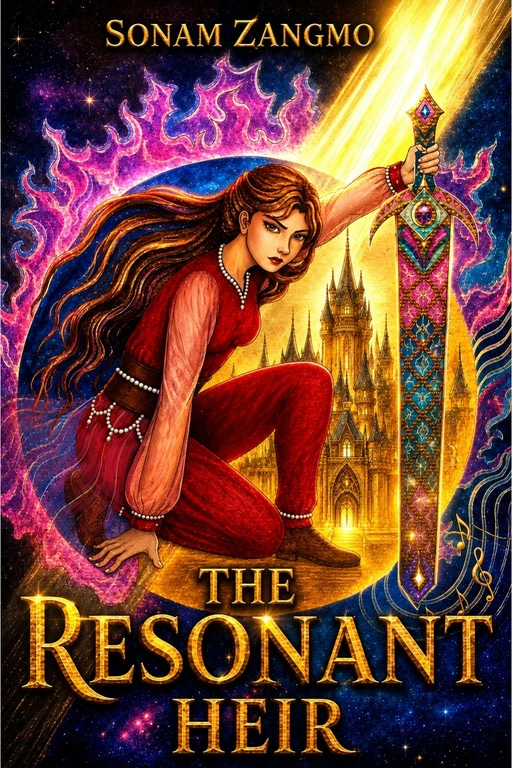
 Explore The Resonant HeirYA crossover royal fantasy · inherited magic · female heir · exile · adventure · Book I Complete
A Literary Commentary on Chapter Nineteen of The Resonant Heir
Between Justice and Reward: A Philosophical Reading of The Rat in the Tower
On the mixed motives of courage, the limits of justified force, and the difference between possessing something valuable and understanding it.
Spoiler Notice: Contains spoilers for Chapter Nineteen.
Explore the sixteen themes in this commentary
- The Problem of a Dirty Shirt
- The Palace as an Unreliable Measure of the World
- Ten Gold and the Purity of Good Intentions
- The Danger in “No Hesitation”
- The Thief Who Knows How the Tower Works
- Learning from Someone One Opposes
- Sion’s Mirror and the Authority of Experience
- The Stone Worth a Mine
- Justice Declared, Force Unexamined
- Gold Thrown Away, Pride Drawn Out
- The Moment the Pursuer Stops Chasing
- The Boundary at a Defeated Enemy’s Throat
- What an Arrest Can and Cannot Repair
- The Reward Is Not Hers Alone
- A Chipped Edge and a Seam in the Stone
- Conclusion: What the Reward Cannot Measure
Theme 01 · Philosophical commentary
The Problem of a Dirty Shirt
“It itches.”
That is how The Rat in the Tower, Chapter Nineteen of Sonam Zangmo’s The Resonant Heir, begins—not with a villain, a prophecy, or the promise of treasure, but with a princess unable to sleep in filthy clothes.
Lyra has survived the collapse of a mine. Her muscles ache, her work has earned her nothing, and the clothes she rinsed as best she could are still stiff with dirt. She decides to wash them at the small pond outside the inn.
The mundane discomfort matters. Only a few chapters earlier, Lyra was a royal child whose meals, rooms, and belongings were attended to by others. Now she has to solve even the problem of a clean shirt herself.
This is not evidence that her suffering is somehow beneficial or deserved. It is a reminder that independence is lived through the body as well as declared through bold decisions. Hunger, exhaustion, cold water, and dirty clothes continue to matter while the fate of a kingdom remains unresolved.
A striking contrast governs the chapter from beginning to end. Lyra goes outdoors seeking something clean. She enters a tower seeking money. She emerges from the encounter with a damaged sword and a question she cannot answer.
Her practical needs lead her toward events whose meaning cannot be measured by their practical reward.
The movement from a dirty shirt to a mysterious stone gives this brief adventure a philosophical shape: necessity begins the action, but necessity does not exhaust what the action reveals.
Theme 02 · Philosophical commentary
The Palace as an Unreliable Measure of the World
Before leaving the inn, Lyra remembers the wanted notices posted around Gemariel. Its High Lord seeks Vespergnaw, a figure blamed for a recent series of thefts.
She is struck by how boldly the thief appears to operate. At the palace, she thinks, such a criminal would scarcely have time to finish a cup before being caught.
The confidence is characteristic of Lyra. She has seen royal power deployed decisively and knows the formidable defenses associated with her former home.
But the reader has recently witnessed how uncertain those defenses can be. An armed intruder reached Lyra in her own place of confinement. Political decisions escaped the king’s knowledge. A system’s impressive outward authority did not guarantee its practical effectiveness.
Gemariel, meanwhile, is not Moontis Palace. The chapter gives no full explanation for how Vespergnaw has evaded capture. It is therefore too early to call the town’s authorities incompetent.
Lyra’s response reveals something subtler: the standard by which she still judges an unfamiliar world is the institution in which she grew up.
Her old assumptions remain available even after the privileges supporting them have vanished.
Leaving a place is often easier than leaving behind the expectations that place taught us.
Lyra is learning to survive beyond the crown, but she has not stopped thinking in the terms of a princess. That tension makes her observations interesting precisely because they are not always complete.
Theme 03 · Philosophical commentary
Ten Gold and the Purity of Good Intentions
Sion finds Lyra beside the pond and points toward four figures moving up the path. She recognizes Vespergnaw by his walk; she has been following the gang since they passed her home.
Lyra remembers the amount on the wanted poster: ten gold.
She immediately measures what the bounty might do. It could pay the inn, help her recover her horse, and enable her to leave Gemariel.
The motive is unmistakably personal.
This matters because Lyra later confronts Vespergnaw in the language of public justice, telling him that he has taken enough from the town and must pay it back.
There is no need to choose between the two motives as though one must expose the other as false.
People often perform socially useful acts while hoping for payment, advancement, or relief from an urgent need. Being rewarded for an action does not by itself make the action corrupt.
The more demanding question is whether the desired reward changes what the person is willing to do in order to obtain it.
Might someone accuse the wrong person? Ignore a chance for peaceful surrender? Take property beyond what is owed? Use more force than the danger requires?
Those are questions of conduct, not merely inward purity.
Justice does not require the absence of self-interest. It requires that self-interest not become an excuse to abandon justice.
Lyra’s pursuit begins in a perfectly human desire to escape debt. The moral meaning of what follows will depend on how she handles the people and choices that pursuit places before her.
Theme 04 · Philosophical commentary
The Danger in “No Hesitation”
Lyra decides to follow the thieves almost instantly.
She abandons the shirt she was washing, grabs her sword, and tells Sion to come. The narration stresses the absence of hesitation.
There is vitality in this response. Lyra is no longer simply waiting for someone else to restore her lost resources. She recognizes an opportunity and acts.
Yet the speed of her decision is also concerning.
She does not know what defenses the tower contains, how the gang fights, or whether any larger group might be waiting. The only companion she takes is Sion, another child who has already survived a near-fatal mine collapse that day.
Courage and sound judgment are related, but they are not identical.
A person may act quickly because the situation demands it. A person may also act quickly because the prospect of success makes uncertainty easier to overlook.
Lyra has shown both tendencies throughout the novel. Her willingness to cross a forbidden line led her into wonder and danger. Her intervention at Elena’s wedding helped create room for a refusal, but it also produced consequences she did not fully understand.
Here the possibility of ten gold sharpens the same inclination to move before the field is clear.
The narrative need not punish her impulsiveness in order for readers to recognize it.
A just goal does not remove the responsibility to consider what pursuing it may cost the people who come along.
Sion follows willingly, but her willingness does not erase the risk that Lyra’s haste helps set in motion.
Theme 05 · Philosophical commentary
The Thief Who Knows How the Tower Works
At the tower, Vespergnaw confronts an entrance without a conventional lock. Three quartz pieces form a triangle in the stone.
He puts his ear against the door and turns them in sequence, listening until the mechanism releases.
He then stops one of his followers from rushing through. A protective ward remains in place, and he understands that it would injure anyone entering carelessly. He scatters a glowing powder across the threshold until the ward breaks apart.
The scene gives Vespergnaw more than an appetite for stolen goods. He possesses technical knowledge, patience, and an understanding of dangerous mechanisms.
His expertise does not vindicate his actions. It shows that expertise is morally versatile.
Knowing how protection works can allow a person to maintain it or defeat it. A clever mind can prevent injury to an accomplice while enabling the theft of something belonging to another.
The ward itself is worth noticing. It appears to have been constructed to exclude intruders, yet someone who understands its vulnerabilities can pass through.
That is not proof that all magical defenses in this world are weak or built with the same flaw. The powder’s composition and wider effects remain unknown.
The immediate lesson is narrower and more useful.
A system can appear secure to those who trust it while remaining penetrable to those who study it.
For Lyra, who grew up under the promise of royal protection, such practical knowledge is part of the wider world she is only beginning to encounter.
Theme 06 · Philosophical commentary
Learning from Someone One Opposes
Lyra observes the powder break the protective ward. Rather than dismissing the method because a thief uses it, she crouches near the door and gathers some of what remains.
She asks Sion to hold it, and Sion opens a pocket.
This is a modest gesture of intellectual growth. Lyra recognizes that an unfamiliar substance may have uses worth investigating.
She does not yet know its composition, whether it acts on other wards, or whether handling it presents risks. Nothing in this chapter establishes a universal device for neutralizing magic.
Still, she has identified evidence that might otherwise have been left behind.
The decision complicates any simple separation of heroes, who supposedly know good things, from villains, who know bad ones.
Vespergnaw has employed his understanding in an illicit intrusion. Lyra can observe that understanding without endorsing the act.
Learning often requires distinguishing knowledge from the purposes to which a person puts it.
The difference is especially important for a protagonist searching for magical truths concealed by institutions and history. Dismissing every source associated with wrongdoing could leave her ignorant. Trusting every clever technique without questioning its use would be equally dangerous.
Wisdom is not refusing to learn from someone who has acted badly. It is learning without surrendering judgment about what that knowledge is for.
The few grains of glowing dust become a small image of that separation.
Theme 07 · Philosophical commentary
Sion’s Mirror and the Authority of Experience
Inside the tower, light from Lume Stones illuminates a winding stair. Voices drift down from the chamber above.
Sion goes first. When the girls reach the inner doorway, she produces a small mirror and angles it through the opening, allowing them to watch without immediately exposing themselves.
Lyra expresses surprise at the number of tricks her companion knows.
Sion’s explanation is brief: street life.
Those two words carry a history of learning outside the structures Lyra once knew. Sion’s experience comes from living in difficult surroundings, where observation and quick invention have practical value.
The contrast recalls the magical mirror in the Hall of Prophecy. Through it, Eryndar could see a daughter he could not reach. Sion’s little mirror accomplishes nothing so grand, but it supplies exactly the information the girls need at a critical moment.
The parallel does not suggest that the objects share magical properties. One is an extraordinary instrument of vision; the other is an ordinary tool used cleverly.
Both scenes nevertheless treat seeing as distinct from acting. Information can improve a decision, but it does not decide for the person who receives it.
Lyra possesses sword training. Sion possesses knowledge of streets, mines, and improvised observation. Their cooperation has begun to draw upon both.
The absence of a title does not mean the absence of authority. Sometimes the person worth following is the one who knows the terrain.
For a possible future ruler, learning that distinction may be as important as winning any single fight.
Theme 08 · Philosophical commentary
The Stone Worth a Mine
Through the mirror, the girls see four members of the rat gang struggling to remove a large gemstone from four gold prongs.
Its upper half is violet, its lower half brown. It is remarkably clear. The Lume light passing through it casts violet and amber across the chamber.
Sion draws in a breath. To her, the object appears worth as much as an entire mine.
It is an estimate, not a verified sale price. Nor does the narrative yet establish who owns the stone, how it came to be installed in the tower, or what purpose the setting serves.
But Sion’s comparison matters.
She has spent years working among miners. For her, the mine is a unit of labor, risk, and economic value. Calling the stone worth a mine expresses astonishment through the world she understands.
The contrast with the preceding chapter is difficult to miss. Lyra and Sion nearly died searching for a small amount of valuable material underground. Here others strain to seize an object whose apparent worth dwarfs their ordinary efforts.
The story does not say the gemstone was produced by Gemariel’s miners or that its market value measures their lives. We should not invent such a connection.
What the juxtaposition does allow is a question about the unequal ways value is recognized.
Gold can be admired for its price. Labor may go unnoticed even when it costs years of health.
The dazzling object draws every eye; the conditions by which people seek wealth are easier to overlook.
The stone will soon demand another kind of attention, one for which price may be an inadequate language.
Theme 09 · Philosophical commentary
Justice Declared, Force Unexamined
When Vespergnaw notices the intruders, Lyra steps into the chamber, draws her sword, and accuses him of having taken enough from the town.
Her accusation has context: wanted posters identify him in connection with a series of thefts, and the group is presently trying to remove a valuable object from its setting.
The pursuit therefore has grounds beyond the promise of payment.
Yet the next action merits scrutiny. As Vespergnaw and the others retreat from the stone, Lyra rushes forward with her blade without first offering a clear demand for surrender.
The gang is potentially dangerous. Its members are quick, armed with fangs, and soon move against her at Vespergnaw’s command. That danger matters.
But the danger does not automatically resolve the question of whether this was the least harmful effective way to begin.
Lyra has not become an authorized court of law merely because she calls out a crime. Neither does her intention to receive a bounty make every use of force permissible.
This is one reason she is more compelling as a character who is learning than as an uncomplicated ideal of heroism.
Her instinct is to intervene. Her emerging task is to determine when and how intervention should occur.
There is a moral difference between having reason to stop someone and being justified in everything one does while stopping them.
The novel does not fully adjudicate her opening strike. It gives the reader enough detail to keep the question alive.
Theme 10 · Philosophical commentary
Gold Thrown Away, Pride Drawn Out
Vespergnaw avoids Lyra’s blade with a series of quick jumps and abrupt changes of direction.
He taunts her. He even grabs a handful of coins and throws them in her path.
The coins are an unusually pointed choice. Lyra entered the pursuit because ten gold could solve urgent problems. For Vespergnaw, money momentarily becomes something to scatter as a distraction.
The objects have not changed. Their use has.
Money can sustain life, serve as a lawful reward, tempt a thief, or function as a weapon in an escape. Its practical value never supplies its moral purpose.
Vespergnaw’s insults also find their mark. Lyra’s irritation is apparent when she thinks of being mocked by a rat.
The encounter exposes how easily a justified pursuit can become entangled with wounded pride.
Lyra wants to capture someone accused of stealing from the town. She also wants to defeat a foe who is making her look foolish.
Those desires may reinforce each other, but they are not the same.
The danger is that an insult can begin directing the person who believes she is acting for a higher reason.
Anger at being mocked is not evidence that the mocker deserves greater harm.
To Lyra’s credit, her next move is not a wild escalation of blows. She changes the rhythm of the encounter instead.
Theme 11 · Philosophical commentary
The Moment the Pursuer Stops Chasing
Lyra lowers her blade and sinks slightly into a new stance. Her eyes close.
Two brief lines appear around the moment of hesitation: “Giving up?” and “Run.”
The text does not provide enough context to assign a supernatural origin to those words or to treat them as proof that a hidden power instructs her.
What is visible is the tactical change that follows.
Vespergnaw reads her posture as an opening. He springs onto the stone and pushes off to vault over her.
Lyra’s strike comes suddenly, skimming his coat before driving into the gemstone.
The movement illustrates an alternative to chasing a faster opponent through a space whose terms he controls.
Rather than continuing to follow every change of direction, Lyra presents an apparent opportunity. Vespergnaw commits himself to a course she can meet.
It is a moment of effective swordsmanship, but it is also a useful image for a broader kind of judgment.
The most forceful-looking response is not always the most effective one. Attention, timing, and restraint in movement can accomplish what pursuit alone cannot.
Still, the action has consequences she did not intend—or at least did not yet understand.
The blade hits the gemstone. A pulse passes through it. The tower shivers.
The successful strike resolves the immediate contest while opening a problem that victory cannot explain.
Theme 12 · Philosophical commentary
The Boundary at a Defeated Enemy’s Throat
Vespergnaw hits the floor, and Lyra’s sword point reaches his throat.
The other rats rush forward but then kneel. One begs the girl they call a hero for mercy.
Lyra does not kill the defeated leader. With Sion’s help, she binds the four gang members instead. The smallest begins to cry.
The word hero comes from someone hoping to survive the encounter. It is not an independent moral certificate.
The more significant fact is that the person with decisive force does not use it to carry out a summary execution.
The gang members’ fear should not erase their possible wrongdoing. Their thefts require examination, and their attempted removal of the gemstone calls for an account of the property and its owner.
But wrongdoing does not mean that every possible punishment is justified.
The moment is especially revealing when placed beside Lyra’s earlier struggles with anger. She has struck people impulsively before, and she has been restrained by others when her fury threatened to carry her too far.
Here she holds the opponent at sword point and allows him to remain alive.
That restraint deserves recognition without exaggeration. We cannot conclude from one arrest that she now possesses a complete theory of lawful force.
We can identify the boundary she observes in this scene: defeat does not become an excuse to kill.
How a victor treats someone who can no longer resist may reveal more about the use of power than the victory itself.
Theme 13 · Philosophical commentary
What an Arrest Can and Cannot Repair
Lyra announces that the prisoners will be taken to Gemariel’s High Lord.
That choice is consequential. She intends to deliver the suspects to public authority rather than keep them captive indefinitely or decide their final punishment herself.
Yet their capture is only one possible step toward justice.
The chapter does not show a hearing, a determination of each prisoner’s involvement in the reported thefts, restitution to the people harmed, or payment of the bounty.
These are not objections to the story’s ending. They mark the limits of what has happened within it.
There is a difference between stopping an apparent offense and completing a fair process of accountability.
The former may prevent further harm. The latter requires evidence, distinctions of responsibility, proportionate consequences, and attention to victims.
Lyra says the gang must repay what it has taken from the town. For that promise to be more than a triumphant line, someone must eventually determine what was taken, from whom, and how repair could occur.
It is possible that the High Lord’s procedures will serve that purpose. The chapter does not yet show them.
A sword can bring suspects before an authority. It cannot by itself establish every fact the authority ought to judge.
For a prospective ruler, learning the distinction between forceful intervention and reliable justice may be one of the most important lessons the pursuit offers.
Theme 14 · Philosophical commentary
The Reward Is Not Hers Alone
Sion contributes far more to the capture than merely following Lyra into the tower.
She identifies Vespergnaw by the way he walks. She has tracked the gang from near her home. She uses the mirror to observe the chamber, blocks the doorway with her knife, and later finds rope in Vespergnaw’s own pouch to bind the prisoners.
Lyra supplies the swordsmanship that ends the fight. Neither contribution renders the other irrelevant.
Afterward, she tells Sion that when the bounty arrives, she will share it.
The phrasing matters. The money has not yet been paid. The prisoners have not yet reached the High Lord. Lyra promises a division of a hoped-for reward, not an immediate distribution of coins already in her possession.
It is also a promise that recognizes effort.
Lyra could easily tell herself that the person who held the final blade deserves the entire payment. Instead, she treats the capture as work achieved together.
This follows the previous chapter, where the girls’ survival required both Sion’s knowledge of the mine and Lyra’s efforts to protect her during its collapse.
Their emerging partnership is built not on identical backgrounds, but on complementary abilities.
Cooperation is not complete when people share the risk. It also asks whether they will share the benefit.
For someone raised to inherit authority, recognizing another person’s labor without requiring that person to possess a title is a small but meaningful kind of fairness.
Theme 15 · Philosophical commentary
A Chipped Edge and a Seam in the Stone
The incident might have ended with the prisoners bound and ready to be taken away.
Instead, Lyra discovers that the edge of her sword has chipped.
The damage draws her back to the gemstone.
Her weapon, once a symbol of the strength she worked to build in the absence of magic, has been injured in the very act that gave her victory.
The chapter does not say how serious the damage is or whether it can be repaired easily. The sword has not been destroyed.
Still, the chip is a physical reminder that even success has consequences.
Following the mark her blade made, Lyra finds a thin seam where the stone’s violet and brown portions meet.
The discovery alters the question surrounding the object.
Sion had seen something worth a fortune. Vespergnaw and his companions had tried to pry it free. Now Lyra sees a structure within it that neither price nor ownership can fully explain.
A strange sensation stirs at the back of her mind, and her skin prickles.
“There’s something inside,” she says.
At this point, the text has not identified that something. It has not established that a creature, spirit, weapon, or particular form of magic resides there. Nor has it confirmed a relationship to Rubiad, Voxath, or the inexplicable roots from the mine.
The mystery should be allowed to remain a mystery.
The stone’s price has attracted thieves. What it may contain has attracted Lyra’s attention. Those are different kinds of desire.
Theme 16 · Philosophical commentary
Conclusion: What the Reward Cannot Measure
The Rat in the Tower begins with a girl seeking a clean shirt and ends with her asking what lies inside a beautiful stone.
Between those moments, the possibility of ten gold moves Lyra into a dangerous pursuit. The bounty could pay what she owes, help her reclaim her horse, and allow her to continue searching for answers about her magic.
Her need for money is neither shameful nor a complete explanation of her conduct.
She acts against people accused of stealing from Gemariel. She also acts too quickly to leave every question of risk and proportional force settled. During the confrontation she shows pride and irritation, but she ultimately restrains the defeated gang rather than killing its members.
Sion, whose street experience and practical intelligence make the pursuit possible, is not forgotten when Lyra imagines the reward. Lyra promises to share it.
There is no claim here that the princess has become a perfect judge or that one successful capture establishes an entirely just use of power.
The more interesting accomplishment is that the episode makes different kinds of value visible beside one another.
There is money that may help Lyra survive. Knowledge that enables a thief to evade a ward. Skill that allows a child to observe without being seen. Mercy owed to defeated people. Labor that deserves recognition. And an object whose worth may be impossible to understand in monetary terms alone.
The moral worth of power is not measured only by whether it wins, or by how much it earns, but by the choices made when winning becomes possible.
Lyra has yet to receive her bounty. Her sword is chipped. The prisoners still have to be delivered to the High Lord.
Yet for a moment the ten gold recedes from her thoughts.
She traces the seam of the two-colored stone and senses an unanswered question.
She came to the tower because she needed something she could spend. She stays, looking closer, because there may be something she needs to understand.
Not everything worth discovering can be claimed by force, bought with gold, or explained by the value others place upon it.