
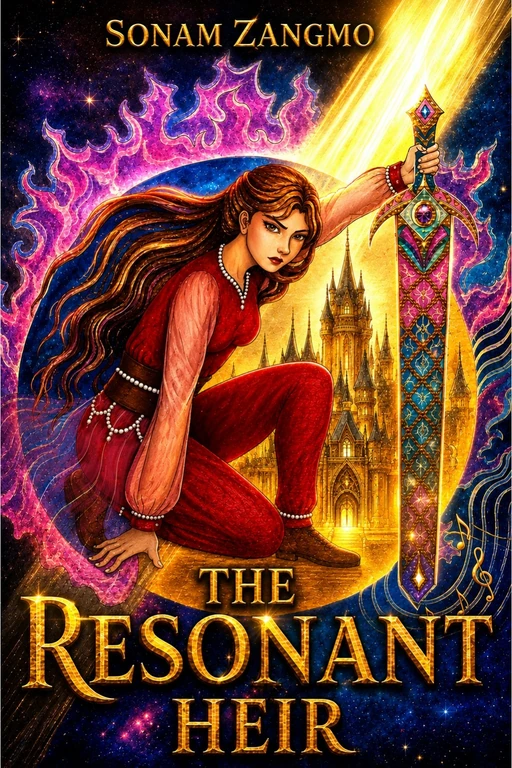
 Explore The Resonant HeirBook I: Reclaim the Throne · Explore the novel
The Resonant Heir · Literary Comparisons · 08
How Fantasy Heroes Think: Intelligence and Quest Design in The Lightning Thief, The Rithmatist, and The Resonant Heir
Three young protagonists, three approaches to magical challenges—and the difference between finding a solution and understanding its cost.
A comparative literary commentary · Book I: Reclaim the Throne
A lopsided chalk circle. A seam between two colors of gemstone. A stone thrown toward an oasis that produces no splash.
Such details are easy to overlook. In the right fantasy story, however, one observation can overturn an apparently impossible situation.
Rick Riordan's The Lightning Thief, Brandon Sanderson's The Rithmatist, and Sonam Zangmo's The Resonant Heir — Book I: Reclaim the Throne all feature young protagonists whose intelligence matters. But the novels do not demonstrate that intelligence in the same way. Percy Jackson learns to recognize dangers concealed within modern versions of Greek myths. Joel Saxon understands a sophisticated magical discipline he cannot personally activate. Princess Lyra must discover unfamiliar rules while navigating physical hazards, conspiracies, and quests whose victories sometimes leave damage behind.
The useful comparison is therefore not a ranking of Percy, Joel, and Lyra by cleverness. It concerns how each author makes problem-solving legible to a reader—and what the story does after an answer has been found.
Comparative literary commentary
1. Seeing the Weakness: Joel's Duel and Lyra's Ametrine Keystone
Early in The Rithmatist, Joel watches Professor Fitch face a challenge from Nalizar. Rithmatic combat is governed by drawn circles, defensive lines, and animated chalk creatures. The configuration matters as much as the talent of the person using it.
Fitch begins drawing an Easton Defense, a formation suited to attackers approaching from several directions. Against one aggressive opponent, its elaborate preparation becomes a disadvantage. Joel recognizes the mismatch. He also notices when Fitch, shaken by the challenge, draws an outer circle unevenly, creating a weakness that would not be present in a precise line.
Joel is not dueling. Fitch and Nalizar perform the magic. Joel's role is to understand why the tactical choices on the floor matter. Sanderson makes this convincing by first explaining enough of the system for a reader to recognize the mistake alongside him. Knowledge does not grant Joel the ability to act as a Rithmatist; that separation is part of the point.
Lyra's confrontation with the Ametrine Keystone in Chapter Twenty-One of The Resonant Heir has a related intellectual structure but reverses the conditions of the test. She has not spent years studying a formal account of the gemstone's defensive magic. Faced with a seemingly resistant opponent, she notices the sound produced near the Ametrine and traces its unusual concentration to the seam between the stone's violet and amber halves.
She strikes that boundary. The gemstone cracks rather than shatters. The attack disrupts the immediate threat and releases a map fragment, but it also splits Lyra's own sword in two. The High Lord has already explained that the keystone protects Gemariel's mining network. If damage causes the seal to fail, the surrounding mines could be devastated. The novel does not say that this collapse actually happens.
The comparison reveals two distinct designs. Joel applies knowledge of a system whose rules are already available. Lyra constructs an explanation from evidence encountered in danger, then acts upon it before she fully understands the wider infrastructure.
Crucially, the Ametrine quest generates the conditions of another quest. Lyra's broken childhood sword leaves her needing a new weapon; that need eventually takes her to the smith Bramor and the dangerous search for Emberheart. The successful discovery is not isolated from the rest of the narrative. It changes the equipment, obligations, and risks that follow.
Comparative literary commentary
2. The Bridge of Fire: When a Physical Puzzle Becomes a Moral Decision
In Chapter Twenty-Four, The Bridge of Fire, Lyra reaches the Dead Crown, a volcanic basin where Emberheart lies atop a pillar connected to the rim by a rope bridge.
She does not immediately charge across it. Sitting on a rock, she counts the intervals between eruptions. Once on the bridge, she studies its sway, lowers her center of gravity, adjusts her weight against its movement, and stops when she needs the oscillation to settle. Her first calculations are imperfect: she steps out of rhythm, the bridge lurches, and she must recover while heat and fire make every delay dangerous.
This is a particularly effective physical trial because the reader can follow the method. The lava has a rhythm. The bridge has a rhythm. Lyra's body must respond to both. She survives through observation and adjustment, not through an unexpected power that cancels the rules.
She obtains an Emberheart shard and crosses back to safety. That completes her original objective. The second trial begins only afterward, when Caelor and Nathan attempt the bridge. Lyra warns them too late to prevent the danger from escalating; the bridge breaks, and Caelor is left hanging above the fire. Lyra could leave with the object she came to collect. Instead, she drives her horse down a dangerous slope to reach him, hauls him up, and suffers burns during the escape.
There is an imperfection in the sequence worth noticing. When Caelor earlier asks whether the crossing is difficult, Lyra answers that it is not, adding only a brief warning to be careful. She has learned a specific and vital pattern, but does not communicate that knowledge clearly. The ensuing rescue is courageous; it should not erase that earlier failure of judgment.
Riordan's The Lightning Thief also links successive dangers to a larger journey, but its encounters tend to draw their rules from recognizable Greek myths translated into modern settings. At the Dead Crown, Zangmo instead lets the reader learn a local physical system with Lyra. The episode then changes genre within itself: the environmental problem is solved, and a moral problem takes its place.
The larger chain continues into the sword-forging storyline. What Lyra seeks from Bramor, and what its making costs him, prevents the replacement weapon from functioning as an uncomplicated adventure prize.
Comparative literary commentary
3. The Monster's Mechanism: Medusa and the Great Serpent
In The Lightning Thief, a confrontation with Medusa cannot be won by approaching her like an ordinary enemy. Her gaze is lethal. Recognizing what she is, and adapting the encounter to that danger, matter as much as wielding a weapon.
Percy's victory also depends on the group. Annabeth contributes knowledge and tactical help; Grover assists; Percy carries out the decisive action. Riordan does not need Percy to invent every element of the solution himself. The pleasure lies partly in recognizing an ancient myth beneath a contemporary disguise and watching the companions put that knowledge to use.
The great-serpent quest in Chapters Forty-Three through Forty-Five of The Resonant Heir likewise requires more than force. Sion has been poisoned, and Lyra and Haris need a serpent's fang to make a protective comb. When they encounter an oasis in the desert, Lyra does not simply trust the apparent water. She throws a stone toward it. There is no splash: the stone passes through the illusion.
The test is modest but precise. Lyra forms a suspicion, checks it against a physical expectation, and revises what she believes she is seeing.
During the confrontation, attacks that should strike the serpent's body are repeatedly diverted. Lyra observes that attacks entering through its open mouth may bypass the protection. She takes the dangerous position required to keep that opening exposed, while Haris fires the decisive ice attack. Lyra is injured in the process.
Both authors create monsters with a particular mechanism that must be understood. Riordan uses the reader's possible familiarity with mythological knowledge; Zangmo makes discovery and experimentation part of the event itself. Both also distribute the solution among companions.
Obtaining the fang is only a partial success. The resulting comb can help contain Sion's affliction; it is not presented as a complete cure. And the urgency of the rescue leads Haris to threaten a frightened craftsman who hesitates to process the fang. The monster is defeated, but the ethical difficulty of saving a friend remains.
Comparative literary commentary
4. Reading Evidence: Joel's Investigation and Lyra's Hemaliel Inquiry
The disappearance of students at Armedius Academy gives The Rithmatist a mystery structure distinct from Percy's road quest. Official publisher materials identify a mysterious chalk symbol at the crime scenes as an important investigative clue. For Joel, whose fascination with Rithmatics gives him unusual technical knowledge, such evidence belongs to a system he has studied closely.
The comparison needs a limit here: a publisher's guide establishes the role of the symbol and the investigation, but it does not justify a detailed reconstruction of every deduction Joel makes across the complete novel. What matters for this analysis is that Sanderson's mystery draws its evidence from the same magical grammar he teaches the reader in the dueling scenes.
Lyra's investigation at Hemaliel in Chapters Forty-Seven and Forty-Eight works through a different grammar: family history and human behavior.
A concealed painting, unexpected reactions to Sion, and contradictory accounts of a supposedly dead child lead Lyra to suspect that the household is hiding something. She studies the High Lady's responses and pushes the inquiry toward a confession.
At a crucial moment, Lyra asserts that she has proof. The manuscript immediately reveals that she has none—not yet. This is a bluff, designed to make the High Lady expose what she knows.
It works, but its success is not evidence that the method is ethically unproblematic. Lyra has assembled a plausible hypothesis; she has not yet independently established every accusation. She relies on pressure and the other person's guilty reaction to move the inquiry forward.
Joel's intellectual specialty helps him read technical traces within a defined magical discipline. Lyra reads omissions, emotions, and the instability of a family narrative. Unlike a defective chalk circle, however, an expression of fear is not a mechanical measurement. It can be misread.
Hemaliel is therefore one of Book I's strongest tests of Lyra's investigative intelligence precisely because it also exposes the danger of confusing a convincing inference with established proof.
Comparative literary commentary
7. Who Solves the Quest—and Who Bears Its Cost?
These comparisons would become misleading if the central characters were credited with every useful idea or every successful action.
Percy's intelligence is inseparable from Annabeth's mythological knowledge and Grover's participation. Joel's analysis does not mean he can activate Rithmatic drawings; Professor Fitch and Melody possess capabilities that his understanding cannot substitute for. Lyra may identify patterns and propose actions, but Sion creates the root-born escape vessel in Chapter Forty-Two, and Haris delivers the ice attack that brings down the great serpent.
The division of labor is more than a practical detail. It reveals the different limits the stories place upon intelligence. A hero can see a solution without possessing the means to carry it out alone.
The aftermath matters, too. Near the conclusion of The Lightning Thief, Percy respects Sally's insistence that she make her own decision about leaving Gabe, rather than using the power available to him on her behalf. Understanding another person's agency becomes more important than immediately exercising his power.
Book I of The Resonant Heir develops a related but distinct burden. Its quests repeatedly leave obligations behind: a cracked keystone, a weapon forged at personal cost, a friend whose affliction cannot simply be erased, and a promise that survives the loss of the means to fulfill it.
At the end of Book I, Lyra has regained the throne. She returns to the imprisoned former High Lord of Sarrakha, intending to honor her promise, only to discover that the mark removed at Awakening Spring was the key she needed. The political victory is real. So is the unresolved debt.
Where Riordan tests a young hero's capacity to respect a loved one's choice, and Sanderson separates comprehension from magical execution, Zangmo makes some of Lyra's victories alter the conditions of future responsibility. The question is not whether these approaches can be ranked by sophistication. It is what each one allows the reader to see about the boundary between knowing, acting, and judging.
Comparative literary commentary
Conclusion: What Happens After the Answer?
Riordan often makes intelligence visible through recognizing mythological danger beneath ordinary appearances. Sanderson shows the power—and limitations—of mastering a consistent technical system. Zangmo puts Lyra through a wider succession of physical, investigative, magical, and ethical trials, where a workable answer may produce another problem.
The strongest moments in all three books resist the fantasy that cleverness makes a character self-sufficient or infallible. Percy needs his companions and cannot rescue everyone at once. Joel can identify errors he lacks the magic to correct himself. Lyra can discover a weakness, pass a trial, or find the destination she has pursued for so long—and still owe something to those affected by the result.
An intelligent hero knows how to solve a problem. An increasingly wise one must also learn what that solution changes.
Editorial transparency
About This Comparison and Its Sources
This literary comparison is published on the website of Sonam Zangmo, author of The Resonant Heir. References to that series concern Book I: Reclaim the Throne only, based on its complete 55-chapter manuscript. Nothing here characterizes the themes, relationships, or narrative choices of subsequent volumes.
The discussions of The Lightning Thief and The Rithmatist draw on official author/publisher materials, authorized excerpts, and reading guides. They should not be presented as exhaustive close readings of the two complete published novels. The other authors and publishers have no stated affiliation with or endorsement of this article.
- Rick Riordan — The Lightning Thief, official book page
- Rick Riordan / Hyperion — The Lightning Thief: Reader's Guide
- Rick Riordan — The Lightning Thief rationale
- Tor/Reactor — The Rithmatist, authorized excerpt
- Macmillan / Tor Teen — The Rithmatist
- Macmillan / Tor Teen — The Rithmatist Reader's Guide
- Brandon Sanderson — Origin of The Rithmatist
Explore the series: The Resonant Heir