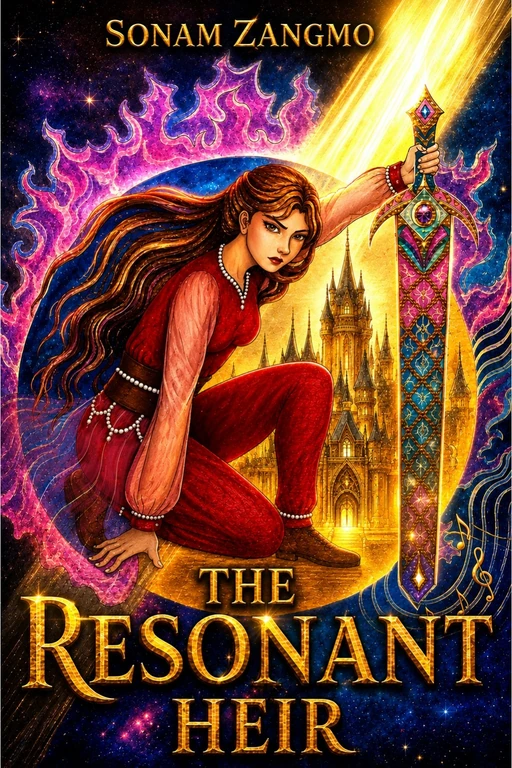
 Explore The Resonant HeirYA crossover royal fantasy · Book I Complete
The Resonant Heir · Literary Comparisons · 05
What Is The Resonant Heir Beside Eragon?
On companionship, inherited weapons, and the debts of becoming a hero.
A Comparative Literary Commentary
Literary comparison
The Farm Boy and the Princess Without a Crown
A farm boy discovers a dragon's egg. A princess loses the protection of her own kingdom.
At first glance, these beginnings seem to lead in opposite directions.
Christopher Paolini's Eragon follows a fifteen-year-old boy whose life has been shaped by the modest routines of farming, hunting, and living with his uncle Garrow and cousin Roran near Carvahall.
When he discovers a mysterious blue stone in the Spine, he has no reason to imagine that a dragon will hatch from it.
Saphira's arrival changes his place in the world.
Through their bond, Eragon becomes a Dragon Rider, inheriting a role associated with an ancient order whose destruction helped establish King Galbatorix's rule.
His importance is unexpected, and it comes with consequences.
The Ra'zac arrive in search of the dragon. Garrow is fatally injured, Eragon's home is destroyed, and the ordinary life he knew becomes impossible to recover.
His journey begins with a discovery that leads to loss.
Princess Lyra, the protagonist of Sonam Zangmo's The Resonant Heir, begins with nearly everything Eragon lacks.
She has a royal name, a palace, attendants, and a recognized place in the succession. Yet those advantages do not protect her from humiliation over her apparent lack of magic or from the political struggle unfolding around her.
Her early defiance eventually brings her into conflict with influential members of the court.
After disrupting a politically significant marriage, she faces imprisonment and an assassination attempt. Leaving the palace becomes a matter of survival.
The contrast becomes especially striking in Chapters Seventeen and Eighteen.
Having escaped the world in which others once served her, Lyra is robbed of her money and forced to work in the mines of Gemariel.
A princess who has never needed to earn her daily survival now enters a world where hunger, wages, and exhaustion are ordinary concerns.
There she meets Sion, a girl whose life has been shaped by poverty and labor.
For Lyra, the experience is not simply a temporary inconvenience before the next magical adventure. It exposes her to circumstances that royal education could never fully communicate.
Eragon leaves a modest home and gradually discovers the enormous importance of his new position.
Lyra leaves a position of enormous importance and discovers how little that status provides when she can no longer rely on it.
Both journeys involve the loss of familiar security, but their narrative directions are different.
Eragon must understand what it means to become someone whose existence matters to a political struggle.
Lyra must understand what it means to remain responsible for others when the privileges of her position have fallen away.
Eragon's transformation begins when extraordinary power finds him.
Lyra's deeper transformation begins when the world stops treating her as extraordinary.
Literary comparison
Learning to Listen
One of the central pleasures of Eragon is watching an inexperienced young person learn how a dangerous magical world operates.
Brom, initially known to Eragon as a village storyteller, becomes his guide. He teaches the boy swordsmanship, the ancient language, and the principles governing the use of magic.
These lessons have immediate practical consequences.
Eragon discovers that magical acts require energy and that attempting something beyond his capacity can place his life in danger.
He cannot simply wish a result into existence. He must learn to consider the cost of an action before attempting it.
Brom also introduces him to a history far more complicated than the stories Eragon heard in Carvahall.
His education therefore involves two kinds of learning: how to use power, and how to understand the world in which that power will be used.
The relationship is not without difficulties.
Brom knows more than he initially reveals. His guidance is valuable, but Eragon must sometimes act without having all the information he wishes he possessed.
The Resonant Heir offers a different approach to magical apprenticeship.
In Chapters Five and Six, Lyra visits Sonareth and learns from her grandfather, High Lord Maldorel.
The lessons at Lake Lyrenthis center upon resonance, perception, and the use of Voxath.
For Lyra, magic is not initially a matter of producing overwhelming destructive force. It is a matter of recognizing vibrations and learning how to direct them.
She must become attentive to things that ordinary hearing cannot detect.
Her first attempts fail because she tries too hard to impose her will upon the sound.
Only when she stops forcing the experience and allows herself to remain present does the resonance begin to respond.
The lesson carries a significance beyond technique.
Lyra has spent much of her childhood wanting to be recognized, praised, and considered worthy. At Lyrenthis, she discovers a form of success that requires less assertion and more attention.
The practical value of the training becomes clearer later.
When Lyra attempts to free Ravok, she returns in her mind to Lake Lyrenthis. The memory helps her use Voxath across a distance.
Still later, during the Trial of Igsvar, her familiarity with sound and concentration provides a way to perceive what she cannot see.
A lesson learned in a peaceful landscape acquires a different meaning when another life depends upon it.
Brom teaches Eragon that magical ability requires discipline, knowledge, and an understanding of consequences.
Maldorel teaches Lyra a form of attention that allows her to interact with the world beyond her apparent magical limitations.
Yet their teaching is not identical.
Eragon is developing powers associated with becoming a Dragon Rider.
Lyra is learning a particular magical discipline while the power she was born with remains obstructed.
Her education also continues long after she leaves Sonareth.
She learns from the working people of Gemariel, from Bramor's forge, from the rulers of other fae territories, and from decisions that nearly cost her life.
Her journey gradually becomes a form of education no single teacher could provide.
In both novels, learning matters because the protagonists do not begin with the wisdom their eventual roles require.
But instruction is more than the transfer of power from someone experienced to someone young.
Knowledge becomes meaningful when it changes what a person notices, what that person questions, and what they are willing to do for someone else.
Literary comparison
A Dragon Partner, a Dragon Prisoner
Dragons occupy important places in both novels, but their narrative functions are profoundly different.
Saphira is central to Eragon's identity as a Dragon Rider.
Their bond allows them to communicate through thought, share experiences, and develop an understanding of one another that changes as they grow.
Saphira is powerful, protective, intelligent, and capable of making judgments that do not always agree with Eragon's.
She is not simply a creature he commands.
Their relationship is a partnership in which the younger, less experienced human must sometimes recognize the dragon's greater understanding.
Eragon's abilities do not exist apart from the bond. His extraordinary position is inseparable from another living being whose choices and well-being matter.
The Resonant Heir introduces Ravok under very different circumstances.
During a royal talent display, Lyra encounters an enormous creature brought into the arena in chains.
Its wings are restrained, and black stitches hold its mouth closed.
The princes attack it with magic before the watching court.
The creature appears to have been reduced to an object through which others demonstrate their own abilities.
Later, Lyra learns that this prisoner is Ravok, once celebrated as Aethrador's dragon champion.
According to the High Lord's account, the former ruler ordered Ravok's mouth sewn shut because the dragon knew truths he wished to conceal.
The discovery destabilizes Lyra's understanding of her grandfather.
A ruler honored for greatness had allegedly silenced a creature that once served him.
At first, Lyra cannot easily accept the accusation.
Her inherited admiration for Aethrador is stronger than her willingness to believe the imprisoned dragon.
But her relationship with Ravok does not end with doubt.
In Chapter Eight, Before Third Bell, Lyra uses Voxath to dissolve the magical restraints holding him.
The black stitches disappear. The chains break. Ravok escapes his imprisonment.
That action changes the meaning of the earlier scenes.
Ravok is not merely a symbol of a voice permanently suppressed. His imprisonment creates a moral demand that Lyra eventually chooses to answer.
The contrast with Saphira is therefore more interesting than the simple opposition between a speaking dragon and a silent one.
Saphira's bond with Eragon shows what can emerge when a human recognizes a dragon as a partner.
Ravok's history shows the violence that becomes possible when a ruler values a creature's service but refuses to recognize its right to contradict him.
Lyra does not become Ravok's Rider.
Their relationship does not reproduce the mutual magical dependence of Eragon and Saphira.
Yet the dragon's suffering forces her to examine the difference between royal authority and justice.
It is possible for someone to be praised as a champion while being denied the freedom to tell their own story.
It is also possible for a child raised to revere a ruler to question that ruler's legacy once she begins listening to those he harmed.
The important act is not simply hearing Ravok.
It is deciding that what she hears matters enough to require action.
Literary comparison
What a Sword Carries
Fantasy swords often serve as visible signs of a hero's growing power.
They can also carry histories that make their possession morally complicated.
In Eragon, Brom gives Eragon a remarkable sword named Zar'roc.
It is a weapon worthy of a Dragon Rider, but its history has not been explained to its new owner.
After Brom's death, Eragon learns from Murtagh that Zar'roc once belonged to Morzan, a Rider who betrayed the old order and served Galbatorix.
The revelation changes how Eragon understands the weapon in his hand.
It has been associated with someone responsible for terrible violence.
The sword's quality has not changed. Its usefulness remains. But its history can no longer be ignored.
Eragon must decide what it means to continue carrying a weapon that once served a traitor.
His decision is constrained by circumstances. He still needs a sword, and Zar'roc is the one available to him.
That practical reality prevents the situation from becoming an abstract moral exercise.
Rejecting the sword would not automatically make him better prepared to survive.
Keeping it, however, does not require him to approve of its former owner.
The Resonant Heir develops a different version of this problem through Bramor, the old smith.
Before Lyra reaches his forge, she loses the sword she has carried since childhood.
In Chapter Twenty-One, The Broken Blade, her weapon splits during the confrontation at the Ametrine Keystone.
The loss marks a break with the life she once knew.
The sword that accompanied her out of the palace cannot accompany her through the remainder of the journey.
Later, Bramor reveals an ancient weapon made from materials brought to him during the war against Aethrador.
The blade bears a dark haze associated with the resentment of those killed in the conflict.
It is not an innocent object waiting to be claimed.
Its history is present in its very substance.
Bramor intends to reforge the weapon for Lyra, but he warns that the resentment within the steel may prevent the work from succeeding.
Before the process begins, Lyra must place three drops of blood upon the blade.
The spirits of the fallen must accept her.
Lyra does not merely demonstrate that she has enough strength to wield the weapon. She must confront a history over which she has no control.
Then Bramor begins the work.
For twelve days and nights, he labors to awaken the blade. The process exhausts him, and his health deteriorates.
He persists long enough to complete the weapon and its unusual sheath, but the effort consumes his remaining strength.
In Chapter Twenty-Eight, The Smith's Last Gift, Bramor dies.
His final gift leaves Lyra with something more difficult to carry than steel.
She understands that using the weapon only to prove herself would betray the person who made it.
The sword becomes inseparable from her obligation to remember him.
But Bramor's death is not meaningful only because of what it teaches Lyra.
Orin, the boy Bramor raised and trained, loses the man who gave him a home.
When Lyra and Sion depart, Orin remains behind with the forge and the task of becoming the smith his father hoped he would be.
For him, the inheritance is not a legendary weapon.
It is a craft, a household, and a future that must continue without Bramor.
That distinction prevents the old smith's death from becoming merely another sacrifice made for the protagonist.
Zar'roc and Lyra's sword share a connection to violent history, but their circumstances are not identical.
Eragon receives an existing weapon and must reckon with the deeds of its former owner.
Lyra receives a weapon transformed through a craftsman's final effort, with the suffering of the dead bound to its past.
Brom's relationship to Eragon is also different from Bramor's relationship to Lyra.
Brom personally teaches Eragon how to survive and eventually dies during their dangerous journey.
Bramor leaves Lyra the product of a final act of craftsmanship, while Orin inherits the work that must continue after him.
Neither weapon can be understood entirely through its sharpness or magical power.
Each asks its new bearer to confront the people whose actions made the weapon possible.
A sword may be inherited from the past. Its future meaning depends upon the hand that carries it.
Literary comparison
Companions Who Change the Plot
A familiar heroic narrative places one exceptional character at the center of events.
Yet that character's apparent independence often conceals a network of relationships without which the journey would not be possible.
In Eragon, Brom teaches and protects his student until his death leaves Eragon without the mentor upon whom he has relied.
Murtagh subsequently becomes a crucial companion.
His fighting ability and practical assistance help Eragon survive, particularly during the attempt to rescue Arya.
Arya herself is not merely someone whose captivity creates a mission for the hero.
Her knowledge, abilities, and connections with the Varden become essential to the larger struggle.
Saphira, meanwhile, remains a constant presence whose judgments and actions can be as important as Eragon's own.
Their contributions are distinct.
Brom cannot simply be replaced by Murtagh.
Murtagh's past creates problems that Brom's authority never did.
Arya's responsibilities extend beyond the personal relationship Eragon hopes to develop with her.
Saphira is a companion whose bond with Eragon makes the very identity of Dragon Rider possible.
The Resonant Heir also becomes difficult to understand if its supporting characters are reduced to helpers who exist only for Lyra.
Sion is a particularly important example.
Lyra meets her in Gemariel when the princess has been pushed into circumstances far removed from her earlier life.
Their friendship develops through shared work, danger, travel, and repeated acts of care.
Sion's generosity and warmth provide Lyra with a relationship not organized around royal obedience.
But Sion has a story of her own.
In Aulith, the apparent revival of dying crops hints at a magical connection with the natural world that Sion does not yet understand.
Later, when Lyra and Sion escape Drazhune by jumping from a cliff, roots catch them and eventually form a vessel that carries them to safety.
Lyra recognizes that Sion has been influencing plant life.
The scene reverses the familiar pattern in which a powerful protagonist repeatedly rescues a weaker companion.
Sion's abilities become necessary for both girls to survive.
Their friendship faces another trial in Sarrakha.
Sion is bitten by a venomous snake, and the poison threatens her mind.
Lyra and Haris risk their lives hunting a great serpent so that one of its fangs can be made into a comb capable of controlling Sion's attacks.
The effort succeeds, but it does not completely cure her.
The friendship now carries continuing responsibility rather than a neatly resolved rescue.
The story then reveals that Sion's past is far more complicated than her life as an orphan suggested.
In Hemaliel, Lyra uncovers the truth about a child who was believed dead.
Sion is reunited with her father, the High Lord, and must begin understanding a family history from which she was separated.
Her identity changes independently of Lyra's search for the Awakening Spring.
She is not simply returned to the protagonist's side once the immediate danger has passed.
Her own future requires a different direction.
Haris undergoes a significant transformation as well.
He begins as one of the boys who ridicule Lyra for her supposed lack of magic.
But by the time he risks entering the guarded palace under Orlas's appearance, travels in search of Lyra, and joins her in saving Sion, his relationship with her has become far more substantial.
He must act, make judgments, and accept danger.
Even Orlas contributes to the unfolding resistance against Syveris, despite the fear that has controlled much of his life.
The heroes of both novels survive because other characters make decisions that matter.
The comparison should not erase the differences between these relationships.
Saphira's bond with Eragon is a defining magical partnership.
Sion's friendship with Lyra is not its equivalent.
What connects them is a more general truth: the growth of a protagonist is partly the result of encountering people whose lives cannot be contained within the protagonist's own ambitions.
A companion becomes most meaningful when the story allows that person to want something, fear something, and choose something of their own.
Literary comparison
When Heroic Decisions Leave Damage
Heroism becomes less convincing when every difficult action by a protagonist is automatically treated as admirable.
Eragon does not entirely avoid this problem.
Eragon's desire to avenge Garrow initially provides much of the emotional force behind his journey.
But as he gains experience, he confronts situations in which the use of violence is not easily justified.
A significant moment occurs when Murtagh kills Torkenbrand, a slave trader.
Eragon is disturbed by the killing.
Torkenbrand's conduct has been cruel, but Eragon does not accept that cruelty alone makes the man's execution morally uncomplicated.
The disagreement exposes different attitudes toward the risks and responsibilities of leaving a dangerous enemy alive.
Murtagh's decision is shaped by survival and the need to prevent future danger.
Eragon's response reflects his reluctance to treat killing as an acceptable solution whenever someone has committed evil.
Neither perspective can be fully understood by describing one character as courageous and the other as weak.
The scene matters because it forces Eragon to confront moral disagreement with someone whose help he depends upon.
The Resonant Heir presents several comparable difficulties without repeating the same circumstances.
In Gemariel, Lyra confronts an ancient guardian protecting the Ametrine Keystone.
During the fight, she strikes the seam between the crystal's two colors.
The blow releases a map fragment but damages the magical safeguard protecting the territory's mining network.
The High Lord fears that a future failure of the seal could threaten the mines on which his people depend.
That wider disaster has not occurred.
But the danger is serious enough that he must arrange for the protection to be restored.
Lyra did not set out to endanger the mining network.
She also did not understand the full consequences of her actions when she struck.
The scene therefore complicates any simple celebration of her determination.
Good intentions do not erase the possibility of unintended harm.
In Chapter Twenty-Four, The Bridge of Fire, she makes another consequential choice.
Having secured the Emberheart, she could leave.
Caelor, however, is in danger on a collapsing bridge.
Lyra turns back to rescue him, risking the prize she came for and her own life.
The significance of the decision becomes clearer when placed beside the Ametrine incident.
Lyra is capable of making a dangerous mistake in pursuit of an objective.
She is also capable of abandoning an objective when another person's life becomes more important.
Her courage does not guarantee flawless judgment.
Nor does one generous act erase the responsibilities created by an earlier mistake.
Her companions face similar dilemmas.
In Sarrakha, Lyra and Haris return with the fang needed to make a comb that can protect Sion from the venom affecting her mind.
The craftsman they approach fears the supernatural consequences of working with the fang and initially refuses.
As Sion's condition worsens, Haris draws his sword and threatens him into completing the work.
His motive is understandable.
Sion's life and identity are at risk, and there is little time to seek another solution.
Nevertheless, the craftsman is compelled to take a danger he has explicitly refused.
Saving one person has required the intimidation of another.
The story does not need to condemn Haris absolutely for this decision. But neither should his loyalty make the coercion invisible.
An even more complicated example appears in Hemaliel.
Lyra suspects that the High Lady is hiding the truth about Sion's birth.
To force the matter into the open, she claims to possess evidence she does not actually have.
The claim helps provoke admissions that reveal a long-concealed crime.
The outcome benefits Sion.
But Lyra's method still deserves examination.
She has used deception and psychological pressure to obtain the truth.
The scene challenges the idea that a righteous goal automatically makes every tactic righteous.
Both novels allow their young protagonists to encounter the limits of instinct and certainty.
The situations are different, and no exact moral equivalence should be imposed upon them.
Eragon is disturbed by the killing of a dangerous captive.
Lyra must live with the risk created by damaging a magical safeguard, while she and her companions sometimes use questionable means to protect others.
The shared question is not whether the heroes are good people.
It is whether doing good can remain meaningful when the person attempting it is capable of harm.
Literary comparison
Buried Histories and Other People's Sins
The past in Eragon is not a distant collection of legends.
Its consequences shape the politics and relationships of the present.
Galbatorix's rise to power was associated with the destruction of the Dragon Riders.
Brom's memories and the stories he tells reveal how deeply that history continues to affect Alagaësia.
But the legacy of betrayal becomes particularly personal through Murtagh.
Murtagh is Morzan's son.
His father was among those who served Galbatorix and betrayed the old order.
That connection follows Murtagh regardless of his own choices.
He has reasons to distrust both the Empire and those who oppose it.
When he reaches the Varden, his ancestry makes him a potential danger in the eyes of the resistance.
Yet Ajihad's caution is not based on Murtagh's ancestry alone.
Murtagh knows the location of the Varden's refuge, and Ajihad fears that Galbatorix could extract that knowledge if he captured him.
Murtagh's refusal to submit to a mental examination therefore creates a genuine security dilemma.
The Varden seek to protect themselves, while Murtagh insists upon keeping his own thoughts beyond their reach.
Ajihad recognizes the danger posed by revealing the young man's identity to people who hate Morzan.
Confinement is presented partly as a means of preventing that danger, even as it restricts Murtagh's freedom.
The arrangement is not permanent or entirely inflexible: Ajihad later allows Murtagh to fight alongside the Varden during the battle.
These details complicate the moral distinction between an oppressive Empire and those who resist it.
Ajihad has legitimate responsibilities toward the people he protects.
Murtagh has legitimate reasons to defend the privacy of his own mind.
Neither position makes the conflict disappear.
The Resonant Heir explores the consequences of the past through several different families.
The revelations surrounding Aethrador challenge Lyra's inherited understanding of royal greatness.
The Soul Covenant in Aulith demonstrates how an agreement made during an earlier war can continue to burden an entire territory decades later.
The High Lord and four elders remain trapped between life and death, while Aulith's people endure the consequences of that history.
Lyra volunteers to serve as a vessel in the attempt to restore them.
The ritual threatens her body and mind, forcing her to endure fragments of memories, resentment, and suffering that do not belong to her.
The experience is more than a test of magical endurance.
She encounters consequences of decisions made long before she could have influenced them.
Then the political conflict within her own family grows worse.
Syveris's resentment toward Eryndar and Aethrador helps drive the struggle for the throne.
His personal wounds become inseparable from the violence he inflicts upon others.
Yet the clearest examination of inherited guilt emerges through Orlas.
Orlas has lived under the influence and control of his father.
He also participates, however cautiously, in actions that help oppose Syveris.
By the conclusion of Book I, he is left grieving the death of a man whose crimes he can no longer deny.
Lyra recognizes that Syveris's guilt cannot simply be transferred to his son.
Her first orders as Queen include the review of old judgments and the rejection of punishment based solely on bloodline.
The comparison with Murtagh is especially revealing.
Both young men are connected to fathers whose reputations or deeds make trust difficult.
But their situations are not identical.
Murtagh faces confinement within an organization whose survival may be endangered by the information he carries.
Orlas must live with grief after the downfall of the man who controlled much of his life.
Eragon and Lyra also occupy different positions in relation to these dilemmas.
Eragon is a young Rider whose trust in Murtagh must be tested against the Varden's security concerns.
Lyra becomes a ruler responsible for deciding whether the new order will continue old patterns of collective punishment.
The two novels ask related questions from different sides of authority.
History may explain why people fear a family name.
It cannot, by itself, establish what an individual deserves.
Literary comparison
Two Victories That Do Not End the Same War
The Battle of Farthen Dûr brings Eragon to a dramatic conclusion.
The Varden and their allies confront a major Urgal assault.
Eragon faces Durza, the Shade responsible for considerable suffering.
Despite his developing abilities, Eragon cannot overcome Durza through swordsmanship and magic alone.
Durza wounds him severely.
The battle turns when Arya and Saphira break Isidar Mithrim, the enormous star sapphire above the chamber.
Their intervention distracts the Shade.
Eragon takes the opportunity to strike Durza through the heart.
His action ends the immediate threat, but its success depends upon the efforts of his companions.
The victory also leaves a lasting wound.
Eragon survives, yet the conflict against Galbatorix remains unresolved.
The destruction of one dangerous servant does not bring down the Empire.
His apprenticeship is incomplete, and the possibility of further training lies ahead.
The Resonant Heir: Book I reaches a different kind of conclusion.
Lyra has obtained the four map fragments, endured the trials within the ancient amber, and reached the Awakening Spring.
The spring removes the seals that had obstructed her magical abilities.
But the purification comes with an unforeseen cost.
The mark left by Vael'Kharoth disappears from her wrist.
For the moment, Lyra is more concerned with returning to the palace before Syveris completes his seizure of the throne.
With help from Haris, Sonareth's forces, her mother's music, and the knowledge accumulated during her journey, she confronts Syveris.
Her final victory is neither the result of restored magic alone nor an isolated display of swordsmanship.
The struggle draws upon relationships and abilities developed throughout the book.
She reclaims the throne.
But that is not where the story ends.
In Chapter Fifty-Five, A Debt Without a Door, Lyra returns to the forbidden garden.
She has not forgotten her promise to free Xareth, the imprisoned former High Lord of Sarrakha.
The promise predates her coronation.
She now possesses a crown and restored magical power, but the mark once used to reach the presence beneath Rubiad has vanished.
The gemstone no longer responds to her.
The very spring that returned her abilities has taken away the means through which she could fulfill an earlier obligation.
This is a different kind of unfinished victory from the one that concludes Eragon.
Eragon defeats Durza, but the greater enemy remains beyond his reach.
Lyra defeats Syveris and becomes Queen, but something she lost in the process prevents her from keeping a promise.
One ending leaves a war unfinished.
The other leaves a debt unpaid.
The difference is not merely structural.
It changes the moral weight of success.
Eragon's future demands further learning and struggle against a power he has not yet overcome.
Lyra's future demands that she confront an obligation her newly restored powers cannot immediately satisfy.
The end of a battle does not necessarily mark the end of what a hero owes.
Literary comparison
Two Different Reading Experiences
There are genuine reasons why readers of one novel might be interested in the other.
Both Eragon and The Resonant Heir offer journeys through invented fantasy worlds filled with magical creatures, distinct peoples, ancient conflicts, and histories that shape the present.
Both follow young protagonists who must learn skills and accept responsibilities beyond their initial understanding.
Both also give considerable importance to friendship, mentorship, and the difference between power and wisdom.
But their reading experiences should not be presented as interchangeable.
Eragon is an epic fantasy adventure organized around the discovery of a dragon, the revival of the Dragon Rider tradition, and a growing conflict against the Empire.
The bond between Eragon and Saphira is central.
So are Brom's teachings, swordsmanship, the ancient language, long journeys, and the mythology of Alagaësia.
Its narrative follows a recognizable heroic trajectory: an ordinary boy discovers an extraordinary role and gradually becomes involved in events far larger than his original life.
The Resonant Heir begins within a royal family.
Its protagonist's political position is established before she acquires the judgment required to occupy it.
The story then expands through the territories of the fae, each with different customs, magical practices, conflicts, and histories.
The Gemariel mining arc emphasizes material survival and friendship across social boundaries.
Igsvar brings trials of courage and sacrifice.
Aulith explores collective suffering, an inherited covenant, and the restoration of a lost ruler.
Drazhune confronts Lyra with grief and the manipulation of painful memories.
Sarrakha places the life of a companion at risk.
Hemaliel develops a mystery about identity, family, and the truth concealed beneath a prosperous court.
These episodes contribute to the larger search for the Awakening Spring, but they also carry stories of their own.
The narrative frequently moves beyond Lyra's immediate perspective to show political developments and personal choices unfolding elsewhere.
That structure gives TRH a different rhythm from the more concentrated Dragon Rider journey of Eragon.
The dragons in the two novels should also shape readers' expectations.
Someone looking specifically for the sustained mental and magical bond between a Rider and a dragon will find it central to Paolini's book.
Ravok's role in TRH is significant, but the novel does not organize Lyra's adventures around an equivalent partnership.
Similarly, readers interested in an extended exploration of a royal succession crisis will find that TRH devotes more attention to such questions within Book I.
Both stories include adventure and the gradual discovery of a larger world.
Their shared genre makes comparison possible.
Their differences make the comparison worth reading.
Literary comparison
The Debts of Becoming a Hero
Fantasy heroes are often remembered for what they accomplish.
They defeat enemies, master extraordinary powers, uncover secrets, and change the fate of kingdoms.
But achievements do not emerge from nothing.
Eragon's journey is shaped by Saphira's companionship, Brom's teaching, Murtagh's assistance, Arya's knowledge, and the sacrifices of those who fight beside him.
His growing abilities make him exceptional.
They do not make him independent of everyone else.
Even his victory over Durza requires another dragon and another warrior to create the opportunity he needs.
Lyra's path is similarly marked by the contributions of other lives.
Her training at Sonareth gives her knowledge she later uses in dangerous circumstances.
Sion provides companionship when royal status offers little protection, then develops abilities that help both girls survive.
Caelor's peril forces Lyra to choose between preserving a hard-won objective and saving someone else.
Bramor's final work places a weapon in her hands at a price she can never repay, while Orin must continue the life his father leaves behind.
Haris becomes someone willing to face danger beside her, even when loyalty leads him toward troubling choices of his own.
The people Lyra encounters are not merely steps toward the restoration of her magic.
They are part of the reason that restoration acquires meaning.
This is why the comparison between the two swords is so revealing.
Zar'roc gives Eragon a connection to a violent history he did not create.
Bramor's blade gives Lyra a responsibility created by another person's final sacrifice.
Neither protagonist can change how the weapon came into being.
Each can decide what to do while carrying it.
The same principle applies to their larger inheritances.
Eragon cannot undo the destruction of the Riders.
Lyra cannot undo the acts of Aethrador or the suffering that followed them.
Neither can restore every life lost during the struggles that bring them to the ends of their first books.
But the past does not leave them without choices.
Eragon must decide how to use the power associated with a fallen order.
Lyra must decide how to govern a kingdom whose history contains obligations that victory alone cannot erase.
And in the final pages of TRH Book I, the limits of recovered power become painfully visible.
Lyra has regained her magic and her throne.
Yet the imprisoned Xareth remains beyond the door she can no longer open.
The promise is still hers.
The distinction between the novels remains important.
Eragon's unfinished responsibility is tied to a war and an education that must continue.
Lyra's unfinished responsibility has become personal, political, and moral at once.
Both endings resist the idea that becoming a hero means reaching a state of complete mastery.
Power can expand what someone is able to accomplish.
It cannot erase the lives, choices, and sacrifices that made that power meaningful.
Perhaps the most valuable connection between Eragon and The Resonant Heir is therefore not the presence of magic, dragons, or legendary weapons.
It is the recognition that extraordinary abilities carry histories, and that those histories involve other people.
Becoming powerful may change what a hero can do. Becoming responsible means remembering who made that power possible—and who may still be waiting for its promise to be fulfilled.
Sources
Sources and Scope
This independent commentary compares Eragon (2003), the first novel in Christopher Paolini's Inheritance Cycle, with The Resonant Heir: Book I by Sonam Zangmo.
The premise, characters, and publishing context of Eragon have been checked against Christopher Paolini's official book page, Penguin Random House's Eragon Reader's Guide, and Kirkus Reviews.
Details concerning Ajihad and Murtagh, Zar'roc, and the Battle of Farthen Dûr have also been checked against Christopher Paolini's official Encyclopedia Alagaësia entries for Ajihad, Brom, and Durza.
Additional plot developments have been cross-checked against secondary literary resources, including SuperSummary's study guide and its analysis of Chapters 49–59. The complete original text of Eragon has not been directly examined for this commentary.
Although the Penguin Random House reader's guide discusses both Eragon and Eldest, this commentary uses only material pertaining to the first novel. Later developments are excluded from the comparison.
The analysis of The Resonant Heir is based on its complete fifty-five-chapter Book I manuscript. Particular attention is given to Chapters 5–8, 17–18, 20–31, 37–50, and 52–55, including Lyra's training at Sonareth, the freeing of Ravok, her experiences in Gemariel, Bramor's final work, the Aulith Soul Covenant, Sion's journey, and the unresolved promise at the conclusion.
The philosophical arguments offered here are interpretations of the works rather than claims about their authors' intentions. This commentary is independent and is not affiliated with Christopher Paolini or his publisher.