
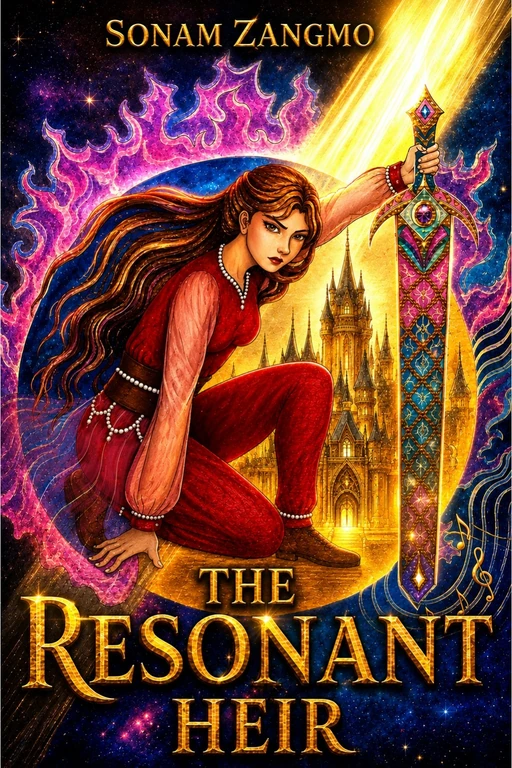
 Explore The Resonant HeirYA crossover royal fantasy · Book I Complete
The Resonant Heir · Literary Comparisons · 04
What Is The Resonant Heir Beside Fourth Wing?
On strength, hidden truths, and the courage to question authority.
A Comparative Literary Commentary
Literary comparison
Two Daughters of Powerful Families
What happens when the world decides what makes someone worthy before that person has been allowed to prove herself?
Rebecca Yarros's Fourth Wing and Sonam Zangmo's The Resonant Heir begin with young women whose family positions appear to offer advantages that others can only imagine.
Violet Sorrengail is the daughter of General Lilith Sorrengail, one of the most powerful military figures in Navarre. She has spent her life preparing to become a scribe, following the scholarly path of her late father.
Yet her mother orders her into the Riders Quadrant of Basgiath War College, a military institution where surviving long enough to bond with a dragon is itself an achievement.
Violet does not enter this world because she has chosen the life of a warrior.
She enters because someone with authority over her has decided that she must.
Princess Lyra, the protagonist of The Resonant Heir, occupies a different position. At eleven, she is already the recognized heir to a kingdom.
Her future appears predetermined, too, but in another direction.
While Violet is forced toward a dangerous profession she never intended to pursue, Lyra is expected to inherit political authority despite apparently lacking the magical abilities associated with royal legitimacy.
Both characters are judged through standards they did not establish.
For Violet, the question is whether her body can survive the demands of a military system that rewards physical endurance and combat ability.
For Lyra, the question is whether someone without visible magic deserves to occupy a throne.
Their circumstances are not equivalent.
Violet lives with persistent physical limitations that affect how she moves, trains, and survives. Lyra's apparent lack of magic eventually proves to have been caused by an attack before her birth.
Nor are their ages or emotional experiences interchangeable.
Violet is twenty when her story begins. Lyra is still a child.
Nevertheless, their stories share an important starting point: both must confront the possibility that the people entrusted with defining their futures have mistaken one kind of ability for the whole measure of a person.
The question is not merely whether they can become strong.
It is whether the standard by which they are judged was ever sufficient.
Literary comparison
When a World Measures Worth Through Strength
At Basgiath, weakness is not an abstract accusation.
It can be fatal.
Cadets must cross a narrow parapet, endure dangerous training, survive attacks from other students, and attempt to bond with dragons that may kill those they find unsuitable.
The institution treats deadly competition as a normal part of producing elite riders.
Violet enters with an obvious disadvantage.
Her joints are unstable, injuries are an ongoing concern, and her body cannot simply be trained into functioning exactly like those of other cadets.
She must therefore develop methods that account for her limitations.
Her preparation as a scribe becomes a source of practical knowledge. She understands history, poisons, plants, and information that other cadets may overlook.
During combat training, she uses herbal substances to weaken opponents before facing them.
The tactic is resourceful, but it complicates an uncomplicated celebration of her cleverness. Violet is willing to use methods that others might regard as unfair when the alternative may be serious injury or death.
Her intelligence does not make every choice ethically simple.
What makes her compelling is that she must repeatedly determine how to survive in circumstances that were not designed to accommodate her.
Nor does success eliminate her physical condition.
Bonding with dragons changes Violet's access to power, but it does not transform her into someone who never needs adjustments, assistance, or care.
This distinction is essential to the novel's treatment of physical vulnerability.
The Resonant Heir approaches social judgment through another system.
In Lyra's kingdom, magic is deeply connected to status and the prestige of royal blood.
A princess without a magical aura is not simply considered unusual.
Her apparent inability threatens the assumptions through which others understand the legitimacy of her position.
In Chapter One, The Forbidden Garden, three princes ridicule Lyra for having no magic.
Her response reveals both pride and insecurity.
After being humiliated, she invokes her inherited authority:
I'm the heir. I set the rules.
Then, in anger, she throws a stone at one of the boys.
The moment matters because Lyra's response is not entirely admirable.
She has been treated cruelly, but she also uses her position as a justification for retaliation.
Her story does not begin with a fully developed understanding of justice.
Like Violet, she has something to learn about the difference between possessing an advantage and using it wisely.
But their advantages differ.
Violet develops ways of working with a body that continues to require consideration. Lyra eventually learns that magical power already belonged to her but had been obstructed.
It would be a mistake to describe Violet's physical condition as a sealed ability waiting to be unlocked.
It would be equally misleading to describe Lyra's situation as a direct representation of chronic illness or disability.
Their narratives address different experiences.
What connects them is the inadequacy of a single standard of worth.
A military academy may confuse physical toughness with capability.
A royal society may confuse magical ability with fitness to rule.
Both systems risk overlooking qualities that cannot be measured by their preferred tests.
If someone must become powerful before being recognized as valuable, what does that reveal about the society doing the judging?
Literary comparison
The Courage to Protect What Others Dismiss
The Threshing in Fourth Wing offers one of the clearest demonstrations of Violet's character.
Cadets enter a dangerous encounter with dragons, hoping to be selected as riders.
Among the dragons is Andarna, a small golden feathertail whom several cadets consider vulnerable enough to attack.
Violet overhears their intentions.
She could preserve her own chances by avoiding the confrontation. She is already struggling to survive an environment where people have repeatedly underestimated her.
Instead, she moves to protect Andarna.
The choice places Violet in immediate danger.
Xaden appears with Sgaeyl and warns the attackers. When they disregard the warning, Violet fights back, while Xaden offers warnings that help her defend herself.
Violet manages to drive Jack Barlowe away and incapacitate another attacker.
As the remaining cadet threatens her, Tairn arrives and ends the confrontation with overwhelming force.
The distinction matters.
Violet's willingness to intervene begins the encounter. She is not rescued before having to act.
Yet she also does not overcome every danger through her own strength alone.
Her decision to defend Andarna becomes significant to Tairn's assessment of her character.
He recognizes qualities beyond conventional physical power, and Violet ultimately forms an extraordinary bond with both Tairn and Andarna.
The episode challenges Basgiath's assumptions without suggesting that physical strength has no practical importance.
Violet still needs skill and training to survive.
What the scene reveals is that the ability to fight is not the only quality worth recognizing.
The Resonant Heir presents a different moral test in Chapter Twenty-Five, The Trial of Igsvar.
Lyra is blindfolded, handed a bow and a single arrow, and instructed to strike a High Lord.
Soldiers stand between them.
A direct shot could pass through one of the men before reaching its intended target.
Lyra recognizes the problem and searches for another possibility.
Rather than shoot through a soldier's body to reach the High Lord, she deliberately wounds one soldier in the leg.
The injury disrupts the formation.
Although she has not struck the High Lord as originally instructed, he declares that she has passed.
He recognizes that she chose not to kill one of his men.
But the trial does not end with simple moral satisfaction.
Lyra has still injured an innocent person.
She apologizes and struggles to accept the consequences of what she has done.
The narration states:
There was no clean win.
Violet's intervention for Andarna and Lyra's decision in Igsvar should not be treated as identical examples of heroism.
Violet attempts to prevent an act of cruelty.
Lyra chooses a harmful action because she believes it is less destructive than the available alternative.
The distinction matters.
In one case, compassion motivates direct protection. In the other, moral judgment requires weighing consequences when every apparent route carries a cost.
Yet the scenes challenge similar assumptions.
Neither heroine demonstrates her worth merely by defeating a stronger opponent.
Their decisions reveal how they respond when another life stands between them and what they want to accomplish.
That is a different measure of strength.
Literary comparison
The History We Are Taught to Believe
Violet begins Fourth Wing with an education built around books, records, and the history of Navarre.
She knows the official accounts of the kingdom's conflicts.
Her preparation to become a scribe has taught her to value knowledge, and she has reason to believe that the institution responsible for preserving history can also be trusted to preserve truth.
But the world outside Navarre's protective wards proves more complicated than the version she has inherited.
Signs that something is missing begin to emerge before the final confrontation.
Violet notices discrepancies in information about military attacks. She also finds a message from her deceased father hidden inside a childhood book of fables.
The note reminds her of the importance of folklore in preserving the past and warns that history can be changed, even erased, within a generation.
Its meaning is not immediately clear to her.
But the warning introduces a possibility that her formal education has not prepared her to accept: the stories dismissed as legends may preserve truths that official records have lost.
Later, Violet discovers that venin, long treated in her understanding as legendary, are real.
The gryphon fliers of Poromiel, whom she has been taught to regard as enemies, are fighting a danger that threatens their own communities.
Xaden and his allies have secretly been providing weapons to help them resist.
The revelation forces Violet to confront a disturbing possibility.
Her education has given her extensive information, but not necessarily an accurate understanding of the war.
Knowledge and truth are not interchangeable when the people controlling the records also have reasons to conceal information.
This is where the comparison with The Resonant Heir becomes particularly meaningful.
Lyra's education has similarly given her a heroic account of her kingdom's past.
She reveres Aethrador, her grandfather, as a figure associated with greatness and justice.
In Chapter Four, The Voice Beneath, that understanding begins to fracture.
Lyra learns that Ravok, once praised as Aethrador's dragon champion, was silenced through an order attributed to the very ruler he had served.
The High Lord explains that Ravok knew truths Aethrador had attempted to bury or distort.
Lyra initially refuses to believe him.
Her grandfather had been celebrated as righteous.
His greatness formed part of the history through which she understood her own family and future.
If that history was incomplete or deliberately altered, then the foundations of her admiration were less secure than she had imagined.
The revelation is not simply a discovery that an ancestor committed wrongdoing.
It challenges the relationship between public memory and political authority.
Both Violet and Lyra encounter information that threatens the legitimacy of stories they were taught to trust.
But the forms of concealment differ.
In Fourth Wing, the secret concerns an ongoing war, the safety of communities beyond Navarre's borders, and the decisions of military leadership.
In The Resonant Heir, the concealed history concerns the deeds of a revered ruler and the moral inheritance of a royal dynasty.
Violet must reconsider the institution she serves.
Lyra must reconsider the legacy she has been raised to continue.
Neither experience proves that every history lesson is false, nor that every inherited institution is beyond reform.
Instead, the revelations demand a more difficult form of judgment.
When the people who preserve a nation's memory also possess the power to control it, loyalty to the truth may require questioning the very institutions that taught us what to believe.
Literary comparison
Loyalty After the Truth Changes
Discovering a hidden truth does not immediately tell someone what to do with it.
In Fourth Wing, Violet's growing relationship with Xaden is complicated by their families' history and the political structure of Navarre.
Xaden is the son of a rebel leader whose execution was connected to Violet's mother.
His position as a powerful wingleader makes him intimidating, while the bond between their dragons eventually ties their survival together.
As their relationship develops, Violet begins to trust him.
That trust is severely tested when she discovers his secret cooperation with gryphon fliers.
Xaden argues that his actions are necessary because Navarre's leaders know about the threat of venin but have allowed communities outside the wards to suffer.
His explanation challenges the moral framework Violet has inherited.
If the official enemy is also fighting to protect innocent people, what does loyalty to one's country require?
Yet the revelation does not absolve Xaden of every responsibility to Violet.
He has withheld information that matters to her understanding of the world.
His reasons for secrecy may be compelling, but Violet must still confront the possibility that someone she loves has controlled what she was allowed to know.
The novel therefore places two questions beside each other.
When is disobedience to authority justified?
And when does secrecy, even for a defensible cause, undermine another person's right to make informed decisions?
Lyra encounters a different version of divided loyalty.
Her attachment to Aethrador is not romantic or institutional in the military sense.
It is familial.
The past she has inherited is inseparable from her understanding of herself.
As she learns more about the history of her kingdom, she must decide whether respecting her ancestors requires defending every action attributed to them.
By the end of Book I, her answer begins to emerge through the way she governs.
She does not simply declare that everyone who served the previous regime deserves punishment.
Instead, she calls for an examination of records, authorities, prisons, and old judgments.
The purpose is not to replace one unquestionable version of history with another.
It is to begin distinguishing responsibility from reputation.
Violet and Lyra stand on opposite sides of political authority.
One is a military trainee discovering reasons to question her country's leadership.
The other becomes the ruler of a kingdom whose history contains unresolved wrongs.
Their decisions therefore cannot be measured by identical obligations.
But both narratives suggest that inherited loyalty becomes morally dangerous when it demands the surrender of independent judgment.
Literary comparison
Trust, Friendship, and the Right to Choose
Fourth Wing gives its heroine several relationships that challenge different aspects of trust.
Rhiannon becomes Violet's friend during their early experiences at Basgiath.
Before crossing the dangerous parapet, Violet exchanges one of her riding boots with Rhiannon, whose footwear is less suitable for the wet stone.
The exchange gives Rhiannon better traction but leaves Violet wearing one less secure boot herself.
Their friendship begins with a small act of practical generosity in a place where cadets are encouraged to view one another as competitors.
Liam provides another form of companionship.
Initially assigned to protect Violet, he becomes someone whose loyalty and friendship carry emotional weight beyond his original responsibility.
Dain Aetos, Violet's childhood friend, represents a more troubling form of care.
He repeatedly worries that Violet cannot survive the Riders Quadrant and urges her toward the life she originally intended to pursue.
His concerns are not without foundation.
Violet does face genuine danger.
But Dain's desire to protect her is accompanied by a tendency to discount her own assessment of what she can accomplish.
The conflict becomes more serious when Violet discovers that he has accessed her memories without her knowledge or permission.
Dain's signet allows him to read recent memories through physical contact.
What once appeared to Violet as familiar affection becomes entangled with a violation of trust.
The consequences are serious, but the novel does not require us to conclude that Dain knowingly intended every harm that followed from the information reaching military leadership.
His breach of Violet's privacy and his understanding of how others might use that information are separate questions.
The revelation raises an important problem: can protection remain benevolent when the person being protected is denied control over personal information?
Xaden presents a contrasting but not uncomplicated relationship.
He recognizes Violet's capacity to adapt and fight, and he becomes an important source of support.
At the same time, his own secrets cause her considerable pain.
The story does not offer a simple division in which one man represents bad loyalty and the other perfect trust.
Rather, Violet must distinguish between affection, protection, honesty, and respect for her autonomy.
Her relationships with Tairn and Andarna further complicate these questions.
The dragons are not merely weapons granting her exceptional abilities.
They possess their own judgments, loyalties, and secrets.
Even the bond that strengthens Violet does not guarantee that she will always be told everything she needs to know.
The Resonant Heir also makes companionship central to its protagonist's development, but with a different narrative emphasis.
Obewich's loyalty begins as the protective vigilance of a steward responsible for a reckless princess.
Haris initially participates in Lyra's humiliation, yet their relationship changes through shared danger and experience.
Sion challenges assumptions about Lyra's worth, including the idea that magical power alone determines strength.
These relationships help Lyra understand that authority does not mean she can always decide what is best for others without listening to them.
The difference between the novels is significant.
In Fourth Wing, romantic tension and intimacy form a major part of the story's emotional structure.
In TRH Book I, friendship, family, and companionship carry more of that weight.
Yet both works examine the problem of caring for someone without taking possession of that person's decisions.
Love and loyalty may explain why we want to protect another person. They do not automatically give us the right to choose that person's life for them.
Literary comparison
What Victory Cannot Undo
Near the end of Fourth Wing, Violet and her companions face a conflict far removed from the controlled exercises of Basgiath.
At Resson, they confront venin and the wyverns associated with them.
The danger is real, and their decisions have consequences that no military exercise can fully reproduce.
During the fighting, Liam's dragon, Deigh, is killed.
Because the life of a rider is bound to that of their dragon, Deigh's death also seals Liam's fate.
Liam dies, leaving Violet to confront the loss of a friend who had helped her survive Basgiath.
Violet herself is wounded by a poisoned blade wielded by a venin.
As the battle continues, she discovers that killing a venin can bring down the wyverns connected to that venin's power.
The discovery allows the fighters to change their strategy.
Their eventual victory depends upon several people and dragons acting together, not upon one heroine's strength alone.
But tactical success cannot restore Liam's life.
Nor can it return Violet to the understanding of Navarre with which she began the novel.
She survives, but the world she thought she knew has fundamentally changed.
The Resonant Heir places a different kind of loss near the conclusion of Book I.
Lyra defeats Syveris and reclaims her position.
Yet Syveris's son Orlas grieves his father's death.
The suffering caused by Syveris does not make Orlas's grief disappear.
Nor does the restoration of Lyra's authority automatically resolve the injustices inherited from earlier reigns.
These events should not be forced into direct correspondence.
Liam dies fighting alongside Violet, while Orlas mourns a father who stood against Lyra.
Their relationships to the protagonists and to the larger conflicts are profoundly different.
What makes the comparison worthwhile is a narrower observation.
In both stories, victory settles an immediate struggle while leaving emotional and political consequences unresolved.
The defeated threat is not the same thing as a healed world.
For Violet, the surviving burden includes grief, betrayal, and the realization that the war she has been taught to understand is not the whole war.
For Lyra, the burden includes responsibility for people harmed by both the defeated regime and the struggle to remove it.
One character must decide how to respond to a concealed conflict.
The other must decide how to govern after an open conflict has ended.
Neither is given the luxury of treating victory as the final answer.
Literary comparison
Two Endings, Two Different Futures
The final revelation of Fourth Wing changes Violet's understanding of her own family.
After surviving Resson, she awakens to discover that Brennan, the brother she believed dead, is alive.
His appearance places her personal history within a larger conflict whose true dimensions she has only begun to understand.
The revelation matters because it reaches beyond military deception.
Violet has not merely learned that her country concealed an enemy.
She has learned that one of the most significant losses in her own life was not what she believed it to be.
The book ends with the possibility of a new allegiance and a more difficult understanding of truth, family, and war.
It does not conclude Violet's larger journey.
The Resonant Heir: Book I ends at a different point in its heroine's development.
Lyra has recovered her magical abilities at the Awakening Spring.
The restoration follows the removal of seals that had obstructed the power she possessed before birth.
It does not transform her into a different person or erase the moral choices she made while believing herself without magic.
By the conclusion of Book I, she has become Queen.
Her earliest decisions as ruler include an examination of old records, imprisonment, and judgments handed down under previous authorities.
She also orders the wounded to be treated regardless of which side they served.
Her instructions reject the assumption that guilt can be established simply through ancestry or allegiance.
The principle is expressed in two short sentences:
Names first. Judgment after.
The line reveals how far Lyra has moved from the child who once insisted that being the heir entitled her to set the rules.
She now begins to recognize that legitimate authority must involve restraint, evidence, and responsibility.
Yet her transformation remains unfinished.
A change of ruler cannot immediately repair every inherited injustice.
The difference between the endings is therefore essential.
Violet finishes Fourth Wing with a far more uncertain understanding of the state and the war around her.
Lyra finishes TRH Book I with political authority and the obligation to act upon the truths she has discovered.
Violet must determine where her loyalty belongs.
Lyra must determine how the loyalty of others should be governed.
The two endings are not versions of the same triumph.
But they illuminate different stages of a related moral question.
What happens after a person stops accepting the story that power tells about itself?
Literary comparison
Two Different Reading Experiences
The thematic parallels between Fourth Wing and The Resonant Heir should not be mistaken for a close resemblance in reading experience.
Rebecca Yarros's Fourth Wing is an adult fantasy romance structured around an elite military academy, dangerous competitions, dragon bonds, political secrets, and an intense romantic relationship.
Its pace is often urgent.
Violet moves from one life-threatening challenge to another, while attraction, suspicion, and intimacy complicate her relationships with those around her.
Dragons are central not only to the magical system but also to the bonds connecting major characters.
The novel features explicit sexual content, graphic violence, and a level of romantic emphasis appropriate to its adult audience.
Its depiction of chronic physical vulnerability is also a distinctive part of Violet's story.
That element should not be overlooked simply because the novel is widely discussed for its romance or dragons.
The Resonant Heir: Book I offers a different experience.
Lyra's journey begins in a royal setting and expands through unfamiliar magical landscapes, encounters with other peoples, dangerous discoveries, and the contested legacy of her kingdom.
The tone is generally brighter and more exploratory.
Friendship and adventure occupy a larger part of the emotional foreground, while romance is not the principal organizing force of Book I.
The story still contains cruelty, grief, betrayal, and difficult moral choices.
But its narrative priorities differ from those of Fourth Wing.
Its central question concerns not only whether Lyra can recover her power, but whether she can grow into the judgment necessary to use that power responsibly.
Violet begins as a young adult with considerable knowledge and a specific professional ambition.
Lyra begins as an eleven-year-old princess whose understanding of her world and herself is still developing.
Their voices, relationships, and forms of agency reflect those differences.
A reader looking for Fourth Wing's military academy, adult romance, sexual tension, and dragon-rider culture should not expect The Resonant Heir to reproduce those experiences.
Similarly, a reader seeking the wider exploration, friendship, royal mysteries, and hopeful adventure of TRH may find Fourth Wing more violent, more romantically intense, and more concentrated on survival.
These differences do not make the comparison less valuable.
They make it more precise.
The books are not interchangeable.
They can, however, be placed beside each other to examine what fantasy reveals about the standards through which people judge strength, loyalty, and truth.
Literary comparison
The Worth of a Person, the Truth of a Kingdom
There is a familiar promise in fantasy stories about underestimated heroes.
A character is dismissed.
The world declares that character too weak, too inexperienced, or too inadequate to succeed.
Then the character discovers extraordinary power.
The world is forced to reconsider.
Both Fourth Wing and The Resonant Heir contain elements of this pattern.
Violet becomes a dragon rider whose bonds and magical abilities are exceptional.
Lyra eventually recovers the power that had been obstructed since before her birth.
Yet focusing exclusively on these transformations risks missing the more difficult questions their stories raise.
Violet's value cannot be measured solely by the strength of Tairn or the power of her lightning.
Before her extraordinary abilities emerge, she already possesses intelligence, courage, loyalty, and the capacity to recognize another creature's vulnerability.
Her continuing physical limitations do not erase those qualities, nor do they diminish because she becomes powerful.
Lyra's worth cannot be measured solely by her restored magic or her claim to the throne.
Before she recovers her abilities, she has already made choices that reveal both her virtues and her faults.
She has acted selfishly, shown courage, harmed others, regretted her decisions, and gradually learned to question the authority she once accepted without hesitation.
Her eventual strength gives her greater capacity to act.
It does not guarantee that every action she takes will be wise.
The hidden histories in both novels deepen this problem.
Violet learns that the institutions responsible for teaching and defending her country's version of the world have withheld essential truths.
Lyra discovers that the celebrated history of her ancestors may conceal acts that cannot be reconciled with the virtues attributed to them.
Neither heroine can continue treating inherited authority as an unquestionable measure of what is right.
But the novels leave them with different responsibilities.
Violet must decide what loyalty means when the official account of a war proves incomplete.
Lyra must decide how to govern when the moral authority of the past has been damaged by truth.
There is no need to declare one protagonist more courageous, more principled, or more deserving than the other.
They face different circumstances, and their stories pursue different emotional and narrative goals.
Their shared concern lies elsewhere.
Both challenge the belief that a person's value can be established by a single form of strength.
Both question whether authority deserves obedience merely because it has inherited the power to demand it.
And both suggest that discovering the truth changes not only what someone knows, but what that person can reasonably choose to do next.
Strength may allow a person to survive a system. Knowledge may reveal why that system exists. But judgment determines what the person does once its rules can no longer be accepted without question.
Sources
Sources and Scope
This independent commentary compares Fourth Wing (2023), the first novel in Rebecca Yarros's The Empyrean series, with The Resonant Heir: Book I by Sonam Zangmo.
The novel's premise, genre, and content warnings have been checked against Rebecca Yarros's official book page. Additional publishing and critical context is available through Publishers Weekly and Kirkus Reviews.
Major plot developments beyond the official promotional material have been cross-checked against independent chapter summaries and analyses, including SparkNotes and SuperSummary. The complete original text of Fourth Wing has not been directly examined for this commentary.
The distinction between Violet's continuing physical limitations and Lyra's magical circumstances is informed by the narrative and by Rebecca Yarros's public discussion of chronic illness representation.
The comparison with The Resonant Heir is grounded in its complete fifty-five-chapter Book I manuscript, particularly Chapters 1, 4, 25, 32, 51, and 55.
The discussion is limited to the events of the first Fourth Wing novel. Developments from subsequent installments are outside its scope.
The philosophical arguments presented here are interpretations of the works, not statements about either author's personal intentions. This commentary is independent and is not affiliated with Rebecca Yarros or her publisher.