
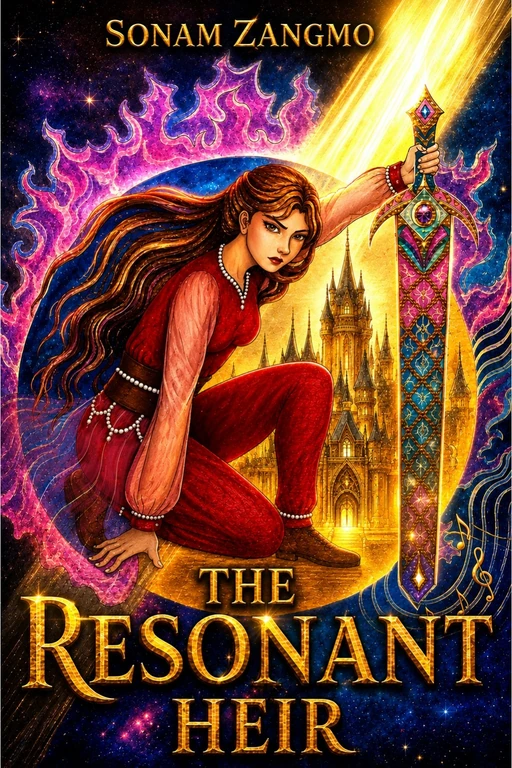
 Explore The Resonant HeirYA crossover royal fantasy · Book I Complete
The Resonant Heir · Literary Comparisons · 07
Beyond the Palace: Adventure in Six Crimson Cranes and The Resonant Heir
A fairy-tale curse, a changing quest, and the dangers that teach two princesses how to survive
A Comparative Literary Commentary · Adventure & Survival
Adventure and survival
When Silk Becomes a Trap
Shiori knows how to swim. That is what makes her near drowning in the opening chapter of Elizabeth Lim's Six Crimson Cranes so effective: her skill is real, but it is not enough. Having chased Kiki, the tiny paper bird she has secretly brought to life, the princess jumps into the Sacred Lake. She has already discarded her heavy ceremonial jacket. The remaining layers of silk still wrap around her legs, turning familiar water into a place she cannot navigate. By the time she struggles free, the surface is too far away. Then she sees a dragon.
Lim begins underwater, with Shiori's frightened, irreverent first-person voice already at work, before moving back to the decisions that led her there. The opening creates curiosity on two levels. How will the girl survive? And how did a princess familiar with this lake manage to trap herself beneath it? Her impulsiveness makes her appealing without protecting her from its consequences.
In The Resonant Heir, Princess Lyra encounters an equally unceremonious object in Gemariel: a mining pick. In Chapter Eighteen, she stands among laborers rather than courtiers, working for the food she needs to continue her journey. At a break, she almost calls for Obewich, her steward, out of habit. There is no one to answer. Then Sion, a girl with worn clothing and calloused hands, offers her water.
Lim makes the loss of royal protection immediate and physical. Zangmo lets it register through hunger, dust, fatigue, and another worker's practical kindness. Shiori's remaining silk and Lyra's pick are not interchangeable symbols: one intensifies a sudden crisis, while the other measures an unfamiliar day's work. Both make privilege unreliable in circumstances where it once seemed natural.
An adventure begins to matter when the traveler discovers that the skills and habits brought from home will not be enough on their own.
Adventure and survival
One Curse, Many Debts
Six Crimson Cranes has a remarkably clear engine. Shiori's stepmother Raikama transforms her six brothers into cranes and warns the princess that each word she speaks will kill one of them. Shiori cannot casually identify herself, explain her predicament, or summon assistance in her own name. Although the meaning of the curse changes as she uncovers its history, the threat she believes she faces keeps the journey sharply directed.
The locations vary—a remote island, a place of exhausting work, a volcanic mountain, a castle where her identity must remain hidden—but the reader carries the same question into each one. How can Shiori find and free her brothers without paying a cost she cannot bear? The restriction turns ordinary needs, such as asking for shelter or defending herself against an accusation, into problems of invention and restraint.
Lyra's journey acquires its shape differently. Driven from the palace after challenging a political marriage and surviving an assassination attempt, she seeks the Awakening Spring to recover the magic denied to her. Reaching it requires clues scattered across fae territories. But the search does not remain a simple inventory of map fragments. In Gemariel, survival brings her into the lives of miners. After securing Emberheart, she encounters another traveler in danger and chooses to help him. In Aulith, Lyra offers to become a living vessel for trapped soul fragments, taking on a burden the map never required. In Drazhune, illusions turn private grief into an obstacle. Sion's illness later redirects the itinerary itself.
Lim holds the changing scenery together with one threatened family loss. Zangmo lets encounters complicate what the destination is supposed to mean. One adventure is concentrated by a prohibition; the other is expanded by obligations acquired along the way.
Each design creates its own risk. The more Lim's mythic explanations accumulate, the harder the central rule must work to hold them together. The more territories Zangmo introduces, the more each episode must transform the search rather than merely delay it. A long route is not necessarily an expansive adventure; a focused quest is not necessarily a predictable one.
Adventure and survival
When Companions Change the Route
Kiki is not simply a charming accessory in Six Crimson Cranes. Her escape from Shiori's sleeve causes the lake incident. Later, when Shiori cannot speak openly or reveal her identity, the paper bird becomes a means of communicating and taking action. The six crane-brothers contribute to the search rather than functioning only as objects to be recovered. Seryu's help at Mount Rayuna gives Shiori a way to face a danger that her courage alone cannot control.
The story also turns the protagonist's surroundings into opportunities for tactical action. During a winter excursion from Castle Bushian, a pack of wolves threatens Shiori and her companions. Takkan tries to get the others to safety, but Shiori returns and notices a smaller wolf with a golden cuff around its leg. Wounding that animal makes it call the pack away. The escape depends on identifying an unusual detail within the threat rather than defeating every attacker. This sequence is documented in later-chapter summaries rather than the publicly available original excerpt, so its significance lies here in the plot's tactical design, not a claim about Lim's exact sentence-by-sentence handling.
TRH gives a different role to a pursuing pack. In Chapter Forty-Two, the High Lord of Drazhune sends wolves after Lyra and Sion. The two girls jump from a cliff rather than remain within the ring of fire. The leap does not itself save them: trapped below, they must discover what Sion's unusual connection to roots can do. Lyra helps her concentrate; Sion directs the roots into a vessel that carries them toward the river. An ability glimpsed earlier in the mines becomes a new route through terrain that seemed impossible to cross.
These encounters show two useful designs for survival. In Lim's wolf scene, an enemy's identifiable feature creates a tactical opening. In Zangmo's, the companion's previously uncertain ability changes the available geography. Both are more satisfying than treating a companion as a spectator waiting for the heroine to win.
The journey then asks more of Lyra's bond with Sion. When poison threatens her friend's mind and body, Lyra and Haris interrupt the original search to hunt a great serpent for the fang needed to make a protective comb. The remedy is temporary; the journey must change again. At Hemaliel, Sion learns who her father is, and Lyra urges her to stay with him even though Sion wants to continue. The companion's life does not remain permanently attached to the heroine's map.
Adventure gains depth when another traveler can open a path, close one, or choose a destination of their own.
Adventure and survival
The Cost of Helping Someone
Not every danger in a quest comes from a monster. Some arise from the characters' attempts to protect people.
Shiori begins with a rule that seems to make her options brutally simple: speak and risk a brother's life, or remain silent and keep searching. The final revelations about Raikama complicate that understanding. According to accounts of the first novel's ending, Raikama intended her magic to protect the royal children, while the dragon pearl's unstable power produced consequences she could not fully direct. Shiori must revise her judgment of the person she had believed to be her enemy.
This reversal deepens the story's fairy-tale design, but it also puts pressure on the reader's faith in the rules. If an adventure derives much of its urgency from a single terrible prohibition, the later explanation must feel like an earned discovery rather than a convenient cancellation. Lim's complication is most compelling when the cost of Shiori's fear remains meaningful even after its cause becomes clearer.
TRH makes a related discomfort visible in a smaller encounter. Having secured a serpent's fang, Lyra and Haris desperately need a craftsman to turn it into a comb before Sion suffers another dangerous episode. The grinder refuses, frightened of the creature from which the material came. Haris brings his sword down near the man's hand and demands the work. Lyra reacts, but does not prevent the threat from succeeding.
The urgency is real, and the comb may protect Sion for a time. So is the coercion. A frightened stranger loses the right to refuse because the protagonists need him. The scene becomes more interesting when that imbalance is allowed to disturb the reader rather than being treated as a straightforward triumph of loyalty.
Lim questions the apparent identity of the antagonist. Zangmo shows the apparent rescuers forcing a cost onto someone outside their circle. Their methods differ, but both widen the adventure beyond the simple satisfaction of completing a task.
Adventure and survival
What Comes Home With the Traveler
A fairy-tale quest promises a return: a curse lifted, a family restored, a lost identity reclaimed. Six Crimson Cranes fulfills much of that promise. Shiori's brothers regain their human forms, yet the truth about Raikama changes how Shiori understands her own family. The dragon pearl leaves her with another responsibility. The first novel completes its central rescue without pretending every consequence has been resolved.
The Resonant Heir makes a different bargain with arrival. Within the Myrren Tree's amber passage, Lyra and Haris are separated. Lyra must navigate misleading roads and memories shaped around her dead father. At the Awakening Spring, a puzzle of time leads to the restoration she has pursued. Her innate magic returns, but the process removes Vael'Kharoth's mark—the means by which she had been able to reach the imprisoned Xareth.
The final political victory does not repair that loss. After Lyra becomes queen, her promise to help Xareth remains unanswered. The journey has delivered its central reward while making an earlier obligation harder to fulfill. And the people met along the way are not simply trophies to be collected: Sion has a family and future of her own; Orlas must live with the death of his father.
Lim's strength is concentration. One vividly stated curse directs far-flung travel, while its reinterpretation complicates the expected homecoming. Zangmo's strength is accumulation. Distinct encounters gradually change the traveler and leave unfinished claims on her attention. Lim risks crowding the last stages of a focused quest with new explanations; Zangmo risks losing momentum when one trial gives way to another without an equally clear causal bridge.
The measure of adventure, then, is neither the distance covered nor the number of hazards survived. At the beginning of Lim's novel, silk pulls a capable swimmer beneath a lake. Later in Zangmo's novel, a princess learns to work with a pick and returns across a deadly bridge for someone she barely knows. By the end, what weighs on the heroines is no longer merely fabric, heat, or stone. It is the knowledge that reaching a destination does not release them from everyone encountered on the road.
Sources and scope
Sources and Scope
This commentary compares only the first novel of Elizabeth Lim's Six Crimson Cranes duology with Book I of Sonam Zangmo's The Resonant Heir. The close reading of Lim's prose is limited to her authorized Chapter One excerpt. Later plot developments have been cross-checked against the publisher's description, chapter-by-chapter accounts, Castle Bushian chapters, final chapters, and Kirkus Reviews. The TRH evidence comes from the author's archived, complete 55-chapter Book I manuscript; current chapter versions may differ. This is a literary interpretation, not a claim about either author's private intentions. The commentary is hosted by the author of The Resonant Heir and is independent of Elizabeth Lim and her publisher.